2026 Class 8 Mathematics · English Version · Chapter 8 · Chapter companion part
Chapter 8E: Special shapes and compass challenges
Construct squares, rectangles, rhombi, parallelograms and trapezia from different data, with instrument checks and explicit restrictions.
About this lesson and its coverage
Class 8 English Version: part E of the chapter 8 companion. Eight teaching sections, 30 written tasks and a notebook challenge. Selected companion coverage, not complete textbook coverage; use all five parts. Independent proofs, compass work, drawings and nets require guardian or teacher review.
For adjacent sides a, b and included angle θ with0°<θ<180°, draw BC=a and BA=b on the angle ray. Through A copy a line parallel to BC and through C one parallel to BA; they meet at D. Alternatively use circles about A, C of radii a, b and select the intended intersection. With a=b the result is a rhombus; with θ=90° it is a rectangle; with both it is a square.
Construct a square from one side or its diagonal
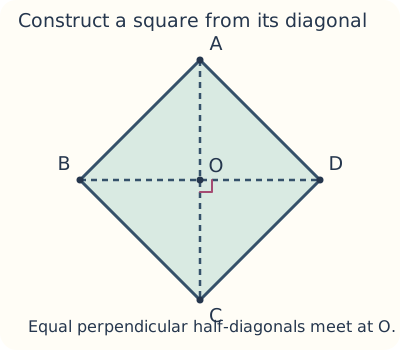
For side s>0 draw BC=s, construct BA⊥BC and BA=s, then complete equal-side right-angle ABCD. For a given diagonal d, bisect AC at O, draw its perpendicular, and mark OB=OD=d/2 on opposite rays. Joining A, B, C, D gives equal perpendicular bisecting diagonals, so a square. Its area is d²/2; d is not the side length.
Construct a rectangle from sides or side and diagonal
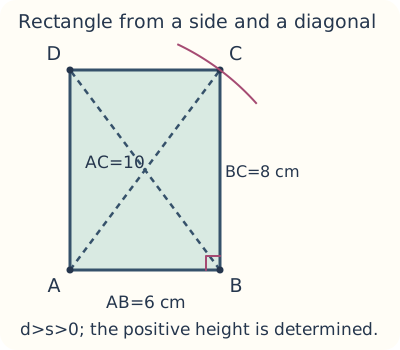
Given adjacent lengths l, b, erect perpendiculars and complete the parallel opposite sides. Given side AB=s and diagonal AC=d>s, draw the perpendicular ray at B and intersect it with the circle about A of radius d. Complete the parallels through A, C. If d≤s the height is zero or impossible. For s=6, d=10, the other side is8 because6²+8²=10².
Construct a rhombus from diagonal data
For positive diagonals p, q, draw AC=p, bisect at O, draw its perpendicular and mark OB=OD=q/2. Join the boundary. For side s and diagonal p, require0<p<2s; radius s arcs from A, C locate B, D on opposite sides. The other diagonal follows. For side5 and one diagonal6, the half-diagonal3 and side5 give other half4, so the other diagonal is8.
A side and two diagonals can define a parallelogram
For AB=s, AC=p, BD=q, construct triangle AOB with sides AO=p/2, BO=q/2, AB=s. Require |p−q|/2<s<(p+q)/2. Extend AO and BO through O to C, D with OC=OA and OD=OB. Mutual bisection proves the parallelogram. If p=q it is a rectangle; if AO⊥BO it is a rhombus. Check the resulting vertex order.
Construct from four diagonal portions and an angle
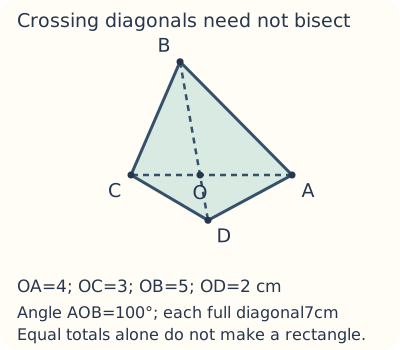
Draw two crossing lines at the supplied angle AOB; place A, C on opposite rays from O with their given distances, and B, D on opposite rays of the second line. Join cyclic ABCD. This gives diagonals intersecting at O, not necessarily bisecting. Equality of OA, OC and OB, OD must be supplied before claiming a parallelogram.
Copy a given angle or construct75° exactly
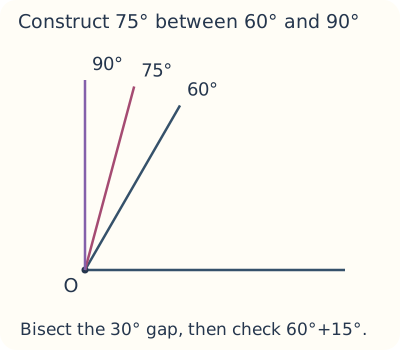
Construct60° using an equilateral-triangle arc construction and90° by a perpendicular at the same vertex. Bisect the angle between their rays to get75°. For an 85° source angle, use a supplied angle to copy, or a protractor approximation stated as such; do not promise an exact straightedge-and-compass construction from lengths alone. Two90° rays also make a right-angle template for special shapes.
Construct a trapezium from both bases and base angles
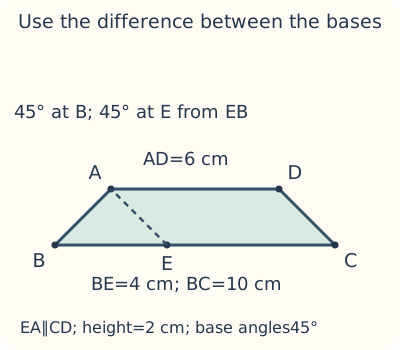
For longer base BC=a, shorter AD=b<a and two acute base angles, mark E on BC with BE=a−b. Construct angle CBA at B and angle BEA equal to the desired interior angle at C; their rays meet at A. Through A draw AD parallel to BC, mark AD=b toward C, and join DC. Triangle BAE supplies the left and right setbacks; translated EA is parallel to CD. Check ray intersection and base lengths, not just a plausible outline.
Worked example
A rhombus with diagonals6 and8 has half-diagonal right triangles3,4,5. All four sides are5; area is6×8/2=24 cm². This validates both diagonal and side-plus-diagonal constructions.
Name the figure in cyclic vertex order and state every given length, angle and assumption.
Draw a labelled model; give a reason for each proof, area calculation or construction step. Check that the data can form the required figure.
Verify the original conditions, units and vertex order. Numeric checks assess the requested value only; proofs, nets and constructions need guardian or teacher review.
Special conditions supply missing data
A square needs only one positive side because equality and right angles determine its other measurements. This does not mean one side fixes a general quadrilateral.
Use the right angle input
75° is constructed by a bisected60°–90° gap. An85° diagram may be copied as a given angle or measured approximately; the methods are not interchangeable.
Special-family construction data
Definitions supply some conditions that a general quadrilateral would need separately.
Special-family construction data
Target and inputs
Construction idea
Restriction
Square, side s
Equal sides and a perpendicular
s>0
Square, diagonal d
Equal perpendicular bisecting diagonals
d>0
Rectangle, adjacent l, b
Perpendicular adjacent sides then parallels
l, b>0
Rectangle, side s, diagonal d
Circle meets perpendicular ray
d>s>0
Rhombus, side s, diagonal p
Two radius-s circles about diagonal ends
0<p<2s
Rhombus, diagonals p, q
Perpendicular diagonals bisected
p, q>0
Parallelogram, side s, diagonals p, q
Half-diagonal triangle AOB
|p−q|/2<s<(p+q)/2
An equality at a triangle bound collapses the figure. Equal diagonal totals without equal halves do not imply a parallelogram.
Use the difference between parallel bases
For longer base a and shorter base b with acute base angles, construct triangle BAE on BE=a−b.
BC = a = 10 cm
AD = b = 6 cm
BE = a−b = 4 cm
B, E, C
Collinear in that order on the longer baseline.
A
Intersection of the two supplied base-angle rays in triangle BAE.
D
Point b units from A on the parallel through A toward C.
Construct the two acute-angle rays at B, E.
Locate their intersection A.
Draw AD parallel to BC with length b.
Translate EA to DC; verify both base angles.
The45°/45° illustration has height2 cm. It is a separate data set from the numeric area task with height4 cm.
Explore the mathematical figures
Match each letter to its explanation. Read the quantities, units and relationships, then check the counts or equations. These are original teaching models.
A square from equal perpendicular diagonals
This alternative constructs a square from a given diagonal and supports the side-based method.
A
A is an endpoint of the given diagonal AC.
B
B is placed on its perpendicular bisector.
C
C is opposite A.
D
D is opposite B with OB=OD=OA.
O
O is midpoint of both equal perpendicular diagonals.
Original labelled mathematical model, not copied source artwork. Verify stated conditions rather than judging shape from appearance.
Explore the mathematical figures
Match each letter to its explanation. Read the quantities, units and relationships, then check the counts or equations. These are original teaching models.
A rectangle from side and diagonal
The25 pixels-per-cm model verifies6²+8²=10² and d>s. Complete opposite parallels after finding C.
A
A is the centre of the radius10 cm arc.
B
B is6 cm from A and the foot of the perpendicular.
C
C is where that perpendicular meets the arc; BC=8 cm.
D
D completes the rectangle using parallels.
Original labelled mathematical model, not copied source artwork. Verify stated conditions rather than judging shape from appearance.
Explore the mathematical figures
Match each letter to its explanation. Read the quantities, units and relationships, then check the counts or equations. These are original teaching models.
Specified diagonal portions and angle
At 23 pixels per cm, both total diagonals are7 cm but their halves differ, so the figure is not a parallelogram.
A
A is4 cm from O on the first line.
B
B is5 cm from O with angle AOB=100°.
C
C is3 cm from O opposite A.
D
D is2 cm from O opposite B.
O
O lies inside both diagonals but bisects neither.
Original labelled mathematical model, not copied source artwork. Verify stated conditions rather than judging shape from appearance.
Explore the mathematical figures
Match each letter to its explanation. Read the quantities, units and relationships, then check the counts or equations. These are original teaching models.
Bisect between60° and90°
Construct60° and90° by compass first, then bisect their gap. This diagram displays the exact directions; retain your own compass arcs.
O
O is the common vertex and origin of the60°,75°,90° rays.
60°
Construct this ray using an equilateral triangle.
90°
Construct this ray perpendicular to the baseline.
75°
The direction halfway between60° and90°.
Original labelled mathematical model, not copied source artwork. Verify stated conditions rather than judging shape from appearance.
Explore the mathematical figures
Match each letter to its explanation. Read the quantities, units and relationships, then check the counts or equations. These are original teaching models.
Construct with the difference of the bases
At 28 pixels per cm, the height is2 cm. Translate EA by6 cm to form CD.
A
A is the intersection of45° rays from B, E.
B
B is the left end of BC=10 cm.
C
C is the right end of the longer base.
D
D is6 cm from A parallel to BC.
E
E is4 cm from B; EA translates to CD.
Original labelled mathematical model, not copied source artwork. Verify stated conditions rather than judging shape from appearance.
Your written practice
Show your working on paper. Check your answer, then choose Next.
Show model answer and explanation
22
2(7+4)=22.
Show model answer and explanation
105
Adjacent parallelogram angles sum to180°.
Show model answer and explanation
36
6²=36.
Show model answer and explanation
50
Its equal perpendicular diagonals give10×10/2=50.
Show model answer and explanation
8
10²−6²=64, whose positive square root is8.
Show model answer and explanation
28
2(6+8)=28.
Show model answer and explanation
8
Half-diagonal3 gives other half4 in a 3–4–5 right triangle; double4.
Show model answer and explanation
5
Half-diagonals3,4 make a right triangle with hypotenuse5.
Show model answer and explanation
6
O is the midpoint of AC.
Show model answer and explanation
10
(12+8)/2=10; the side must be strictly smaller.
Show model answer and explanation
7
A, O, C are collinear with O between:4+3=7.
Show model answer and explanation
7
5+2=7; equal total diagonals do not imply bisection.
Show model answer and explanation
75
60+(90−60)/2=75.
Show model answer and explanation
4
BE=a−b=10−6.
Show model answer and explanation
32
(10+6)×4/2=32.
Write in your own words. A guardian or teacher should review this response.
Show model answer and explanation
Draw BC=7 and BA=4 on a 60° ray. Through A draw a parallel to BC; through C a parallel to BA. Their intersection D completes the figure. The construction supplies both pairs; check opposite lengths and angle.
Show how parallels or compass copies are made and retain their marks.
Write in your own words. A guardian or teacher should review this response.
Show model answer and explanation
Draw BC=6, erect a perpendicular at B, mark BA=6. Circles about A, C each radius6 give the intersection D away from B; join AD, DC. All sides equal and angle B right, so the rhombus is a square.
Do not choose B as the second circle intersection.
Write in your own words. A guardian or teacher should review this response.
Show model answer and explanation
Draw AC=10, bisect at O, erect the perpendicular at O and mark B, D at 5 cm on its opposite rays. Both diagonals are equal, perpendicular and bisected, so cyclic ABCD is a square.
Show perpendicular-bisector arcs and all four half lengths.
Write in your own words. A guardian or teacher should review this response.
Show model answer and explanation
The adjacent-side method erects perpendiculars6 and8. The diagonal method intersects the perpendicular at B with the circle about A radius10; its positive height is8 from6²+8²=10². Complete parallels and verify.
Use independent input conditions rather than assuming the answer.
Write in your own words. A guardian or teacher should review this response.
Show model answer and explanation
A nonzero perpendicular side creates a hypotenuse strictly longer than either leg. A5 cm diagonal cannot reach the line6 cm from its centre; at 6 cm the circle is tangent at B and the other side has length0.
Give both impossible and equality cases.
Write in your own words. A guardian or teacher should review this response.
Show model answer and explanation
Draw AC=6, construct its perpendicular bisector at O, mark OB=OD=4. Join the four endpoints cyclically. The perpendicular half-diagonal triangles have legs3,4, so all sides5.
Verify mutual bisection and equal sides.
Write in your own words. A guardian or teacher should review this response.
Show model answer and explanation
Draw AC=6. Radius5 arcs from A, C meet at B, D on opposite sides. Join cyclically. Require0<6<2×5, or in general0<p<2s, for distinct intersections and a nondegenerate rhombus.
Retain both arc pairs and show all four equal radius lengths.
Write in your own words. A guardian or teacher should review this response.
Show model answer and explanation
Build AOB with AO=6, BO=4, AB=5;2<5<10 verifies the triangle. Extend through O to C, D with OC=6, OD=4. The diagonals bisect, so ABCD is a parallelogram.
Show the half-lengths and both strict bounds.
Write in your own words. A guardian or teacher should review this response.
Show model answer and explanation
Half-diagonal lengths are6 and4. Their difference is2, so side2 equals the lower bound rather than exceeding it. The three points are collinear and no nondegenerate parallelogram results.
Five or three numbers can satisfy an equality but still fail construction.
Write in your own words. A guardian or teacher should review this response.
Show model answer and explanation
Draw crossing lines at 100°, put A, C on opposite rays with distances4,3 and B, D on the other pair with5,2. Join cyclically. The halves differ, so the diagonals do not bisect and it is not a parallelogram.
Label O and retain the given angle; do not infer from equal diagonal totals7.
Write in your own words. A guardian or teacher should review this response.
Show model answer and explanation
Construct60° and90° rays from one baseline at the same vertex. Bisect the30° gap with equal-radius arc intersections. Its direction is60+15=75°.
Show the angle-bisector arcs, not only a protractor reading.
Write in your own words. A guardian or teacher should review this response.
Show model answer and explanation
A given drawn85° angle can be copied by equal-radius chord transfer. If using a protractor, describe the result as a measured approximation. This lesson does not claim an exact85° construction from a unit segment alone.
Name the available input and instrument; do not silently substitute methods.
Write in your own words. A guardian or teacher should review this response.
Show model answer and explanation
Draw BC=10, mark BE=4 toward C. At B make a 45° ray above BC; at E make a ray above EB making45° to EB. They meet at A,2 cm above the baseline. Through A draw AD∥BC, AD=6 toward C; join DC. Both base angles are45° and the bases are10,6.
Verify the height2 and avoid assuming the separate4 cm-height numeric task is this construction.
Write in your own words. A guardian or teacher should review this response.
Show model answer and explanation
Mark BE=a−b on BC=a. Triangle BAE uses angle ABE=x and BEA=y. Its rays meet above BC. Through A draw a parallel to BC and AD=b toward C; then EA∥CD because E and C differ by b, so angle BCD=y.
Check the acute-angle conditions and the translated side direction.
Write in your own words. A guardian or teacher should review this response.
Show model answer and explanation
Transfer7 and4 end-to-end to make diagonal11. Bisect it, erect its perpendicular and mark the other diagonal halves5.5 on opposite rays. Join the four endpoints. The equal perpendicular bisecting diagonals define the square; its area is121/2=60.5 cm².
Do not use11 as the square’s side.
Progress and browser storage
Notebook challenge, sources and further study
Your quadrilateral geometry notebook
Make a construction portfolio with one general and three special figures.
Review with a guardian or teacher
List givens and restrictions before drawing.
Keep compass arcs and separate exact constructions from measured approximations.
Verify every side, angle and diagonal condition.
Keep your work on paper or in a local file. This page does not upload it or automatically grade the project.
Chapter companion and further study
This original Kidemy practice follows the topic order of 2026 Class 8 Mathematics · English Version, chapter 8, printed pages 133–151. It does not replace the complete chapter or its practical teaching.
Compare these original method-based tasks with the independent source exercises. This companion does not reproduce every printed question.
Verify drawings with instruments and review full proof reasons. Original companions for all 11 chapter headings are available; independent source exercises and full working still need review.
Teacher-led lessons, schedules and prices for this outline are upcoming. You can use any starter practice above now without booking.
Your next step
Solo practice works without an account. Sign in to save a practice record to your learner profile.
Keep practising
Exact lesson links and related activities are labelled separately. Return-to-course links retain your selected learning path.