2026 Class 8 Mathematics · English Version · Chapter 8 · Chapter companion part
Chapter 8D: Five general construction methods
Choose a construction from explicit givens, check existence and justify the selected circle or ray intersections.
About this lesson and its coverage
Class 8 English Version: part D of the chapter 8 companion. Eight teaching sections, 30 written tasks and a notebook challenge. Selected companion coverage, not complete textbook coverage; use all five parts. Independent proofs, compass work, drawings and nets require guardian or teacher review.
A general quadrilateral commonly needs five suitably placed independent measurements. Four sides can flex while their lengths stay fixed. Some five-measurement lists are inconsistent or ambiguous; special families need fewer because their definitions supply conditions. Label exactly which angle and diagonal are given and check a simple noncrossing result. Do not treat a rough sketch as an exact construction.
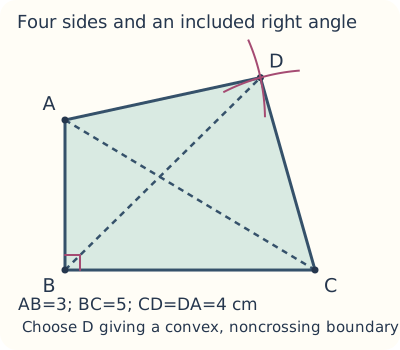
Four sides and their included angle
For AB=3, BC=5, CD=4, DA=4 cm and ABC=90°, draw BC=5 and a perpendicular at B, mark A3 cm along it. Intersect circles centred A, C each of radius4 cm at D, choosing the point giving cyclic convex ABCD. Join AD, DC. The other intersection may lie outside the intended region. Verify all four lengths and the90° included angle; the angle location is essential.
Four sides and a specified diagonal
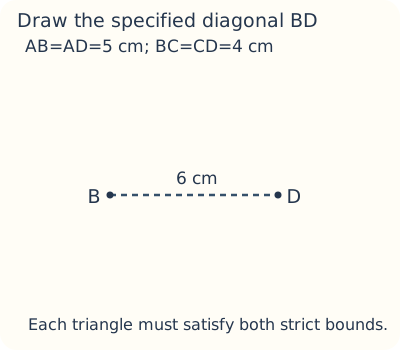
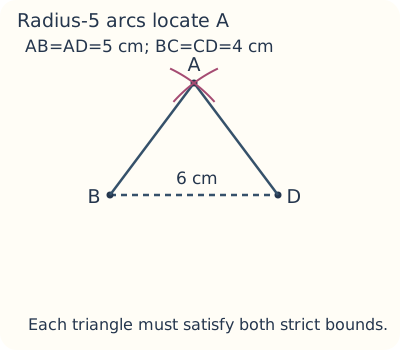
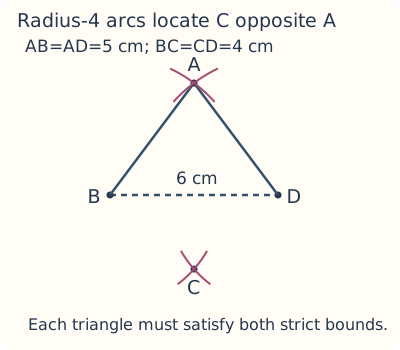
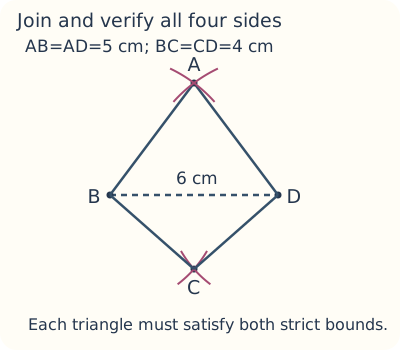
Let BD=6, BA=DA=5, BC=DC=4 cm. Draw BD. Radius5 arcs about B, D locate A above it; radius4 arcs locate C below it. Join cyclic A, B, C, D. For a triangle with side radii r, s and centre distance e require |r−s|<e<r+s. Check this for both triangles. Equality gives a flat triangle; the source lists upper-sum bounds but the lower-difference bounds are also necessary.
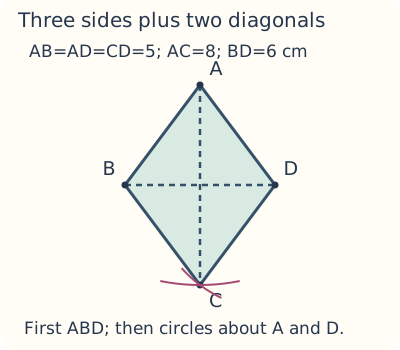
Three sides and two diagonals
Specify AB, AD, CD and diagonals BD, AC. First construct ABD by SSS on BD. Then circles centred A, D with radii AC, CD locate C; choose the point on the opposite side of BD from A when this exists and produces the required convex order. Both triangle stages need full inequalities and a final side-of-line check. Giving only the first triangle’s condition, as the source summary does, does not guarantee the second construction.
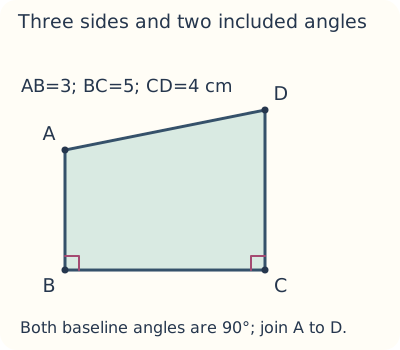
Three consecutive sides and two included angles
Given AB=3, BC=5, CD=4 cm with ABC=90°, BCD=90°, draw BC, erect same-side perpendicular rays at B, C, mark A, D at distances3,4 and join AD. General given angles are copied at the specified vertices. Check A, D on the intended side, noncrossing boundary and every supplied length. The final AD is determined, not an extra freely chosen length.
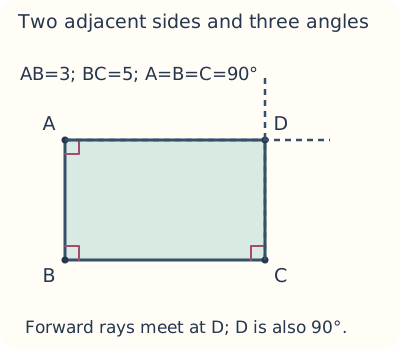
Two adjacent sides and three angles
Given AB=3, BC=5 cm and ABC=90°, BCD=90°, BAD=90°, build triangle ABC using the first included angle. At C draw the ray making the supplied BCD angle; at A draw the ray making BAD. Their forward intersection is D. Parallel rays or an intersection behind a ray fail this construction. For a convex result the remaining angle360°−A−B−C must be between0° and180°.
Explain impossible or ambiguous data
With a proposed triangle sides2,3 and diagonal6,2+3<6 so the arcs do not meet. With sides1,5 and diagonal2, their sum exceeds2 but |5−1|=4>2, so one circle lies inside the other without meeting. Angles20°,30°,40° force a 270° fourth angle, ruling out the intended convex quadrilateral. State convexity when making that conclusion; angle sum alone does not prohibit every concave figure.
Retain arcs and justify the result
An instrument construction records the baseline, copied angles, compass centres, radii and chosen intersections. A proof then matches each given to a construction step. If two non-adjacent sides and three right angles are given, a rectangle with only one side length fixed can still have many widths; such data may be insufficient. Numerical coordinates in our models verify the illustrated construction, while your independent compass drawing needs review.
Worked example
A diagonal construction with radii1 and5 and centre distance2 fails:2<1+5 is true, but2>|5−1| is false. Both strict bounds are necessary before drawing arcs.
Name the figure in cyclic vertex order and state every given length, angle and assumption.
Draw a labelled model; give a reason for each proof, area calculation or construction step. Check that the data can form the required figure.
Verify the original conditions, units and vertex order. Numeric checks assess the requested value only; proofs, nets and constructions need guardian or teacher review.
Five numbers are not an existence proof
The chapter’s introductory list describes useful data patterns. Compatibility, full inequalities and placement still need checking.
Keep a compass construction exact
Our numerical coordinates check the SVG model. Plotting rounded points is not a substitute for the stated compass steps.
Choose the construction from named givens
The position of each side, angle and diagonal matters.
Choose the construction from named givens
Method
First fixed structure
Remaining point
Four sides+included angle
The two adjacent sides and angle
Two circle radii from the fixed endpoints
Four sides+diagonal
The specified diagonal
One triangle on each side
Three sides+two diagonals
One SSS triangle on the given diagonal
Second circle intersection from two named centres
Three consecutive sides+included angles
Baseline and its two angle rays
Mark both endpoint lengths, join
Two adjacent sides+three angles
One SAS triangle
Forward intersection of two angle rays
Check full triangle inequalities, ray directions, distinct vertices and the required convex/noncrossing result. A list of five values alone does not certify a construction.
Both triangle inequalities are necessary
Two circle radii r, s and centre distance e form a nondegenerate triangle only between strict bounds.
|r−s| < e < r+s
For r=1, s=5, e=2:
4 < 2 < 6 is false
r, s
Positive side/radius lengths.
e
Distance between circle centres, not a radius.
Check the lower difference bound.
Check the upper sum bound.
Reject tangency equality for a nondegenerate triangle.
Repeat the check for the second triangle.
The upper-sum inequalities printed in the source are necessary but not sufficient by themselves.
Construct from four sides and a diagonal
BD=6 cm, AB=AD=5 cm, BC=CD=4 cm. Every coloured arc is centred on the labelled endpoint with the stated radius.
All stages: readable static alternative
1 · Draw BD=6 cm: Use the supplied diagonal as the baseline. Check0<6<10 and0<6<8 for the two isosceles triangle constructions.
2 · Locate A: Radius5 cm arcs from B, D intersect above BD. Join A to B, D.
3 · Locate C on the opposite side: Radius4 cm arcs from B, D intersect below BD. Keep this intersection distinct from A and the baseline.
4 · Join and verify: Join A, B, C, D cyclically. Check AB=AD=5, BC=CD=4 and BD=6 cm. The two perpendicular apex heights are4 and√7 centimetres.
No autoplay. Manual stages, static alternatives and replay remain available. Reduced motion disables timed playback; leaving the page pauses it.
Explore the mathematical figures
Match each letter to its explanation. Read the quantities, units and relationships, then check the counts or equations. These are original teaching models.
Four sides and an included angle
Build the included-angle triangle, then select the circle intersection producing the convex boundary.
A
A is3 cm above B.
B
B is the supplied90° angle vertex.
C
C is5 cm from B on the baseline.
D
D is the chosen intersection of radius4 cm arcs about A and C.
Original labelled mathematical model, not copied source artwork. Verify stated conditions rather than judging shape from appearance.
Explore the mathematical figures
Match each letter to its explanation. Read the quantities, units and relationships, then check the counts or equations. These are original teaching models.
Four sides and a diagonal
Check both strict triangle bounds for each pair of arcs before joining.
A
A is above BD with AB=AD=5 cm.
B
B is one end of the6 cm diagonal.
C
C is below BD with BC=CD=4 cm.
D
D is the other diagonal endpoint and an arc centre.
Original labelled mathematical model, not copied source artwork. Verify stated conditions rather than judging shape from appearance.
Explore the mathematical figures
Match each letter to its explanation. Read the quantities, units and relationships, then check the counts or equations. These are original teaching models.
Three sides and two diagonals
First build ABD on BD. The second intersection uses centres A, D and radii AC, CD. Check both triangles.
A
A is located by the first SSS triangle.
B
B is one end of BD=6 cm.
C
C is located by circles about A, D with radii8 cm,5 cm.
D
D is the other end of BD; AD=CD=5 cm.
Original labelled mathematical model, not copied source artwork. Verify stated conditions rather than judging shape from appearance.
Explore the mathematical figures
Match each letter to its explanation. Read the quantities, units and relationships, then check the counts or equations. These are original teaching models.
Three sides and two included angles
Both rays are on the intended same side of BC. A, D need not have equal height.
A
A is3 cm along the perpendicular at B.
B
B is one end of BC=5 cm.
C
C is the other end with a perpendicular ray.
D
D is4 cm along the perpendicular at C; AD is the final join.
Original labelled mathematical model, not copied source artwork. Verify stated conditions rather than judging shape from appearance.
Explore the mathematical figures
Match each letter to its explanation. Read the quantities, units and relationships, then check the counts or equations. These are original teaching models.
Two adjacent sides and three angles
A valid intersection must lie on both forward rays, not merely their extended lines.
A
A is3 cm from B and supplies the third90° ray.
B
B supplies the first90° angle.
C
C is5 cm from B and supplies the second90° ray.
D
D is the forward-ray intersection; its angle is also90°.
Original labelled mathematical model, not copied source artwork. Verify stated conditions rather than judging shape from appearance.
Your written practice
Show your working on paper. Check your answer, then choose Next.
Show model answer and explanation
5
Five is the usual general count; compatibility and placement still matter.
Show model answer and explanation
16
3+5+4+4=16; a successful drawing must match these lengths.
Show model answer and explanation
90
It is the stated included angle at B, copied in the construction.
Show model answer and explanation
3
Symmetry places each intersection above or below the midpoint,3 cm from either end horizontally.
Show model answer and explanation
4
The altitude bisects6 to3; 5²−3²=16, so altitude4.
Show model answer and explanation
8
A nondegenerate triangle needs e<4+4=8.
Show model answer and explanation
16
5+5+6=16.
Show model answer and explanation
16
5+5+6=16; the second triangle requires its own check.
Show model answer and explanation
1
Their heights are3 and4 above the same baseline.
Show model answer and explanation
90
360−270=90.
Show model answer and explanation
75
360−110−80−95=75.
Show model answer and explanation
4
|5−1|=4; an upper-sum check alone would miss this restriction.
Show model answer and explanation
270
360−90=270; this is not a convex interior angle.
Show model answer and explanation
16
2(5+3)=16; changing the width would change this result.
Show model answer and explanation
18
2(5+4)=18, illustrating that a fixed length alone does not fix the figure.
Write in your own words. A guardian or teacher should review this response.
Show model answer and explanation
A hinged four-side frame can change angles and diagonals while preserving side lengths. For example equal fixed sides can make rhombi with different included angles. Another compatible condition is needed.
Name what changes and what stays fixed.
Write in your own words. A guardian or teacher should review this response.
Show model answer and explanation
Set B=(0,0), C=(5,0), A=(0,3) as a verification model. Radius4 circles about A, C meet; choose the intersection to the right and above giving convex ABCD. Join AD, DC and check distances. The compass construction uses these lengths, not plotted decimal estimates.
Preserve arcs and verify all five givens.
Write in your own words. A guardian or teacher should review this response.
Show model answer and explanation
Draw BD=6. Equal radius5 arcs locate A on one side; equal radius4 arcs locate C on the other. Join the boundary and verify both triangle inequalities and four sides.
Do not place both apex points on the same chosen side without checking the shape.
Write in your own words. A guardian or teacher should review this response.
Show model answer and explanation
If |r−s|≥e one circle is inside the other or internally tangent, so no nondegenerate triangle exists. Require |r−s|<e<r+s with positive lengths. Sides1,5, e=2 pass the sum test but fail the difference test.
Give a concrete counterexample and both strict inequalities.
Write in your own words. A guardian or teacher should review this response.
Show model answer and explanation
Construct ABD on BD using AB, AD. Then intersect the circle about A of radius AC with the circle about D of radius CD. Check |AB−AD|<BD<AB+AD and |AC−CD|<AD<AC+CD. Choose a C on the opposite side of BD from A and verify a convex noncrossing boundary.
The first triangle’s success alone does not prove the whole construction works.
Write in your own words. A guardian or teacher should review this response.
Show model answer and explanation
Build ABD with sides5,5,6. Its apex A is4 cm above the midpoint of BD. Circles about A, D of radii8,5 locate C on the opposite side,4 cm below BD. All four sides become5, diagonals6 and8.
Show both stages and check C rather than assuming its final position.
Write in your own words. A guardian or teacher should review this response.
Show model answer and explanation
Draw BC=5, same-side perpendicular rays at B, C, mark BA=3 and CD=4, then join AD. The labelled coordinates B(0,0), C(5,0), A(0,3), D(5,4) verify a convex figure with the requested givens.
Do not add a fourth side length that was not given.
Write in your own words. A guardian or teacher should review this response.
Show model answer and explanation
Build BC=5 and BA=3 on a perpendicular. Draw the perpendicular ray at C and a ray at A perpendicular to AB directed toward that C ray. They meet at D, making a 3-by5 rectangle.
Use forward rays, correct vertices and all three supplied angles.
Write in your own words. A guardian or teacher should review this response.
Show model answer and explanation
The supporting lines might meet behind a specified ray endpoint. That point does not satisfy the chosen interior-angle rays. Parallel rays may never meet. Verify a forward intersection and final cyclic interior angles.
Distinguish lines from rays.
Write in your own words. A guardian or teacher should review this response.
Show model answer and explanation
The shortest path along the two sides has length2+3=5, less than6. Triangle inequality fails, so no circle intersection constructs a nondegenerate triangle.
Do not describe failure as a bad drawing technique.
Write in your own words. A guardian or teacher should review this response.
Show model answer and explanation
The fourth would be270°, which exceeds180° and is reflex. Therefore no convex quadrilateral has those angles. The angle sum alone does not rule out every concave interpretation.
State exactly the convexity assumption.
Write in your own words. A guardian or teacher should review this response.
Show model answer and explanation
Rectangles of length5 and widths3 or4 both satisfy those opposite-side lengths and angles, but have different perimeters16 and18. An adjacent width is still missing.
Give two noncongruent examples with the same stated data.
Write in your own words. A guardian or teacher should review this response.
Show model answer and explanation
List the named givens, baseline, angle vertices, compass centres/radii, intersection choice and final joins. Then verify each given individually and the simple convex boundary.
A final outline without steps is incomplete.
Write in your own words. A guardian or teacher should review this response.
Show model answer and explanation
After placing the included-angle triangle, compute or compare the distance between the remaining circle centres. Their radii must satisfy both strict intersection inequalities; select an intersection producing the intended boundary, not a repeated or crossed vertex.
A five-number count does not guarantee existence or the intended orientation.
Write in your own words. A guardian or teacher should review this response.
Show model answer and explanation
Copy60° at the specified baseline endpoint and75° at the other with the correct interior orientation. Mark the given adjacent side lengths on those rays, join the endpoints and verify the resulting convex shape.75° can be constructed by bisecting between60° and90°.
Keep the positions of both angles explicit; do not swap them.
Progress and browser storage
Notebook challenge, sources and further study
Your quadrilateral geometry notebook
Construct one valid figure and document one impossible data set.
Review with a guardian or teacher
Name all five givens and test triangle/ray conditions.
Retain arcs and angle marks.
Explain how the final joins meet every given.
Keep your work on paper or in a local file. This page does not upload it or automatically grade the project.
Chapter companion and further study
This original Kidemy practice follows the topic order of 2026 Class 8 Mathematics · English Version, chapter 8, printed pages 133–151. It does not replace the complete chapter or its practical teaching.
Compare these original method-based tasks with the independent source exercises. This companion does not reproduce every printed question.
Verify drawings with instruments and review full proof reasons. Original companions for all 11 chapter headings are available; independent source exercises and full working still need review.
Teacher-led lessons, schedules and prices for this outline are upcoming. You can use any starter practice above now without booking.
Your next step
Solo practice works without an account. Sign in to save a practice record to your learner profile.
Keep practising
Exact lesson links and related activities are labelled separately. Return-to-course links retain your selected learning path.