2026 Class 8 Mathematics · English Version · Chapter 8 · Chapter companion part
Chapter 8C: Triangle areas, box nets and surface area
Derive quadrilateral areas from triangles and calculate cube/cuboid surface area from labelled, matching faces.
About this lesson and its coverage
Class 8 English Version: part C of the chapter 8 companion. Eight teaching sections, 30 written tasks and a notebook challenge. Selected companion coverage, not complete textbook coverage; use all five parts. Independent proofs, compass work, drawings and nets require guardian or teacher review.
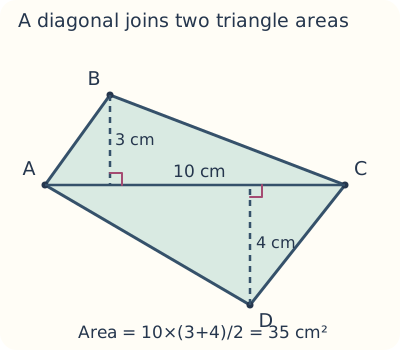
For convex ABCD, diagonal AC of length d separates two triangles. If B, D have perpendicular distances h₁, h₂ to line AC on opposite sides, area=dh₁/2+dh₂/2=d(h₁+h₂)/2. Use perpendicular distance, not a sloping side. The formula assumes the internal diagonal partitions the region without overlap.
Average the two parallel lengths
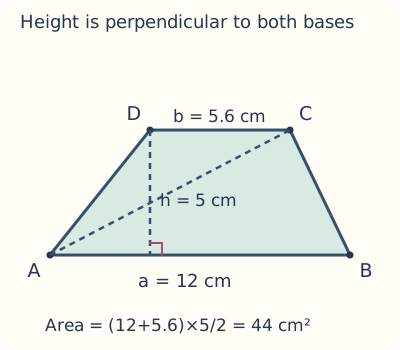
For parallel bases a, b and perpendicular separation h, a trapezium has area (a+b)h/2. One derivation draws a diagonal: the two triangles have bases a, b and the same height h. Another places two congruent trapezia together as a parallelogram of base a+b and height h, then halves its area. Average of the two lengths means (a+b)/2, not another halving of an already averaged sum.
Use perpendicular diagonals for the rhombus
Rhombus diagonals p, q bisect each other at right angles. Taking p as a common triangle base gives two heights q/2, so total area=pq/2. Equivalently four right triangles each have legs p/2, q/2. For a general quadrilateral with nonperpendicular diagonals, pq/2 need not be its area. A parallelogram area is base×perpendicular height, not usually the product of adjacent side lengths.
A solid has faces, edges and vertices
A rectangular solid, or cuboid, has 6 rectangular faces,12 edges and8 vertices. Opposite faces have equal dimensions. A cube is the special cuboid whose edges all have equal length and whose faces are squares. A drawn solid is a perspective model: parallel depth edges appear slanted, and their page lengths are not measurements of the real solid.
A net lays out every face once
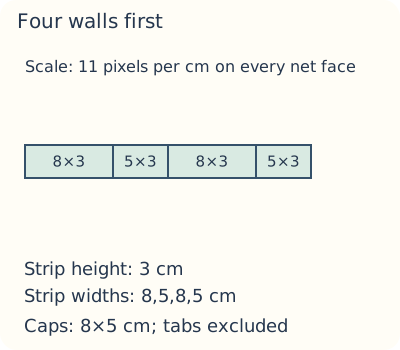
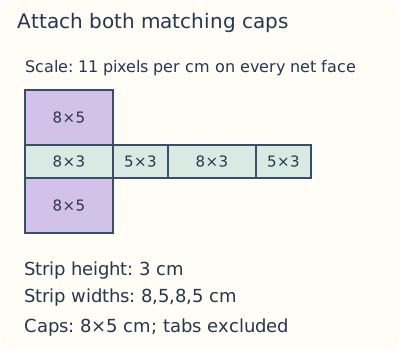
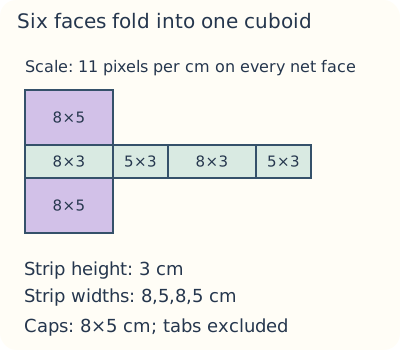
An open net for a cuboid can use four side rectangles of widths l, b, l, b in a strip of height h, with two l-by-b end faces attached above and below one l-wide strip face. Fold the shared edges; verify all six faces close with no overlaps or missing face. Not every arrangement of six squares makes a cube net. Tabs for glue are additional material and are not part of the ideal surface area.
Add the three opposite-face pairs
A cuboid with length l, breadth b, height h has two lb faces, two bh faces and two lh faces. Total surface area=2(lb+bh+lh), in square units. A cube of edge s has six s² faces, total6s². Volume lbh is a different quantity measured in cubic units. Label dimensions before inserting numbers to avoid interchanging a face area and a length.
Count only the faces requested
An open-top l-by-b-by-h box has base lb and four walls2lh+2bh, so material area=lb+2lh+2bh, ignoring thickness, tabs and waste. Painting only four walls uses2h(l+b). A closed-box formula is wrong if the question explicitly excludes the top. State whether internal surfaces or both sides of a sheet are counted.
Check units and composite boundaries
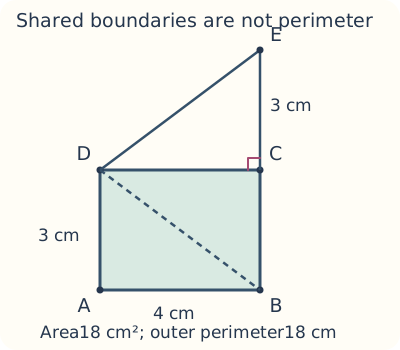
Convert all lengths to one unit before squaring or multiplying. Since1 m=100 cm,1m²=10,000cm². A 3-by-4 rectangle with a right triangle attached has area from the two regions; its outer perimeter excludes the shared boundary. If a diagonal gives a 3–4–5 right triangle, verify 3²+4²=5² before using that length; a later chapter develops the theorem fully.
Worked example
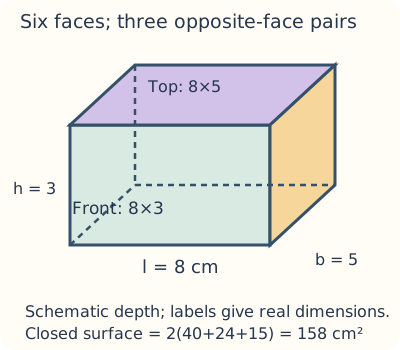
An8×5×3 cuboid has paired face areas40,15,24 cm². Its closed surface area is2(40+15+24)=158 cm². Removing a 40 cm² top gives118 cm² for an ideal open-top box.
Name the figure in cyclic vertex order and state every given length, angle and assumption.
Draw a labelled model; give a reason for each proof, area calculation or construction step. Check that the data can form the required figure.
Verify the original conditions, units and vertex order. Numeric checks assess the requested value only; proofs, nets and constructions need guardian or teacher review.
Drawings use two kinds of scale
Plane area models use their stated dimensions. A perspective cuboid is a schematic view; use its dimension labels and matching net.
Material needs assumptions
Ideal surface area excludes thickness, glue tabs and waste unless a task supplies them.
A diagonal splits the area
Let d be an internal diagonal and h₁, h₂ perpendicular heights on its opposite sides.
The sloping boundary lengths are not substitutes for these heights.
Count the requested box faces
Use l=8, b=5, h=3 centimetres.
Count the requested box faces
Surface
Area expression
Area in cm²
Two caps
2×8×5
80
Two long walls
2×8×3
48
Two short walls
2×5×3
30
Closed total
80+48+30
158
Open-top total
40+48+30
118
Walls only
48+30
78
Ideal material area excludes thickness, glue tabs and cutting waste. A face area is not volume.
From wall strip to closed-box faces
Follow the matching dimensions before folding. Use manual stages or replay; nothing starts automatically.
All stages: readable static alternative
1 · Lay out the four walls: The strip is3 cm high with widths8,5,8,5 cm. It supplies four distinct vertical faces.
2 · Attach both caps: Attach one8×5 rectangle above and one below the same8 cm wall. All six rectangles use the same net scale.
3 · Match the closed solid: After folding, opposite faces pair as8×5,8×3,5×3. This perspective view is schematic; its labelled lengths refer to the real box.
Static frames remain readable. No autoplay; reduced motion disables timed playback, and leaving the page pauses it. This sequence explains face correspondence rather than simulating a physical paper fold.
Explore the mathematical figures
Match each letter to its explanation. Read the quantities, units and relationships, then check the counts or equations. These are original teaching models.
Add the two triangle areas
The SVG uses30 pixels per cm. Area=10×(3+4)/2=35cm².
A
A is the left endpoint of diagonal AC.
B
B is3 cm from AC on one side.
C
C is the other endpoint of the10 cm diagonal.
D
D is4 cm from AC on the other side.
Original labelled mathematical model, not copied source artwork. Verify stated conditions rather than judging shape from appearance.
Explore the mathematical figures
Match each letter to its explanation. Read the quantities, units and relationships, then check the counts or equations. These are original teaching models.
Use the perpendicular height
The exact25 pixels-per-cm model gives area44cm² from the two triangles, not from a sloping leg.
A
A is the left end of the12 cm lower base.
B
B is its right end.
C
C is the right end of the5.6 cm upper base.
D
D is the left end of the upper base; its perpendicular height is5 cm.
Original labelled mathematical model, not copied source artwork. Verify stated conditions rather than judging shape from appearance.
Explore the mathematical figures
Match each letter to its explanation. Read the quantities, units and relationships, then check the counts or equations. These are original teaching models.
Match the three opposite-face pairs
There are two faces of each area24,40,15cm²; total158cm². The perspective drawing is not a true-length measurement.
l
Length8 cm is shared by front and cap dimensions.
b
Breadth5 cm runs in the schematic depth direction.
h
Height3 cm is shared by every wall.
Original labelled mathematical model, not copied source artwork. Verify stated conditions rather than judging shape from appearance.
Explore the mathematical figures
Match each letter to its explanation. Read the quantities, units and relationships, then check the counts or equations. These are original teaching models.
A dimension-matched cuboid net
All faces use11 pixels per cm. Fold to six distinct face directions; opposite faces match. Glue tabs are excluded.
8×3
Two long walls, each24cm².
5×3
Two short walls, each15cm².
8×5
Two caps, each40cm²; both needed for a closed box.
Original labelled mathematical model, not copied source artwork. Verify stated conditions rather than judging shape from appearance.
Explore the mathematical figures
Match each letter to its explanation. Read the quantities, units and relationships, then check the counts or equations. These are original teaching models.
Separate area joins from the outer boundary
At 40 pixels per cm, area12+6=18cm². Boundary AB+BE+ED+DA=4+6+5+3=18 cm; shared DC is not an outer edge.
A
A is the lower-left rectangle corner.
B
B is the lower-right corner; BE=6 cm.
C
C is the upper-right rectangle corner and midpoint of BE.
D
D is the upper-left corner; DC is an internal shared edge.
E
E is the external triangle apex; DE=5 cm.
Original labelled mathematical model, not copied source artwork. Verify stated conditions rather than judging shape from appearance.
Your written practice
Show your working on paper. Check your answer, then choose Next.
Show model answer and explanation
35
10×(3+4)/2=35.
Show model answer and explanation
50
(12+8)×5/2=50.
Show model answer and explanation
12
Average base=area/height=60/5.
Show model answer and explanation
5
2×50/(12+8)=5.
Show model answer and explanation
48
12×8/2=48.
Show model answer and explanation
36
9×4=36; the sloping side is not used.
Show model answer and explanation
6
There are three opposite-face pairs.
Show model answer and explanation
12
Four edges in each of three dimension directions.
Show model answer and explanation
6
Every surface appears exactly once.
Show model answer and explanation
158
2×(40+15+24)=158.
Show model answer and explanation
121.5
6×4.5²=121.5.
Show model answer and explanation
118
40+2×24+2×15=118; no top.
Show model answer and explanation
78
2×3×(8+5)=78.
Show model answer and explanation
600
Each square metre is10,000 square centimetres.
Show model answer and explanation
18
12+4×3/2=18; the regions do not overlap.
Write in your own words. A guardian or teacher should review this response.
Show model answer and explanation
The diagonal divides the convex region into two triangles. Their areas are dh₁/2 and dh₂/2, whose sum is d(h₁+h₂)/2.
Draw both perpendicular heights and identify the internal diagonal.
Write in your own words. A guardian or teacher should review this response.
Show model answer and explanation
A diagonal gives two triangles with bases a, b and common height h; their sum is (a+b)h/2. Two congruent copies make a parallelogram of base a+b and height h, so one is half its area.
Give two labelled constructions, not two restatements of a formula.
Write in your own words. A guardian or teacher should review this response.
Show model answer and explanation
h is the shortest perpendicular separation of the parallel base lines. A sloping leg usually exceeds it; draw a right-angle height before calculating.
Identify the parallel sides and the foot of the perpendicular.
Write in your own words. A guardian or teacher should review this response.
Show model answer and explanation
Diagonals p, q meet perpendicularly and bisect. Two triangles with base p each have height q/2; total is2×(p×q/2)/2=pq/2.
Explain why q/2 is a perpendicular height.
Write in your own words. A guardian or teacher should review this response.
Show model answer and explanation
The formula is base times perpendicular height. A sloping adjacent side is a hypotenuse of a height triangle and is longer than its altitude unless perpendicular. A rectangle is the special case where the adjacent side is a height.
Use a labelled counterexample or the base9, height4 model.
Write in your own words. A guardian or teacher should review this response.
Show model answer and explanation
A cuboid has6 faces,12 edges,8 vertices. In a cube all12 edges have one length and all6 faces are equal squares; it still has the same counts.
Do not count a hidden edge as an absent edge.
Write in your own words. A guardian or teacher should review this response.
Show model answer and explanation
Use a strip of height3 with widths8,5,8,5. Attach an 8-by5 face above and another below an 8-wide face. There are two8×5, two8×3, two5×3 faces; folding the strip and two caps closes the box.
Check shared edge lengths and six distinct final faces.
Write in your own words. A guardian or teacher should review this response.
Show model answer and explanation
Folding around successive edges wraps a strip and makes faces overlap or leaves the top and bottom unclosed. Six correct face areas alone do not ensure the right adjacency and orientation.
Use a paper fold or distinct face directions to demonstrate failure.
Write in your own words. A guardian or teacher should review this response.
Show model answer and explanation
Add opposite pairs:lb+lb, bh+bh, lh+lh. Their total is2(lb+bh+lh). Each product is an area and all dimensions must use one length unit.
Show three pairs and square units.
Write in your own words. A guardian or teacher should review this response.
Show model answer and explanation
Each face is4.5²=20.25 cm²; six give121.5 cm². Volume is4.5³=91.125 cm³ and measures internal space instead.
Use distinct meanings and units for the two quantities.
Write in your own words. A guardian or teacher should review this response.
Show model answer and explanation
Closed area158 cm². Remove one8×5 top to get118 cm². Remove the base too to leave78 cm² of walls. These ideal areas ignore thickness, tabs and cutting waste.
Name exactly which faces are included.
Write in your own words. A guardian or teacher should review this response.
Show model answer and explanation
A1 m-by1 m square is100 cm by100 cm, containing100×100=10,000 unit squares. Both length factors must be converted.
Use a square model or multiplication of two converted dimensions.
Write in your own words. A guardian or teacher should review this response.
Show model answer and explanation
Area12+6=18 cm². The rectangle contributes the other three sides3+4+3=10; triangle contributes3+5=8, giving perimeter18 cm. The shared4 cm join is internal.
Draw the attachment and exclude its shared edge from perimeter.
Write in your own words. A guardian or teacher should review this response.
Show model answer and explanation
Convert0.08 m to8 cm. Then2(8×5+5×3+8×3)=158cm². Mixing0.08 with5 and3 without conversion would multiply incompatible numerical scales.
Write the conversion before substitution.
Write in your own words. A guardian or teacher should review this response.
Show model answer and explanation
Label six rectangles with the three matching opposite pairs. Every exposed face is counted once before folding, so their summed areas equal the ideal closed surface area. Exclude glue tabs or state their additional area separately.
Teacher review checks closure, no overlap and dimensions.
Progress and browser storage
Notebook challenge, sources and further study
Your quadrilateral geometry notebook
Make a labelled quadrilateral area diagram and a folding cuboid net.
Review with a guardian or teacher
Mark perpendicular heights with right-angle symbols.
Label all six faces and pair their areas.
Explain any omitted face and keep square units.
Keep your work on paper or in a local file. This page does not upload it or automatically grade the project.
Chapter companion and further study
This original Kidemy practice follows the topic order of 2026 Class 8 Mathematics · English Version, chapter 8, printed pages 133–151. It does not replace the complete chapter or its practical teaching.
Compare these original method-based tasks with the independent source exercises. This companion does not reproduce every printed question.
Verify drawings with instruments and review full proof reasons. Original companions for all 11 chapter headings are available; independent source exercises and full working still need review.
Teacher-led lessons, schedules and prices for this outline are upcoming. You can use any starter practice above now without booking.
Your next step
Solo practice works without an account. Sign in to save a practice record to your learner profile.
Keep practising
Exact lesson links and related activities are labelled separately. Return-to-course links retain your selected learning path.