2026 Class 8 Mathematics · English Version · Chapter 9 · Chapter companion part
Chapter 9A: Right triangles, proofs and the converse
Identify the hypotenuse, justify three proof methods and use the converse without assuming the result.
About this lesson and its coverage
Class 8 English Version:part A of the chapter9 companion. Eight teaching sections and30 original written tasks. Selected companion coverage,not complete textbook coverage; use both parts and review full proofs,drawings and exact surds with a guardian or teacher.
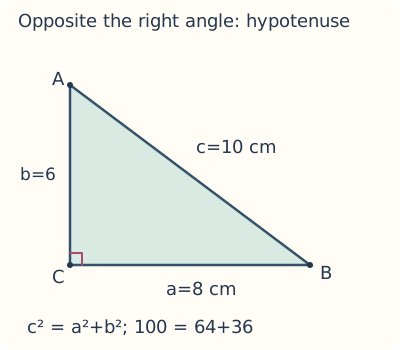
A right triangle has one90° angle. The two sides meeting there are its legs; the opposite, longest side is the hypotenuse. If C is right, AB is the hypotenuse even when the triangle is rotated. We consistently use c for the hypotenuse and a, b for the legs in the formula c²=a²+b². The source changes letter roles between proofs; read the angle and side labels anew rather than assuming b or c always has one role.
A squared-length statement gives a length
For legs6 cm and8 cm, c²=36+64=100cm², so c=10 cm, the positive square root. Adding legs6+8=14 does not find the hypotenuse. With c=13 and one leg5, the other leg is√(169−25)=12. The hypotenuse must exceed each positive leg. The formula applies directly only when the two named legs are perpendicular.
Proof by a trapezium made of three triangles
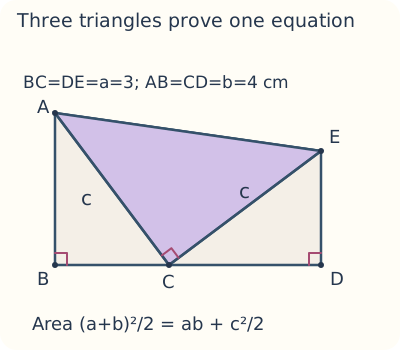
Place B, C, D collinearly with BC=a, CD=b. Erect BA=b and DE=a on the same side, join AC, CE, AE. Triangles ABC and CDE are congruent by SAS, so AC=CE=c. Their acute-angle complements give ACE=90°. The trapezium ABDE area is(a+b)²/2. Its three triangle areas total ab/2+ab/2+c²/2. Equating and multiplying by2 cancels2ab, giving c²=a²+b². This proof does not assume the theorem to establish ACE. If a=b, the outer region is a rectangle; the same parallel-side area formula remains valid.
Proof by similar altitude triangles
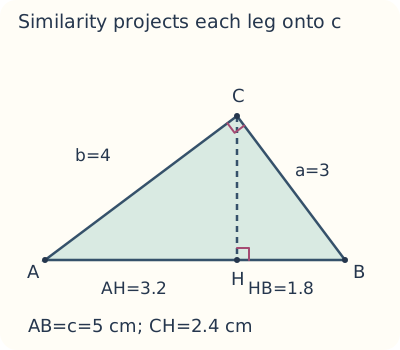
In right ABC with C=90°, drop CH perpendicular to AB=c; write AH=d, HB=e, BC=a, CA=b. Angle-angle similarity gives a/c=e/a and b/c=d/b, hence a²=ce, b²=cd. Add to obtain a²+b²=c(d+e)=c². The final source line omits an equals sign between c(d+e) and c×c; the intended equality is written here. Similar triangles need correct corresponding sides, not merely a shared shape.
Four triangles leave an inner square
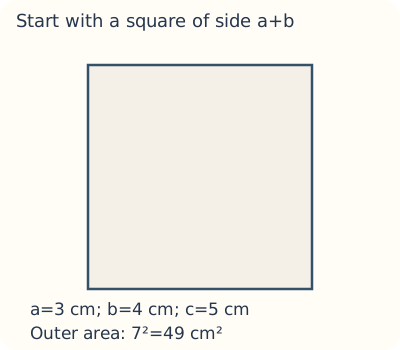
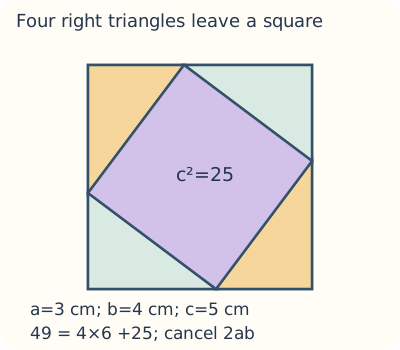
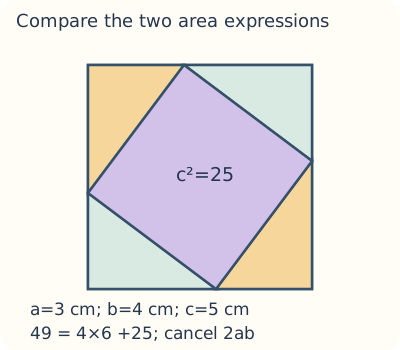
Place four congruent right triangles with legs a, b in the corners of a square of side a+b. Every remaining inner edge is a hypotenuse c. At each inner vertex the two acute triangle angles add to90°, so the remaining angle is90°; equal sides alone would only establish a rhombus. Thus(a+b)²=4(ab/2)+c². Expand and subtract2ab to derive c²=a²+b².
A different arrangement uses the difference
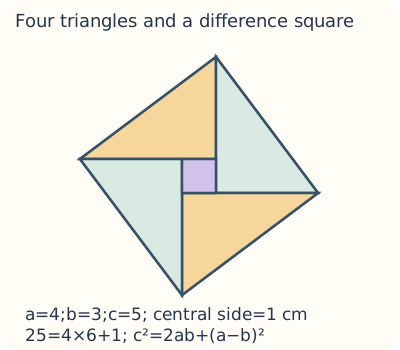
For a≥b>0, four congruent right triangles can lie inside a tilted outer square of side c, leaving an inner square of side a−b. Then c²=4(ab/2)+(a−b)²=2ab+a²−2ab+b²=a²+b². Verify the outer right angles from the complementary acute angles. If a=b, the central gap has area0; it is not a positive-side square.
The converse tests a triangle from side lengths
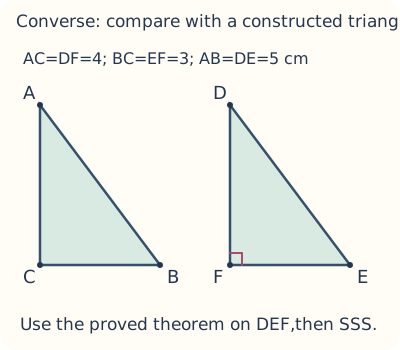
For positive lengths, first check a+b>c with c the largest. If a²+b²=c², the opposite angle is90°. To prove it, construct another right triangle with legs a, b. The already proved theorem gives its hypotenuse√(a²+b²)=c. SSS makes it congruent to the original triangle, so the corresponding angle is right. A drawing that looks right is not this proof.
Keep exact roots and complementary angles
A surd is an exact root that cannot be written as a terminating or recurring rational decimal, such as√2. For equal legs5, c=5√2; do not mark7.07 as an exact answer. A finite check can ask c²=50 instead. The two acute angles sum to90°: if one is twice the other, the smaller is30°; if their difference is12°, the smaller is(90−12)/2=39°. State whether a requested approximation is rounded and to what precision.
Worked example
For right ABC, C=90°, BC=3, CA=4, AB=5:AH=16/5=3.2, HB=9/5=1.8, andCH=12/5=2.4 cm. Similarity and the two area expressions agree.
Locate the stated right angle and its opposite hypotenuse; name every point and length.
Write the applicable theorem, converse, similarity or area identity before substitution. Keep squared lengths separate from lengths.
Check the positive root, units and original assumptions. Review proofs, diagrams and exact radical expressions with a guardian or teacher.
Letter roles change in the source
This companion consistently reservesc for a general hypotenuse, but identifies named sides individually in each task.
Measurement illustrates, proof explains
A measured3–4–5 sketch supports a check. The geometric/algebraic derivations establish the theorem for all positive right-triangle leg lengths.
Hypotenuse first, then the positive root
RightABC has legs6 cm,8 cm and hypotenusec.
c²=6²+8²=100 cm²
c=√100=10 cm
c
The side opposite the90° angle.
c²
A squared length, not the length itself.
Identify the two perpendicular legs.
Add their squares.
Take the positive root for a length.
Verify10>8 and10>6.
If a leg is missing, subtract its known companion square from the hypotenuse square.
Three area equations, one theorem
Prove right angles and piece congruence before using their area expressions.
Three area equations, one theorem
Construction
Area equality
After simplification
Trapezium
(a+b)²/2=ab+c²/2
c²=a²+b²
Outer(a+b)-square
(a+b)²=4(ab/2)+c²
c²=a²+b²
Outerc-square
c²=4(ab/2)+(a−b)²
c²=a²+b²
For equal legsa=b, the difference-square gap has zero area. The trapezium becomes a rectangle under the exactly-one-pair naming convention, but the parallel-side area formula still applies.
Build the square-dissection proof
One fixed7 cm outer square and four congruent3-by4 triangles. No stage plays automatically.
All stages: readable static alternative
1 · Establish the outer square: Its side is a+b=7 cm, so its area is49cm².
2 · Place the four triangles: Each triangle area is6cm². The inner four equal edges are hypotenuses; complementary acute angles make every inner angle90°.
3 · Equate and simplify: 49=4×6+25. In symbols(a+b)²=2ab+c², so subtracting2ab givesc²=a²+b².
Manual stages, static alternatives and replay are available. No autoplay; reduced motion disables timed playback and leaving the page pauses it.
Explore the mathematical figures
Match each letter to its explanation. Read the quantities, units and relationships, then check the counts or equations. These are original teaching models.
Locate the hypotenuse opposite90°
The30 pixels-per-cm model verifies6²+8²=10².
A
One end of the6 cm leg and the hypotenuse.
B
One end of the8 cm leg and the hypotenuse.
C
The right-angle vertex; AB is its opposite side.
Original exact-coordinate model, not source artwork. Read the angle and side labels; a page orientation does not identify the hypotenuse.
Explore the mathematical figures
Match each letter to its explanation. Read the quantities, units and relationships, then check the counts or equations. These are original teaching models.
Three triangles in the area proof
SAS and complementary angles establish the middle right triangle. Compare outer area24.5 with6+6+12.5cm².
A
AB=b=4 cm is perpendicular to the baseline.
B
Right-angle endpoint with BC=a=3 cm.
C
AC and CE are equal hypotenuses and perpendicular.
D
CD=b=4 cm; DE=a=3 cm.
E
The top of the right vertical side and other central-triangle vertex.
Original exact-coordinate model, not source artwork. Read the angle and side labels; a page orientation does not identify the hypotenuse.
Explore the mathematical figures
Match each letter to its explanation. Read the quantities, units and relationships, then check the counts or equations. These are original teaching models.
Project the legs onto the hypotenuse
Similar triangles giveCA²=AB×AH andCB²=AB×HB. The model uses60 pixels per cm.
A
Endpoint of legCA=4 cm and hypotenuseAB=5 cm.
B
Endpoint of legCB=3 cm and the hypotenuse.
C
The original right angle.
H
The altitude foot; its two projection lengths sum toAB.
Original exact-coordinate model, not source artwork. Read the angle and side labels; a page orientation does not identify the hypotenuse.
Explore the mathematical figures
Match each letter to its explanation. Read the quantities, units and relationships, then check the counts or equations. These are original teaching models.
Four triangles leave a hypotenuse square
At 32 pixels per cm, the outer 49cm² is four 6cm² triangles plus25cm². Inner right angles require the complementary-angle argument.
a=3
One leg in each corner triangle.
b=4
The other leg.
c=5
Every inner edge is a hypotenuse.
Original exact-coordinate model, not source artwork. Read the angle and side labels; a page orientation does not identify the hypotenuse.
Explore the mathematical figures
Match each letter to its explanation. Read the quantities, units and relationships, then check the counts or equations. These are original teaching models.
Use the difference-square rearrangement
At 34 pixels per cm,25=4×6+1. Thusc²=2ab+(a−b)².
a=4
The longer leg.
b=3
The shorter leg.
c=5
Each outer edge is a hypotenuse.
Original exact-coordinate model, not source artwork. Read the angle and side labels; a page orientation does not identify the hypotenuse.
Explore the mathematical figures
Match each letter to its explanation. Read the quantities, units and relationships, then check the counts or equations. These are original teaching models.
Use a separate constructed triangle
Do not assume C is right before the argument. Only F has a given right-angle mark. The right-angle result at C follows after applying SSS. The two equal side triples use40 pixels per cm.
A
Given-triangle endpoint corresponding toD.
B
Corresponds toE.
C
Corresponds to the constructed right angleF after SSS.
D
Constructed leg endpoint withDF=4 cm.
E
Constructed leg endpoint withEF=3 cm.
F
The constructed right-angle vertex.
Original exact-coordinate model, not source artwork. Read the angle and side labels; a page orientation does not identify the hypotenuse.
Your written practice
Show your working on paper. Check your answer, then choose Next.
Show model answer and explanation
10
√(6²+8²)=√100=10.
Show model answer and explanation
12
√(13²−5²)=√144=12.
Show model answer and explanation
90
AB is opposite C.
Show model answer and explanation
24.5
(3+4)²/2=49/2=24.5.
Show model answer and explanation
12.5
Two outer triangles contribute6 each;24.5−12=12.5.
Show model answer and explanation
3.2
CA²=AB×AH gives16/5=3.2.
Show model answer and explanation
1.8
BC²=AB×HB gives9/5=1.8.
Show model answer and explanation
49
(3+4)²=49.
Show model answer and explanation
24
4×3×4/2=24.
Show model answer and explanation
25
49−24=25.
Show model answer and explanation
1
(4−3)²=1.
Show model answer and explanation
90
8²+15²=64+225=289=17², so the converse applies.
Show model answer and explanation
50
c²=25+25=50; the exact length is5√2 cm.
Show model answer and explanation
30
x+2x=90.
Show model answer and explanation
39
x+(x+12)=90 givesx=39.
Write in your own words. A guardian or teacher should review this response.
Show model answer and explanation
AB is opposite C. Rotation changes orientation but preserves right-angle position and lengths. It remains the longest side.
Use opposite the right angle, not the sloping-looking side.
Write in your own words. A guardian or teacher should review this response.
Show model answer and explanation
c²=6²+8²=100cm²; taking the positive square root givesc=10 cm.14 cm would incorrectly add the two leg lengths.
Keep square and linear units distinct.
Write in your own words. A guardian or teacher should review this response.
Show model answer and explanation
x²=81−25=56, so x=√56=2√14 cm. A rounded decimal is an approximation only.
Select the positive root and retain the exact expression.
Write in your own words. A guardian or teacher should review this response.
Show model answer and explanation
Construct perpendicular BA=b, DE=a on baseline BD with BC=a, CD=b. SAS gives AC=CE=c. Acute-angle complementarity proves ACE=90°. Equate(a+b)²/2=ab/2+ab/2+c²/2, expand and cancel to obtainc²=a²+b².
Justify the central right angle before assigning its area.
Write in your own words. A guardian or teacher should review this response.
Show model answer and explanation
AA gives a/c=e/a and b/c=d/b. Hencea²=ce, b²=cd. Add:a²+b²=c(e+d)=c², sinced+e=c.
State both similarity correspondences and the segment sum.
Write in your own words. A guardian or teacher should review this response.
Show model answer and explanation
The projections are16/5=3.2 and9/5=1.8 cm, summing5. Area is3×4/2=6cm², also5h/2, soh=2.4 cm. Their product3.2×1.8=5.76 equals2.4².
All lengths refer to this explicitly supplied triangle.
Write in your own words. A guardian or teacher should review this response.
Show model answer and explanation
Four equal sides would permit a non-right rhombus. The adjacent acute triangle angles are complementary, so the interior gap angle is180−90=90°. Thus it is a square of areac².
Do not use appearance or equal sides alone.
Write in your own words. A guardian or teacher should review this response.
Show model answer and explanation
(a+b)²=4(ab/2)+c². Expanda²+2ab+b²=2ab+c², then subtract2ab from both sides.
Explain the four triangles and remaining square before the algebra.
Write in your own words. A guardian or teacher should review this response.
Show model answer and explanation
Arrange four right triangles in an outer c-square around a central(a−b)-square. Then c²=2ab+(a−b)²=a²+b². For a=b, the central area is0 and the triangles fill the outer square.
Verify the arrangement and handle the zero gap without claiming a positive-side square.
Write in your own words. A guardian or teacher should review this response.
Show model answer and explanation
Construct a separate right triangle with the two smaller lengths a, b. Its hypotenuse is c by the proved theorem and given equality. SSS makes it congruent to the original, so the corresponding angle is90°.
Keep the constructed triangle separate from the original assumption.
Write in your own words. A guardian or teacher should review this response.
Show model answer and explanation
They form a triangle since6+8>11, but36+64=100 differs from121. Therefore it is not right-angled; a successful triangle inequality alone does not imply rightness.
Check existence first, then compare squares.
Write in your own words. A guardian or teacher should review this response.
Show model answer and explanation
The triangle inequality fails:1+2<4. No nondegenerate triangle has those lengths. The equality-of-squares test does not replace the existence check.
Identify the failed prerequisite.
Write in your own words. A guardian or teacher should review this response.
Show model answer and explanation
After scaling by positive k, the sides arek, k, k√2. Their squares satisfyk²+k²=(k√2)², so the converse gives90° opposite the largest side. The other two angles are45°.
A ratio describes proportional lengths, not the number of angles.
Write in your own words. A guardian or teacher should review this response.
Show model answer and explanation
x+4x=90 givesx=18°, and the other angle is72°. Both are acute and total90°.
State the equation and check the result.
Write in your own words. A guardian or teacher should review this response.
Show model answer and explanation
Locate the right angle in each diagram, identify its opposite side, and rewrite the equation with that side squared alone. Our general notationc²=a²+b² is a convention, not a rule that a printed letterc must be the hypotenuse.
Label a fresh drawing before applying the formula.
Progress and browser storage
Notebook challenge, sources and further study
Your right-triangle investigation
Build two dissection proofs and one converse check.
Review with a guardian or teacher
Mark the right angles and name the hypotenuse.
Show why the central region is a square.
Separate exact lengths from rounded measurements.
Keep your work on paper or in a local file. This page does not upload it or automatically grade the project.
Chapter companion and further study
This original Kidemy practice follows the topic order of 2026 Class 8 Mathematics · English Version, chapter 9, printed pages 152–158. It does not replace the complete chapter or its practical teaching.
These method-based tasks do not reproduce every exact printed question. Independent derivations, proofs and constructions need review.
Historical attribution is outside this mathematical-method mapping. Original companions for all 11 chapter headings are available; independent source exercises and full working still need review.
Teacher-led lessons, schedules and prices for this outline are upcoming. You can use any starter practice above now without booking.
Your next step
Solo practice works without an account. Sign in to save a practice record to your learner profile.
Keep practising
Exact lesson links and related activities are labelled separately. Return-to-course links retain your selected learning path.