2026 Class 8 Mathematics · English Version · Chapter 9 · Chapter companion part
Chapter 9B: Applications, medians and proof challenges
Use right-triangle equations in composite figures and prove shared-height, median and midpoint identities while detecting false claims.
About this lesson and its coverage
Class 8 English Version:part B of the chapter9 companion. Eight teaching sections and30 original written tasks. Selected companion coverage,not complete textbook coverage; use both parts and review full proofs,drawings and exact surds with a guardian or teacher.
A labelled application starts with its right angle
For a ladder of length13 m with foot5 m from a vertical wall, the height is√(13²−5²)=12 m if wall and ground are perpendicular. A rectangle with sides8,15 has diagonal17. A square of side s has diagonal²=2s², so its area is half the area of the square on its diagonal. These are geometric idealisations; a sloping wall needs a different model.
Split composite regions before using a radical
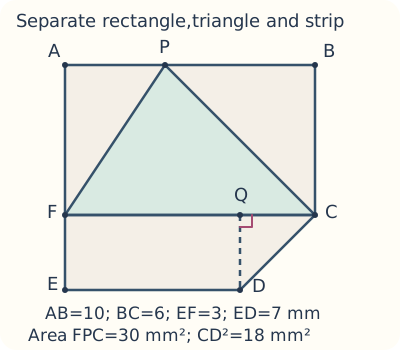
In an original composite model, ABCF is a 10-by6 rectangle and E, D lie3 units below FC with ED=7. Then a right triangle atQ has legsCQ=3, DQ=3, soCD²=18 andCD=3√2. A pointP anywhere on AB makes triangleFPC area10×6/2=30, independent of its horizontal position. The source uses millimetres but labels one requested area square metres; keep area units consistent with lengths.
A median is not an altitude
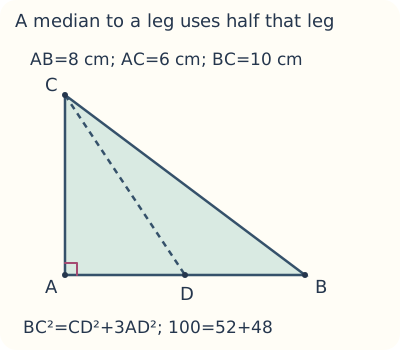
In right ABC with A=90°, let D be midpoint of AB, AD=DB=m and AC=n. ThenCD²=m²+n² whileBC²=4m²+n², soBC²=CD²+3AD². Median means it joins a vertex to the opposite-side midpoint; it need not be perpendicular. A median to the hypotenuse is a different segment from this median to a leg.
Two leg medians give a five-to-four identity
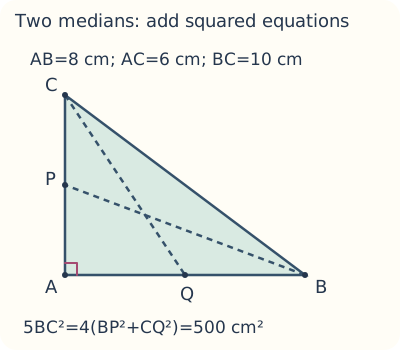
With A=90°, writeAB=u, AC=v, P midpoint of AC, Q midpoint of AB. ThenBP²=u²+v²/4 andCQ²=v²+u²/4. Their sum is5(u²+v²)/4=5BC²/4. Multiply by4 to obtain5BC²=4(BP²+CQ²). State which side each midpoint belongs to before using half lengths.
Perpendicular diagonals give a squared-side balance
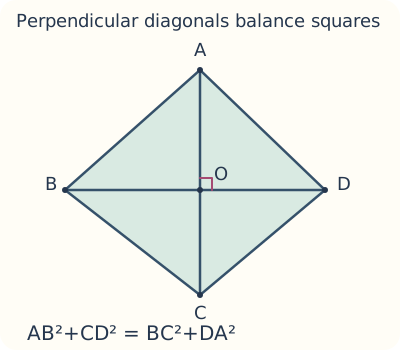
If cyclic ABCD has AC⊥BD at O, setOA=p, OC=q, OB=r, OD=s. Four right triangles giveAB²=p²+r², BC²=q²+r², CD²=q²+s², DA²=p²+s². Adding opposite pairs givesAB²+CD²=BC²+DA². Bisection and equal opposite sides are not required. This identity alone is not a claim that every such figure is a rectangle.
Subtract equal-height equations
IfAD⊥BC at D, thenAB²=AD²+BD² andAC²=AD²+CD², soAB²−AC²=BD²−CD². AnyP on lineAD similarly givesPB²−PC²=BD²−CD², unchanged when its height varies. For rightA and anyD onAC, BC²=AB²+AC² andBD²=AB²+AD², soBC²+AD²=BD²+AC². Equal right-triangle terms cancel; do not subtract unsquared lengths.
Midpoints and similar crossed triangles
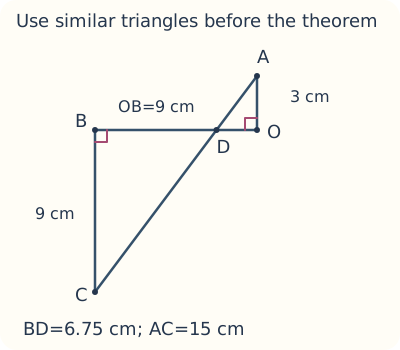
For rightA and D, E midpoints ofAB, AC, triangleADE givesDE²=AD²+AE²=BD²+CE². In the separate crossed model, OB=9, OA=3, BC=9 withAO∥BC and A, D, C collinear acrossBO. Similar right trianglesAOD, CBD giveOD:BD=3:9 andOD+BD=9, soOD=2.25, BD=6.75. The wholeAC has horizontal9 and vertical12, soAC=15.
A false printed statement must not receive an invented proof
SourceExercise9(7) says a right triangle with altitudeAD toBC satisfiesAB²+BC²+CA²=4AD². For A-right3–4–5, the left is9+25+16=50, butAD=12/5 gives right side576/25=23.04. The statement is false as printed. A valid altitude identity isAB²+AC²=BD²+CD²+2AD². Also source short(a) listsAB=15, BC=12, AC=9 but asksBAC:the right angle isBCA, notBAC. Do not silently answer90° for the wrong vertex.
Worked example
ForAB=8, AC=6 andA=90°, BC²=100. WithP midpoint ofAC andQ midpoint ofAB, BP²=73, CQ²=52, and4(73+52)=500=5BC². The theorem applies to the two smaller right triangles separately.
Locate the stated right angle and its opposite hypotenuse; name every point and length.
Write the applicable theorem, converse, similarity or area identity before substitution. Keep squared lengths separate from lengths.
Check the positive root, units and original assumptions. Review proofs, diagrams and exact radical expressions with a guardian or teacher.
A source statement fails a counterexample
Exercise9(7) is false as printed; the companion shows numerical evidence and a valid related identity instead of manufacturing a proof.
A source angle name matters
For sides9,12,15, the right angle is opposite15. BAC andBCA name different vertices and cannot be exchanged silently.
One geometry, two squared equations
Use rightABC, A=90°, AB=8, AC=6; P midpoint ofAC, Q midpoint ofAB.
One geometry, two squared equations
Quantity
Right-triangle calculation
Squared length in cm²
BC²
8²+6²
100
BP²
8²+3²
73
CQ²
6²+4²
52
4(BP²+CQ²)
4(73+52)
500
5BC²
5×100
500
These entries are squared lengths. BP andCQ themselves are√73 and√52 cm; they are not73 cm and52 cm.
Shared-height subtraction
AD is perpendicular toBC atD.
AB²=AD²+BD²
AC²=AD²+CD²
AB²−AC²=BD²−CD²
AD
The identical height in both right triangles.
BD, CD
Distances along the baseline.
Write the first right-triangle equation.
Write the second with the same height.
Subtract to cancelAD².
Repeat forP on the same altitude line.
This is a squared-length identity. It does not justifyAB−AC=BD−CD.
Test the false source altitude claim
Use anA-right3–4–5 triangle, with altitudeAD to its5 cm hypotenuse.
Test the false source altitude claim
Expression
Calculation
Value in cm²
AB²+BC²+CA²
9+25+16
50
AltitudeAD
2×area/BC=12/5
2.4 cm is a length
4AD²
4×(12/5)²
23.04
The first and last values differ, so printedExercise9(7) is false. The correct summed altitude identity isAB²+AC²=BD²+CD²+2AD². A valid counterexample refutes a universal claim.
Explore the mathematical figures
Match each letter to its explanation. Read the quantities, units and relationships, then check the counts or equations. These are original teaching models.
A median to a leg need not be perpendicular
BC²=100=52+3×16=CD²+3AD².
A
The original right angle.
B
Endpoint ofAB=8 cm.
C
Vertex joined to the opposite-side midpoint.
D
AD=DB=4 cm; CD²=52cm².
Original exact-coordinate model, not source artwork. Read the angle and side labels; a page orientation does not identify the hypotenuse.
Explore the mathematical figures
Match each letter to its explanation. Read the quantities, units and relationships, then check the counts or equations. These are original teaching models.
Two medians produce two smaller right triangles
BP²=73, CQ²=52;4(73+52)=500=5BC².
A
Right-angle vertex shared by the small triangles.
B
MedianBP joins B toP.
C
MedianCQ joins C toQ.
P
AP=PC=3 cm.
Q
AQ=QB=4 cm.
Original exact-coordinate model, not source artwork. Read the angle and side labels; a page orientation does not identify the hypotenuse.
Explore the mathematical figures
Match each letter to its explanation. Read the quantities, units and relationships, then check the counts or equations. These are original teaching models.
Four right triangles share diagonal portions
Adding opposite squared sides gives the same four half-diagonal squares on both sides.
A
Contributes OA² in AB² and DA².
B
Contributes OB² in AB² and BC².
C
Contributes OC² in BC² and CD².
D
Contributes OD² in CD² and DA².
O
The right-angle crossing; its four portions need not be equal.
Original exact-coordinate model, not source artwork. Read the angle and side labels; a page orientation does not identify the hypotenuse.
Explore the mathematical figures
Match each letter to its explanation. Read the quantities, units and relationships, then check the counts or equations. These are original teaching models.
Keep the composite dimensions and units
At 25 pixels per mm, areaFPC=30mm² andCD²=18mm².
A
Upper-left corner of the rectangle.
B
Upper-right corner; BC=6 mm.
C
Right endpoint ofFC; CQ=3 mm.
D
Lower point withDQ=3 mm.
E
Lower-left point; ED=7 mm.
F
EF=3 mm; FC=10 mm.
Q
Right-angle foot fromD toFC.
P
Any point onAB has the same height aboveFC.
Original exact-coordinate model, not source artwork. Read the angle and side labels; a page orientation does not identify the hypotenuse.
Explore the mathematical figures
Match each letter to its explanation. Read the quantities, units and relationships, then check the counts or equations. These are original teaching models.
Combine similar triangles with a whole-line distance
Similarity gives the split onBO. WholeAC has horizontal9 and vertical12, so length15 cm.
A
Top endpoint,3 cm aboveO.
B
Left crossing-line endpoint.
C
Bottom endpoint,9 cm belowB.
D
AC intersectsBO; BD=6.75 cm.
O
Right endpoint ofBO; OD=2.25 cm.
Original exact-coordinate model, not source artwork. Read the angle and side labels; a page orientation does not identify the hypotenuse.
Your written practice
Show your working on paper. Check your answer, then choose Next.
Show model answer and explanation
12
√(169−25)=12.
Show model answer and explanation
17
√(64+225)=17.
Show model answer and explanation
98
7²+7²=98.
Show model answer and explanation
30
FC=10 mm and its perpendicular distance toAB is6 mm, so area30mm².
Show model answer and explanation
18
3²+3²=18; CD=3√2 mm.
Show model answer and explanation
52
AD=4; CD²=4²+6²=52.
Show model answer and explanation
48
100−52=48, also3×4².
Show model answer and explanation
73
8²+3²=73.
Show model answer and explanation
52
6²+4²=52.
Show model answer and explanation
500
4(73+52)=500=5×100.
Show model answer and explanation
54
(9+25)+(16+4)=54.
Show model answer and explanation
55
The common25 cancels:64−9=55.
Show model answer and explanation
6.75
OD:BD=1:3 andOD+BD=9, soBD=27/4.
Show model answer and explanation
50
9+16+25=50, regardless of which leg is3 or4.
Show model answer and explanation
23.04
Area6 givesAD=12/5;4×(12/5)²=576/25=23.04.
Write in your own words. A guardian or teacher should review this response.
Show model answer and explanation
Vertical wall and horizontal ground give a right angle. The ladder is the hypotenuse, soh²=13²−5²=144 andh=12 m. This ideal model ignores ladder thickness and wall/ground unevenness.
Draw the right angle and identify the positive length.
Write in your own words. A guardian or teacher should review this response.
Show model answer and explanation
For sides, the diagonal d satisfiesd²=s²+s²=2s². Original square area iss²=d²/2, half the diagonal-square aread².
Compare areas, not side lengths.
Write in your own words. A guardian or teacher should review this response.
Show model answer and explanation
FC is fixed10 andAB∥FC at separation6. EveryP onAB has the same perpendicular height6 aboveFC, so its area is10×6/2=30 square units.
P must remain on the stated parallel line.
Write in your own words. A guardian or teacher should review this response.
Show model answer and explanation
CD=√18=3√2 mm. Any area computed from these millimetre lengths is in mm². The source square-metre label beside its millimetre figure is inconsistent; convert explicitly if metres are requested.
Do not silently combine millimetre lengths with square-metre values.
Write in your own words. A guardian or teacher should review this response.
Show model answer and explanation
LetAD=DB=m, AC=n. Right trianglesCAD, CAB giveCD²=m²+n² andBC²=(2 m)²+n². Subtraction givesBC²−CD²=3m².
Use the midpoint condition, not an unsupported perpendicular median.
Write in your own words. A guardian or teacher should review this response.
Show model answer and explanation
WriteAB=u, AC=v. BP²=u²+v²/4 andCQ²=v²+u²/4. Add to get5(u²+v²)/4=5BC²/4; multiply by4.
Show both small right triangles and their half-side lengths.
Write in your own words. A guardian or teacher should review this response.
Show model answer and explanation
LetOA=p, OC=q, OB=r, OD=s. ThenAB²+CD²=p²+r²+q²+s², whileBC²+DA²=q²+r²+p²+s². The same four terms establish equality.
No midpoint or equal-side assumption is needed.
Write in your own words. A guardian or teacher should review this response.
Show model answer and explanation
AB²=AD²+BD², AC²=AD²+CD². Subtract to cancel the identicalAD². Lengths are nonnegative distances, so the squared relations remain valid when a foot is on the extended line.
State each right triangle before subtraction.
Write in your own words. A guardian or teacher should review this response.
Show model answer and explanation
PB²=PD²+BD² andPC²=PD²+CD², so their difference isBD²−CD². The analogousA equations give exactly that difference. Hence it is independent ofP height.
Explain what remains fixed whenP moves.
Write in your own words. A guardian or teacher should review this response.
Show model answer and explanation
BC²=AB²+AC² andBD²=AB²+AD². AddAD² to the first orAC² to the second:both equalAB²+AC²+AD².
Identify the two common-right-angle triangles.
Write in your own words. A guardian or teacher should review this response.
Show model answer and explanation
TriangleADE is right atA, soDE²=AD²+AE². Midpoints giveAD=BD andAE=CE; substituting yields the claim.
Use the midpoint equalities only after the right-triangle equation.
Write in your own words. A guardian or teacher should review this response.
Show model answer and explanation
Right trianglesAOD, CBD are similar, soOD/BD=3/9=1/3. SinceOD+BD=9, OD=2.25, BD=6.75. A andC differ horizontally9 and vertically3+9=12, soAC=√(81+144)=15 cm.
Use the entire vertical separation forAC, not9−3.
Write in your own words. A guardian or teacher should review this response.
Show model answer and explanation
The squared-side sum is50. Area6 gives altitudeAD=12/5, so4AD²=23.04, which differs from50. A correct general altitude identity isAB²+AC²=BD²+CD²+2AD², obtained by adding the two right-triangle equations.
A counterexample refutes the printed universal statement; never invent a proof for it.
Write in your own words. A guardian or teacher should review this response.
Show model answer and explanation
Since9²+12²=15², the longest sideAB is the hypotenuse and its opposite angleBCA is90°. BAC is acute, not90°; if inverse trigonometry is available, cos(BAC)=9/15=3/5 gives about53.13°. State the naming issue.
Do not silently changeBAC toBCA when reporting the answer.
Write in your own words. A guardian or teacher should review this response.
Show model answer and explanation
Check givens, vertex order, units and calculations. Present the counterexample explicitly, then offer a correctly stated related identity with a proof. Record any interpretation change and ask a teacher to review the original wording.
Reasoned correction is part of learning; an answer key is not permission to assert something false.
Progress and browser storage
Notebook challenge, sources and further study
Your right-triangle investigation
Make a proof-and-error notebook using one median and one shared-height model.
Review with a guardian or teacher
Name each midpoint, perpendicular foot and right angle.
Write the two squared equations before combining them.
Keep the source counterexample separate from a corrected claim.
Keep your work on paper or in a local file. This page does not upload it or automatically grade the project.
Chapter companion and further study
This original Kidemy practice follows the topic order of 2026 Class 8 Mathematics · English Version, chapter 9, printed pages 152–158. It does not replace the complete chapter or its practical teaching.
These method-based tasks do not reproduce every exact printed question. Independent derivations, proofs and constructions need review.
Historical attribution is outside this mathematical-method mapping. Original companions for all 11 chapter headings are available; independent source exercises and full working still need review.
Teacher-led lessons, schedules and prices for this outline are upcoming. You can use any starter practice above now without booking.
Your next step
Solo practice works without an account. Sign in to save a practice record to your learner profile.
Keep practising
Exact lesson links and related activities are labelled separately. Return-to-course links retain your selected learning path.