2026 Class 8 Mathematics · English Version · Chapter 4 · Chapter companion part
Chapter 4A: Squares, products and reciprocal reasoning
Explain square identities, expand signed expressions, recover values from sums/products and respect reciprocal conditions.
About this lesson and its coverage
Class 8 English Version: part A of the chapter 4 companion. Eight sections and 30 written tasks. Selected companion coverage, not complete textbook coverage; use all four parts and compare the mapped source methods. The software checks stated numerical values or coefficients; symbolic work, equivalent forms and proofs need guardian or teacher review.
An identity is an equality true for every allowed value of its variables. For example (a + b)² = a² + 2ab + b² follows by multiplying (a + b)(a + b). An equation such as x + 2 = 5 instead restricts x. Trying several numerical examples can reveal a false identity, but does not by itself prove that a statement works for every value.
Two cross products explain the middle term
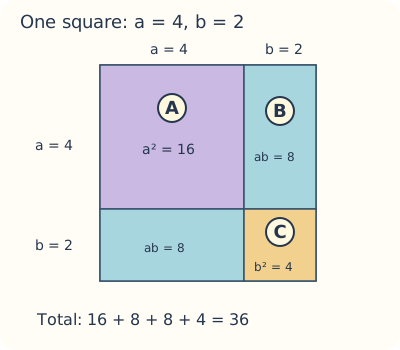
The four products in (a + b)(a + b) are a², ab, ba and b². Since ab = ba, the two equal cross products combine to 2ab. For (2x + 3y)², use whole terms a = 2x and b = 3y: 4x² + 12xy + 9y². In the positive-length area model, two different rectangles each have area ab; there is no missing middle rectangle.
Carry a negative sign through the whole term
Replace b by −b in the sum-square identity to get (a − b)² = a² − 2ab + b². For (3x − 4y)², the middle term is −24xy while the last term is +16y². Also (−2x − y)² = (2x + y)². Squaring a negative entire expression makes it non-negative at real inputs; it does not erase every internal cross-product sign.
Conjugates and a common first term
Conjugates a + b and a − b multiply to a² − b² because the cross products cancel. Thus (5x + 2)(5x − 2) = 25x² − 4. More generally (u + r)(u + s) = u² + (r + s)u + rs. For (3x + 2)(3x − 5), use u = 3x, r = 2, s = −5 to get 9x² − 9x − 10.
A trinomial square contains three paired cross products
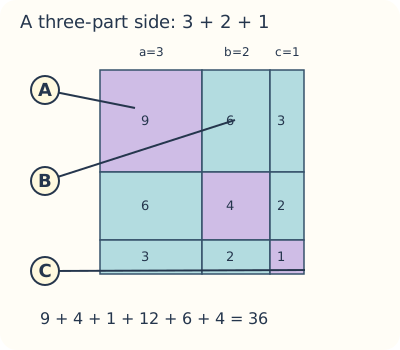
Expand (a + b + c)² as a² + b² + c² + 2ab + 2bc + 2ca. There are three square cells and six off-diagonal cells in the positive-length grid. For signed terms, substitute them with signs attached: (2x + 3y − z)² = 4x² + 9y² + z² + 12xy − 4xz − 6yz. Grouping u = 2x + 3y and then squaring u − z gives the same result.
Rearrange a known sum or difference
Let s = a + b, d = a − b and p = ab. Then a² + b² = s² − 2p = d² + 2p; d² = s² − 4p; s² = d² + 4p. Also 2(a² + b²) = s² + d² and 4ab = s² − d². If s = 11 and p = 24, the square sum is 73 and d² = 25. A squared difference gives only |d|; choosing d = 5 requires an ordering such as a > b.
Mean and half-difference turn a product into two squares
For expressions U and V, set M = (U + V)/2 and D = (U − V)/2. Then U = M + D, V = M − D and UV = M² − D². For U = 2x + 5 and V = 4x − 1, M = 3x + 2 and D = −x + 3. Their product is (3x + 2)² − (x − 3)² = 8x² + 18x − 5. Define a temporary expression without confusing it with a new independent variable.
Reciprocals require nonzero inputs and feasible real conditions
For x ≠ 0, x × (1/x) = 1. If s = x + 1/x, then x² + 1/x² = s² − 2 and x⁴ + 1/x⁴ = (s² − 2)² − 2. If t = x − 1/x, then (x + 1/x)² = t² + 4. Source exercise 4.4 gives x² − √3 x + 1 = 0: completing the square gives (x − √3/2)² + 1/4 = 0, so there is no real solution. Its formal complex-number consequences are different from a feasible real example; our numerical variants state feasible conditions.
Worked example
For (100 + 3)², compute 10000 + 600 + 9 = 10609. The 600 is 2 × 100 × 3, not 3² or a second copy of 10000. Multiplying 103 × 103 checks the result independently.
Identify the structure, define any substituted expression and state nonzero or positive-length conditions.
Write the identity or factor method, substitute entire terms including their signs, and show every step.
Expand to verify factors or substitute back to check a value. Write the requested number for a check; review full algebra and proofs with a guardian or teacher.
Positive tiles illustrate a general identity
The tile lengths a = 4 and b = 2 are original teaching values. Negative variables require algebraic reasoning; the drawing does not represent negative physical area.
Source real-number condition
The source exercise with coefficient √3 has no real root, although formal complex consequences can be computed. We explain that limitation and use feasible real conditions for automatic tasks.
Read the structure before choosing an identity
These are exact identities for permitted real variables, not measured observations.
Read the structure before choosing an identity
Structure
Identity
What to notice
Square of a sum
(a + b)² = a² + 2ab + b²
Two cross products
Square of a difference
(a − b)² = a² − 2ab + b²
Last square is positive
Conjugates
(a + b)(a − b) = a² − b²
Cross products cancel
Common first term
(u + r)(u + s) = u² + (r + s)u + rs
Use signed r and s
Three-term square
(a + b + c)² = a² + b² + c² + 2ab + 2bc + 2ca
Three paired cross products
For (3x + 2)(3x − 5), the common first term is 3x and the signed constants are 2 and −5. The middle coefficient is (2 − 5) × 3 = −9.
Derive and rearrange the square identities
Distribute first; adding and subtracting the expansions supplies all six square corollaries.
(a + b)² = a² + 2ab + b²
(a − b)² = a² − 2ab + b²
a² + b² = (a + b)² − 2ab = (a − b)² + 2ab
(a + b)² = (a − b)² + 4ab
(a − b)² = (a + b)² − 4ab
2(a² + b²) = (a + b)² + (a − b)²
4ab = (a + b)² − (a − b)²
a / b
Any permitted real values or complete algebraic expressions.
ab
Product of a and b; 2ab is twice that product.
Multiply (a + b)(a + b) into four terms.
Combine the two equal ab products.
Replacing b by −b gives the difference-square expansion.
Adding eliminates cross terms; subtracting eliminates pure squares.
An area diagram uses positive lengths. The algebraic derivation also handles signed values. A squared difference does not fix a signed difference.
Build one square from four pieces
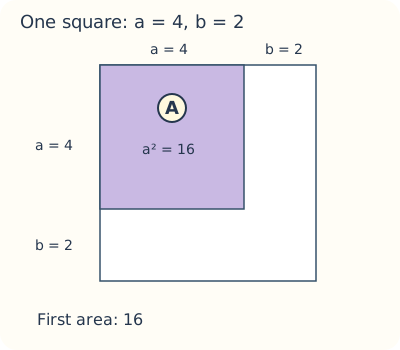
Original positive lengths a = 4, b = 2. Each side of the complete square is 6 units.
All stages: readable static alternative
1 · Start with a² = 16: A 4-by-4 square occupies 16 square units. The outlined full square has side 6.
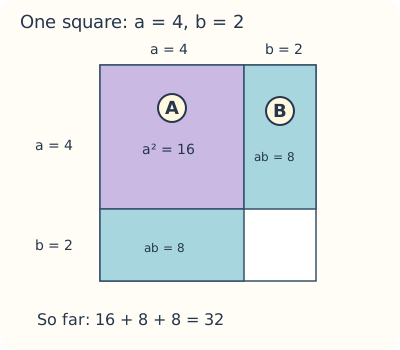
2 · Add two ab rectangles: Each 4-by-2 rectangle has area 8. Together they add 16, giving 32 square units so far.
3 · Add b² = 4: The 2-by-2 corner adds 4. Total is 16 + 8 + 8 + 4 = 36 = (4 + 2)².
The pieces meet without overlap. Play is optional; Previous/Next and all static stages remain available. Reduced motion disables timed playback, and changing lesson mode pauses it. Physical lengths are positive.
A product is a difference of two squares
The mean and half-difference use complete expressions, including their signs.
M = (U + V)/2
D = (U − V)/2
UV = (M + D)(M − D) = M² − D²
U / V
The two expressions being multiplied.
M / D
Their mean / signed half-difference.
Take U = 2x + 5 and V = 4x − 1.
M = (6x + 4)/2 = 3x + 2.
D = (−2x + 6)/2 = −x + 3.
Product = (3x + 2)² − (x − 3)² = 8x² + 18x − 5.
Changing the sign of D does not change D². This is an identity, not a need to solve for x.
Nonzero reciprocals: square and fourth powers
Division by x requires x ≠ 0; check that a stated real condition is possible.
s = x + 1/x; t = x − 1/x
x² + 1/x² = s² − 2 = t² + 2
x⁴ + 1/x⁴ = (s² − 2)² − 2
(x + 1/x)² = t² + 4
x
A nonzero real number in the main lesson.
s / t
Reciprocal sum / reciprocal difference.
For s = 3, square the sum to get x² + 2 + 1/x² = 9.
Thus the square sum is 7.
Square 7: x⁴ + 2 + 1/x⁴ = 49, so the fourth sum is 47.
A premise x² − √3 x + 1 = 0 has no real root, since it becomes a square plus 1/4 equal to zero.
The source’s formal complex consequences do not establish a real solution. Never divide by a variable before checking the condition.
Explore the mathematical figures
Match each letter to its explanation. Read the quantities, units and relationships, then check the counts or equations. These are original teaching models.
Two cross rectangles complete a square
Follow the controlled construction or inspect the whole static square. The middle coefficient 2 counts two distinct, equal-area rectangles.
A · a²
4 × 4 = 16 square units.
B · Two ab rectangles
Each is 4 × 2 = 8; together they contribute 2ab = 16.
C · b²
The 2 × 2 corner contributes 4; total 16 + 8 + 8 + 4 = 36.
Original positive-length model, drawn with one scale for every region. It illustrates an identity; negative physical lengths or negative-area tiles are not assumed.
Explore the mathematical figures
Match each letter to its explanation. Read the quantities, units and relationships, then check the counts or equations. These are original teaching models.
Nine cells explain a three-term square
Read the row length and column length to identify each cell’s product. Every unordered pair appears in two positions.
A · Three pure squares
a² + b² + c² = 9 + 4 + 1.
B · Three paired products
2ab = 12, 2ac = 6 and 2bc = 4.
C · Whole square
The total is 36 = (3 + 2 + 1)².
Original exact positive-length grid. The general signed identity is established by algebra, rather than by negative physical areas.
Your written practice
Show your working on paper. Check your answer, then choose Next.
Show model answer and explanation
10404
(100 + 2)² = 10000 + 400 + 4 = 10404.
Show model answer and explanation
9604
(100 − 2)² = 10000 − 400 + 4 = 9604.
Show model answer and explanation
12
2 × 2 × 3 = 12.
Show model answer and explanation
9
(3x)² gives 9x².
Show model answer and explanation
-24
2 × 3 × (−4) = −24.
Show model answer and explanation
73
11² − 2 × 24 = 73.
Show model answer and explanation
53
5² + 2 × 14 = 53.
Show model answer and explanation
16
10² − 4 × 21 = 16.
Show model answer and explanation
20
4² + 4 = 20.
Show model answer and explanation
7
3² − 2 = 7.
Show model answer and explanation
47
The square sum is 7, so the fourth-power sum is 7² − 2 = 47.
Show model answer and explanation
25
The product is 25x² − 4.
Show model answer and explanation
1
4 + (−3) = 1.
Show model answer and explanation
-6
2 × 3 × (−1) = −6.
Show model answer and explanation
20
4ab = 9² − 1² = 80, so ab = 20.
Write in your own words. A guardian or teacher should review this response.
Show model answer and explanation
4x² + 12xy + 9y². Multiplication produces two 6xy rectangles, whose sum is 12xy.
Show all four products and combine like terms.
Write in your own words. A guardian or teacher should review this response.
Show model answer and explanation
9x² − 24xy + 16y². The cross products are −12xy each; (−4y)² is positive.
Check the middle and last signs separately.
Write in your own words. A guardian or teacher should review this response.
Show model answer and explanation
The whole expression is −(2x + y). Its square equals (2x + y)² = 4x² + 4xy + y².
Do not replace the middle plus with a minus simply because the original terms were negative.
Write in your own words. A guardian or teacher should review this response.
Show model answer and explanation
4x² + 9y² + z² + 12xy − 4xz − 6yz. The three cross terms are 2(2x)(3y), 2(2x)(−z) and 2(3y)(−z).
Require all three squares and all three signed pair terms.
Write in your own words. A guardian or teacher should review this response.
Show model answer and explanation
x⁶ − 4x⁴y + 4x²y². The middle product is −2(x³)(2xy), and powers of x add in a product.
Do not square only the coefficient of a compound term.
Write in your own words. A guardian or teacher should review this response.
Show model answer and explanation
Let U = x + 2y. Product = U² − (3z)² = x² + 4xy + 4y² − 9z².
Name the complete conjugate terms before expanding.
Write in your own words. A guardian or teacher should review this response.
Show model answer and explanation
9x² − 9x − 10, using (r + s)u = (2 − 5)(3x).
Check the linear coefficient and constant product.
Write in your own words. A guardian or teacher should review this response.
Show model answer and explanation
Mean M = 3x + 2; half-difference D = −x + 3. Product = (3x + 2)² − (x − 3)² = 8x² + 18x − 5.
Either sign for the squared half-difference is equivalent; show its derivation.
Write in your own words. A guardian or teacher should review this response.
Show model answer and explanation
The expression is (U + V)² = (3a + 2b)² = 9a² + 12ab + 4b².
Substitute whole expressions and collect before expanding.
Write in your own words. A guardian or teacher should review this response.
Show model answer and explanation
The square sum is 121 − 48 = 73. The squared difference is 121 − 96 = 25.
Explain why knowing the squared difference alone does not fix its sign.
Write in your own words. A guardian or teacher should review this response.
Show model answer and explanation
Divide by x to obtain x + 1/x = 3. The square sum is 7 and the fourth-power sum is 47. This quadratic has real nonzero solutions.
State the division condition and both identity steps.
Write in your own words. A guardian or teacher should review this response.
Show model answer and explanation
Over real values a − b may be 4 or −4. Under the added condition a > b it must be 4.
Never infer a positive sign from a square without the ordering condition.
Write in your own words. A guardian or teacher should review this response.
Show model answer and explanation
For a > b > 0, cut a b-by-b square from an a-by-a square and rearrange the remaining pieces into a rectangle with sides a + b and a − b. Algebraic multiplication proves the identity for all real a,b; the physical-area drawing needs positive lengths.
Explain the two different domains and preserve area during rearrangement.
Write in your own words. A guardian or teacher should review this response.
Show model answer and explanation
Add the two expansions to get 2(a² + b²) = (a + b)² + (a − b)². Subtract to get 4ab = (a + b)² − (a − b)². Rearranging either original expansion gives the two square-sum forms and the two sum/difference-square forms.
Write the rearrangements with their signs; no division by a variable is needed.
Write in your own words. A guardian or teacher should review this response.
Show model answer and explanation
The expression is a² − b² + 4ab = (a + b)(a − b) + 4ab. Since (a − b)² = 100 − 84 = 16 and a > b, the difference is 4. The value is 10 × 4 + 84 = 124. Values a = 7, b = 3 give 13² − 45 = 124.
Derive the transformation for all allowed a,b. Checking one pair alone is not a proof of the identity.
Progress and browser storage
Notebook challenge, sources and further study
Your algebra notebook
Build the positive-length square model, then write an identity page with signed and reciprocal examples.
Review with a guardian or teacher
Label both cross rectangles and all variables; state where a physical model needs positive lengths.
Expand one composite and one trinomial expression and show all signs.
Use nonzero reciprocal conditions, and distinguish a calculation check from a proof.
Keep your work on paper or in a local file. This page does not upload it or automatically grade the project.
Chapter companion and further study
This original Kidemy practice follows the topic order of 2026 Class 8 Mathematics · English Version, chapter 4, printed pages 48–76. It does not replace the complete chapter or its practical teaching.
Fresh companion practice follows the chapter methods, rather than reproducing every printed question. Keep full written working and review alternative factor orderings and proof reasoning.
All reciprocal expressions require nonzero denominators. Geometric drawings assume positive lengths; Original companions for all 11 chapter headings are available; independent source exercises and full working still need review.
Teacher-led lessons, schedules and prices for this outline are upcoming. You can use any starter practice above now without booking.
Your next step
Solo practice works without an account. Sign in to save a practice record to your learner profile.
Keep practising
Exact lesson links and related activities are labelled separately. Return-to-course links retain your selected learning path.