2026 Class 8 Mathematics · English Version · Chapter 4 · Chapter companion part
Chapter 4B: Cubes, cube factors and higher powers
Expand and recognise cube structures, derive sum/difference factors and evaluate reciprocal powers with explicit conditions.
About this lesson and its coverage
Class 8 English Version: part B of the chapter 4 companion. Eight sections and 30 written tasks. Selected companion coverage, not complete textbook coverage; use all four parts and compare the mapped source methods. The software checks stated numerical values or coefficients; symbolic work, equivalent forms and proofs need guardian or teacher review.
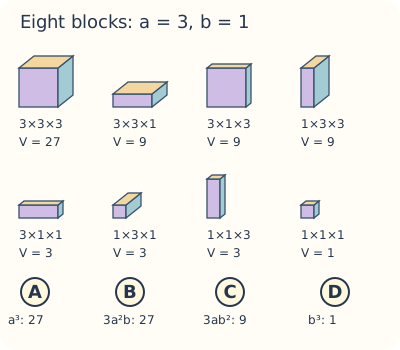
(a + b)³ = a³ + 3a²b + 3ab² + b³. Each mixed type occurs three times when choosing terms from three factors. For (2x + 3y)³ the coefficients are 8, 36, 54 and 27. The exploded positive-length cube with a = 3 and b = 1 has volumes 27, three 9s, three 3s and 1, totalling 64.
A difference cube keeps alternating signs
(a − b)³ = a³ − 3a²b + 3ab² − b³. Substitute the full second term: (3x − 2y)³ = 27x³ − 54x²y + 36xy² − 8y³. Cubing a negative entire expression changes its sign, unlike squaring. A physical block model needs positive lengths, while the distributed identity holds for signed real values.
Recognise a cube before expanding composite expressions
For any expressions U and V, U³ + 3U²V + 3UV² + V³ = (U + V)³. If U = 2m + n and V = m − n, their sum is 3m and the result is 27m³. Similarly U³ − V³ − 3UV(U − V) = (U − V)³. Define and recover the whole substituted expressions, including signs.
A trinomial cube can be grouped twice
For (a + b + c)³, first set U = a + b and cube U + c. Then expand U² and U³. There are three pure cubes, six mixed terms of type a²b with coefficient 3, and the term 6abc. The compact equivalent is a³ + b³ + c³ + 3(a + b)(b + c)(c + a). A negative term is substituted as a signed value throughout; no pair term may be dropped.
Sum and difference of cubes have different middle signs
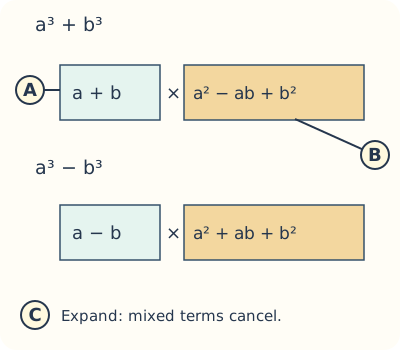
a³ + b³ = (a + b)(a² − ab + b²), while a³ − b³ = (a − b)(a² + ab + b²). Verify by multiplying: the unwanted mixed terms cancel. Thus (3x + 2)(9x² − 6x + 4) = 27x³ + 8. A sum of cubes is not generally just the cube of a sum.
Recover cube sums or complete a hidden cube
If s = a + b and p = ab, then a³ + b³ = s³ − 3ps. If d = a − b, then a³ − b³ = d³ + 3pd. For 8t³ + 36t² + 54t + 25, recognise (2t + 3)³ − 2, because that cube has constant 27. At t = 2, the value is 341. Keep the correction constant rather than declaring a near-cube to be an exact cube.
Reciprocal cubes and a fifth-power extension
For x ≠ 0, let s = x + 1/x and t = x − 1/x. Then x³ + 1/x³ = s³ − 3s and x³ − 1/x³ = t³ + 3t. Also x⁴ + 1/x⁴ = t⁴ + 4t² + 2, giving x⁵ − 1/x⁵ = t(x⁴ + x² + 1 + x⁻² + x⁻⁴) = t⁵ + 5t³ + 5t. These follow by multiplying and cancelling; keep denominators nonzero.
Correct an assertion before trying to prove it
Source exercise 4.4 item 6(iii) is false as written: a³ + b³ equals (a + b)³ minus 3ab(a + b), not plus. Exercise 4.4 item 20C also omits z in the cross term. If z = 3x + 5y, then z³ = 27x³ + 125y³ + 45xyz. At x = y = 1, z = 8, the printed left side without z gives 197, but z³ is 512. The corrected cross term gives 360 and restores 512.
Worked example
For a + b = 9 and ab = 20, the cube sum is 9³ − 3 × 20 × 9 = 189. For example a = 4 and b = 5 gives 64 + 125 = 189. The substituted values check this case; the derived identity supplies the general reason.
Identify the structure, define any substituted expression and state nonzero or positive-length conditions.
Write the identity or factor method, substitute entire terms including their signs, and show every step.
Expand to verify factors or substitute back to check a value. Write the requested number for a check; review full algebra and proofs with a guardian or teacher.
Blocks show a positive-length case
Eight original blocks have volumes 27,9,9,9,3,3,3,1 for a = 3, b = 1. Exploded-view gaps are display spacing, not part of the volume.
A source statement can be a deliberate distractor
The false plus sign in exercise 4.4 item 6(iii) belongs to an assertion-selection question. The missing z in item 20C instead makes the requested proof false as written; the lesson distinguishes these cases.
Count cube term types
This inventory comes from distributing three binomial factors.
Count cube term types
Chosen type
How many choices
Term
Three a terms
1
a³
Two a terms and one b
3
3a²b
One a term and two b
3
3ab²
Three b terms
1
b³
With a = 3, b = 1, the eight block volumes are 27,9,9,9,3,3,3,1. Their sum is 64, agreeing with 4³. For a signed b, algebraic signs change even though physical blocks cannot have negative volume.
Cubes, corollaries and cube factors
Distinguish the cube of a sum from the sum of cubes.
(a + b)³ = a³ + 3a²b + 3ab² + b³
(a − b)³ = a³ − 3a²b + 3ab² − b³
a³ + b³ = (a + b)³ − 3ab(a + b)
a³ − b³ = (a − b)³ + 3ab(a − b)
a³ + b³ = (a + b)(a² − ab + b²)
a³ − b³ = (a − b)(a² + ab + b²)
a / b
Whole signed values or algebraic expressions.
3a²b / 3ab²
The two mixed-term families.
Multiply the known square identity by a + b.
Collect both mixed terms, each occurring three times.
Factor the rearranged sum of cubes by a + b.
Multiply (a + b)(a² − ab + b²) to see the unwanted cross terms cancel.
The minus sign in the sum-of-cubes corollary is essential. The source’s plus-sign assertion is an intentional false statement to diagnose.
Nonzero; the main practice uses feasible real conditions.
Cube s and subtract the three mixed products, using x × 1/x = 1.
For t = 2, the reciprocal cube difference is 8 + 6 = 14.
Factor the fifth-power difference by x − 1/x.
Use fourth sum + square sum + 1 to get t(t⁴ + 5t² + 5); at t = 2 it equals 82.
Retain the central 1 in the factored fifth-power sum. The source creative fifth-power question uses this same derivation type.
Explore the mathematical figures
Match each letter to its explanation. Read the quantities, units and relationships, then check the counts or equations. These are original teaching models.
Eight blocks explain the cube coefficients
Count the blocks in each family, then check (3 + 1)³ = 64. Permuting which edge has length b creates three mixed blocks of the same volume.
A · a³
One 3 × 3 × 3 block has volume 27.
B · 3a²b
Three blocks have volume 9 each, giving 27.
C · 3ab²
Three blocks have volume 3 each, giving 9.
D · b³
One unit cube contributes 1; all eight total 64.
Original projected blocks with dimensions labelled and a common coordinate scale. Blocks are separated to reveal their faces; display gaps do not add volume. Positive lengths are assumed.
Explore the mathematical figures
Match each letter to its explanation. Read the quantities, units and relationships, then check the counts or equations. These are original teaching models.
Cube factors have a compensating middle sign
Expand one complete row. The middle term is not chosen by copying the linear sign.
A · Linear factor
Use a + b for a cube sum and a − b for a cube difference.
B · Quadratic factor
The middle sign compensates so unwanted terms cancel.
C · Multiply to check
Distribution recovers only the two pure cubes.
Original symbolic relationship map, not a physical area or volume scale. Algebraic identities apply to all permitted real values.
Your written practice
Show your working on paper. Check your answer, then choose Next.
Show model answer and explanation
1728
(10 + 2)³ = 1000 + 600 + 120 + 8 = 1728.
Show model answer and explanation
6859
(20 − 1)³ = 8000 − 1200 + 60 − 1 = 6859.
Show model answer and explanation
36
3 × 2² × 3 = 36.
Show model answer and explanation
54
3 × 2 × 3² = 54.
Show model answer and explanation
-54
3 × 3² × (−2) = −54.
Show model answer and explanation
-8
(−2y)³ gives −8y³.
Show model answer and explanation
91
7³ − 3 × 12 × 7 = 91.
Show model answer and explanation
117
3³ + 3 × 10 × 3 = 117.
Show model answer and explanation
52
4³ − 3 × 4 = 52.
Show model answer and explanation
14
2³ + 3 × 2 = 14.
Show model answer and explanation
82
2⁵ + 5 × 2³ + 5 × 2 = 82.
Show model answer and explanation
194
The square sum is 14; its square minus 2 is 194.
Show model answer and explanation
35
The product is x³ + 8 = 27 + 8 = 35.
Show model answer and explanation
37
The product is 8x³ − 27 = 64 − 27 = 37.
Show model answer and explanation
341
(2t + 3)³ − 2 = 7³ − 2 = 341.
Write in your own words. A guardian or teacher should review this response.
Show model answer and explanation
8x³ + 36x²y + 54xy² + 27y³. There are three choices for the position of the single different term in each mixed type.
Show either distribution or the cube identity with complete signed terms.
Write in your own words. A guardian or teacher should review this response.
Show model answer and explanation
27x³ − 54x²y + 36xy² − 8y³.
The middle signs alternate; the squared second term is positive while its cube is negative.
Write in your own words. A guardian or teacher should review this response.
Require all ten term types and check the three-variable term coefficient.
Write in your own words. A guardian or teacher should review this response.
Show model answer and explanation
The expression is (U + V)³ = (3m)³ = 27m³.
Recover both substituted expressions before cubing their sum.
Write in your own words. A guardian or teacher should review this response.
Show model answer and explanation
It is (U − V)³ = (a + b)³ = a³ + 3a²b + 3ab² + b³.
Confirm that U − V = a + b, including the double negative.
Write in your own words. A guardian or teacher should review this response.
Show model answer and explanation
(3x + 2)(9x² − 6x + 4). The mixed terms cancel to leave 27x³ + 8.
The quadratic has the opposite middle sign from the linear sum.
Write in your own words. A guardian or teacher should review this response.
Show model answer and explanation
(2p − 3q)(4p² + 6pq + 9q²).
Keep the positive middle term in the quadratic and cube both coefficients.
Write in your own words. A guardian or teacher should review this response.
Show model answer and explanation
The first two factors give x³ + 8, so the product is (x³ + 8)(x³ − 8) = x⁶ − 64.
Apply the cube identity and then the difference-of-squares identity.
Write in your own words. A guardian or teacher should review this response.
Show model answer and explanation
Cube the sum: 64 = x³ + 1/x³ + 3(x + 1/x). Subtract 12 to get 52.
Use x × 1/x = 1 and show why the mixed terms combine.
Write in your own words. A guardian or teacher should review this response.
Show model answer and explanation
Factor the fifth-power difference as t times (x⁴ + x² + 1 + x⁻² + x⁻⁴). The square sum is t² + 2 and fourth sum is t⁴ + 4t² + 2. Therefore the result is t⁵ + 5t³ + 5t, giving 82 at t = 2.
Retain the central 1 and explain both reciprocal sums.
Write in your own words. A guardian or teacher should review this response.
The third variable remains in the mixed term after substitution.
Write in your own words. A guardian or teacher should review this response.
Show model answer and explanation
Then z = 8. The printed left side is 197, while the right side is 512. The missing factor is z: 27 + 125 + 45 × 8 = 512.
A counterexample disproves the original; show the corrected general identity too.
Write in your own words. A guardian or teacher should review this response.
Show model answer and explanation
The correct sign is minus. At a = b = 1 the asserted right side is 14, while the left side is 2; the corrected right side is 8 − 6 = 2.
Identify this as an assertion to reject, not a formula to memorise.
Write in your own words. A guardian or teacher should review this response.
Show model answer and explanation
Cube a² + b²: c⁶ = a⁶ + b⁶ + 3a²b²(a² + b²). Replace the parenthesis by c².
Do not replace c² by c or cube each term without the mixed contribution.
Write in your own words. A guardian or teacher should review this response.
Show model answer and explanation
The cube constant is 27, so the expression is (2t + 3)³ − 2. At t = 2 it is 341; direct evaluation gives 64 + 144 + 108 + 25 = 341.
Check the constant separately and show both routes.
Progress and browser storage
Notebook challenge, sources and further study
Your algebra notebook
Make a cube-term inventory and write one composite, one factor and one reciprocal derivation.
Review with a guardian or teacher
Keep the signed terms and the multiplicity of each mixed term.
Verify a factor product by expansion and state nonzero reciprocal conditions.
Correct a source assertion with a counterexample and then a valid identity.
Keep your work on paper or in a local file. This page does not upload it or automatically grade the project.
Chapter companion and further study
This original Kidemy practice follows the topic order of 2026 Class 8 Mathematics · English Version, chapter 4, printed pages 48–76. It does not replace the complete chapter or its practical teaching.
Fresh companion practice follows the chapter methods, rather than reproducing every printed question. Keep full written working and review alternative factor orderings and proof reasoning.
All reciprocal expressions require nonzero denominators. Geometric drawings assume positive lengths; Original companions for all 11 chapter headings are available; independent source exercises and full working still need review.
Teacher-led lessons, schedules and prices for this outline are upcoming. You can use any starter practice above now without booking.
Your next step
Solo practice works without an account. Sign in to save a practice record to your learner profile.
Keep practising
Exact lesson links and related activities are labelled separately. Return-to-course links retain your selected learning path.