2026 Class 8 Mathematics · English Version · Chapter 2 · Chapter companion part
Chapter 2B: Simple profit and finding missing values
Explain simple profit, use annual rates and time consistently, and recover a missing principal, rate or duration.
About this lesson and its coverage
Class 8 English Version: part B of the chapter 2 companion. Eight teaching sections, 30 written tasks and a notebook challenge. Selected companion coverage, not complete textbook coverage; use all four parts and ask a teacher to review explanations and open solutions.
P is the initial principal, I is accumulated simple profit, and A = P + I is the total amount, called profit-principal in the source. A deposit of 6000 gaining 1440 has amount 7440. Profit is not the whole amount. The source also uses interest terminology; this lesson follows its calculation model without recommending a financial product.
Turn an annual percentage into a rate
Use R for the percentage number, such as 8, and r = R/100 = 0.08 for the decimal annual rate. An 8% annual simple rate earns Tk 8 per Tk 100 of initial principal in one year. Simple profit uses the original principal each year: I = Prt and A = P(1 + rt). No profit is reinvested in this model.
Match time to the annual rate
When r is annual, t is in years. Three months is 3/12 = 0.25 year, six months is 0.5 year and two years six months is 2.5 years. For P = 8000, r = 0.06 and t = 0.5, I = 240. Multiplying the annual rate by six as if months were years exaggerates the time by a factor of twelve.
Rearrange before substituting
From I = Prt, find P = I/(rt), r = I/(Pt), or t = I/(Pr) when the denominator is nonzero. Convert r back to a percentage number using R = 100r. If amount A is known instead of I, either subtract a known P or use P = A/(1 + rt). Define the unknown and check it in the original equation.
Use fractions of principal and amount
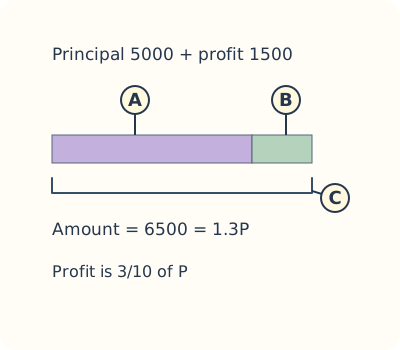
If I is a fraction f of P, then A = (1 + f)P. For I = 3P/10 and A = 6500, P = 6500/1.3 = 5000 and I = 1500. Doubling the amount means I = P, not I = 2P. At a fixed simple rate, tripling requires twice the doubling time because the required profits are P and 2P.
Subtract dated amounts to isolate annual profit
Suppose a fixed principal has simple amount 5600 after three years and 6000 after five. The increase 400 over two years means 200 profit per year. Subtract three years of profit from 5600 to find P = 5000; r = 200/5000 = 0.04 = 4% annually. This constant-difference method does not apply unchanged to compound amounts.
Compare rates and equal-profit conditions
If the same P and t use rates r1 and r2, the profit difference is P(r2 − r1)t. An increase from 8% to 10% is two percentage points, or a decimal difference 0.02. If two deposits must earn the same simple profit, equate their P × r × t values. Compare rates only after putting periods in consistent units.
Check the source condition before solving
Some source wording is inconsistent. In simple example 5, printed 16, the sidebar lists six years while the prompt and arithmetic use five: 1500/(3000 × 5) = 0.10, or 10%; using six would instead give 8⅓%. Exercise 2.1 item 20C asks for a principal reaching a stated amount without a duration, so it has no unique answer. Our numeric tasks specify all needed conditions.
Worked example
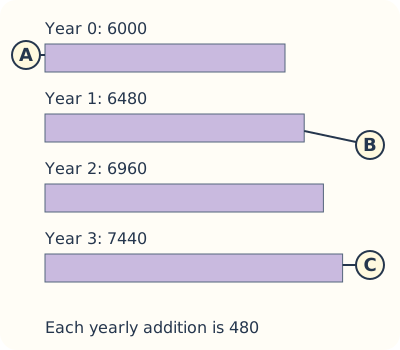
For principal 6000 at 8% simple annual profit, the yearly addition is 480. After three years the profit is 1440 and amount 7440. Check the amount table: 6000, 6480, 6960, 7440.
Identify cost or principal, rate, time and the requested quantity; state units and the calculation model.
Convert percentage numbers to decimals and months to years; show substitutions and intermediate steps.
Check the balance or reverse calculation. Write a plain number for a numeric check; show reasoning on paper for review.
The book’s rate definition needs its base
Read the annual percentage as profit on each Tk 100 of initial principal, not as a fixed Tk 100 payout. Use the explicit decimal-rate convention in every formula.
Simple does not mean every account behaves this way
These are specified classroom models. No assumption about an actual account’s rate, guarantee, fee or payout schedule follows from the calculation.
Check both requested answers, even when the key prints one
Exercise 2.1(17) gives amount Tk 5600, profit two fifths of principal and an annual simple rate of 8%. Amount is P + 2P/5 = 7P/5, so P = 5600 × 5/7 = Tk 4000. Profit is Tk 1600 and time is 1600/(4000 × 0.08) = 5 years. The printed key lists only 5 years. A complete written answer supplies both principal and time, with units.
Simple profit and the amount
Define the annual rate before substituting.
r = R/100
I = Prt
A = P + I = P(1 + rt)
P
Initial principal in taka.
R / r
Annual percentage number / annual decimal rate.
t
Time in years when r is annual.
I / A
Simple profit / total amount, in taka.
Choose P = 6000, R = 8 and t = 3.
r = 8/100 = 0.08; yearly profit is 480.
I = 6000 × 0.08 × 3 = 1440.
A = 6000 + 1440 = 7440.
Simple profit uses the unchanged initial principal. No deposits, withdrawals or reinvestment are included in this formula.
Recover the missing value
Rearrange the equation before entering numbers, and check the result in I = Prt.
P = I/(rt)
r = I/(Pt)
t = I/(Pr)
P = A/(1 + rt)
P / I / A
Principal, simple profit and amount, in taka.
r
Decimal annual rate; multiply by 100 to express a percentage.
t
Time in years.
Given I = 1200, r = 0.05 and t = 4, P = 6000.
Given I = 900, P = 5000 and t = 3, r = 0.06 = 6%.
Given I = 1800, P = 6000 and r = 0.10, t = 3 years.
Given A = 7800, r = 0.10 and t = 3, P = 7800/1.3 = 6000.
Division needs a nonzero denominator. Amount alone and a rate alone cannot determine principal without the time and model.
Convert time before multiplying
Read each duration in years for use with an annual rate. The last column uses invented principal 8000 and rate 6%.
Convert time before multiplying
Duration
Years t
Simple profit (Tk)
3 months
0.25
120
6 months
0.5
240
2 years 6 months
2.5
1200
4 years
4
1920
For six months, 8000 × 0.06 × 0.5 = 240. The percentage is annual, so six months is not six annual periods.
Subtract dated amounts or compare rates
Use these forms only for a fixed principal with simple profit and no other transactions.
Annual profit = (A2 − A1)/(t2 − t1)
P = A1 − t1 × annual profit
Difference in I = P(r2 − r1)t
A1 / A2
Simple amounts at distinct times t1 and t2, in taka.
t1 / t2 / t
Elapsed times in years.
P
Initial principal, in taka.
r1 / r2
Compared decimal annual rates.
Amounts 5600 at year 3 and 6000 at year 5 differ by 400 over two years.
A change from 8% to 10% over four years on 1000 changes profit by 1000 × 0.02 × 4 = 80.
Do not use constant differences to infer an annual compound rate; the compound base changes.
Explore the mathematical figures
Match each letter to its explanation. Read the quantities, units and relationships, then check the counts or equations. These are original teaching models.
Simple profit adds the same amount each year
Compare consecutive increases, not just the final amount. The arithmetic uses years and an annual decimal rate 0.08.
A · Original principal
At 8% simple annually, the unchanged base is 6000.
B · Equal additions
Each year adds 6000 × 0.08 = 480.
C · Amount after three years
7440 includes original 6000 and accumulated profit 1440.
Original invented values; all bars start at zero and share one scale of Tk 25 per drawing unit. No deposits or withdrawals are included.
Explore the mathematical figures
Match each letter to its explanation. Read the quantities, units and relationships, then check the counts or equations. These are original teaching models.
A fraction of principal is not a fraction of amount
Read the whole bar as amount and the original segment as principal. Dividing amount by 1.3 reverses the relationship.
A · Principal P
This is the base of the fraction.
B · Profit 3P/10
1500 is 30% of 5000, not 30% of 6500.
C · Amount 1.3P
5000 + 1500 = 6500, so P = 6500/1.3.
Original invented values; the two segment lengths are proportional to 5000 and 1500. Labels define the quantities independently of colour.
Your written practice
Show your working on paper. Check your answer, then choose Next.
Show model answer and explanation
0.08
8/100 = 0.08.
Show model answer and explanation
0.25
3/12 = 0.25.
Show model answer and explanation
2.5
2 + 6/12 = 2.5.
Show model answer and explanation
1440
6000 × 0.08 × 3 = 1440.
Show model answer and explanation
7440
6000 + 1440 = 7440.
Show model answer and explanation
6000
1200/(0.05 × 4) = 6000.
Show model answer and explanation
6
100 × 900/(5000 × 3) = 6.
Show model answer and explanation
3
1800/(6000 × 0.10) = 3.
Show model answer and explanation
6000
7800/(1 + 0.10 × 3) = 6000.
Show model answer and explanation
5000
P + 0.3P = 6500; P = 5000.
Show model answer and explanation
12.5
I = P, so r = 1/8 = 0.125, or 12.5%.
Show model answer and explanation
12
Twice as much profit requires twice the time.
Show model answer and explanation
5000
Annual profit is 200; 5600 − 3 × 200 = 5000.
Show model answer and explanation
1000
80/(0.02 × 4) = 1000.
Show model answer and explanation
6000
The amount factor is 5200/4000 = 1.3; 7800/1.3 = 6000.
Write in your own words. A guardian or teacher should review this response.
Show model answer and explanation
Profit is the extra 1440; amount includes the original 6000, so 6000 + 1440 = 7440.
Name all three quantities and use consistent units.
Write in your own words. A guardian or teacher should review this response.
Show model answer and explanation
R percent means R per 100, or r = R/100. One year earns Pr; t years earn Prt on the unchanged original principal.
Mention the simple-model condition and annual time unit.
Write in your own words. A guardian or teacher should review this response.
Show model answer and explanation
t = 2.5; I = 7200 × 0.075 × 2.5 = 1350; A = 8550.
Check conversion, decimal rate and amount versus profit.
Write in your own words. A guardian or teacher should review this response.
Show model answer and explanation
P = 9600/(1 + 0.05 × 4) = 8000; I = 1600. Check 8000 × 0.05 × 4 = 1600.
Do not insert amount as principal into I = Prt.
Write in your own words. A guardian or teacher should review this response.
Show model answer and explanation
P = 2040/(0.085 × 4) = 6000.
Read the fractional percentage as 0.085, not 8.5.
Write in your own words. A guardian or teacher should review this response.
Show model answer and explanation
r = 1440/(4800 × 5) = 0.06; R = 6%.
State the rate as both decimal and percentage.
Write in your own words. A guardian or teacher should review this response.
Show model answer and explanation
t = 1500/(5000 × 0.12) = 2.5 years = two years six months.
Require a reverse check and a time unit.
Write in your own words. A guardian or teacher should review this response.
Show model answer and explanation
1.4P = 8400 gives P = 6000 and I = 2400. t = 2400/(6000 × 0.08) = 5 years.
Keep the fraction relative to principal, not amount.
Write in your own words. A guardian or teacher should review this response.
Show model answer and explanation
Doubling requires profit P in five years; tripling requires 2P, reached in ten years at the same simple rate. Fifteen years would earn 3P and give amount 4P.
Separate profit multiples from amount multiples.
Write in your own words. A guardian or teacher should review this response.
Write in your own words. A guardian or teacher should review this response.
Show model answer and explanation
Difference = 6000 × (0.09 − 0.07) × 3 = 360.
Use a two-percentage-point difference, not 2% of the old profit.
Write in your own words. A guardian or teacher should review this response.
Show model answer and explanation
Target profit is 1000 × 0.06 × 5 = 300. Required P = 300/(0.05 × 2.5) = 2400.
Equate profits after converting time.
Write in your own words. A guardian or teacher should review this response.
Show model answer and explanation
Use rate 0.06 and time 0.5 year. I = 8000 × 0.06 × 0.5 = 240.
Identify separate rate and time errors.
Write in your own words. A guardian or teacher should review this response.
Show model answer and explanation
The question and calculation use five years, giving 10% annually. Six years would give 8⅓%. State the inconsistency instead of silently combining incompatible inputs.
Accept either conditional result only with its duration explicitly named.
Write in your own words. A guardian or teacher should review this response.
Show model answer and explanation
P = 9000/(1 + 0.05t). At t = 2, P = 9000/1.1; at t = 4, P = 7500. Different times give different principals, so a duration is needed.
A formula with the missing variable is better than a guessed single answer.
Progress and browser storage
Notebook challenge, sources and further study
Your profits and balance notebook
Make a formula page and solve one task for each missing value P, r, t and I.
Review with a guardian or teacher
Define symbols and show percentage/time conversions.
Substitute each recovered value back into I = Prt.
Explain a missing condition or source discrepancy in words.
Keep your work on paper or in a local file. This page does not upload it or automatically grade the project.
Chapter companion and further study
This original Kidemy practice follows the topic order of 2026 Class 8 Mathematics · English Version, chapter 2, printed pages 12–28. It does not replace the complete chapter or its practical teaching.
Use all four Profits companions and compare your written methods with the source exercises. This companion teaches the source problem types with fresh values; it is not a reproduction of every printed question.
Statements are fictional classroom examples. Real account terms, fees and rounding can differ. Original companions for all 11 chapter headings are available; independent source exercises and full working still need review.
Teacher-led lessons, schedules and prices for this outline are upcoming. You can use any starter practice above now without booking.
Your next step
Solo practice works without an account. Sign in to save a practice record to your learner profile.
Keep practising
Exact lesson links and related activities are labelled separately. Return-to-course links retain your selected learning path.