2026 Class 8 Mathematics · English Version · Chapter 2 · Chapter companion part
Chapter 2A: Buying, selling and the percentage base
Find full cost, profit or loss, and explain percentages, inverse prices and successive sellers.
About this lesson and its coverage
Class 8 English Version: part A of the chapter 2 companion. Eight teaching sections, 30 written tasks and a notebook challenge. Selected companion coverage, not complete textbook coverage; use all four parts and ask a teacher to review explanations and open solutions.
Cost price C includes the purchase price and any stated transport, packing, rent allocation or other related expense. Selling price S is what the seller receives for the same quantity. For an invented parcel bought for Tk 480 with Tk 20 transport, C = 500. A selling price of Tk 575 gives Tk 75 profit. Do not omit an expense explicitly included in the task, or add an unstated expense.
Profit, loss and no change
If S > C, profit G = S − C. If S < C, loss L = C − S. Equal prices give neither profit nor loss. State which quantity your positive difference represents. A Tk 50 loss on a Tk 500 cost leaves a Tk 450 selling price. A negative signed change S − C can describe a loss, but calling a negative number a positive profit is misleading.
A percentage needs a named base
Profit percentage is 100G/C and loss percentage is 100L/C, using cost as the base. With C = 500 and G = 75, 75/500 = 0.15 = 15%. This means Tk 15 gained per Tk 100 of cost. Dividing by selling price instead measures a different relationship. Our task uses the cost-based convention taught in this chapter.
Reverse a price using a multiplier
Let R be the profit percentage number and q = R/100. At profit, S = C(1 + q), so C = S/(1 + q). At loss, S = C(1 − q), so C = S/(1 − q). For a 15% profit and S = 690, C = 690/1.15 = 600. Subtracting 15% of 690 would use the wrong base. A positive selling price cannot follow a loss of 100% or more under this ordinary model.
Compare two possible selling prices
The same item sold at 10% loss would bring 0.90C; sold at 15% profit it would bring 1.15C. The difference is 0.25C. If that difference is Tk 200, then C = 200/0.25 = 800. The 25 percentage points describe the difference between the two cost-based rates; they are not 25% of either selling price.
Make quantities comparable first
Six items for Tk 30 cost Tk 5 each; five items sold for Tk 30 bring Tk 6 each. One item therefore gains Tk 1 on cost Tk 5, or 20%. A quad or hali means four items. Convert both sides to a common item count or unit price before subtracting. A lower number of items per taka means a higher price per item.
Equal pieces and equal spending are different
Buy equal numbers at eight pieces for Tk 24 and twelve pieces for Tk 24. Unit costs are Tk 3 and Tk 2. For equal pieces the mean unit cost is (3 + 2)/2 = 2.50; selling ten for Tk 25 breaks even. If equal amounts of money are spent, the quantities differ and the simple mean of the two unit costs is not appropriate. Show actual total cost divided by actual total pieces.
Each seller has a new cost
A wholesaler buys for Tk 1000 and sells at 20% profit for Tk 1200. A retailer treats Tk 1200 as cost and sells at 10% profit for Tk 1320. The combined multiplier is 1.20 × 1.10 = 1.32, giving 32% relative to the first cost. The rates do not simply add to 30%. To work backwards, divide the final price by both multipliers.
Worked example
For a purchase 750 plus stated expenses 50, cost is 800. At a loss of 7.5%, loss = 800 × 0.075 = 60 and sale = 740. Check 740 + 60 = 800.
Identify cost or principal, rate, time and the requested quantity; state units and the calculation model.
Convert percentage numbers to decimals and months to years; show substitutions and intermediate steps.
Check the balance or reverse calculation. Write a plain number for a numeric check; show reasoning on paper for review.
Percentages have no taka unit
A money amount may be Tk 8; a rate is 8%. Source wording sometimes places Tk before a percentage. Keep money and rates separate.
Fresh practice, not live prices
All prices and quantities in these tasks are invented to practise the source methods. They are not current market observations.
Complete the cost-and-sale table
Read the cost first, then find the signed change and divide its magnitude by cost.
Complete the cost-and-sale table
Cost (Tk)
Sale (Tk)
Result (Tk)
Percentage on cost
500
575
Profit 75
15%
500
450
Loss 50
10%
800
880
Profit 80
10%
800
740
Loss 60
7.5%
600
636
Profit 36
6%
Invented teaching prices. The percentage column uses each row’s cost, not its selling price. Check 60/800 × 100 = 7.5% in row four.
Define the cost-based percentage
Compare the same quantity and include the stated related expenses in cost.
G = S − C (when S > C)
L = C − S (when S < C)
Profit % = 100G/C; loss % = 100L/C
C
Full cost in taka, positive for percentage calculations.
S
Selling price in taka for the same quantity.
G / L
Positive profit or positive loss in taka, respectively.
Purchase 480 plus transport 20 gives C = 500.
Selling at 575 gives G = 575 − 500 = 75.
Profit percentage = 100 × 75/500 = 15%.
Check 15% of 500 = 75 and 500 + 75 = 575.
A percentage is a ratio per hundred, not a taka amount. Cost zero makes this percentage undefined.
Reverse one price or a two-seller chain
Each percentage applies to that seller’s own cost.
At profit: S = C(1 + q), C = S/(1 + q)
At loss: S = C(1 − q), C = S/(1 − q)
Final = initial × (1 + q1)(1 + q2)
q
Profit or loss percentage number divided by 100.
q1 / q2
Decimal profit rates of successive sellers.
C / S
Cost and selling price for one seller.
For a sale 690 at 15% profit, q = 0.15.
Cost = 690/1.15 = 600; verify profit 90.
For initial 1000 with successive gains 20% then 10%, final = 1320.
Reverse the chain: 1320/1.10/1.20 = 1000.
The inverse loss formula requires q < 1 here. Multiplying the rates’ factors preserves their different bases.
Quantity first: equal pieces versus equal spending
Convert every group price to cost per piece, then use the actual quantities.
Quantity first: equal pieces versus equal spending
Buying plan
Pieces
Total cost (Tk)
Mean cost/piece (Tk)
12 pieces at 8 per 24
12
36
3
12 pieces at 12 per 24
12
24
2
Equal pieces combined
24
60
2.50
Spend 24 at each price
8 + 12 = 20
48
2.40
Invented data. Equal-piece cost is 60/24; equal-spending cost is 48/20. Selling at 2.50 per piece breaks even only for the first combined plan.
Explore the mathematical figures
Match each letter to its explanation. Read the quantities, units and relationships, then check the counts or equations. These are original teaching models.
Compare every price with the same cost base
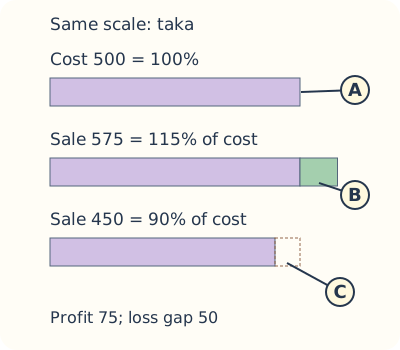
Read the values and divide the change by the cost. The coloured extension and outlined gap have the same scale as the cost bar.
A · Cost is 100%
The 500-taka cost is the denominator for both rates.
B · Added 75
75/500 = 15%; the 575 sale is 115% of cost.
C · Missing 50
A sale of 450 is short of cost by 50; 50/500 = 10% loss.
Original invented prices; one drawing unit represents Tk 2. This is a comparison model, not a current price chart.
Explore the mathematical figures
Match each letter to its explanation. Read the quantities, units and relationships, then check the counts or equations. These are original teaching models.
Two sellers use different cost bases
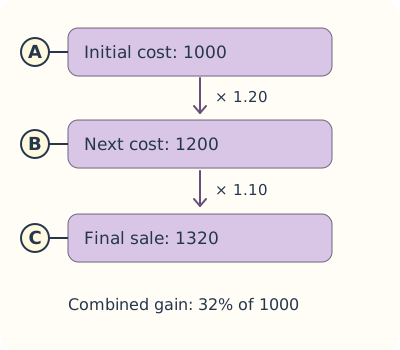
Follow each arrow’s multiplier. To work backwards, divide by 1.10 and then 1.20.
A · First cost
Start at 1000.
B · First sale becomes new cost
1000 × 1.20 = 1200.
C · Final sale
1200 × 1.10 = 1320; relative to the original 1000 this is a 32% gain.
Original invented values. Box sizes do not encode money amounts; numeric labels and arrow multipliers carry the relationship.
Your written practice
Show your working on paper. Check your answer, then choose Next.
Show model answer and explanation
500
480 + 20 = 500.
Show model answer and explanation
75
575 − 500 = 75.
Show model answer and explanation
50
500 − 450 = 50.
Show model answer and explanation
15
100 × 75/500 = 15; write 15, not the decimal rate 0.15.
Show model answer and explanation
10
100 × 50/500 = 10.
Show model answer and explanation
neither
Their difference is zero.
Show model answer and explanation
600
690/1.15 = 600; check 600 + 90 = 690.
Show model answer and explanation
560
640 × 0.875 = 560.
Show model answer and explanation
800
720/0.90 = 800.
Show model answer and explanation
800
The difference is 25% of cost; 200/0.25 = 800.
Show model answer and explanation
20
Unit cost 5 and sale 6 give 100 × 1/5 = 20.
Show model answer and explanation
neither
Mean unit cost and selling price are both Tk 2.50.
Show model answer and explanation
1320
1000 × 1.20 × 1.10 = 1320.
Show model answer and explanation
1300
1716/(1.10 × 1.20) = 1300.
Show model answer and explanation
5
100 × 46/920 = 5.
Write in your own words. A guardian or teacher should review this response.
Show model answer and explanation
Stated related expenses belong to the full cost. A Tk 480 purchase plus Tk 20 transport costs Tk 500; selling for Tk 575 gains Tk 75, not Tk 95.
Identify included expenses and compare the same quantity.
Write in your own words. A guardian or teacher should review this response.
Show model answer and explanation
Mark cost 500 as 100%, an added 75 as 15%, and selling price 575 as 115% of cost. The 15% is based on cost.
Check labels, proportions and the named base.
Write in your own words. A guardian or teacher should review this response.
Show model answer and explanation
The rows give profit 80 at 10%; loss 60 at 7.5%; and cost 600 with profit 36 at 6%. Each percentage divides the change by its own cost.
Require all four quantities and calculation steps.
Write in your own words. A guardian or teacher should review this response.
Show model answer and explanation
The numerator is right but the denominator is selling price. Profit on cost is 75/500 × 100 = 15%. The other ratio uses a different base.
Do not claim the other arithmetic is impossible; identify what it measures.
Write in your own words. A guardian or teacher should review this response.
Write in your own words. A guardian or teacher should review this response.
Show model answer and explanation
Cost = 765/0.85 = 900. Adding 15% of 765 uses sale as the base and gives 879.75, not the original cost.
Show the correct multiplier and reverse check.
Write in your own words. A guardian or teacher should review this response.
Show model answer and explanation
0.15C = 120, so C = 800. Prices are 760 and 880, differing by 120.
Both rates must use the same cost.
Write in your own words. A guardian or teacher should review this response.
Show model answer and explanation
Three quads are twelve items; cost 84, sale 96, profit 12. Percentage = 100 × 12/84 = 100/7%, about 14.29%.
Use exact fractions until the final stated rounding.
Write in your own words. A guardian or teacher should review this response.
Show model answer and explanation
First unit cost is 4, so 100 cost 400. The two batches cost 96 + 72 = 168 and all 48 sell for 192, giving profit 24 and rate 100/7%, about 14.29%. Mean cost is 3.50; four pieces for 25% profit must sell for 4 × 3.50 × 1.25 = 17.50.
Check equal quantities, the requested quantity and all percentage bases.
Write in your own words. A guardian or teacher should review this response.
Show model answer and explanation
Fourteen items cost 48 and sell for 56. Profit = 8; percentage = 100/6%, about 16.67%. Equal spending differs from equal pieces.
Check quantities and do not reuse the equal-piece mean.
Write in your own words. A guardian or teacher should review this response.
Show model answer and explanation
The first sale is 600 and the next is 720. Profit relative to 500 is 220, or 44%. The second 20% is calculated on 600.
A claim of 40% must be corrected with both stages.
Write in your own words. A guardian or teacher should review this response.
Write in your own words. A guardian or teacher should review this response.
Show model answer and explanation
No. A cost 1000 becomes 900 and then 990. The final price is 1% below the first cost because the bases differ.
Use multipliers or a valid numerical counterexample.
Write in your own words. A guardian or teacher should review this response.
Show model answer and explanation
Loss = 90 and sale = 1110. Check 1110 + 90 = 1200 and 90/1200 = 0.075.
Require units and the correct base.
Write in your own words. A guardian or teacher should review this response.
Show model answer and explanation
For example (400,500) and (800,1000). Each sale is 1.25 times cost even though the profit amounts are 100 and 200.
Accept other valid positive pairs after checking their ratios.
Progress and browser storage
Notebook challenge, sources and further study
Your profits and balance notebook
Create a miniature shop ledger with one profit, one loss, one no-change row and a two-seller chain.
Review with a guardian or teacher
Use complete costs and comparable quantities; label each percentage base.
Show forward and reverse calculations with units.
Explain one incorrect method and correct it with a teacher or guardian.
Keep your work on paper or in a local file. This page does not upload it or automatically grade the project.
Chapter companion and further study
This original Kidemy practice follows the topic order of 2026 Class 8 Mathematics · English Version, chapter 2, printed pages 12–28. It does not replace the complete chapter or its practical teaching.
Use all four Profits companions and compare your written methods with the source exercises. This companion teaches the source problem types with fresh values; it is not a reproduction of every printed question.
Statements are fictional classroom examples. Real account terms, fees and rounding can differ. Original companions for all 11 chapter headings are available; independent source exercises and full working still need review.
Teacher-led lessons, schedules and prices for this outline are upcoming. You can use any starter practice above now without booking.
Your next step
Solo practice works without an account. Sign in to save a practice record to your learner profile.
Keep practising
Exact lesson links and related activities are labelled separately. Return-to-course links retain your selected learning path.