2026 Class 8 Mathematics · English Version · Chapter 1 · Chapter companion part
Chapter 1C: Geometric growth, nth terms and totals
Count shared edges in original figures, express growth algebraically and distinguish an nth figure from a sum of figures.
About this lesson and its coverage
Class 8 English Version: part C of the chapter 1 companion. Eight teaching sections, 30 written tasks and a notebook challenge. Selected companion coverage, not complete textbook coverage; use all three parts and review independent proofs and drawings with a teacher.
Use drawn unit segments or paper strips, not lit matches. Two adjacent squares share a side: 4 + 3 = 7 separate unit segments, not 8. Each new square in a single row adds three. For n connected squares the count is 3n + 1. State whether figures share an edge or are built separately; the same drawing can otherwise invite different material-count interpretations.
Compare the three source stick families
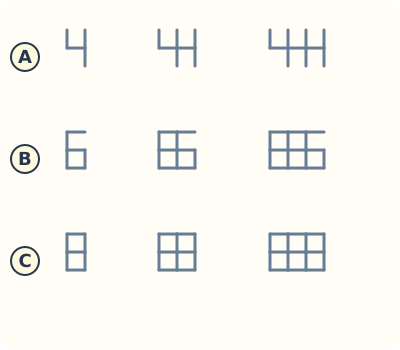
The source uses repeating shapes like digits 4, 6 and a two-square column. In the supplied original models, their counts follow 3n + 1, 5n + 1 and 5n + 2. For the first family, the first part costs 4 and each extra part adds 3. For the other two, the first counts are 6 and 7 while each new part adds 5. The same difference does not imply the same starting value.
Turn a linear rule into an nth term
If the first term is a and each next term adds d, the nth term is a + (n − 1)d for positive integer positions n. For 7,12,17,... this becomes 7 + 5(n − 1) = 5n + 2. The n − 1 counts the gaps after the first term. Check n = 1 as well as a later value. A term formula gives one position; it does not automatically add all previous terms.
Shared-wall houses add five each time
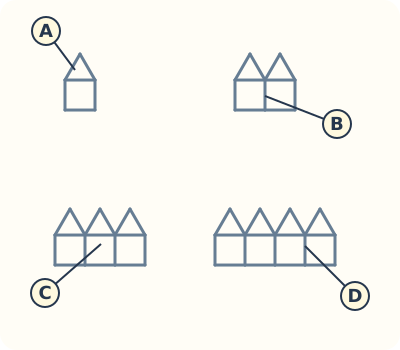
One square house with two equal roof slopes uses six unit segments. A neighbouring house shares a vertical wall and adds five new segments. For n houses in one row, H(n) = 6 + 5(n − 1) = 5n + 1. The fourth row has 21 segments and the twentieth has 101. Roof slopes in the drawing have the same length as the wall segments; roof height is shorter than that length.
One figure and many separate figures differ
For the house pattern, H(20) = 101 counts the twentieth figure alone. To build separate figures 1 through 20, sum 6,11,...,101: 20 × (6 + 101) ÷ 2 = 1070. This total assumes separate builds with no reuse of strips. Extending one row successively reuses existing parts and is a different material question. Always state the assumption.
An odd number of joined squares
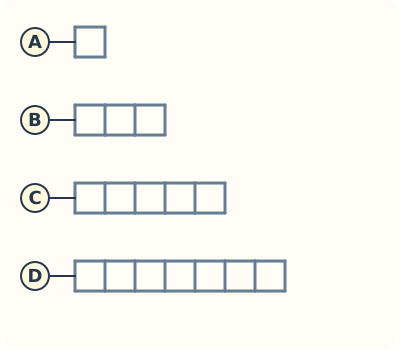
The source creative figure uses 1,3,5,... joined squares at figure k, so the number of cells is 2k − 1. Each row of c squares uses 3c + 1 segments. Substitute c = 2k − 1 to obtain T(k) = 6k − 2. Figure 15 uses 88; figure 21 uses 124. To sum only figures 4 through 15, count 12 terms with endpoints 22 and 88, giving 660 separate segments.
Adjacent-term sums make a new sequence
Let the original linear sequence be a(k) = 4k for k = 1,2,... . Adding each neighbouring pair gives b(k) = a(k) + a(k + 1) = 4k + 4(k + 1) = 8k + 4. Its first term is 12. The term at position k − 2 is b(k − 2) = 8k − 12, valid only when k − 2 ≥ 1. Substituting k − 2 into the new formula differs from adding the original terms at positions k and k + 1.
Check a formula against the picture and table
Build a table with position, count, difference and algebraic rule. The rules 2n + 1, 3n + 1 and 4n + 3 are linear; n² − 1 is not because its differences change. A valid proposed rule matches every supplied case and the structural growth. A single agreement does not prove the formula. In written work, state the meaning of the variable and explain where both the repeated and fixed parts come from.
Worked example
For seven adjacent squares, count 7 top + 7 bottom + 8 vertical segments = 22. This agrees with 3c + 1 at c=7 and with figure rule 6k−2 at k=4. The two variables count different things.
State the rule and define the position variable before calculating.
Show the labelled figure, substitution and arithmetic; keep one figure separate from a sum of figures.
Check a small case and explain the result, then compare with the model response.
Source arithmetic checked
The source house example has H(50)=251 and separate total 50×(6+251)/2=6425. Those calculations agree with the shared-wall rule. The companion uses additional original positions for practice.
A figure does not show a unique rule forever
The drawn sequence suggests its stated construction rule. To justify an nth-term count, explain how each new part is added; do not rely only on guessing a number sequence.
Substitute the position without confusing the rules
The source table mixes linear and non-linear expressions. Check the exponent and first term.
Substitute the position without confusing the rules
Expression
n = 1
n = 2
n = 10
n = 100
2n + 1
3
5
21
201
3n + 1
4
7
31
301
n² − 1
0
3
99
9999
4n + 3
7
11
43
403
n is a positive integer position here. The differences of n² − 1 grow, so that row is not a linear pattern.
From first term and difference to an nth term
There are n − 1 gaps after the first term.
T(n) = a + (n − 1)d
n
Positive integer position.
a
First term.
d
Constant increase for each step.
T(n)
Value at position n, not a cumulative total.
For 7,12,17,..., a = 7 and d = 5.
T(n) = 7 + 5(n − 1) = 5n + 2.
Check n = 1: 5 + 2 = 7.
At n = 10, T(10) = 50 + 2 = 52.
The derivation assumes a constant difference and positions starting at 1.
House-row count versus separate-build sum
A shared wall is counted once inside each figure. Separate figures are built without reusing strips.
H(n) = 5n + 1
S(n) = n(5n + 7) ÷ 2
n
Number of houses in figure n; also the final position in the separate-build sum.
H(n)
Unit segments in one figure.
S(n)
Total segments in separate figures 1 through n.
One house uses 6; each extra house adds 5 after sharing a wall.
H(20) = 5 × 20 + 1 = 101.
For twenty separate figures, endpoints are 6 and 101.
S(20) = 20 × (6 + 101) ÷ 2 = 1070.
Extending one reusable row is a different material question. State which interpretation the task requires.
Odd-square rows: two variables count different things
Shifted position, which is positive only for k ≥ 3.
Original terms begin 4,8,12,16; pair sums begin 12,20,28.
4k + 4(k + 1) simplifies to 8k + 4.
Replace the index everywhere: b(k − 2) = 8(k − 2) + 4.
For k = 5, b(3) = 28, agreeing with 8 × 5 − 12.
Do not substitute k − 2 into only part of a formula, or confuse a sum of two terms with a sum of all terms.
Explore the mathematical figures
Match each letter to its explanation. Read the quantities, units and relationships, then check the counts or equations. These are original teaching models.
Three unit-edge families with different starting counts
Follow individual unit segments and count a shared side once. Different first counts can share the same added count.
A · Four-like family
Counts 4,7,10: first 4, then 3 new unit edges per added part.
B · Six-like family
Counts 6,11,16: first 6, then 5 new unit edges.
C · Two-square columns
Counts 7,12,17: first 7, then 5 new unit edges.
Original connected constructions corresponding to the source families. Diagram coordinates use equal unit lengths; do not count a two-unit vertical as one strip.
Explore the mathematical figures
Match each letter to its explanation. Read the quantities, units and relationships, then check the counts or equations. These are original teaching models.
Shared-wall houses have equal-length unit edges
Count physical unit edges, including the roof bases only once where they are also square tops. Each roof slope equals one wall unit.
A · First figure
Four square sides plus two roof slopes make six unit edges.
B · Shared wall
A neighbour reuses one vertical side, adding five new unit edges.
C · Third figure
6 + 5 + 5 = 16, agreeing with 5 × 3 + 1.
D · Fourth figure
6 + 3 × 5 = 21, agreeing with 5 × 4 + 1.
Original geometry. Roof height is √3/2 of the unit edge, so the slopes remain equal in length. These are paper-strip models; no flames or real match-lighting is needed.
Explore the mathematical figures
Match each letter to its explanation. Read the quantities, units and relationships, then check the counts or equations. These are original teaching models.
Position k is not the number of squares
First find how many squares the position contains, then count their edges. The figure count increases by two squares each step.
A · k = 1
One square uses four unit edges.
B · k = 2
Three joined squares use ten unit edges.
C · k = 3
Five joined squares use sixteen unit edges.
D · k = 4
Seven joined squares use twenty-two unit edges; c = 2k − 1 and T(k) = 6k − 2.
Original redrawing of the mathematical construction, not copied source artwork. Counts assume a single row with shared sides and equal unit lengths.
Your written practice
Show your working on paper. Check your answer, then choose Next.
Show model answer and explanation
10
4 + 3 + 3 = 10; shared sides count once.
Show model answer and explanation
31
3 × 10 + 1 = 31.
Show model answer and explanation
42
5 × 8 + 2 = 42.
Show model answer and explanation
101
5 × 20 + 1 = 101.
Show model answer and explanation
1070
20 × (6 + 101) ÷ 2 = 1070.
Show model answer and explanation
88
6 × 15 − 2 = 88.
Show model answer and explanation
124
6 × 21 − 2 = 124.
Show model answer and explanation
660
There are 12 terms; 12 × (22 + 88) ÷ 2 = 660.
Show model answer and explanation
403
4 × 100 + 3 = 403.
Show model answer and explanation
9999
10000 − 1 = 9999.
Show model answer and explanation
52
7 + 9 × 5 = 52.
Show model answer and explanation
12
4 + 8 = 12.
Show model answer and explanation
44
8 × 5 + 4 = 44.
Show model answer and explanation
167
3 × 55 + 2 = 167.
Show model answer and explanation
nonlinear
Its early differences are 3,5,7,..., not constant.
Write in your own words. A guardian or teacher should review this response.
Show model answer and explanation
Start at 4 and add 3 for each of n − 1 extra squares: 4 + 3(n − 1) = 3n + 1. Alternatively count n top, n bottom and n + 1 vertical segments: 2n + n + 1.
Both routes must count each shared unit edge once.
Write in your own words. A guardian or teacher should review this response.
Show model answer and explanation
They begin with 4,6,7 respectively and add 3,5,5 for each new repeated part. Use first + added × (n − 1), then simplify.
Relate the fixed remainder to the actual diagram; do not assume equal difference means equal formula.
Write in your own words. A guardian or teacher should review this response.
Show model answer and explanation
Position 1 already contains a. Reaching position n crosses n − 1 gaps of size d, giving a + (n − 1)d. Using nd adds one extra gap.
Check the first position explicitly.
Write in your own words. A guardian or teacher should review this response.
Show model answer and explanation
One house uses six unit segments. Each extra house shares a vertical wall and adds five, so 6 + 5(n − 1) = 5n + 1.
Show the shared edge and the two roof slopes.
Write in your own words. A guardian or teacher should review this response.
Show model answer and explanation
H(20)=101 is one figure. Separate builds require 6+11+...+101=1070 segments. Reusing parts to extend one row is another assumption and does not require that separate-build total.
Name what each count represents and whether parts are reused.
Write in your own words. A guardian or teacher should review this response.
Show model answer and explanation
The endpoints are 6 and 5n+1 with n terms, so S(n)=n(5n+7)/2. For n=20 this is 20×107/2=1070.
State that this sums an arithmetic pattern of separate figures.
Write in your own words. A guardian or teacher should review this response.
Show model answer and explanation
A row with c squares uses 3c+1 unit segments. Substitute c=2k−1 to get 3(2k−1)+1=6k−2.
Keep figure position k separate from square count c.
Write in your own words. A guardian or teacher should review this response.
Show model answer and explanation
The required positions are 4 through 15, so there are 12 terms. T(4)=22 and T(15)=88; the sum is 12×110/2=660.
Do not sum all fifteen figures or count the interval as eleven terms.
Write in your own words. A guardian or teacher should review this response.
Show model answer and explanation
The rows are 3,5,7,9,11,21,201; 4,7,10,13,16,31,301; 0,3,8,15,24,99,9999; and 7,11,15,19,23,43,403.
Show substitution for at least one large position; n²−1 is not linear.
Write in your own words. A guardian or teacher should review this response.
Show model answer and explanation
b(k)=4k+4(k+1)=8k+4. Then b(k−2)=8(k−2)+4=8k−12, for k≥3.
Define the new sequence and its valid positive position range.
Write in your own words. A guardian or teacher should review this response.
Show model answer and explanation
Test several cases including the first, then derive the count from fixed and repeated parts of the structure. A formula that happens to fit one total can still fail the next figure.
Provide one structural reason and a small-case check.
Write in your own words. A guardian or teacher should review this response.
Show model answer and explanation
n²−1 has changing differences, while 4n+3 increases by 4 at each integer position. The exponent matters; containing a letter does not establish linear growth.
Use actual early differences to support the distinction.
Write in your own words. A guardian or teacher should review this response.
Show model answer and explanation
The next has 7 adjacent squares and 3×7+1=22 segments, agreeing with T(4)=6×4−2.
Human review checks the seven squares and shared-side counting.
Write in your own words. A guardian or teacher should review this response.
Show model answer and explanation
Define figure 1 and a constant number of added non-overlapping unit edges. Derive first+added×(n−1), state n is a positive integer, and check at least three figures.
Different correctly explained constructions are acceptable.
Write in your own words. A guardian or teacher should review this response.
Show model answer and explanation
For example under H(n)=5n+1, n=12 gives H(12)=61. That means the twelfth connected house-row figure has 61 unit segments, not that the first twelve figures together use 61.
Require formula, substitution, arithmetic and a correct statement of what is counted.
Progress and browser storage
Notebook challenge, sources and further study
Your pattern notebook
Make three paper-strip figures, a position table and a written nth-term derivation. Add a separate-build material estimate.
Review with a guardian or teacher
Count shared unit edges once and use the same unit length for all strips.
Define position and cell-count variables, then check small and later positions.
Separate one figure from a sum and state whether materials are reused.
Keep your work on paper or in a local file. This page does not upload it or automatically grade the project.
Chapter companion and further study
This original Kidemy practice follows the topic order of 2026 Class 8 Mathematics · English Version, chapter 1, printed pages 1–11. It does not replace the complete chapter or its practical teaching.
Use the other two companion parts and review the complete source exercises independently.
Explanations, constructions and open alternatives need human review. Original companions for all 11 chapter headings are available; independent source exercises and full working still need review.
Teacher-led lessons, schedules and prices for this outline are upcoming. You can use any starter practice above now without booking.
Your next step
Solo practice works without an account. Sign in to save a practice record to your learner profile.
Keep practising
Exact lesson links and related activities are labelled separately. Return-to-course links retain your selected learning path.