2026 Class 8 Mathematics · English Version · Chapter 2 · Chapter companion part
Chapter 2C: Compound growth, periods and reverse calculations
Build compound amounts stage by stage, distinguish amount from profit, and apply the model with clear periods and rounding.
About this lesson and its coverage
Class 8 English Version: part C of the chapter 2 companion. Eight teaching sections, 30 written tasks and a notebook challenge. Selected companion coverage, not complete textbook coverage; use all four parts and ask a teacher to review explanations and open solutions.
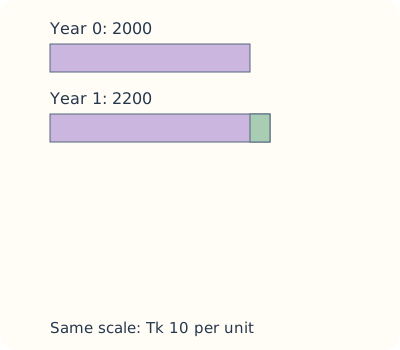
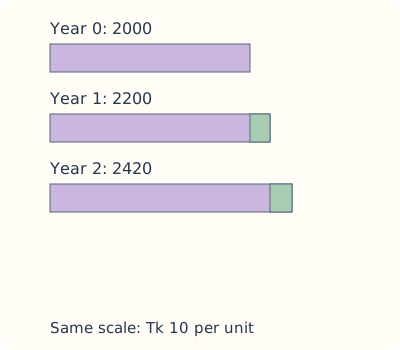
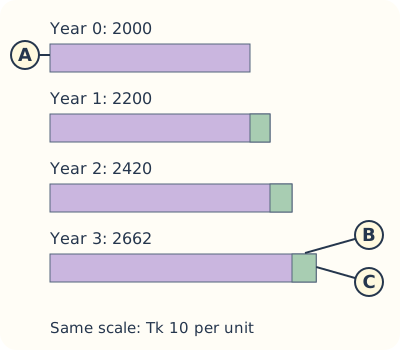
For annual compounding, the profit at each year end is added before the next year. Start with P = 2000 and decimal annual rate r = 0.10. Year one adds 200, giving 2200. Year two adds 220 on the new base, giving 2420. Year three adds 242, giving 2662. The extra amounts grow because the base grows.
An exponent counts the growth periods
Let A0 = P and Ak = A(k−1)(1 + r) for integer annual periods k. Repeating the multiplier gives An = P(1 + r)^n. Compound profit is An − P. At 2000 and 10% for three years, amount is 2662 and profit is 662. The source uses C for compound principal; C here would equal An, not the original principal P.
Keep exact values until the rounding step
With P = 5000 and r = 0.085 for two years, amount is 5000 × 1.085² = 5886.125. Rounding half-up to two decimal places gives Tk 5886.13 and profit Tk 886.13. This task explicitly rounds only the final result. Rounding each year can change a later total; real account rules must specify their convention.
Compare simple and compound on the same basis
At P = 2000, r = 10% and three years, simple profit is 600 and compound profit is 662, a difference of 62. After one year the two models agree under the same annual rate and timing. At zero rate both give the original principal. For positive rate and more than one full annual period, reinvested profit creates the difference.
Name the compounding frequency
For an explicitly nominal annual rate r split equally into m periods per year, each rate is r/m and the number of periods over t years is mt. Amount = P(1 + r/m)^(mt), for whole completed periods. At nominal 12%, half-yearly means 6% twice: 20000 × 1.06² = 22472 after one year. This differs from a single 12% annual multiplication. Do not divide an effective annual rate by two and call it the same offer.
Recover a rate from adjacent annual amounts
With no deposits or withdrawals and the same annual rate, A2/A1 = 1 + r. If amounts are 5500 after one year and 6050 after two, r = 6050/5500 − 1 = 0.10. Then P = 5500/1.10 = 5000. Check both years. The difference divided by the original principal would not give this adjacent-year rate.
The same multiplier can model population
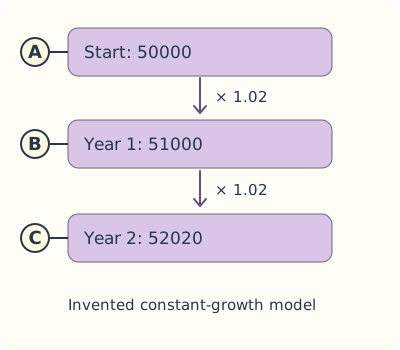
A stated growth of 20 per thousand annually is 20/1000 = 0.02 = 2%. A fictional town of 50000 under this constant model reaches 50000 × 1.02² = 52020 after two years. This is a mathematical projection under assumed constant growth, not measured evidence or a guarantee. Round a non-integer population only at the requested final stage.
Correct the approximation before judging a claim
Sample question 3, printed 28, gives 66 for three-year compound profit on 200 at 10%. Exact calculation is 200 × 1.1³ − 200 = 66.20; the exact amount is 266.20 and the difference from simple profit is 6.20. The source’s whole-taka values are approximations only if rounding is explicitly intended. Our checks never treat an unstated approximation as exact.
Worked example
Half-yearly compounding at a nominal annual 12% has rate 0.06 per period. On 20000 the first closing amount is 21200 and the second is 22472; profit is 2472. There are two completed periods, not one period at 12%.
Identify cost or principal, rate, time and the requested quantity; state units and the calculation model.
Convert percentage numbers to decimals and months to years; show substitutions and intermediate steps.
Check the balance or reverse calculation. Write a plain number for a numeric check; show reasoning on paper for review.
Purposeful motion is optional
Step through the three annual stages, or read all static stages. Play never starts automatically; pause and replay remain available, and reduced motion disables timed playback.
Population is a model here
Every population value in this companion is invented. Constant proportional growth is an assumption for calculation, not a forecast about a named real city.
An unstated rounding creates a faulty question
The source sample gives Tk 200 at 10% annual compound profit for 3 years, then calls the profit Tk 66. Exact amount is 200 × 1.1³ = Tk 266.20; exact profit is Tk 66.20. Simple profit is Tk 60, making the exact difference Tk 6.20. Only its first claim is exact, so no printed combination is exact. If whole-taka rounding is explicitly requested, 266 and 6 are rounded answers. Explain the rounding; do not mark those as exact values.
Recover a rate before comparing two models
For the source creative amounts Tk 19500 after year one and Tk 20280 after year two, annual growth factor is 20280/19500 = 1.04. Principal is 19500/1.04 = Tk 18750. After 3 years, compound profit is 18750(1.04³ − 1) = Tk 2341.20; simple profit is 18750 × 0.04 × 3 = Tk 2250. Their difference is Tk 91.20. Keep the same principal, rate and period in both calculations.
Repeated annual multiplication
The closing amount becomes the next year’s opening amount.
A0 = P
Ak = A(k−1)(1 + r)
An = P(1 + r)^n
Compound profit = An − P
P / A0
Original principal.
r
Fixed decimal rate per annual period.
k / n
Current / final whole-number annual period.
Ak / An
Closing amount after k / n periods.
Start at 2000 and r = 0.10.
A1 = 2000 × 1.10 = 2200.
A2 = 2200 × 1.10 = 2420; A3 = 2420 × 1.10 = 2662.
Cumulative profit = 2662 − 2000 = 662.
This form assumes no other cash flows and a constant rate. The exponent counts completed compounding periods.
Read simple and compound columns separately
Invented principal 2000; both annual rates are 10%; values are exact.
Read simple and compound columns separately
Year
Simple profit (Tk)
Simple amount (Tk)
Compound profit (Tk)
Compound amount (Tk)
0
0
2000
0
2000
1
200
2200
200
2200
2
400
2400
420
2420
3
600
2600
662
2662
At year three the difference of profits is 662 − 600 = 62. The same difference appears between amounts because both include the same initial principal.
Follow three annual compound stages
Step through invented principal 2000 at 10% annual compounding. Each new amount becomes the next base.
All stages: readable static alternative
1 · First year: base 2000: 10% of 2000 is 200. Add it to reach 2200.
2 · Second year: base 2200: 10% of the new base is 220. Closing amount is 2420.
3 · Third year: base 2420: 10% of 2420 is 242. Closing amount is 2662; cumulative profit is 662.
Play is optional and never automatic. Previous/Next and all three static stages remain available; reduced motion disables timed playback. Bar lengths share one money scale.
Compounding frequency and a reverse annual rate
A nominal annual rate split equally between periods is an explicit condition, not a universal account rule.
A = P(1 + r/m)^(mt)
From adjacent annual amounts: r = A2/A1 − 1
Original P = A1/(1 + r)
r
Nominal annual decimal rate for the first formula; annual decimal rate for adjacent annual amounts.
m / t
Equal compounding periods per year / elapsed years, with mt a whole period count.
P / A
Original principal / final amount.
A1 / A2
Amounts after years one and two, with no other transactions.
Nominal 12% half-yearly means m = 2 and period rate 0.06.
For 20000 over one year, A = 20000 × 1.06² = 22472.
Adjacent annual amounts 5500 and 6050 give r = 6050/5500 − 1 = 0.10.
P = 5500/1.10 = 5000; checking the second year gives 6050.
An effective annual rate must not be divided by m and treated as the same arrangement. The reverse ratio requires equal annual intervals and no cash flows.
Convert a per-thousand growth rate
A constant proportional-growth model reuses the same multiplier; it is a classroom assumption, not a real-city forecast.
g = b/1000
Population after n years = P0(1 + g)^n
b
Stated annual increase per thousand.
g
Decimal annual growth rate.
P0
Initial population count.
n
Whole number of elapsed annual growth periods.
For b = 20, g = 20/1000 = 0.02 = 2%.
Invented starting count P0 = 50000.
After one year: 50000 × 1.02 = 51000.
After two years: 51000 × 1.02 = 52020; state any requested final rounding.
The second addition is 1020 because its base is 51000. Thirty per thousand would be 3%, not 30%.
Explore the mathematical figures
Match each letter to its explanation. Read the quantities, units and relationships, then check the counts or equations. These are original teaching models.
Compound profit changes the next year’s base
Use the controlled stages or the complete static drawing. Trace each closing amount into the following year’s base.
A · Initial 2000
The first year gains 200.
B · Third-year addition
The year-three base is 2420, so 10% adds 242.
C · Final amount
2662 includes cumulative profit 662. That is different from the third-year addition alone.
Original invented values. Every bar shares a zero origin and a scale of Tk 10 per drawing unit. The sequence assumes no other transactions.
Explore the mathematical figures
Match each letter to its explanation. Read the quantities, units and relationships, then check the counts or equations. These are original teaching models.
Per thousand becomes a repeated growth factor
Convert per thousand to a decimal before repeating the annual factor. Name the model’s constant-growth assumption.
A · Invented initial count
50000 is the initial model value, not observed data.
B · First annual increase
20 per thousand means 2%; 50000 × 1.02 = 51000.
C · Second annual increase
51000 × 1.02 = 52020; the second gain is 1020, not 1000.
Original fictional model. Boxes are not scaled population graphics; no forecast about a real city is implied.
Your written practice
Show your working on paper. Check your answer, then choose Next.
Show model answer and explanation
2200
2000 × 1.10 = 2200.
Show model answer and explanation
2420
2000 × 1.10² = 2420.
Show model answer and explanation
420
Amount 2420 minus principal 2000 gives 420.
Show model answer and explanation
2662
2000 × 1.10³ = 2662.
Show model answer and explanation
62
662 − 600 = 62.
Show model answer and explanation
5886.13
Exact amount 5886.125 rounds to 5886.13.
Show model answer and explanation
22472
20000 × 1.06² = 22472.
Show model answer and explanation
6
12/2 = 6, corresponding to decimal 0.06.
Show model answer and explanation
10
100 × (6050/5500 − 1) = 10.
Show model answer and explanation
5000
5500/1.10 = 5000.
Show model answer and explanation
52020
50000 × 1.02² = 52020.
Show model answer and explanation
2.5
25/1000 × 100 = 2.5.
Show model answer and explanation
5
100 × (5040/4800 − 1) = 5.
Show model answer and explanation
4000
The multiplier is 1 each period.
Show model answer and explanation
242
2420 × 0.10 = 242; this is not the cumulative profit 662.
Write in your own words. A guardian or teacher should review this response.
Show model answer and explanation
Bases are 2000, 2200 and 2420; additions are 200, 220 and 242; closing amounts are 2200, 2420 and 2662. Prior profit remains invested.
Connect each new base to the preceding closing amount.
Write in your own words. A guardian or teacher should review this response.
Show model answer and explanation
Year one gives P(1 + r). Year two adds rP(1 + r), so the total is P(1 + r)(1 + r) = P(1 + r)².
The second profit must use the enlarged base.
Write in your own words. A guardian or teacher should review this response.
Show model answer and explanation
Amount = 4000 × 1.05³ = 4630.50; profit = 630.50.
Require both quantities and defined periods.
Write in your own words. A guardian or teacher should review this response.
Show model answer and explanation
Simple profit is 1200; compound amount is 7260 and profit 1260; the excess is 60.
Compare profits with profits, not a profit with an amount.
Write in your own words. A guardian or teacher should review this response.
Show model answer and explanation
Expand P(1 + r)² − P = 2Pr + Pr². Simple profit is 2Pr, leaving Pr².
State same principal, annual rate, two years and no cash flows.
Write in your own words. A guardian or teacher should review this response.
Show model answer and explanation
Amount = 8000 × 1.075² = 9245; profit = 1245.
Use 0.075, not 7.5, and retain precision.
Write in your own words. A guardian or teacher should review this response.
Show model answer and explanation
Annual amount = 11000; half-yearly amount = 10000 × 1.05² = 11025. The difference is 25 under the stated nominal-rate convention.
Do not describe the two effective yearly gains as equal.
Write in your own words. A guardian or teacher should review this response.
Show model answer and explanation
The ratio is 1.04, giving rate 4%. Principal = 6240/1.04 = 6000. Three-year compound amount is 6749.184, so profit is 749.184; simple profit is 720. Their difference is 29.184, or 29.18 rounded half-up at the end.
State the no-other-transactions assumption and compare profits over the same three years.
Write in your own words. A guardian or teacher should review this response.
Show model answer and explanation
P = 10648/1.1³ = 8000.
Divide by the full growth factor, not by three times the rate.
Write in your own words. A guardian or teacher should review this response.
Show model answer and explanation
Rate = 0.025; amount = 80000 × 1.025² = 84050. The model assumes the rate persists.
State what the rate means and that the result is an assumed projection.
Write in your own words. A guardian or teacher should review this response.
Show model answer and explanation
30/1000 = 0.03 = 3%. A 1000-person base gains 30 under the stated annual model; 30% would gain 300.
Name the denominator and illustrate the tenfold difference.
Write in your own words. A guardian or teacher should review this response.
Show model answer and explanation
Exact compound profit is 66.20; exact amount is 266.20; simple profit is 60 and the difference is 6.20. Whole-taka rounding would need to be stated.
Accept an explicitly labelled approximation, never as an exact equality.
Write in your own words. A guardian or teacher should review this response.
Show model answer and explanation
That expression gives simple amount 2600. Annual compound amount applies three successive 1.10 multipliers and gives 2662.
Explain the changing base instead of only replacing a formula.
Write in your own words. A guardian or teacher should review this response.
Show model answer and explanation
The no-transaction closed formula alone is insufficient. Update the balance at the specified transaction time, then apply each subsequent period’s factor to that balance.
Require transaction timing; do not guess an ordering.
Write in your own words. A guardian or teacher should review this response.
Show model answer and explanation
One valid choice is 4000 → 4200 → 4410, with additions 200 and 210. Amount minus original principal gives profit 410.
Accept any positive choice with consistent calculations and an explicitly stated rounding rule.
Progress and browser storage
Notebook challenge, sources and further study
Your profits and balance notebook
Build an annual ledger and a half-yearly ledger, then explain why their bases change.
Review with a guardian or teacher
State the rate convention, period count and transaction assumptions.
Separate original principal, period profit, cumulative profit and amount.
Retain precision and explain one incorrect formula or source approximation.
Keep your work on paper or in a local file. This page does not upload it or automatically grade the project.
Chapter companion and further study
This original Kidemy practice follows the topic order of 2026 Class 8 Mathematics · English Version, chapter 2, printed pages 12–28. It does not replace the complete chapter or its practical teaching.
Use all four Profits companions and compare your written methods with the source exercises. This companion teaches the source problem types with fresh values; it is not a reproduction of every printed question.
Statements are fictional classroom examples. Real account terms, fees and rounding can differ. Original companions for all 11 chapter headings are available; independent source exercises and full working still need review.
Teacher-led lessons, schedules and prices for this outline are upcoming. You can use any starter practice above now without booking.
Your next step
Solo practice works without an account. Sign in to save a practice record to your learner profile.
Keep practising
Exact lesson links and related activities are labelled separately. Return-to-course links retain your selected learning path.