2026 Class 8 Science · English Version · Chapter 1 · Chapter companion part
Chapter 1B: Segmented animals and invertebrate chordates
Compare annelids, arthropods, molluscs and echinoderms, then explain why some chordates have no backbone.
Class 8 English Version: part B of the chapter 1 companion. Eight teaching sections, 30 written tasks and a notebook challenge. Selected companion coverage, not complete textbook coverage; use all three parts and review independent responses with a teacher.
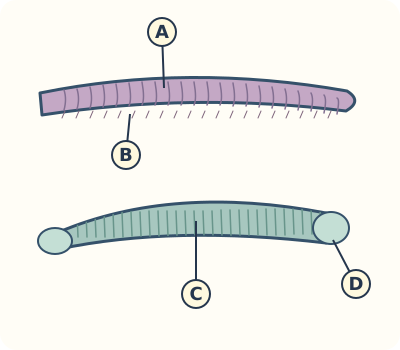
Earthworms and leeches are annelids with a segmented body and a true coelom: a body cavity between the gut and body wall fully lined by mesoderm. Earthworm body segments commonly carry short bristles called setae, which help grip the ground during movement. Leeches do not have those setae and use suckers in movement or attachment. Nephridia are excretory organs in many annelids. A ringed external outline alone is not a complete identification; compare several structures. Observe supplied models without digging for or handling animals.
Arthropoda: joints and an external skeleton
Arthropods have jointed appendages, a segmented body and a chitin-containing exoskeleton. An appendage is a projecting part such as a leg or antenna. Growth involves moulting the outer covering. Their main circulating body space is a haemocoel. Cockroach, butterfly, prawn, grasshopper and crab are source examples. Jointed legs and the covering support the group; having wings is not required, and an exoskeleton is not the same thing as a vertebral column.
An insect is one kind of arthropod
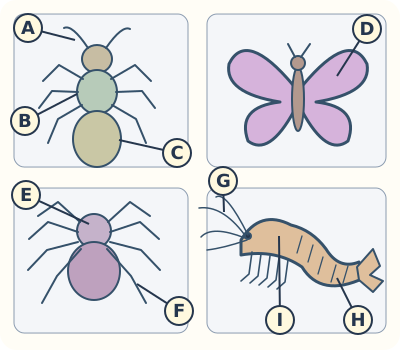
The supplied adult insect model has head, thorax and abdomen; three pairs of legs attach to the thorax and one pair of antennae attaches to the head. Cockroach, butterfly and grasshopper are insects. A spider is an arachnid with four pairs of walking legs and no antennae. A typical crustacean such as a prawn has two pairs of antennae. These comparisons explain why the source’s insect body description cannot be applied to all Arthropoda.
Mollusca: soft body, mantle and foot
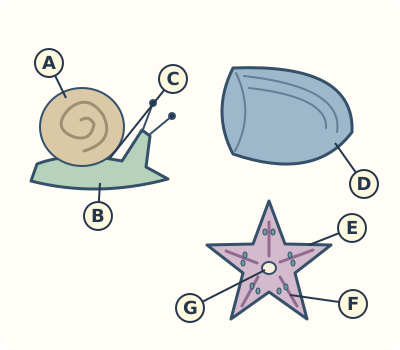
A snail is a mollusc with a muscular foot, a mantle and a soft body. The mantle secretes the shell in a shell-bearing example; not every mollusc has an external shell. A mussel has two shell valves and is also a mollusc. Some molluscs breathe using gills; a land snail uses a lung-like mantle cavity. Do not identify every hard-shelled animal as a mollusc: a crab instead has jointed appendages and an arthropod exoskeleton.
Echinodermata: a marine water-vascular system
Sea stars and sea cucumbers are echinoderms. Adults commonly show a five-part arrangement around an axis. Radial symmetry means that more than one plane through the central axis can divide the body into similar halves; sea-star larvae are bilateral. Tube feet connected to a water-vascular system contribute to movement, attachment and other functions. Echinoderms are marine. The oral surface bears the mouth and the opposite surface is aboral; these surfaces are distinct even if a simple outline does not show all details. A sea star is not a fish, despite the common name starfish.
Chordata: a life-cycle feature matters
Chordates have a notochord, a dorsal hollow nerve cord and pharyngeal slits or pouches at some stage, together with a post-anal tail at some stage. A notochord is a flexible supporting rod; it is not the nerve cord. The chordate subgroups in this chapter are Urochordata, Cephalochordata and Vertebrata. Not every chordate has a vertebral column. Presence of a feature in a larva can matter even when the adult looks very different.
Tunicate and lancelet: no vertebral column
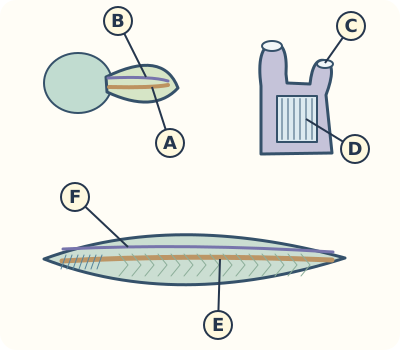
Ascidia is a tunicate in Urochordata. In the simplified larval model the notochord is in the tail; the attached adult has a filtering pharyngeal basket and two siphons. Do not claim that all its pharyngeal slits disappear in the adult. Branchiostoma is a lancelet in Cephalochordata with a notochord running along the body and persisting into adulthood. Both are chordates without a vertebral column. A fish-like outline alone does not make a lancelet a vertebrate fish.
Use an evidence-based identification route
Ask which features are actually given. Jointed appendages and an exoskeleton support Arthropoda; a soft body with mantle and muscular foot supports Mollusca; a marine five-part adult with tube feet supports Echinodermata. If a source chart states only that an animal lays eggs and is ectothermic, several vertebrate groups remain possible. Say what further evidence is needed. Observation and uncertainty are part of classification, not a failure to remember a name.
Worked example
A supplied lancelet retains a notochord and a dorsal nerve cord but has no vertebral column. It belongs to Chordata, subphylum Cephalochordata, and is an invertebrate. Chordate and vertebrate are therefore not interchangeable words.
Observe the labelled features before choosing a group.
Name the group and connect at least two features to your decision.
Check the comparison, explain a limitation and correct your notebook response.
A subgroup description is not the entire phylum
Printed page 5 describes an insect’s head, thorax, abdomen and one pair of antennae while discussing Arthropoda. The spider and prawn comparison shows why that pattern cannot describe every arthropod.
A source split that needs correction
Chordata includes invertebrate tunicates and lancelets as well as vertebrates. Printed pages 6–7 provide those very examples; use them to correct the earlier first-eight-versus-last wording.
Match a body plan to its group
Start with an observed or stated feature, then compare a second feature. Similar surroundings do not establish a shared phylum.
Match a body plan to its group
Group
Evidence in selected model
Avoid this shortcut
Annelida
Repeated body segments; earthworm setae or leech suckers
Not every annelid has setae
Arthropoda
Jointed appendages and an exoskeleton
Wings are not compulsory
Mollusca
Mantle, soft body and muscular foot
A hard covering alone is insufficient
Echinodermata
Marine adult with water-vascular system and tube feet
The common name starfish does not mean fish
Invertebrate chordate
Notochord and other chordate features; no vertebral column
Chordata is broader than Vertebrata
Worked reading: a lancelet belongs in Chordata while remaining an invertebrate. The source classification tree itself provides this counterexample.
Adult insect, spider and prawn: compare appendages
Compare the explicitly selected adult models. Antennae and walking legs are different appendages; small mouthparts are not counted as walking legs.
Adult insect, spider and prawn: compare appendages
Example
Antennae
Walking-leg/body evidence
Adult insect
One pair
Three leg pairs on thorax; head/thorax/abdomen
Spider
No antennae
Four walking-leg pairs; two principal body regions
Typical prawn
Two pairs
Crustacean plan; selected small appendages omitted in model
Worked count: three pairs of insect legs means 3 × 2 = 6 legs. Four spider walking-leg pairs means 4 × 2 = 8. The comparison supports different arthropod subgroups, not different phyla.
Read the scientific images
Match each letter to its structure and function. These original study diagrams are simplified models, not microscope observations.
Two segmented annelids, different movement structures
Shared segmentation can occur with different movement adaptations. The statement that every annelid bears setae is too broad.
A · Earthworm segments
Repeated annelid body organisation supports classification with other features.
B · Setae
Short bristles help the earthworm grip; they are not jointed arthropod legs.
C · Leech body
Leeches are annelids even though the model has no setae.
D · Suckers
Attachment/movement structures at the leech ends differ from earthworm bristles.
Original comparative outlines; internal coelom and nephridia are described in the lesson, not falsely shown as visible external features.
Four arthropod examples: shared joints, different regions
Compare each subgroup before generalising. Cockroach, butterfly and grasshopper use the insect plan; a spider and prawn show why it is not the whole phylum.
A · Insect antennae
One pair arises on the adult insect head.
B · Thoracic legs
Three leg pairs attach to the thorax, not the abdomen.
C · Main insect regions
Head, thorax and abdomen describe the selected adult insect plan.
D · Butterfly wings
Two forewings and two hindwings are shown; wings are not required for all arthropods.
E · Spider body
The simplified spider has two principal body regions and no antennae.
F · Spider legs
Four walking-leg pairs distinguish this example from the adult insect.
G · Prawn antennae
Two pairs distinguish this typical crustacean from the insect example.
H · Prawn abdomen
Repeated abdominal segments and a tail fan form part of the prawn model.
I · Exoskeleton
The outer covering and jointed appendages are shared arthropod features, despite the different layouts.
Original simplified models with selected appendages. Tiny mouthparts and swimmerets are omitted; leg counts refer to the explicitly drawn adult insect and spider, not every stage of every species.
Snail, mussel and sea-star evidence
A hard covering alone is not a phylum. Read the foot and mantle in molluscs; read the marine water-vascular model in the echinoderm.
A · Snail shell
A coiled covering secreted by the mantle in this shell-bearing mollusc.
B · Muscular foot
The broad underside supports crawling; it is not a jointed leg.
C · Mantle region
Tissue beneath the shell makes shell material; the small guide marks its model location.
D · Mussel valves
Two shell valves belong to a bivalve mollusc, not an arthropod exoskeleton.
E · Five-part adult plan
The sea-star arms radiate around a central region; this is an adult model.
F · Tube-foot rows
The oral view deliberately shows the underside, where tube feet act in movement and attachment.
G · Oral mouth
The central mouth identifies the oral side; the opposite aboral side is different.
Original schematic views. The source sea-star outline does not show all underside details; the oral view here is explicitly chosen to explain them. No real animal is turned over or handled.
Chordate features across two life cycles and body forms
Both examples are chordates without a backbone. A larval feature can be decisive even when the attached adult looks different.
A · Larval tail notochord
The supporting rod is in the tunicate larva’s tail.
B · Dorsal nerve cord
A nervous structure lies above the supporting rod; the two structures are distinct.
C · Adult siphons
One inlet and one outlet support the attached tunicate’s water-flow/filter-feeding model.
D · Pharyngeal basket
Adult tunicates retain a perforated filtering pharynx; not every chordate feature disappears.
E · Lancelet notochord
The supporting rod extends along the body and persists into adult life.
F · Lancelet nerve cord
It lies dorsally above the notochord; there is no vertebral column in this example.
Original schematic cutaways. Arrow-free side-by-side stages are not measured development timings. The adult Ascidia and Branchiostoma source examples are accounted for without copying their outlines.
Your written practice
Show your working on paper and enter your answer here. If it does not match, compare the model and try again.
Show model answer and explanation
Annelida
The selected animals share a segmented annelid body plan.
Show model answer and explanation
setae
Leeches are a counterexample to the claim that every annelid has setae.
Show model answer and explanation
nephridia
These differ from a flatworm flame-cell system.
Show model answer and explanation
Arthropoda
Wings are not required for this phylum.
Show model answer and explanation
moulting
The new covering allows growth before it hardens.
Show model answer and explanation
haemocoel
It is not the same description as a true coelom.
Show model answer and explanation
3
Three pairs means six legs, attached to the thorax.
Show model answer and explanation
thorax
They do not attach to the abdomen in this model.
Show model answer and explanation
4
Four pairs means eight walking legs.
Show model answer and explanation
mantle
A muscular foot is primarily involved in movement.
Show model answer and explanation
Mollusca
Soft body, mantle and foot support the group.
Show model answer and explanation
Echinodermata
The adult five-part plan and tube feet support this group.
Show model answer and explanation
notochord
The dorsal nerve cord is a different structure.
Show model answer and explanation
Urochordata
The larval notochord lies in its tail.
Show model answer and explanation
Cephalochordata
The lancelet retains a notochord along its body.
Write in your own words. A guardian or teacher should review this response.
Show model answer and explanation
Both are segmented annelids. The earthworm model has setae for gripping; the leech lacks setae and has suckers. Shared segmentation supports their group while the movement structures differ.
Use both a similarity and a real difference.
Write in your own words. A guardian or teacher should review this response.
Show model answer and explanation
Label three main body regions, one antenna pair on the head and three leg pairs on the thorax. Wings may be present but are not compulsory for every insect.
Show where each appendage attaches; do not add four pairs of insect legs.
Write in your own words. A guardian or teacher should review this response.
Show model answer and explanation
All are arthropods with jointed appendages and exoskeletons. The spider has four walking-leg pairs and no antennae; the adult grasshopper has three leg pairs and one antenna pair; a typical prawn has two antenna pairs.
Keep the phylum features separate from features of one subgroup.
Write in your own words. A guardian or teacher should review this response.
Show model answer and explanation
Check jointed appendages, segmented organisation and exoskeleton. Many arthropods have no wings, so wings alone would wrongly exclude them.
Use a wingless arthropod counterexample.
Write in your own words. A guardian or teacher should review this response.
Show model answer and explanation
A snail is a mollusc with a mantle and muscular foot; its shell is secreted by the mantle. A crab is an arthropod with jointed appendages and a chitin-containing exoskeleton. A hard covering alone does not put them in one phylum.
Use the supporting body structures, not shell hardness alone.
Write in your own words. A guardian or teacher should review this response.
Show model answer and explanation
Both are molluscs with mantle tissue and a muscular foot, although modified for their ways of life. A typical snail has one coiled external shell; a mussel has two valves.
Do not infer that every mollusc has the same shell form.
Write in your own words. A guardian or teacher should review this response.
Show model answer and explanation
The adult has arms arranged around a central region. Tube feet occur on the oral underside and connect to a water-vascular system. A top view does not reveal every underside structure; oral and aboral surfaces differ.
Link symmetry and tube feet, then name the view limitation.
Write in your own words. A guardian or teacher should review this response.
Show model answer and explanation
A sea star lacks a vertebral column and belongs to Echinodermata, with a marine water-vascular system and tube feet. A common name does not determine its classification.
Use structural evidence rather than the word fish.
Write in your own words. A guardian or teacher should review this response.
Show model answer and explanation
The notochord is a supporting rod. The dorsal hollow nerve cord is nervous tissue. A vertebral column is a series of vertebrae found in vertebrates; in many vertebrates it largely replaces the notochord’s support role.
Three names refer to different structures; do not label a nerve as bone.
Write in your own words. A guardian or teacher should review this response.
Show model answer and explanation
During development the larval tail and its notochord are lost or reduced as the animal becomes an attached filtering adult. Classification uses features across the life cycle, not only the adult outline.
Use the two stages without calling them separate species.
Write in your own words. A guardian or teacher should review this response.
Show model answer and explanation
Branchiostoma has a notochord and other chordate features but no vertebral column. It is a cephalochordate and an invertebrate chordate.
State the positive chordate evidence and the absent backbone.
Write in your own words. A guardian or teacher should review this response.
Show model answer and explanation
The adult Ascidia retains a perforated pharyngeal basket for filter feeding. Its tail notochord is the prominent larval feature that is lost in the adult form.
Do not apply the larval-only rule to both structures.
Write in your own words. A guardian or teacher should review this response.
Show model answer and explanation
Earthworm: Annelida. Prawn and grasshopper: Arthropoda. Snail and mussel: Mollusca. Hilsa and magpie-robin: Chordata.
Include a supporting feature for at least three groups in your own response.
Write in your own words. A guardian or teacher should review this response.
Show model answer and explanation
The combination supports an arthropod, likely an insect in this chapter context. It does not mean all arthropods have wings or that every winged-looking animal is an insect.
Separate the chart’s example from a universal claim.
Write in your own words. A guardian or teacher should review this response.
Show model answer and explanation
Use supplied images or harmless distance observation without collecting, touching, feeding or disturbing animals. Record visible features, stated information and uncertainties in a notebook.
Preserve the comparison task without capture or handling.
Your classification notebook
Make an evidence trail for six fictional picture cards: earthworm, adult insect, spider, snail, sea star and lancelet.
Review with a guardian or teacher
For each card write two relevant features and the supported phylum.
Draw and label insect leg attachment and a separate chordate support/nerve comparison.
Record one unknown feature and use pictures or distance observation only.
Keep your work on paper or in a local file. This page does not upload it or automatically grade the project.
Chapter companion and further study
This original Kidemy practice follows the topic order of 2026 Class 8 Science · English Version, chapter 1, printed pages 1–13. It does not replace the complete chapter or its practical teaching.