2026 Class 8 Science · English Version · Chapter 1 · Chapter companion part
Chapter 1C: Vertebrate groups and reasoned written answers
Compare the source’s seven vertebrate groups, interpret exercise evidence and write supported answers without overclaiming.
Class 8 English Version: part C of the chapter 1 companion. Eight teaching sections, 30 written tasks and a notebook challenge. Selected companion coverage, not complete textbook coverage; use all three parts and review independent responses with a teacher.
Vertebrates are chordates with a vertebral column; their internal support includes cartilage or bone. The source surveys Cyclostomata, Chondrichthyes, Osteichthyes, Amphibia, Reptilia, Aves and Mammalia. These are its school comparison headings, not an assertion that every modern evolutionary classification uses the same ranks. Use combinations of body covering, skeleton, breathing, reproduction and other evidence. Shared habitat does not make a dolphin a bony fish.
Cyclostomata: the lamprey example
Petromyzon is the source lamprey example: an elongated jawless vertebrate with a circular oral disc, no paired fins and no ordinary fish scales. Its internal support is cartilaginous and the notochord persists. Gill openings occur along the sides behind the head. Do not confuse its jawless mouth with a shark’s jaws or use an eel-like body as the only identification feature. The drawing is a structural model, not enough to identify an exact lamprey species.
Chondrichthyes: cartilaginous fishes
Sharks and rays have skeletons mainly made of cartilage, paired fins and gill slits. The source’s hammerhead drawing is a shark, despite its Hammer fish label. Sharks typically lack a swim bladder; buoyancy also involves a large oily liver and movement. Most cartilaginous fishes are marine, but freshwater examples occur. Swordfish is a bony fish and should not be copied from the source’s cartilaginous examples. Tail shapes and gill-opening counts vary, so use the skeleton distinction rather than one silhouette alone.
Osteichthyes: the bony-fish comparison
Hilsa is the source bony-fish example. The skeleton is mainly bony; a bony gill cover or operculum covers the gills in the supplied model. Bony fishes occur in freshwater and marine habitats. Paired fins, scales and a roughly similar upper/lower tail shape describe many examples but not every bony fish. A fish outline with a long sword-like bill does not make swordfish a shark. Compare the stated skeleton and gill structures.
Amphibia and Reptilia
Frogs and toads are amphibians. Typical examples have moist glandular skin without reptilian scales; larvae breathe with gills and adults use lungs and skin. Many lay jelly-coated eggs in water, with exceptions across the group. Lizards, snakes, crocodiles and turtles are reptiles with keratinised scales or scutes and lung breathing. Many lay shelled eggs; some give birth to live young. Ectothermic, often called cold-blooded, means much body heat comes from the environment; it does not mean always cold to touch.
Aves: feathers provide strong evidence
A bird has feathers, a beak and forelimbs modified as wings. Birds breathe with lungs assisted by air sacs; their skeleton and muscles have adaptations to their ways of life. Not every bird flies, and air sacs are not simply bags that replace lungs. The source magpie-robin, called Doel locally, is a bird example. Endothermic, often called warm-blooded, means internal metabolism supplies much body heat; body temperature can still vary with conditions.
Mammalia: hair and milk
Mammals have hair at some stage and mammary glands that produce milk for young. The Royal Bengal tiger is the source mammal example. Mammals breathe using lungs; aquatic mammals still need air. Most give birth to live young, but egg-laying mammals such as the platypus show why live birth alone is not the defining rule. Tooth patterns differ among mammals; the source’s different-shaped-teeth description fits many examples but not every adult mammal.
Reason from exercises, not a single clue
For source P grasshopper, Q bird and R tiger, identify Arthropoda for P; Q and R share Chordata but differ as Aves and Mammalia. For its M roundworm-like, N snail and O tapeworm-like pictures, use Nematoda, Mollusca and Platyhelminthes with suitable caution about exact species. The sentence calling both N and O parasites conflicts with the snail picture. Treat that as unresolved wording; compare the stated parasitic worm examples M and O rather than declaring every snail a parasite.
Worked example
An unfamiliar animal has feathers, a beak and lungs. The evidence supports Aves even if no flight is seen. It does not identify its species. A complete written answer names the class, cites the features and states that limit.
Observe the labelled features before choosing a group.
Name the group and connect at least two features to your decision.
Check the comparison, explain a limitation and correct your notebook response.
Source examples and revisions
Printed page 8 includes Sword fish with cartilaginous fishes and says they all live in the sea. Swordfish is bony; freshwater cartilaginous examples exist. The hammerhead illustration itself is a shark.
Read scale and tooth vocabulary
Placoid scales are tooth-like denticles; cycloid scales have a smooth posterior edge and ctenoid scales a comb-like edge. Typical ganoid scales are rhomboid and articulate with joints. These are selected scale forms, not a claim that every fish has scales. Heterodont means having different-shaped teeth adapted to different tasks, as in many mammals; it is not a universal mammal tooth rule.
An unresolved exercise reference
Printed page 13 calls N and O parasites, but N visibly depicts a snail. This companion does not accept snail equals parasite as an answer and does not claim to know the author’s intended replacement letter.
The source’s seven vertebrate comparison headings
Use each row as a selected example. These school headings are not a claim that every modern system uses identical ranks.
The source’s seven vertebrate comparison headings
Source heading / example
Useful evidence
A limitation or exception
Cyclostomata / lamprey
Jawless mouth; no paired fins
An eel-like shape alone is not enough
Chondrichthyes / shark
Mainly cartilaginous skeleton; jaws and paired fins
Some live in freshwater; swordfish is not in this group
Worked comparison: bird and tiger share Chordata, yet feathers versus hair and milk support different classes. Shared endothermy alone does not separate them.
Interpret the m / n / o / p exercise evidence
These letters belong to the source feature chart, not the separate uppercase M/N/O picture question. State what is supported and what remains unknown.
Interpret the m / n / o / p exercise evidence
Chart letter
Given clue
Supported interpretation
m
Wings and haemocoel
Arthropod; an insect is intended in this school context
n
Feathers and air sacs with lungs
Aves; flight is not proved for every bird
o
Ectothermic and lays eggs
Insufficient to choose one class uniquely
p
Scales and paired fins
Supports a fish comparison; skeleton evidence still needed
Worked reasoning: o could fit several fishes, amphibians or reptiles. Ask for skin, breathing, skeleton or development evidence instead of guessing a unique class.
Read the scientific images
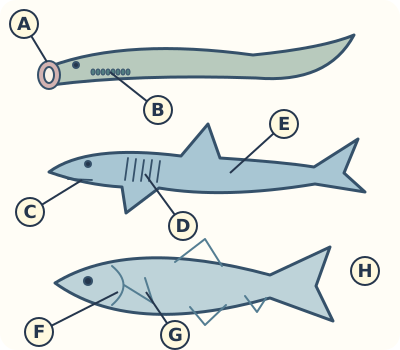
Match each letter to its structure and function. These original study diagrams are simplified models, not microscope observations.
Lamprey, shark and bony-fish models
Use jaws, paired fins, gill-cover arrangement and the stated skeleton material together. Both shark and bony-fish groups include marine examples.
A · Lamprey oral disc
The circular mouth is jawless; it is not a shark jaw.
B · Lamprey gill openings
A row of lateral openings is shown; paired fins are absent.
C · Shark jaws
The selected shark has a jawed mouth and paired fins.
D · Shark gill slits
Exposed slits are features of the shark model, not every cartilaginous-fish arrangement.
E · Shark support
Its internal skeleton is mainly cartilage; this is stated evidence, not something proved by a solid outline.
F · Operculum
The Hilsa model has a gill cover rather than the shark’s exposed lateral slits.
G · Bony-fish fins
Paired pectoral/pelvic fins occur in this selected model.
H · Bony skeleton
Mainly bony support distinguishes Hilsa from the shark model; the inside is not revealed by this external view.
Original models with selected fins and openings; not exact species portraits. The source hammerhead is a shark. Its swordfish example is corrected in the lesson: swordfish is bony. Shapes are not to a common scale.
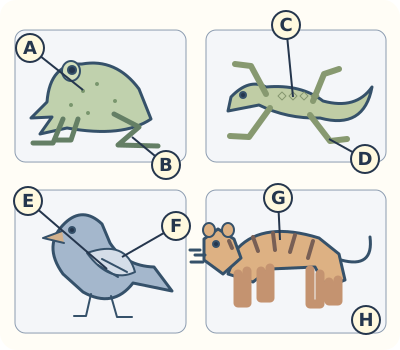
Four vertebrate examples: use coverings and functions
The bird and tiger share Chordata but differ at class level. The toad and lizard are ectothermic examples with different skin and life-cycle features.
A · Toad skin
Moist glandular skin fits the amphibian example; no reptilian scales are shown.
B · Toad limbs
Hindlimbs are folded for the selected posture; body shape alone does not identify the species.
C · Lizard scales
Keratinised scales cover the reptile model; it breathes with lungs.
D · Lizard limbs
Four legs fit this lizard; snakes show why legs cannot define all reptiles.
E · Bird feathers
Feathers support Aves even when no flight is observed.
F · Beak and wing
These structures fit the bird body plan; not every bird can fly.
G · Mammal hair
The tiger has hair, with stripes represented as a pattern, not measured markings.
H · Milk for young
Mammary-gland function is identifying evidence supplied by the lesson, not a visible organ in this external model.
Original schematic examples corresponding to source toad, wall lizard, magpie-robin and tiger. This is a structure guide, not a diagnostic species-identification image; hidden organs are never claimed visible.
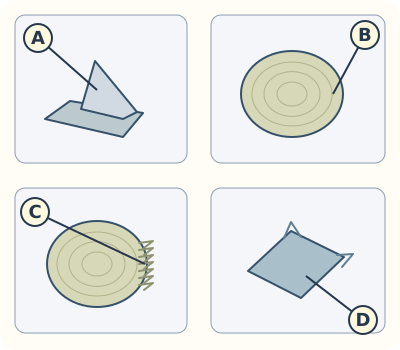
Compare four selected fish-scale models
Compare the named edge or form, not colour. Some fishes lack scales and scale type can vary even on different sides of a fish.
A · Placoid
A tooth-like dermal denticle characteristic of shark/ray examples. The sketch does not resolve microscopic layers.
B · Cycloid
The posterior edge is smooth, without the comb-like ctenii.
C · Ctenoid
Comb-like projections occur at the posterior edge; cycloid and ctenoid scales occur in many bony fishes.
D · Ganoid
A typical rhomboid, hard scale; peg-and-socket joints allow adjacent scales to articulate.
Original unmeasured models; not all scale kinds are included. Surface rings are illustrative, not annuli counted to assign an age. No museum artwork is copied.
Your written practice
Show your working on paper and enter your answer here. If it does not match, compare the model and try again.
Show model answer and explanation
Cyclostomata
The lamprey is the jawless example.
Show model answer and explanation
jawless
A circular oral disc does not mean it has ordinary fish jaws.
Show model answer and explanation
Chondrichthyes
Use skeleton material rather than marine habitat alone.
Show model answer and explanation
Osteichthyes
Hilsa is not a cartilaginous shark.
Show model answer and explanation
operculum
It covers the gills in the supplied Hilsa model.
Show model answer and explanation
bony
Swordfish is not an example of Chondrichthyes.
Show model answer and explanation
Amphibia
The chapter compares its moist glandular skin with reptilian scales.
Show model answer and explanation
cycloid
Ctenoid instead has comb-like projections.
Show model answer and explanation
placoid
The original scale plate shows its tooth-like model.
Show model answer and explanation
ctenoid
The comb-like structures are ctenii.
Show model answer and explanation
mammary glands
Egg laying does not exclude an animal from Mammalia.
Show model answer and explanation
ectothermic
It is more precise than assuming an animal always feels cold.
Show model answer and explanation
endothermic
It is not a promise of exactly constant temperature.
Show model answer and explanation
ganoid
The shape/joint model is not a measured specimen.
Show model answer and explanation
Aves
Feathers are stronger evidence than flight alone.
Write in your own words. A guardian or teacher should review this response.
Show model answer and explanation
The lamprey is jawless without paired fins and has cartilaginous support. The shark has jaws, paired fins and a mainly cartilaginous skeleton. Hilsa has jaws, paired fins and a mainly bony skeleton with covered gills in the model.
Use several stated structures, not only tail shape.
Write in your own words. A guardian or teacher should review this response.
Show model answer and explanation
Swordfish is bony and should not be listed as a cartilaginous fish. Most cartilaginous fishes are marine, but freshwater sharks or rays show that all live in the sea is too broad.
Correct both the example and the universal habitat claim.
Write in your own words. A guardian or teacher should review this response.
Show model answer and explanation
The toad has moist glandular skin and uses skin as well as lungs as an adult; typical larvae use gills. The lizard has dry keratinised scales and breathes using lungs.
Use the life stage and at least two differences.
Write in your own words. A guardian or teacher should review this response.
Show model answer and explanation
Many reptiles and birds lay eggs, and monotreme mammals such as the platypus also lay eggs. Use body covering, milk production and other features together.
Give a counterexample without claiming every mammal lays eggs.
Write in your own words. A guardian or teacher should review this response.
Show model answer and explanation
A penguin has feathers and other bird features and belongs to Aves. Flight is not required for every bird; inability to fly does not imply milk production or Mammalia.
Use positive identifying evidence and name the weak clue.
Write in your own words. A guardian or teacher should review this response.
Show model answer and explanation
It is a mammal that breathes air with lungs and feeds its young milk. Habitat and swimming form alone are insufficient to classify it as a fish.
Use the relevant mammal functions rather than environment alone.
Write in your own words. A guardian or teacher should review this response.
Show model answer and explanation
Ectothermy concerns sources of body heat, not a fixed skin temperature. Temperature changes with surroundings and touching wildlife is unnecessary; use supplied structural and physiological evidence.
Define the term accurately and use a non-handling method.
Write in your own words. A guardian or teacher should review this response.
Show model answer and explanation
The bird is Aves with feathers and eggs; the tiger is Mammalia with hair and milk for its young. Both are vertebrate chordates and obtain much body heat metabolically.
Give class-level differences and a shared higher group.
Write in your own words. A guardian or teacher should review this response.
Show model answer and explanation
P belongs to Arthropoda with jointed legs and an exoskeleton. Q and R belong to Chordata; feathers support Aves for Q and hair plus milk support Mammalia for R.
A bird picture does not need an exact species identification to support its class.
Write in your own words. A guardian or teacher should review this response.
Show model answer and explanation
State the visible forms and supported phyla: M Nematoda, N Mollusca and O Platyhelminthes. The parasite sentence conflicts with the snail image; do not assume an ordinary snail is parasitic. Ask a teacher to resolve the wording and compare specified parasitic worm examples separately.
Make the mismatch explicit without silently changing the picture labels.
Write in your own words. A guardian or teacher should review this response.
Show model answer and explanation
Those clues also fit many fishes and amphibians. More evidence such as skin covering, breathing, skeleton or development is needed to choose a class.
Give another compatible group and request a distinguishing feature.
Write in your own words. A guardian or teacher should review this response.
Show model answer and explanation
The feathers support Aves; air sacs fit the bird respiratory model. These clues do not prove that every member of the class can fly.
Do not turn a class identification into a universal flight claim.
Write in your own words. A guardian or teacher should review this response.
Show model answer and explanation
Use lamprey, shark, Hilsa, toad, wall lizard, magpie-robin and tiger. Label relevant features such as jaw state, skeleton material, gill cover, skin, scales, feathers or hair. Mark them as simplified models.
Review seven group assignments, accurate labels and stated model limits.
Write in your own words. A guardian or teacher should review this response.
Show model answer and explanation
The supplied features support Aves. Feathers are the key evidence; the beak and lung breathing fit the model. They do not identify its species, habitat or ability to fly without further information.
Use claim → evidence → limitation, with no invented species.
Write in your own words. A guardian or teacher should review this response.
Show model answer and explanation
Placoid is tooth-like, cycloid has a smooth posterior edge, ctenoid has comb-like posterior projections, and typical ganoid scales are rhomboid with joints. Some fishes lack scales, and the schematic alone cannot identify a species or its age.
Name the four forms and one evidence limit; do not count invented rings as measured annual growth.
Your classification notebook
Build a seven-group vertebrate comparison and write three evidence paragraphs for unfamiliar fictional animal cards.
Review with a guardian or teacher
Use at least two supported features per group and keep the phylum/class ranks separate.
Explain a flight, egg-laying or habitat counterexample instead of memorising an absolute rule.
Record the M/N/O source mismatch and mark drawings as models; use no animal capture.
Keep your work on paper or in a local file. This page does not upload it or automatically grade the project.
Chapter companion and further study
This original Kidemy practice follows the topic order of 2026 Class 8 Science · English Version, chapter 1, printed pages 1–13. It does not replace the complete chapter or its practical teaching.