2026 Class 8 Science · English Version · Chapter 1 · Chapter companion part
Chapter 1A: Classification, sponges and worm body plans
Use classification ranks and structural evidence to distinguish sponges, cnidarians, flatworms and roundworms.
Class 8 English Version: part A of the chapter 1 companion. Eight teaching sections, 30 written tasks and a notebook challenge. Selected companion coverage, not complete textbook coverage; use all three parts and review independent responses with a teacher.
Classification organises organisms using shared features and evidence of relationships. A taxon is a named group; taxonomy is the study of naming and classifying. Grouping helps us identify, compare and communicate about unfamiliar organisms. Habitat, size or usefulness alone is not enough: a whale and a fish both swim, but belong to different vertebrate groups. Classification is a system for describing relationships, not a ladder from bad to good animals.
Read a hierarchy in the right direction
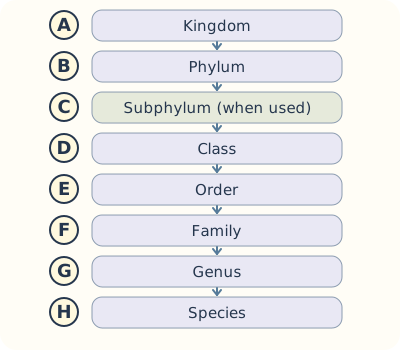
For this chapter use kingdom → phylum → class → order → family → genus → species. Subphylum, when used, sits below phylum and above class. Each step narrows the chosen group. Two species can share a genus without being the same species. Humans belong to kingdom Animalia and species Homo sapiens; the word human on its own is a common name, not a scientific two-part name.
Write a scientific name carefully
A two-part scientific name contains a genus name and a specific epithet: Homo sapiens. Capitalise Homo, keep sapiens lowercase, and italicise both in print or underline the two words separately in handwriting. The second word alone does not uniquely identify the species. Names are Latin or treated as Latin, even when derived from other languages. An ordinary English common name is not automatically a scientific name. Linnaeus helped establish the standard binomial naming system.
Use the chapter’s survey with its limits
The book selects nine major animal phyla for this survey; this is not a universal fixed count of all animal phyla. Modern Animalia contains multicellular eukaryotes. Amoeba is generally studied among protists, not as an animal in this modern grouping. Invertebrate means an animal without a vertebral column. Chordata contains vertebrates and some invertebrates, so do not turn the book’s first-eight-versus-last split into a universal rule.
Porifera: water moves through a sponge
Sponges have many small pores and internal water channels. Water brings suspended food and oxygen; specialised cells drive water flow and capture food. Water leaves through larger openings called oscula. Sponges lack the true tissues and organs present in the other groups studied here. Most are marine; Spongilla provides a freshwater example. The branching sponge diagram is one body form, not the shape of every sponge.
Cnidaria: a Hydra has true tissue layers
Hydra is a freshwater cnidarian. Its tentacles surround a mouth that opens into a gastrovascular cavity, also called the coelenteron. In this simple model one opening serves food entry and waste exit; there is no separate anus. Cnidocytes are specialised cells with stinging capsules used in prey capture and defence. The body has outer and inner tissue layers with a jelly-like layer between them. This two-embryonic-layer organisation is called diploblastic. Do not confuse a cnidocyte with a pore on a sponge.
Platyhelminthes: flattened worms
Flatworms have a body flattened from top to bottom and bilateral symmetry: one main plane makes left and right mirror halves. Fasciola is a fluke and Taenia is a tapeworm. Many are parasites, but free-living flatworms also exist. Flame-cell systems help manage water balance and waste. Parasitic adaptations such as attachment suckers or hooks depend on the species; not every flatworm has all of them. Taenia absorbs nutrients and lacks a digestive tract; other flatworms can have an incomplete gut.
Nematoda: round, unsegmented worms
Roundworms have an unsegmented, cylindrical body, tapered ends and a protective cuticle. They have a complete digestive tract with mouth and anus. A body cavity lies between the gut and body wall, but it is not a true coelom fully lined by mesoderm, the middle embryonic tissue layer. A body cavity lacking that complete lining is called a pseudocoelom. Ascaris is the source’s parasitic example; many other nematodes live freely in soil or water. A curved outline alone does not identify a species or show whether an animal is parasitic. Study supplied drawings rather than handling worms or contaminated soil.
Worked example
An unknown drawing has a cylindrical, unsegmented body, tapered ends and a mouth-to-anus gut. These supplied features support Nematoda rather than a flatworm. They do not identify the exact species or prove parasitism.
Observe the labelled features before choosing a group.
Name the group and connect at least two features to your decision.
Check the comparison, explain a limitation and correct your notebook response.
Read the source wording carefully
Printed pages 1–3 include Amoeba in an older animal grouping and a fixed phylum count. This companion uses modern multicellular Animalia and treats the nine phyla as a selected school survey.
History and the purpose of naming
Aristotle, John Ray and Linnaeus are historical figures named in the source. Linnaeus helped standardise binomial naming. Learning those names does not replace using shared structures and reliable evidence to classify a new example.
Check the exercise rather than memorising an error
The Scypha–Hydra sample asks about tissue layers. Both are multicellular, but the sponge does not have true tissues. Use the explicit distinction and discuss the source-dependent wording with a teacher.
Four body plans: compare the same features
Read across one row and give two pieces of evidence. The selected examples do not describe every species in a phylum.
Worked comparison: both a sponge and Hydra are multicellular, but only Hydra has true tissue organisation in this pair. Similarity and difference should both appear in your answer.
Read the observation chart without inventing facts
The source asks about monkey, earthworm, mussel, bird and fish. Use supplied information or harmless distance observation. Usefulness and harmfulness depend on a particular situation.
Read the observation chart without inventing facts
Example
Feature to record
What needs more evidence
Monkey
Hair, limbs and other visible features
Species, precise habitat and ecological effects
Earthworm
Segmented form; setae if shown clearly
Exact species and role in the stated soil
Mussel
Two shell valves; foot if shown
Freshwater or marine species, filter-feeding evidence
Bird
Feathers, beak and wing form
Species and whether this individual can fly
Fish
Fins, gill cover or slits if visible
Skeleton type unless explicitly supplied
Worked reading: a closed mussel picture can show shell valves but may not show its foot. Write not visible rather than pretending you observed it. Do not collect animals.
Read the scientific images
Match each letter to its structure and function. These original study diagrams are simplified models, not microscope observations.
Read the nested classification ranks
Trace broad to narrow. The chart shows ranks along one selected path, not that all animals belong to one species.
A · Kingdom
Animalia is the broad group used for the multicellular animals in this chapter.
B · Phylum
A major grouping such as Chordata; different phyla are branches, not steps to climb.
C · Subphylum
An additional rank used here between phylum and class, for example Vertebrata.
D · Class
The source compares Aves and Mammalia at this rank.
E · Order
A narrower rank inside the selected class.
F · Family
A grouping inside the selected order.
G · Genus
The first word of a two-part scientific name, such as Homo.
H · Species
The full two-word example is Homo sapiens; sapiens alone is its specific epithet.
Original rank guide. Subphylum is included because the source uses it; modern classifications can use additional ranks and clades.
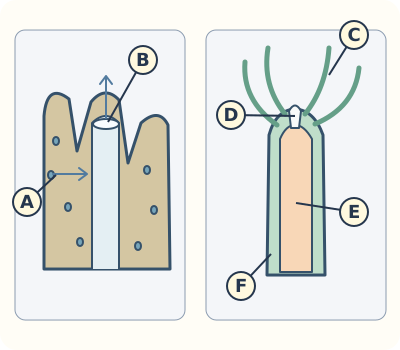
Water pores and a tentacled body are different plans
Compare water flow through a sponge with food entry into a Hydra cavity. Both are multicellular; only the Hydra has true tissues in this pair.
A · Sponge pores
Small openings let water carrying oxygen and suspended food enter.
B · Osculum
A larger outlet lets water leave; it is not an ordinary mouth.
C · Hydra tentacles
Tentacles surround the mouth and bear specialised cnidocytes.
D · Hydra mouth
The opening leads to the cavity; there is no separate anus in this model.
E · Gastrovascular cavity
The coelenteron is involved in digestion and distribution.
F · Tissue layers
The Hydra model has outer and inner tissue layers; the sponge lacks true tissues.
Original schematic alternatives to Spongilla and Hydra source figures. Colour distinguishes parts, not natural colour or microscopic appearance. Cnidocytes are too small to be individually drawn here.
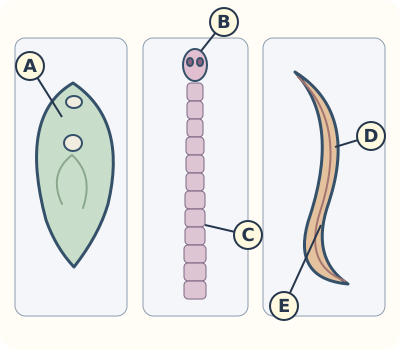
Flat and round worm models
Use multiple body-plan features to distinguish Platyhelminthes and Nematoda. Parasitism is not visible merely from a curved outline.
A · Fluke form
Fasciola is the source leaf-like flatworm. Its form differs from a cylindrical roundworm.
B · Tapeworm attachment end
Taenia attaches with specialised structures; exact hooks differ by species and are not resolved in this model.
C · Reproductive units
Tapeworm proglottids repeat along the body; this does not make the animal an annelid.
D · Roundworm covering
A cuticle covers the unsegmented cylindrical body of the Ascaris-type model.
E · Complete gut model
Separate anterior mouth and posterior anus contrast with the single-opening Hydra model.
Original models, not specimen identifications. The source exercise M/N/O parasite sentence conflicts with its snail image. No worm or contaminated material needs to be handled.
Your written practice
Show your working on paper and enter your answer here. If it does not match, compare the model and try again.
Show model answer and explanation
taxonomy
Classification is the grouping process; taxonomy studies its naming and organisation.
Show model answer and explanation
taxon
Taxon can refer to a group at different ranks.
Show model answer and explanation
genus
The sequence narrows from family to genus to species.
Show model answer and explanation
subphylum
Do not place subphylum below species.
Show model answer and explanation
Homo
The genus begins with a capital letter.
Show model answer and explanation
specific epithet
The complete two-word name identifies the species.
Show model answer and explanation
Porifera
Its pores and lack of true tissues fit the sponge group.
Show model answer and explanation
oscula
Small pores admit water; larger oscula allow water to leave.
Show model answer and explanation
Cnidaria
Hydra has true tissue layers and specialised cnidocytes.
Show model answer and explanation
cnidocyte
The capsule is a structure inside the cell.
Show model answer and explanation
coelenteron
It is the digestive cavity, not a vertebral column.
Show model answer and explanation
Platyhelminthes
These are flatworm examples.
Show model answer and explanation
Nematoda
Ascaris has a cylindrical unsegmented body.
Show model answer and explanation
flame cell
Flame-cell systems help with water balance and waste.
Show model answer and explanation
bilateral symmetry
This differs from several planes around a central axis.
Write in your own words. A guardian or teacher should review this response.
Show model answer and explanation
Shared features let us compare and identify unfamiliar animals, communicate reliably and study relationships. A reasoned group gives information beyond one isolated common name.
Give two uses and connect them to shared features.
Write in your own words. A guardian or teacher should review this response.
Show model answer and explanation
Kingdom → phylum → subphylum when used → class → order → family → genus → species. Each nested step narrows the chosen group.
Keep the seven main ranks in order and place the optional rank correctly.
Write in your own words. A guardian or teacher should review this response.
Show model answer and explanation
Write Homo sapiens, underline each word separately, capitalise the genus and keep the specific epithet lowercase. The two words together form the species name.
Capitalisation and formatting require human review; do not call sapiens alone the full species name.
Write in your own words. A guardian or teacher should review this response.
Show model answer and explanation
Amoeba is generally grouped among protists in modern classification. Small size alone does not define an animal, and modern Animalia contains multicellular organisms.
Separate size from cell organisation and classification.
Write in your own words. A guardian or teacher should review this response.
Show model answer and explanation
The sponge has many water-entry pores and lacks true tissues. Hydra has true tissue layers, a mouth surrounded by tentacles and cnidocytes.
Both are multicellular; do not call both diploblastic true-tissue animals.
Write in your own words. A guardian or teacher should review this response.
Show model answer and explanation
Water enters small pores, moves through channels where cells capture food, and exits through a larger osculum. The sponge has no ordinary mouth-and-gut organ system.
Use the flow direction and name the different openings.
Write in your own words. A guardian or teacher should review this response.
Show model answer and explanation
Tentacles surround the mouth and bear specialised cnidocytes; captured food enters the gastrovascular cavity or coelenteron. One opening serves entry and exit in this model.
Include three structure–function links and label the model as not to scale.
Write in your own words. A guardian or teacher should review this response.
Show model answer and explanation
The cnidocyte is the specialised cell; the capsule is housed within it. The capsule can discharge a thread involved in capture or defence.
Distinguish the whole cell from its contained structure; no real-animal handling.
Write in your own words. A guardian or teacher should review this response.
Show model answer and explanation
Fasciola is leaf-like and Taenia is ribbon-like; both are Platyhelminthes. Ascaris is cylindrical and unsegmented, belonging to Nematoda.
Do not classify all three merely as worms or all as one phylum.
Write in your own words. A guardian or teacher should review this response.
Show model answer and explanation
Its repeated reproductive units are not the same body segmentation used to identify annelids. Use its flattened tapeworm body plan and other evidence; it belongs to Platyhelminthes.
A repeated visible pattern alone is insufficient evidence of annelid membership.
Write in your own words. A guardian or teacher should review this response.
Show model answer and explanation
A complete tract has separate mouth and anus. Hydra has a single opening into a gastrovascular cavity, so food entry and undigested waste exit share that opening.
Name the openings, not just the organism’s outline.
Write in your own words. A guardian or teacher should review this response.
Show model answer and explanation
Many flatworms are parasites, including the selected fluke and tapeworm examples, but free-living flatworms exist. Attachment hooks vary between groups and species.
Keep the selected examples while correcting the universal claim.
Write in your own words. A guardian or teacher should review this response.
Show model answer and explanation
Use supplied images and columns for visible structures, stated habitat and evidence limits. Describe ecological roles in context rather than assigning every animal a permanent useful or harmful label.
Do not catch animals or invent features that an image does not show.
Write in your own words. A guardian or teacher should review this response.
Show model answer and explanation
Both are multicellular and lack developed organ systems in this comparison. Hydra has true tissue layers; sponges do not have the true tissue organisation meant by diploblastic.
Explain the shared features and the important difference; do not accept the tissue-layer claim for the sponge.
Write in your own words. A guardian or teacher should review this response.
Show model answer and explanation
The book selects groups for teaching, while classification changes with definitions and evidence. Use its nine selected phyla to learn the features without claiming that nine or a stated fixed total is the only possible system.
State the survey’s purpose and limit without inventing a new universal count.
Your classification notebook
Create a broad-to-narrow rank ladder and a four-group identification card set using the supplied sponge, Hydra, flatworm and roundworm models.
Review with a guardian or teacher
Explain one feature that supports each group; do not use habitat alone.
Write a scientific two-part name with the correct handwritten convention.
Include one source correction and one limit of identifying an animal from a schematic.
Keep your work on paper or in a local file. This page does not upload it or automatically grade the project.
Chapter companion and further study
This original Kidemy practice follows the topic order of 2026 Class 8 Science · English Version, chapter 1, printed pages 1–13. It does not replace the complete chapter or its practical teaching.