2026 Class 8 Mathematics · English Version · Chapter 4 · Chapter companion part
Chapter 4D: Common factors, common multiples and mixed checks
Factor first, choose minimum or maximum powers correctly, verify divisibility and review mixed chapter reasoning.
About this lesson and its coverage
Class 8 English Version: part D of the chapter 4 companion. Eight sections and 30 written tasks. Selected companion coverage, not complete textbook coverage; use all four parts and compare the mapped source methods. The software checks stated numerical values or coefficients; symbolic work, equivalent forms and proofs need guardian or teacher review.
The highest common factor (HCF), also called greatest common divisor (GCD), contains every factor shared by all inputs at the smallest exponent present in them. Use the school integer-coefficient convention: extract positive numerical content, the greatest common divisor of each polynomial’s integer coefficients. A leading coefficient alone is not necessarily content: 2x + 1 has content 1, not an extractable factor 2 in integer coefficients.
Minimum powers belong to the HCF
For 12a³b²c, 18a²bc² and 30a⁵b⁴c³, numerical HCF is 6. The common exponents are a², b and c, giving 6a²bc. A missing factor has exponent zero and cannot appear in the HCF of all inputs. The source’s highest common power wording must be read with divisibility: using a larger exponent would fail to divide an input.
Factor each expression before comparing
For x² − 3x, x² − 9 and x² − 4x + 3, write x(x − 3), (x − 3)(x + 3) and (x − 3)(x − 1). The HCF is x − 3. For a quadratic like 6x² − x − 1, first factor (3x + 1)(2x − 1); its primitive binomial factors already contain their leading coefficients, so an extra factor 6 must not be inserted into the LCM.
An LCM contains the union of required factors
The least common multiple (LCM) is divisible by every input. Choose the numerical LCM of their contents and the largest required exponent of every distinct primitive polynomial factor, including factors absent from some inputs. For 6a²b, 10ab³ and 15a³b², LCM is 30a³b³. Highest powers do not mean only factors common to all three.
Repeated and composite factors need an inventory
For 2x(x + 1), 3(x + 1)² and 4(x² − 1), factor the last as 4(x − 1)(x + 1). The LCM is 12x(x + 1)²(x − 1). Cubic factors may reveal additional quadratics: x³ − 1 = (x − 1)(x² + x + 1). A table recording each exponent prevents missing an input’s unique factor.
Check two expressions with products and quotients
For A = 6x²(x − 1) and B = 4x(x − 1)², H = 2x(x − 1) and L = 12x²(x − 1)². Each A/H and B/H is a polynomial; each L/A and L/B is a polynomial. Also HL = AB = 24x³(x − 1)³ under these normalised signs. The two-input product relation does not extend unchanged to three inputs: HCF(2,3,6) × LCM(2,3,6) = 6, while 2 × 3 × 6 = 36.
Signs and substitution require care
Factors x − 2 and 2 − x differ by −1. They represent the same nonconstant factor after consistent sign normalisation; do not list them as unrelated LCM factors. Algebraic HCF followed by numerical substitution can differ from numerical HCF after substitution. At x = 2, A = 24 and B = 8 in the preceding example; algebraic HCF evaluates to 4 while numerical HCF is 8. Substitution can create extra numerical divisibility.
A proposed common multiple must divide correctly
If A = (x − 4)(x − 2) and B = (x − 4)(x + 1), the proposed LCM (x − 4)(x − 2) omits x + 1 and fails the second divisibility check. The true LCM is (x − 4)(x − 2)(x + 1). This is the same error type as source sample 3’s deliberately false LCM assertion. In a real-number setting, also reject impossible reciprocal premises rather than force a result. Keep proof questions and equivalently ordered factors under human review.
Worked example
For contents 6 and 4, x powers 2 and 1, and (x − 1) powers 1 and 2, read minimums for HCF and maximums for LCM. The resulting 2x(x − 1) and 12x²(x − 1)² pass all four polynomial quotient checks.
Identify the structure, define any substituted expression and state nonzero or positive-length conditions.
Write the identity or factor method, substitute entire terms including their signs, and show every step.
Expand to verify factors or substitute back to check a value. Write the requested number for a check; review full algebra and proofs with a guardian or teacher.
Divisibility determines the answer
Highest common factor refers to divisibility, not the greatest value after choosing a number for x. Least common multiple is likewise a polynomial relationship.
Proofs and equivalent forms need a person
These numerical checks are practice feedback. They do not automatically grade a polynomial proof, an alternative valid factor order or an entire written exam.
Inventory powers before choosing HCF or LCM
Original inputs A = 6x²(x − 1) and B = 4x(x − 1)².
Inventory powers before choosing HCF or LCM
Content or factor
Input A
Input B
HCF choice
LCM choice
Numerical content
6
4
2
12
x exponent
2
1
1
2
x − 1 exponent
1
2
1
2
Reading minimum powers gives 2x(x − 1). Reading maximum powers and numerical LCM gives 12x²(x − 1)². Numerical content is the common coefficient factor, not automatically the leading coefficient.
Check all four polynomial quotients
Use H = 2x(x − 1), L = 12x²(x − 1)² for the same two inputs.
Check all four polynomial quotients
Quotient
Polynomial result
Meaning
A/H
3x
H divides A
B/H
2(x − 1)
H divides B
L/A
2(x − 1)
A divides L
L/B
3x
B divides L
Each result is a polynomial after exact factor cancellation. This verifies divisibility as a polynomial relationship, not merely at one numerical input.
Minimum common powers, maximum required powers
Assume nonzero integer-coefficient polynomials, fully factored with positive numerical content and consistently normalised overall signs.
HCF = gcd(contents) × product of common minimum powers
LCM = lcm(contents) × product of all required maximum powers
For two inputs: HCF × LCM = A × B, up to an overall sign
content
The positive gcd of all integer coefficients of one input polynomial.
primitive factor
A polynomial factor with numerical content 1.
minimum / maximum
Smallest / largest exponent present across the input factor inventory.
Factor each input before making an inventory.
Treat an absent factor as exponent zero for HCF.
For LCM include a factor needed by even one input.
Verify divisibility and the two-input product relation with consistent signs.
The source’s highest common power wording does not permit maximum powers in HCF. The two-input product equality is not a three-input rule.
Check the mixed reciprocal task from its equation
The stated quadratic has nonzero real roots; divide only after noting x ≠ 0.
A nonzero real solution of the specified quadratic.
12
Twice the product of 2x and 3/x.
Factor the quadratic as (2x − 1)(x − 3) if you want to check its roots.
Its roots 1/2 and 3 are both nonzero.
The squared reciprocal combination gives the answer without selecting a root.
Check either root: the requested value is 37.
Numerical examples are checked values. A full proof of the transformation and the condition still needs written reasoning.
Explore the mathematical figures
Match each letter to its explanation. Read the quantities, units and relationships, then check the counts or equations. These are original teaching models.
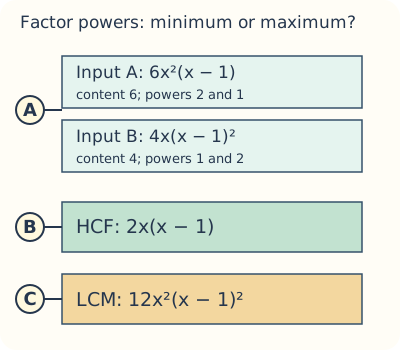
One inventory, two different power choices
Read one column at a time, then verify that the HCF divides both inputs and the LCM is divisible by both.
A · Full input factors
A = 6x²(x − 1); B = 4x(x − 1)².
B · Common minimum powers
Content gcd is 2 and both common powers are 1.
C · Required maximum powers
Content lcm is 12 and both required powers are 2.
Original symbolic cards. Exponents represent repeated factors, not a ranking or a numerical value for x.
Explore the mathematical figures
Match each letter to its explanation. Read the quantities, units and relationships, then check the counts or equations. These are original teaching models.
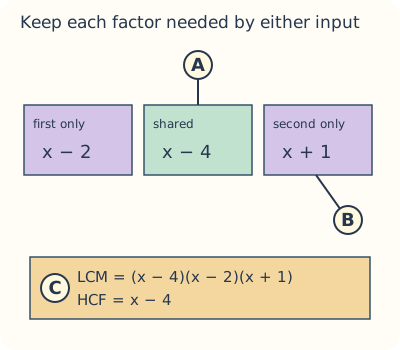
The LCM must cover a factor needed by either input
Check input 1 = (x−4)(x−2) and input 2 = (x−4)(x+1) against the proposed multiple. A unique factor can be necessary even though it is not common.
A · HCF
The shared primitive factor is x − 4.
B · A missing factor matters
Leaving out x + 1 prevents divisibility by the second input.
C · LCM
Use every required factor once here, because all exponents are 1.
Original factor-set schematic. Positions are categorical; they do not encode magnitude or geometric overlap.
Your written practice
Show your working on paper. Check your answer, then choose Next.
Show model answer and explanation
6
Six is the largest positive integer dividing all three.
Show model answer and explanation
2
Use the minimum exponent, 2.
Show model answer and explanation
1
Use min(2,1,4) = 1.
Show model answer and explanation
30
30 is divisible by each and uses the needed prime powers 2 × 3 × 5.
Show model answer and explanation
3
Use the maximum exponent, 3.
Show model answer and explanation
3
5 − 2 = 3. This asks for the value of the polynomial HCF.
Show model answer and explanation
15
3 × 5 × 1 = 15.
Show model answer and explanation
4
2 × 2 × 1 = 4.
Show model answer and explanation
48
12 × 4 × 1 = 48.
Show model answer and explanation
8
Both values are divisible by 8; this differs from the polynomial HCF value 4.
Show model answer and explanation
1
The minimum required exponent is 1.
Show model answer and explanation
3
The maximum required exponent is 3.
Show model answer and explanation
12
Use 2² × 3 = 12.
Show model answer and explanation
1
A constant 1 divides both; neither linear factor divides the other.
Show model answer and explanation
30
Their product is 6 × 60 = 360; 360/12 = 30.
Write in your own words. A guardian or teacher should review this response.
Show model answer and explanation
6a²bc. Use gcd(12,18,30) = 6 and the minimum exponents 2,1,1.
Divide each original monomial by the answer and check that every quotient is a polynomial.
Write in your own words. A guardian or teacher should review this response.
Show model answer and explanation
30a³b³. The numerical contents need 30 and the maximum exponents are 3 for both variables.
Check that the result is divisible by all three original monomials.
Write in your own words. A guardian or teacher should review this response.
Show model answer and explanation
Their factorizations are x(x − 3), (x − 3)(x + 3) and (x − 3)(x − 1); HCF is x − 3.
Show all three factorizations; do not compare additive terms as if they were factors.
Write in your own words. A guardian or teacher should review this response.
Show model answer and explanation
The first cube difference and the second quartic both contain x² + xy + y². Numerical HCF is 3; common monomial is xy². HCF is 3xy²(x² + xy + y²).
Factor the quartic as (x² + xy + y²)(x² − xy + y²) and verify minimum exponents.
Write in your own words. A guardian or teacher should review this response.
Show model answer and explanation
12x(x + 1)²(x − 1). The factor x − 1 occurs only in the third expression but is required in the LCM.
Use content LCM 12 and a union of factor powers.
Write in your own words. A guardian or teacher should review this response.
Show model answer and explanation
(x − 1)³(x + 1)²(x² + x + 1).
Show cube and square differences and take the highest exponent of each distinct factor.
Write in your own words. A guardian or teacher should review this response.
Show model answer and explanation
2 − x = −(x − 2). After normalising signs they are the same primitive linear factor. Choose HCF and LCM x − 2 under the stated sign convention; quotients may be −1.
Preserve the sign in each division instead of silently identifying unequal expressions.
Write in your own words. A guardian or teacher should review this response.
Show model answer and explanation
Polynomial HCF is 2x(x − 1), giving 4. The evaluated inputs are 24 and 8, whose numerical HCF is 8. Substitution has introduced extra numerical common factors.
Explain the order of operations and why the two questions differ.
Write in your own words. A guardian or teacher should review this response.
Show model answer and explanation
H = 2x(x − 1), L = 12x²(x − 1)², so HL = 24x³(x − 1)³. Multiplying A and B gives the same product.
Also verify the quotient conditions; a product coincidence alone does not identify both correctly.
Write in your own words. A guardian or teacher should review this response.
Show model answer and explanation
The three-input HCF is 1 and LCM is 6, whose product is 6. The product of the inputs is 36.
Use all three inputs consistently; the failed equality disproves the claimed generalisation.
Write in your own words. A guardian or teacher should review this response.
Show model answer and explanation
The proposed multiple lacks x + 1 and is not divisible by the second polynomial. The correct LCM is (x − 4)(x − 2)(x + 1).
Identify the missing factor and show both quotient checks.
Write in your own words. A guardian or teacher should review this response.
Show model answer and explanation
Factor as (3x + 1)(2x − 1), (3x + 1)(x + 2) and (2x − 1)(x + 2). LCM is (3x + 1)(2x − 1)(x + 2). Each polynomial has numerical content 1.
Do not multiply by another 6 merely because the leading coefficients include 6,3,2.
Write in your own words. A guardian or teacher should review this response.
Show model answer and explanation
Divide by x: 2x + 3/x = 7. Square to get 4x² + 12 + 9/x² = 49, so the requested value is 37. Roots 3 and 1/2 both give 37.
Explain why no choice between the roots is needed and why division by x is allowed.
Write in your own words. A guardian or teacher should review this response.
Show model answer and explanation
Contents 6 and 4 give HCF 2 and LCM 12. Powers of x are 2,1; powers of x − 1 are 1,2. Thus HCF 2x(x − 1) and LCM 12x²(x − 1)².
Treat numerical content and polynomial factors separately and verify divisibility.
Write in your own words. A guardian or teacher should review this response.
Show model answer and explanation
Complete the square: (x − √3/2)² + 1/4 = 0. The left side is positive for every real x, so no real solution exists. Over complex numbers the formal reciprocal consequences are sum √3, square sum 1 and cube sum 0, but that is a different number domain.
Do not use the formal manipulation as evidence of a feasible real x.
Progress and browser storage
Notebook challenge, sources and further study
Your algebra notebook
Build a common-factor inventory and a short mixed written paper with worked corrections.
Review with a guardian or teacher
Separate numerical content from leading coefficients and fully factor all inputs.
Use common minimum powers for HCF and union maximum powers for LCM; verify polynomial quotients.
Explain a source condition, sign equivalence and the limitation of a two-input product rule.
Keep your work on paper or in a local file. This page does not upload it or automatically grade the project.
Chapter companion and further study
This original Kidemy practice follows the topic order of 2026 Class 8 Mathematics · English Version, chapter 4, printed pages 48–76. It does not replace the complete chapter or its practical teaching.
Fresh companion practice follows the chapter methods, rather than reproducing every printed question. Keep full written working and review alternative factor orderings and proof reasoning.
All reciprocal expressions require nonzero denominators. Geometric drawings assume positive lengths; Original companions for all 11 chapter headings are available; independent source exercises and full working still need review.
Teacher-led lessons, schedules and prices for this outline are upcoming. You can use any starter practice above now without booking.
Your next step
Solo practice works without an account. Sign in to save a practice record to your learner profile.
Keep practising
Exact lesson links and related activities are labelled separately. Return-to-course links retain your selected learning path.