2026 Class 8 Mathematics · English Version · Chapter 5 · Chapter companion part
Chapter 5A: Factors, restrictions and common denominators
Simplify algebraic fractions by factors, retain excluded values and build equivalent common-denominator forms.
About this lesson and its coverage
Class 8 English Version: part A of the chapter 5 companion. Eight sections, 30 written tasks and a notebook project. Selected companion coverage, not complete textbook coverage; use all four parts. Numerical/coefficient answers are checked; equivalent symbolic forms, domains and proofs need guardian or teacher review.
An algebraic fraction P/Q represents division of expressions and requires Q ≠ 0. P is the numerator; Q is the denominator. A zero numerator is allowed when Q is nonzero: 0/5 = 0. Division by zero and 0/0 are undefined. For (x + 1)/(x − 4), exclude x = 4 before simplifying or substituting. These are expression restrictions, not an instruction to solve an equation.
Cancel factors, not pieces of a sum
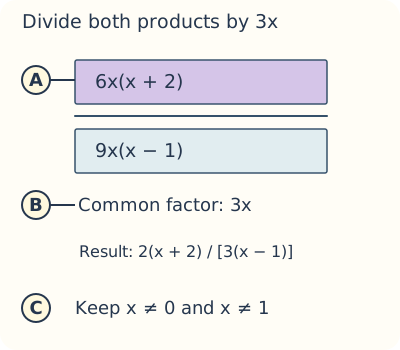
In 6x(x + 2)/[9x(x − 1)], x is a complete factor of both numerator and denominator. For x ≠ 0,1 the reduced fraction is 2(x + 2)/[3(x − 1)]. In (x + 2)/x, x is not a factor of the whole numerator: division gives 1 + 2/x, not 2. Cancellation means dividing top and bottom by the same nonzero factor; it never means erasing matching letters wherever they appear.
Reduce coefficients and powers separately
For 12x³y²/(18x²y), the coefficient ratio is 2/3 and the shared x²y cancels, giving 2xy/3 for x,y ≠ 0. For 6x²/(9x⁵), reduce to 2/(3x³), retaining x ≠ 0. Expand powers of products correctly: (2x)³ = 8x³. The highest common factor belongs to whole products; subtract exponents only when dividing powers with the same base.
Factor polynomials before reducing
Use x² − 9 = (x − 3)(x + 3). Then (x² − 9)/(x − 3) reduces to x + 3 for x ≠ 3. For (x² − 5x + 6)/(x² − 4), factor the top as (x − 2)(x − 3) and the bottom as (x − 2)(x + 2); the result is (x − 3)/(x + 2), still with x ≠ 2,−2. Lowest form has no common polynomial factor left.
Recognise whole squares, cubes and grouped terms
Treat b + c as one term when factoring a² − b² − 2bc − c² = a² − (b + c)². Its factors are (a − b − c)(a + b + c). Also a² + 2ab + b² − c² = (a + b − c)(a + b + c). Their quotient reduces to (a − b − c)/(a + b − c), but both original denominator factors must remain nonzero. Higher-degree factors use the same square/cube identities from chapter 4.
A shorter form does not restore a forbidden input
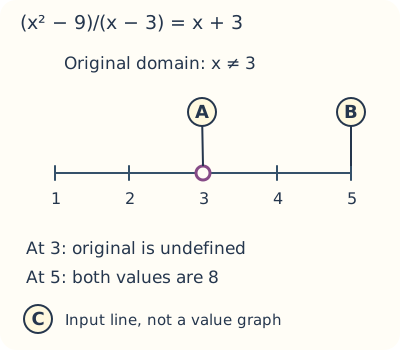
The graph or value rule for (x² − 9)/(x − 3) agrees with x + 3 wherever the original is defined. At x = 3 the original is 0/0, not 6. A number-line drawing marks an excluded input with an open circle; it is a domain guide, not a plotted fraction graph. Record all distinct excluded roots, even when a factor was repeated or cancelled.
Choose each denominator factor at its largest needed power
A common denominator is divisible by each denominator. For 6x²y and 9xy³, the least positive numerical content is 18 and the needed powers are x² and y³, so use D = 18x²y³. The respective multipliers are 3y² and 2x. For x² − 1 and x² − x, factor first: D = x(x − 1)(x + 1). The original exclusions are x ≠ −1,0,1.
Multiply the entire numerator by the missing factor
If D is the chosen common denominator, rewrite P/Q as P(D/Q)/D; multiply top and bottom equally. For 1/(x − 1) and 2/(x + 1), the common forms are (x + 1)/(x² − 1) and 2(x − 1)/(x² − 1). Reversed factors differ by a sign: 2 − x = −(x − 2). The printed page 80 activity has a² − 4b, not a² − 4b²; do not assume it equals (a − 2b)(a + 2b). A safe common denominator for that printed pair is (a + 2b)(a² − 4b).
Worked example
For (x² − 7x + 10)/(x² − 25), factor to (x−5)(x−2)/[(x−5)(x+5)]. Cancel x−5 only for x≠5, giving (x−2)/(x+5), with x≠5,−5. At x=7 both forms give 5/12; at x=5 the original remains undefined.
Record every original nonzero denominator and, for division, the nonzero divisor. Identify the operation and factor complete expressions.
Show a common denominator for addition/subtraction or a reciprocal for division. Cancel only complete common factors and preserve brackets.
Check a permitted numerical input and retain the original exclusions. Compare full written reasoning with the model; the automatic checker handles only the requested finite answer.
Domain is part of the result
A simplified formula without its original restrictions can describe additional inputs. Keep the excluded values beside the final fraction.
The source denominator stays literal
The printed page 80 activity uses a²−4b. The companion explains a safe product denominator instead of silently changing b to b².
Read the whole original denominator
Restrictions are found before cancellation. These are original teaching examples.
Read the whole original denominator
Original expression
Reduced form
Original restriction
(x²−9)/(x−3)
x+3
x≠3
(x²−5x+6)/(x²−4)
(x−3)/(x+2)
x≠2,−2
6x²/(9x⁵)
2/(3x³)
x≠0
(x−2)/(2−x)
−1
x≠2
At x=3 the first original is 0/0, so its value is undefined. The displayed x+3 is only an equivalent value rule on the original domain.
A denominator inventory supplies the multiplier
Take denominators 6x²y and 9xy³, with x,y nonzero.
A denominator inventory supplies the multiplier
Factor/content
First
Second
Chosen in D
Numerical content
6
9
18
Power of x
2
1
2
Power of y
1
3
3
Multiplier to reach D
3y²
2x
D=18x²y³
Check 6x²y×3y²=18x²y³ and 9xy³×2x=18x²y³. Multiply each entire numerator by the same respective multiplier.
Reduction preserves the original domain
Factor numerator and denominator before cancelling.
Real variables restricted by both original denominators.
x³±y³
Use the complete linear and quadratic cube factors.
Factor x³−y³=(x−y)(x²+xy+y²).
Factor x²−y²=(x−y)(x+y) and x³+y³=(x+y)(x²−xy+y²).
Cancel x−y and x²−xy+y² on the original domain.
At x=2,y=1 the result is 7/9; direct evaluation gives 21/27.
Retain x²−y²≠0 and x³+y³≠0; the reduced denominator alone does not describe every original restriction.
Explore the mathematical figures
Match each letter to its explanation. Read the quantities, units and relationships, then check the counts or equations. These are original teaching models.
Cancel a whole common factor
Trace the same divisor on both sides of the fraction bar. Contrast this with (x+2)/x, whose numerator does not have factor x.
A · Whole products
The numerator and denominator are products of complete factors.
B · Common nonzero divisor
Divide both by 3x, requiring x≠0.
C · Original domain
x=1 is also excluded by x−1; both exclusions survive.
Original symbolic schematic. Box widths organise factors, not numerical magnitudes or lengths.
Explore the mathematical figures
Match each letter to its explanation. Read the quantities, units and relationships, then check the counts or equations. These are original teaching models.
A cancelled factor leaves an excluded input
The open circle marks a forbidden input, not a zero output. The line is not a graph of the fraction’s values.
A · Excluded 3
The original denominator is zero, so the fraction is undefined.
B · Allowed 5
The original and reduced expressions both give 8.
C · Domain condition
x≠3 remains part of the reduced result.
Original domain schematic, equally spaced integer ticks; the real line continues beyond the displayed interval.
Your written practice
Show your working on paper. Check your answer, then choose Next.
Show model answer and explanation
2
5 − 3 = 2, so substitution is allowed.
Show model answer and explanation
4
The denominator is zero exactly at x = 4.
Show model answer and explanation
4
The reduced form is 2xy/3; 2 × 3 × 2 / 3 = 4.
Show model answer and explanation
3
Divide coefficients by 5 and cancel ab: 3a/(2b), with a,b nonzero.
Show model answer and explanation
3
The denominator retains x^(5−2) = x³; x ≠ 0.
Show model answer and explanation
8
(25 − 9)/(5 − 3) = 16/2 = 8.
Show model answer and explanation
1
Only x = 3 makes its original denominator zero.
Show model answer and explanation
7
6/21 reduces to 2/7.
Show model answer and explanation
-1
The factor subtracts the complete sum b + c.
Show model answer and explanation
18
The least common multiple of 6 and 9 is 18.
Show model answer and explanation
2
Use the larger exponent, max(2,1) = 2.
Show model answer and explanation
3
Use max(1,3) = 3.
Show model answer and explanation
4
The missing factor is x, which equals 4.
Show model answer and explanation
-1
3/(−3) = −1; reversed differences have opposite signs.
Show model answer and explanation
2
The two excluded values are 2 and −3; repeated factors do not create extra distinct values.
Write in your own words. A guardian or teacher should review this response.
Show model answer and explanation
Numerator 2x − 1, denominator x + 5, and x ≠ −5. A numerator of zero is allowed if the denominator is nonzero.
Identify both whole expressions and derive the excluded value.
Write in your own words. A guardian or teacher should review this response.
Show model answer and explanation
3x²/(4y), with x ≠ 0 and y ≠ 0. Divide by 6x²y²; x remains excluded even after disappearing from the denominator.
Show the common factor and retain both original restrictions.
Write in your own words. A guardian or teacher should review this response.
Show model answer and explanation
36x/y, with x,y ≠ 0. Numerical ratio is 16×16×243/(27×64) = 36; powers leave x/y.
Expand product powers before reducing coefficients.
Write in your own words. A guardian or teacher should review this response.
Show model answer and explanation
(x − 2)/(x + 5), with x ≠ 5,−5; factor the numerator as (x − 5)(x − 2).
Check both original roots, not only the remaining denominator.
Write in your own words. A guardian or teacher should review this response.
Show model answer and explanation
(x − 3)/(x − 5), with x ≠ 4,5, by cancelling x − 4.
Expand both factorizations and preserve the cancelled exclusion.
Write in your own words. A guardian or teacher should review this response.
Show model answer and explanation
(a − b − c)/(a + b − c), with a + b − c ≠ 0 and a + b + c ≠ 0. Both polynomials are differences of squares after grouping.
Name b+c and a+b as complete grouped expressions.
Write in your own words. A guardian or teacher should review this response.
Show model answer and explanation
(x² + xy + y²)/(x + y)² on the original domain. Factor cubes and squares; original factors x−y, x+y and x²−xy+y² must be nonzero.
Do not drop original exclusions or claim an equality at (0,0).
Write in your own words. A guardian or teacher should review this response.
Show model answer and explanation
a(a² + ab + b²)/[b(a² + b²)(a² − ab + b²)]. Use (a+b)² and the cube factors, then cancel (a+b)²(a−b). Retain (a³+b³)(a⁴b−b⁵) ≠ 0.
Check cancellation by expanding factors and state the original denominator condition.
Write in your own words. A guardian or teacher should review this response.
Show model answer and explanation
x is not a factor of the whole numerator. The expression is 1 + 6/x for x ≠ 0; at x = 3 it is 3, not 6.
Use both structural reasoning and a permitted counterexample.
Write in your own words. A guardian or teacher should review this response.
Show model answer and explanation
They agree for x ≠ 3; the original is undefined at 3 while x+3 is defined there. Cancellation preserves values on the original domain, not the missing input.
Mark an open circle at 3 on a domain line and label its meaning.
Write in your own words. A guardian or teacher should review this response.
Show model answer and explanation
Use 6x²y³: the numerators become 4y² and 5x. Require x,y ≠ 0.
Multiply entire numerators by their missing factors.
Write in your own words. A guardian or teacher should review this response.
Show model answer and explanation
D=x(x−1)(x+1); numerators x and 2(x+1). Require x ≠ −1,0,1.
Inventory all factors and keep parentheses around x+1.
Write in your own words. A guardian or teacher should review this response.
Show model answer and explanation
Use ybn with y,b,n nonzero. The equivalent numerators are xbn, ayn and myb. It is a valid symbolic common denominator; special numerical choices may admit a smaller one.
Divide the chosen denominator by each original denominator before rewriting.
Write in your own words. A guardian or teacher should review this response.
Show model answer and explanation
(a−2b)(a+2b)=a²−4b², which is different. A valid common denominator is (a+2b)(a²−4b); retain both nonzero conditions. Do not silently insert a missing square.
State what is actually printed and distinguish an assumption from an identity.
Write in your own words. A guardian or teacher should review this response.
Show model answer and explanation
It equals −1 for x ≠ y because y−x=−(x−y). At equality both numerator and denominator are zero, so the original is undefined.
Explain the sign and the excluded equality.
Progress and browser storage
Notebook challenge, sources and further study
Your algebraic-fraction notebook
Make a factor-and-domain notebook with two monomial fractions, two polynomial fractions and one common-denominator pair.
Review with a guardian or teacher
Write original denominator conditions before cancelling and show the common factor.
Use a factor inventory and show every numerator multiplier.
Check a permitted input, mark exclusions and ask for review of symbolic equivalents.
Keep your work on paper or in a local file. This page does not upload it or automatically grade the project.
Chapter companion and further study
This original Kidemy practice follows the topic order of 2026 Class 8 Mathematics · English Version, chapter 5, printed pages 77–100. It does not replace the complete chapter or its practical teaching.
Fresh tasks map the chapter methods rather than reproduce every printed question. Keep full working and review source exercises and alternative equivalent forms with a guardian or teacher.
A cancelled denominator remains excluded. A divisor must also be nonzero. Later Class 8 chapters remain in preparation.
Teacher-led lessons, schedules and prices for this outline are upcoming. You can use any starter practice above now without booking.
Your next step
Solo practice works without an account. Sign in to save a practice record to your learner profile.
Keep practising
Exact lesson links and related activities are labelled separately. Return-to-course links retain your selected learning path.