2026 Class 8 Mathematics · English Version · Chapter 4 · Chapter companion part
Chapter 4C: Factorisation and middle-term splitting
Choose a factor method, split signed middle terms, handle substituted quadratics and verify the result by expansion.
About this lesson and its coverage
Class 8 English Version: part C of the chapter 4 companion. Eight sections and 30 written tasks. Selected companion coverage, not complete textbook coverage; use all four parts and compare the mapped source methods. The software checks stated numerical values or coefficients; symbolic work, equivalent forms and proofs need guardian or teacher review.
A factor divides an expression exactly in the chosen polynomial setting. Factoring reverses multiplication. First extract a common numerical/variable factor: 12x³y² + 18x²y = 6x²y(2xy + 3). Additive terms are not automatically factors; x + 2 is a sum, while x(x + 2) is a product. Expanding the proposed product checks the whole expression.
Grouping exposes a repeated expression
For ax + ay + bx + by, group a(x + y) + b(x + y), then factor (a + b)(x + y). Terms may be reordered, but signs must move with them. If two grouped brackets are opposites, factor out −1 from one bracket before combining. Do not discard an unmatched term to manufacture a common bracket.
Recognise squares or make a difference of squares
9x² − 12xy + 4y² = (3x − 2y)². A complete-square expression can also be followed by a subtraction: x² + 4xy + 4y² − 9z² = (x + 2y − 3z)(x + 2y + 3z). Adding and subtracting the same expression does not change a polynomial; use it transparently to complete a square rather than insert an unmatched term.
Extract a common factor and continue with cubes
2x⁴ + 54xy³ = 2x(x³ + 27y³) = 2x(x + 3y)(x² − 3xy + 9y²). For x⁶ − y⁶, start with a difference of squares or cubes and continue: (x − y)(x + y)(x² + xy + y²)(x² − xy + y²). Say over which coefficient domain the factorisation is complete; do not stop at an expression that still has a known factor pattern.
A monic quadratic needs both a sum and a product
Monic means the coefficient of x² is 1. For x² + px + q, find signed integers m,n with m + n = p and mn = q; then factor (x + m)(x + n). Positive q gives equal signs, chosen by the sum; negative q gives opposite signs. For x² + 9x + 20, choose 4 and 5. For x² − 9x + 20, choose −4 and −5. Checking the product alone is insufficient.
For a nonmonic quadratic split using ac
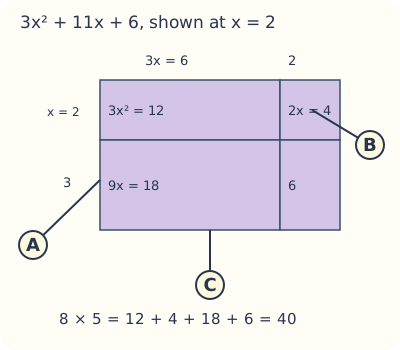
For ax² + bx + c with a ≠ 0, seek m + n = b and mn = ac. In 3x² + 11x + 6, ac = 18 and 2 + 9 = 11. Rewrite 3x² + 2x + 9x + 6 = x(3x + 2) + 3(3x + 2) = (3x + 2)(x + 3). The split numbers are middle-term coefficients; they do not necessarily become the constants in two monic factors. With p as the variable and q as a parameter, 2p² − 7pq + 3q² splits as 2p² − 6pq − pq + 3q² and factors as (2p − q)(p − 3q).
Treat a repeated expression as one temporary variable
For (x² − x)² + 2(x² − x) − 8, set u = x² − x. Then u² + 2u − 8 = (u + 4)(u − 2). Substitute back and continue: (x² − x + 4)(x − 2)(x + 1). Parameter expressions also serve as coefficients: x² + (3a + 4b)x + (2a² + 5ab + 3b²) factors as (x + a + b)(x + 2a + 3b). Verify both the linear sum and the constant product.
State the domain and verify the final product
Integer-pair search does not always succeed: x² + 1 has no integer linear factors. The pairs with integer product 1 are (1,1) and (−1,−1); neither sum is 0. An identity such as ax² + (a² + 1)x + a = (ax + 1)(x + a) holds even at a = 0, but it is then not a quadratic in x. Expanding is a general verification; trying one numerical input can miss an incorrect factorisation.
Worked example
For 4x² + 8x + 3, ac = 12 and split 8 as 6 + 2. Then 4x² + 6x + 2x + 3 = 2x(2x + 3) + (2x + 3) = (2x + 1)(2x + 3). Expansion recovers 4x² + 8x + 3.
Identify the structure, define any substituted expression and state nonzero or positive-length conditions.
Write the identity or factor method, substitute entire terms including their signs, and show every step.
Expand to verify factors or substitute back to check a value. Write the requested number for a check; review full algebra and proofs with a guardian or teacher.
The same polynomial has equivalent factor orderings
A reviewer should accept reordered factors and paired sign changes when their product is unchanged. An exact string match cannot fairly grade all such answers.
Integer factor search has a boundary
If no integer pair works, recheck the coefficients and domain. Do not fabricate a pair or silently switch to complex factors.
Signed pairs must pass both tests
Original examples of monic quadratic middle-term pairs.
Signed pairs must pass both tests
Polynomial
Pair
Sum / product
x² + 9x + 20
4, 5
9 / 20
x² − 9x + 20
−4, −5
−9 / 20
x² + 2x − 15
−3, 5
2 / −15
x² − 2x − 15
−5, 3
−2 / −15
For negative constant −15, the signs are opposite. Choose their magnitudes and signs so the sum also matches; multiplying to −15 alone is not enough.
Extract a common factor, group and verify
Factoring reverses multiplication without dropping any term.
Select 2 and 9 because their sum is 11 and product 18.
Group the four terms into two copies of 3x + 2.
Expand the final product: 3x² + 9x + 2x + 6.
The split pair need not equal the constants in two monic factors. If no integer pair works, recheck the input and coefficient domain.
Substitute back and continue factoring
A temporary variable represents the same expression everywhere.
u = x² − x
u² + 2u − 8 = (u + 4)(u − 2)
= (x² − x + 4)(x² − x − 2)
= (x² − x + 4)(x − 2)(x + 1)
u
A temporary name for the complete expression x² − x.
x
The original variable, recovered in the final line.
Find the pair 4 and −2 for the quadratic in u.
Replace every u by x² − x.
Factor x² − x − 2 with pair −2,1.
The remaining x² − x + 4 has no integer linear factor pair.
Do not leave u in the final answer unless the task asks for it. Completeness is relative to integer coefficients in this example.
Explore the mathematical figures
Match each letter to its explanation. Read the quantities, units and relationships, then check the counts or equations. These are original teaching models.
A split middle term gives a rectangle
Follow the four products from the side partitions. Algebraic grouping proves the factorisation for all x; the positive rectangle is one illustration.
A · Factor sides
At x = 2 the lengths are 8 and 5; their product is 40.
B · Split 11x
2x + 9x = 11x, matching split coefficients 2 and 9 with product 18 = ac.
C · Expanded area
3x² + 11x + 6 has value 12 + 22 + 6 = 40.
Original proportionate rectangle at the explicitly chosen x = 2. The drawing is not a physical model for negative side lengths.
Explore the mathematical figures
Match each letter to its explanation. Read the quantities, units and relationships, then check the counts or equations. These are original teaching models.
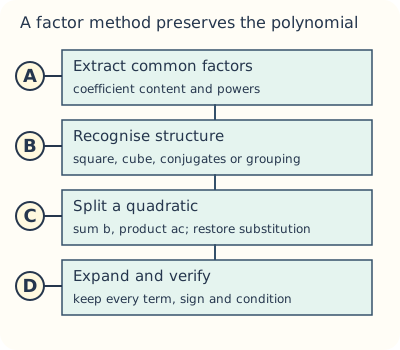
A factor method keeps every term
Use this as a decision aid, not a claim that every polynomial has integer linear factors. Stop and state the domain if no valid pair exists.
A · Common factor first
Check the coefficient content and minimum variable powers.
B · Structure next
Try a square, cube, conjugate pair or repeated bracket.
C · Middle-term conditions
For ax²+bx+c use sum b and product ac, with a nonzero.
D · Verify the product
Restore any temporary expression and expand all factors.
Original symbolic guide. Arrows show a reasoning sequence, not mandatory trial steps for every expression.
Your written practice
Show your working on paper. Check your answer, then choose Next.
Show model answer and explanation
6
The greatest common divisor of coefficients 12 and 18 is 6.
Show model answer and explanation
2
The common exponent is min(3,2) = 2.
Show model answer and explanation
4
4 + 5 = 9 and 4 × 5 = 20.
Show model answer and explanation
5
The larger addend is 5.
Show model answer and explanation
-5
−5 + (−4) = −9 and their product is 20.
Show model answer and explanation
-3
−3 + 5 = 2 and (−3) × 5 = −15.
Show model answer and explanation
-5
−5 + 3 = −2 and (−5) × 3 = −15.
Show model answer and explanation
18
a = 3 and c = 6, so ac = 18.
Show model answer and explanation
2
The pair is 2 and 9.
Show model answer and explanation
2
Expanding (3x + 2)(x + 3) gives 3x² + 11x + 6.
Show model answer and explanation
-6
−6 and −1 sum to −7 and multiply to 6.
Show model answer and explanation
4
4 − 2 = 2 and 4 × (−2) = −8.
Show model answer and explanation
24
(5 − 1)(5 + 1) = 4 × 6 = 24.
Show model answer and explanation
63
2⁶ − 1 = 64 − 1 = 63.
Show model answer and explanation
0
The pairs (1,1) and (−1,−1) have sums 2 and −2; neither qualifies.
Write in your own words. A guardian or teacher should review this response.
Show model answer and explanation
6x²y(2xy + 3). The common coefficient is 6; minimum exponents are x² and y.
Expand the result and retain both original terms.
Write in your own words. A guardian or teacher should review this response.
Show model answer and explanation
a(x + y) + b(x + y) = (a + b)(x + y).
Reordering is allowed; every sign and term must be preserved.
Write in your own words. A guardian or teacher should review this response.
Show model answer and explanation
(3x − 2y)². The middle term is −2 × 3x × 2y.
Check both outer squares and the signed middle product.
Write in your own words. A guardian or teacher should review this response.
Show model answer and explanation
(x + 2y)² − (3z)² = (x + 2y − 3z)(x + 2y + 3z).
Show the complete-square stage before using conjugates.
Write in your own words. A guardian or teacher should review this response.
Show model answer and explanation
2x(x³ + 27y³) = 2x(x + 3y)(x² − 3xy + 9y²).
Do not leave the recognised cube sum unfactored.
Write in your own words. A guardian or teacher should review this response.
Show model answer and explanation
(x − y)(x + y)(x² + xy + y²)(x² − xy + y²). Start with (x³ − y³)(x³ + y³), then factor both cubes.
Expand paired factors or apply both cube identities to verify.
Write in your own words. A guardian or teacher should review this response.
Show model answer and explanation
The first is (x + 4)(x + 5); the second is (x − 4)(x − 5). Both constant products are 20, while the sums are 9 and −9.
Require sum and product checks for both rows.
Write in your own words. A guardian or teacher should review this response.
Show model answer and explanation
The first is (x − 3)(x + 5); the second is (x − 5)(x + 3). The products are negative and the larger-magnitude signed addend determines the sum.
Check both signed sums as well as products.
Write in your own words. A guardian or teacher should review this response.
Keep the parameter and the minus sign when extracting the second group.
Write in your own words. A guardian or teacher should review this response.
Show model answer and explanation
With u = x² − x, factor (u + 4)(u − 2). Substitute back: (x² − x + 4)(x² − x − 2) = (x² − x + 4)(x − 2)(x + 1).
The remaining quadratic has no integer pair with product 4 and sum −1.
Write in your own words. A guardian or teacher should review this response.
Show model answer and explanation
(x + a + b)(x + 2a + 3b). The constant product (a + b)(2a + 3b) is 2a² + 5ab + 3b².
Verify the full coefficient sum and constant product, treating a,b as parameters.
Write in your own words. A guardian or teacher should review this response.
Show model answer and explanation
(ax + 1)(x + a). Expansion proves it for every a. At a = 0 it becomes x, so the identity holds but the expression is no longer quadratic in x.
Do not divide by a without stating a ≠ 0.
Write in your own words. A guardian or teacher should review this response.
Show model answer and explanation
This is (a − b)³ − b³, so it equals (a − 2b)(a² − ab + b²).
Show the extra −b³ and expand to check the final three mixed coefficients.
Write in your own words. A guardian or teacher should review this response.
Show model answer and explanation
For a monic integer factorisation, the constants must multiply to ±1 and sum to 0. Product +1 allows only (1,1) or (−1,−1), neither with sum 0. Product −1 allows (1,−1), giving (x + 1)(x − 1).
State the integer-coefficient domain rather than saying no factorisation exists in any number system.
Progress and browser storage
Notebook challenge, sources and further study
Your algebra notebook
Create a factor-method decision card and five fully worked factorisations, including a substitution.
Review with a guardian or teacher
Extract common factors first and justify the signed sum/product or ac split.
Substitute temporary expressions back and continue a recognised factor pattern.
Expand every final product; state the coefficient domain and any degenerate parameter.
Keep your work on paper or in a local file. This page does not upload it or automatically grade the project.
Chapter companion and further study
This original Kidemy practice follows the topic order of 2026 Class 8 Mathematics · English Version, chapter 4, printed pages 48–76. It does not replace the complete chapter or its practical teaching.
Fresh companion practice follows the chapter methods, rather than reproducing every printed question. Keep full written working and review alternative factor orderings and proof reasoning.
All reciprocal expressions require nonzero denominators. Geometric drawings assume positive lengths; Original companions for all 11 chapter headings are available; independent source exercises and full working still need review.
Teacher-led lessons, schedules and prices for this outline are upcoming. You can use any starter practice above now without booking.
Your next step
Solo practice works without an account. Sign in to save a practice record to your learner profile.
Keep practising
Exact lesson links and related activities are labelled separately. Return-to-course links retain your selected learning path.