2026 Class 7 Science · English Version · Chapter 1 · Chapter companion part
Chapter 1B: Useful microbes and routes of infection
Explain useful microbial roles, distinguish routes of contamination, and make a safe, respectful hygiene plan.
Class 7 English Version: part B of the companion for chapter 1, Lower Organisms. Eight teaching sections, 30 written tasks and a notebook challenge. Selected companion coverage, not complete textbook coverage; practical and independent review remain.
Fungi are eukaryotes that absorb nutrients from organic material rather than photosynthesising. Many have branching filaments called hyphae; a network is a mycelium. Yeasts are single-celled fungi. Fungi form a separate kingdom, despite the source’s older plant-like description. A mushroom is a reproductive structure of some fungi, not the whole hidden network.
Useful and harmful are context-dependent
Decomposer fungi and bacteria break down dead organic material and recycle nutrients. Yeast produces carbon dioxide that helps bread dough rise; selected bacteria help make curd and separate jute fibres. Some microbes produce medically useful substances in controlled production. Other species spoil materials or cause disease. Never taste unknown fungi or grow mould for this online lesson.
Algae, pigments and water
Algae are diverse photosynthetic organisms, from microscopic forms to large seaweeds. Chlorophyll helps capture light, but other pigments can mask green colour. Some marine algae supply alginate, a useful thickener, and algae support aquatic food webs. Dense blooms and their decay can contribute to low dissolved oxygen; not every algal bloom is toxic and a picture cannot establish the cause of fish deaths.
Amoeba is not the same as every Entamoeba
Amoeba in a freshwater example and Entamoeba histolytica are not interchangeable names. E. histolytica can cause amebiasis, including amoebic dysentery; some other Entamoeba species do not cause that disease. A cyst is a resistant stage involved in transmission. A simple drawing or a learner’s symptoms cannot distinguish these infections: diagnosis belongs to a healthcare professional.
Trace contamination as a route
Contamination means unwanted germs or substances reaching something. Faecal contamination can pass from unsafe sanitation to water, food or fingers and then to a person’s mouth. The arrows describe a possible route, not proof that every dirty-looking item contains a particular microbe. Clear water can still contain microbes, and a water source must be assessed rather than assumed safe from appearance.
Break a route without blaming a person
Wash hands with soap and water after toilet use and before handling food. Keep food and drinking water protected and use safe sanitation. For fungal infections such as ringworm, avoid sharing personal towels and ask a guardian about professional advice. These measures reduce particular opportunities for spread; they do not guarantee that illness will never occur. Support an ill person without teasing or excluding them.
Different causes need different responses
A pathogen is an agent that can cause disease. Viruses, bacteria and fungi are different groups; a single medicine is not a remedy for all. The source’s plague example among virus-derived vaccines is misleading: plague is caused by the bacterium Yersinia pestis. A school exercise does not prescribe treatment. Tell a guardian about illness and seek appropriate professional care instead of self-medicating.
Plan a safe awareness activity
Use a fictional classroom plan to place handwashing reminders, protect drinking water and explain one route of contamination. Do not list classmates’ health, inspect other families’ toilets or collect names and addresses. Do not culture bread mould, handle waste, burn infected plants, spray chemicals or manage sick animals. Use pictures and supplied cases; responsible authorities and professionals handle real hazards.
Worked example
In a fictional lunch area, unwashed fingers touch prepared food. Washing hands before food handling interrupts that possible route. The story does not identify a pathogen or prove that a child became ill.
SourceUnsafe sanitation
TransferWater, food or fingers
EntryMouth
InterruptSafe sanitation, protected food and water, handwashing
Possible faecal contamination route and points where exposure can be reduced.
Identify the structure, evidence or route named in the question.
Link each feature to its function; include a labelled sketch where useful.
Compare with the model, explain a correction and try the independent task.
Book wording and correction
Printed page 4 says “Fungi are non-green thallophytic plants.” Fungi are a separate kingdom with eukaryotic cells and absorptive nutrition. Its broad statement that fungal diseases are highly contagious also needs care: spread differs between infections; do not diagnose or avoid an ill person from this sentence.
A source example that needs checking
Printed page 3 lists plague in a virus-derived vaccine example. Plague is bacterial. Keep that correction visible and discuss a source-dependent exam question with your teacher; this practice does not mark the viral claim correct.
Read the scientific images
Match each letter to its structure and function. These original study diagrams are simplified models, not microscope observations.
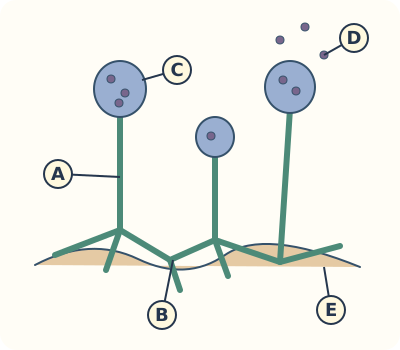
A filamentous fungus model
Distinguish a single filament, the whole network and the reproductive structures. Yeast is single-celled, so this branching form is not a model of every fungus.
A · Hypha
One threadlike fungal filament. It is not a plant root.
B · Mycelium
A branching network of hyphae; much of a fungus may be within its growth material.
C · Spore case
A simplified sporangium in this mould example; not every fungus has this same structure.
D · Spores
Reproductive units in this illustrated fungus. Do not confuse these with bacterial endospores or a parasite cyst.
E · Growth material
The depicted surface supplies organic material. Fungi absorb nutrients; the picture does not show green-plant photosynthesis.
Original explanatory addition to the chapter-opening fungus picture, not a copied micrograph or a home culture activity. Use supplied images; do not grow or handle mould.
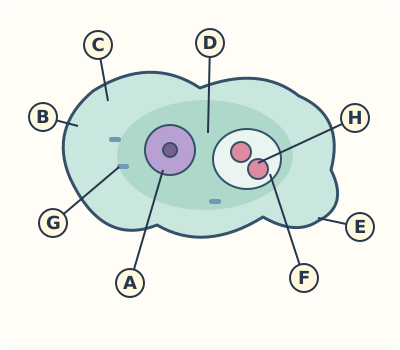
An Entamoeba study model
Separate the amoeba’s own structures from material it has engulfed. Entamoeba histolytica is a particular species; not every Entamoeba causes amebiasis.
A · Nucleus
A membrane-bound compartment. Its presence distinguishes a nucleated amoeba from a bacterium.
B · Plasmalemma
The cell membrane around the changing outline.
C · Ectoplasm
The clearer outer cytoplasmic region.
D · Endoplasm
The inner cytoplasm, containing the drawn inclusions.
E · Pseudopodium
A temporary extension, not a permanent limb.
F · Food vacuole
A space containing engulfed material; its contents vary.
G · Bacteria
The small rods depict engulfed bacteria, not organelles made by the amoeba.
H · Ingested red blood cells
Shown because the source figure includes them. Not every Entamoeba contains them, and this drawing cannot diagnose a species or infection.
Original schematic, not to scale. This is not a diagnostic slide. Even ingested red blood cells are not an infallible species test; specialist laboratory interpretation is needed.
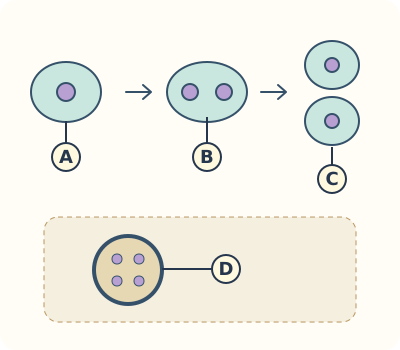
Division and a resistant stage are different
Explain which arrows show cell multiplication and why the separate cyst box represents a different concept. The book’s figure 1.8 mixes a multiple-fission title with Entamoeba labels and sporulation.
A · Trophozoite
The active feeding stage in this simplified Entamoeba explanation.
B · Nuclear division
Genetic material is distributed before the two cell bodies separate. This diagram is not a full account of cell division.
C · Binary fission
One cell gives rise to two daughter cells. CDC describes Entamoeba trophozoites multiplying by binary fission.
D · Cyst stage
A resistant stage associated with transmission. Four small circles represent nuclei in this mature-cyst model, not four daughter cells. A cyst is not a fungal spore or a virus.
Visible correction: the source’s mixed multiple-fission/sporulation sequence is not taught here as the life cycle of E. histolytica. Its label chromatin granules refers to genetic material associated with proteins, not free spores. This is a simplified corrected model, not its complete life cycle.
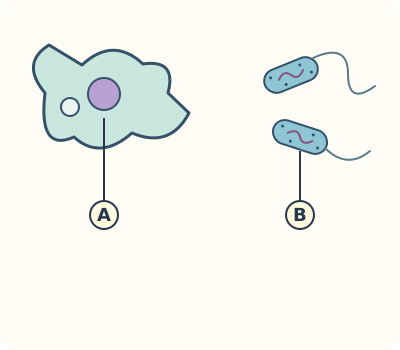
Read an unfamiliar image with evidence
State what the image supports and what remains unknown. Species, medical effect and actual size cannot be established from these simplified models without further evidence.
A · Amoeboid cell
An irregular outline, a nucleus and vacuolar spaces support this broad description, not a particular disease identification.
B · Rod-shaped bacterial model
Rods illustrate a bacterial shape. Thin external flagella in the model can help movement; they are not nuclei or the rods themselves.
The source exercise B is a micrograph-like image. This replacement is explicitly an original schematic, not a newly observed or relabelled micrograph; no scale bar is invented.
Your written practice
Show your working on paper and enter your answer here. If it does not match, compare the model and try again.
Show model answer and explanation
Fungi
Fungi are not plants, even though older descriptions called them plant-like.
Show model answer and explanation
yeast
Baker’s yeast releases a gas during fermentation.
Show model answer and explanation
carbon dioxide
Gas bubbles expand the dough.
Show model answer and explanation
decomposer
Decomposers include many fungi and bacteria.
Show model answer and explanation
algae
Algae are diverse; some are microscopic and others large.
Show model answer and explanation
chlorophyll
Other pigments can mask green colour.
Show model answer and explanation
alginate
Alginate is used as a thickener; it is not the name of an organism.
Show model answer and explanation
Entamoeba histolytica
Do not label every Amoeba or every Entamoeba species as this pathogen.
Show model answer and explanation
contamination
Contamination describes an unwanted presence, not a diagnosis.
Show model answer and explanation
soap
Soap and water are part of the stated hygiene step.
Write in your own words. A guardian or teacher should review this response.
Show model answer and explanation
Some fungi decompose dead matter or are used in food production; other species cause disease or spoil materials. The effect depends on the species and context.
Give a useful and a harmful role without treating all fungi as pathogens.
Write in your own words. A guardian or teacher should review this response.
Show model answer and explanation
Both examples have eukaryotic cells. A fungus absorbs organic nutrients; a green alga photosynthesises using chlorophyll under suitable conditions.
Shared cell organisation does not mean identical feeding.
Write in your own words. A guardian or teacher should review this response.
Show model answer and explanation
Low oxygen related to a bloom is one possibility, but pollution, temperature or other factors may contribute. Measurements and identification would be needed.
Separate a possible mechanism from a confirmed cause.
Write in your own words. A guardian or teacher should review this response.
Show model answer and explanation
Safe sanitation reduces contamination at its source; safe water and protected food reduce ingestion, and handwashing can interrupt transfer by fingers.
Link each action to a route; do not claim any action guarantees protection.
Write in your own words. A guardian or teacher should review this response.
Show model answer and explanation
Use your own clean towel and ask a guardian for appropriate advice. Support the person who is ill and do not tease, name or exclude them.
Give a practical action without stigma or a diagnosis.
Write in your own words. A guardian or teacher should review this response.
Show model answer and explanation
Several organisms have amoeboid forms. The pathogen is a particular species, and appearance in a simple diagram does not identify it or establish infection.
Keep names, species and diagnostic evidence distinct.
Write in your own words. A guardian or teacher should review this response.
Show model answer and explanation
Use supplied photographs or drawings to compare fungal structures without growing, opening, smelling or handling a mould culture.
Preserve the learning aim without introducing microbial exposure.
Write in your own words. A guardian or teacher should review this response.
Show model answer and explanation
Plague is caused by the bacterium Yersinia pestis. It should not be used as evidence that plague is caused by a virus.
Correct the causal group; no medicine or dosage is requested.
Write in your own words. A guardian or teacher should review this response.
Show model answer and explanation
Use a fictional classroom map and place handwashing, safe-water and food-protection reminders. Explain the routes they interrupt without names, household visits or health lists.
State the useful output and the privacy-preserving method.
Write in your own words. A guardian or teacher should review this response.
Show model answer and explanation
Hygiene reduces some routes of spread but cannot guarantee prevention. Tell a guardian and seek appropriate healthcare advice rather than making a diagnosis or choosing treatment from this lesson.
Avoid both an absolute promise and self-treatment advice.
Show model answer and explanation
B
B marks the network; A is a single hypha.
Show model answer and explanation
D
D marks reproductive units in this particular fungal model.
Show model answer and explanation
H
H marks engulfed material, not a required organelle.
Show model answer and explanation
binary fission
The corrected Entamoeba explanation uses binary fission.
Show model answer and explanation
cyst
A cyst is not a fungal spore or a virus.
Write in your own words. A guardian or teacher should review this response.
Show model answer and explanation
A hypha is one filament, a mycelium is their network, and the spore case is a reproductive structure in this example. It is not a root-and-flower system.
Use A, B and C accurately and avoid extending the model to every fungus.
Write in your own words. A guardian or teacher should review this response.
Show model answer and explanation
The nucleus, membrane and cytoplasm belong to the cell. Bacteria at G and red blood cells at H represent engulfed material, not its own organelles.
Compare the labelled categories rather than calling every internal shape an organelle.
Write in your own words. A guardian or teacher should review this response.
Show model answer and explanation
The book mixes a multiple-fission title, sporulation and Entamoeba labels. The corrected model describes trophozoites multiplying by binary fission and distinguishes the cyst stage.
Do not present the mixed source sequence as a verified E. histolytica life cycle.
Write in your own words. A guardian or teacher should review this response.
Show model answer and explanation
A schematic supplies selected features rather than a patient sample. Related organisms can look similar, and specialist testing and interpretation are required.
Use the model’s explicit limits; no symptom-based diagnosis is requested.
Write in your own words. A guardian or teacher should review this response.
Show model answer and explanation
A is a nucleated amoeboid model; B shows rod-shaped bacteria and flagella. The drawings do not establish exact species, size or the disease affecting a person.
Name visible evidence and a genuine information limit.
Your science notebook challenge
Make a one-page diagram of useful microbial roles and a separate fictional contamination route. Add a respectful hygiene reminder and one evidence limit.
Review with a guardian or teacher
Include bacteria, fungi and algae with accurate useful roles.
Link two prevention actions to specific arrows without promising complete protection.
Use no names, health details, cultures, waste handling or treatment instructions.
Keep your work on paper or in a local file. This page does not upload it or automatically grade the project.
Chapter companion and further study
This original Kidemy practice follows the topic order of 2026 Class 7 Science · English Version, chapter 1, printed pages 1–11. It does not replace the complete chapter or its practical teaching.