2026 Class 8 Mathematics · English Version · Chapter 11 · Chapter companion part
Chapter 11A: Organising records, tallies and frequency tables
Organise observations without losing records, choose non-overlapping groups and explain what each count represents.
About this lesson and its coverage
Class 8 English Version: part A of the Chapter 11 companion. Eight teaching sections and 30 original written tasks. Selected companion coverage, not complete textbook coverage; use all four parts. Written interpretation, chart drawing and complete working need guardian or teacher review.
Data are recorded observations. Statistics is the practice of organising, describing and learning from them. Our invented ten reading-session lengths are 12, 14, 14, 16, 18, 18, 18, 20, 22 and 28 minutes. Each number records one session, not one child’s ability. The observation count n=10 says how many sessions are listed. A table of these fictional records is a teaching example, not a report about real pupils.
Check how the records were obtained
Primary data are collected directly for your question; secondary data come from an existing source. The source says direct data are more reliable, but that is not guaranteed. A poorly measured direct record can be worse than a checked published dataset. Ask who collected it, how, when, which cases were included and whether units agree. Do not upload names, ages, heights or family details to practise this lesson; anonymous object counts work.
Sort the values, keep every repeat
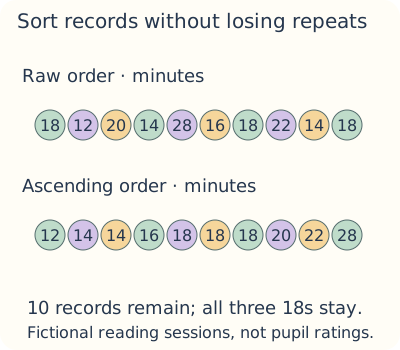
Ascending order goes from smallest to largest; descending order reverses it. Sorting changes positions, not the number or total of the observations. In our list, three separate 18-minute sessions remain three records. Equal values are not accidental duplicates to delete. Recheck the count after sorting and compare with the raw list. Missing and recorded-zero values are different: a missing measurement is not automatically zero.
Separate spread from inclusive counting
The usual range measures the spread from the smallest to largest value: maximum minus minimum. Our maximum 28 and minimum 12 give a range of 16 minutes. Printed page 172 adds one and calls the result range. For consecutive whole-number possibilities, 28−12+1=17 counts the possible integer values; it is an inclusive span, not a 17-minute measured distance. The plus-one rule does not apply to arbitrary decimals or continuous lengths.
Give every value exactly one home
A frequency is the number of observations in a named value or group. For whole-minute records, inclusive classes 10–14, 15–19, 20–24, 25–29 each cover five integers. For measurements rounded to the nearest minute, their continuous boundaries can be 9.5, 14.5, 19.5, 24.5, 29.5; choose lower-inclusive, upper-exclusive intervals to prevent overlap. Alternatively use directly defined intervals such as 10≤x<15. State the convention instead of counting a shared endpoint twice.
Choose a start and cover the largest value
For integer classes of width w beginning at lower limit L, enough classes are needed to cover the maximum M: round (M−L+1)/w upwards to the next whole number. This is a coverage count, not rounding to the nearest integer. For L=10, M=28, w=5, the quotient is 19/5=3.8, so four classes are needed. Changing the start can change the number and grouping. The book’s suggestion about five to fifteen is not a universal statistical rule.
A tally records one observation once
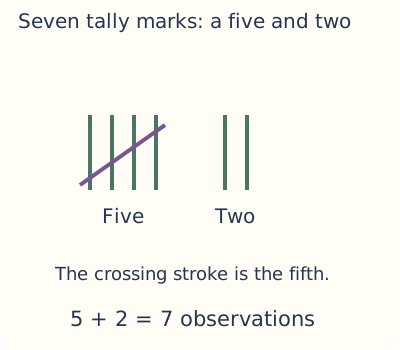
Tally marks are counting strokes, commonly grouped in fives by crossing the first four with the fifth. Seven records make one complete five and two additional strokes. For our four classes the frequencies are 3, 4, 2, 1. Their sum is 10, matching all ten sessions. Frequency is a count of records, not their sum in minutes. A class with no records still has frequency zero and should remain in a continuous interval sequence.
A correct table still has limits
A frequency table groups observations so patterns are easier to see, but intervals hide individual values. In our example 15–19 contains four sessions; it does not mean each lasted 17 minutes. Check the total, boundaries and missing entries before interpreting. A small convenient set of ten sessions does not establish what every learner does. The table describes these records; extending its conclusions needs a justified collection plan.
Worked example
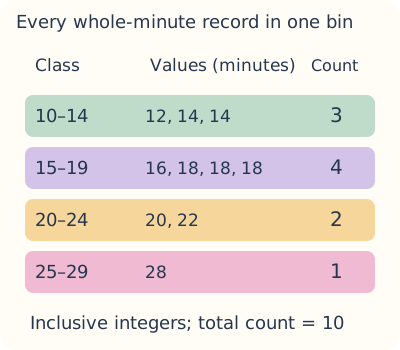
For our ten invented sessions, the inclusive classes 10–14,15–19,20–24,25–29 have frequencies 3,4,2,1. The total 10 confirms every listed session has been counted; it does not restore exact durations hidden by grouping.
Name the observations, unit, total and question. Explain what the requested summary or chart measures.
Show sorting, counts, boundaries or a fully labelled calculation. State whether the result is exact for the listed records or a grouped estimate.
Check totals, positions, units and arithmetic. Explain the result in context and say what the data cannot establish.
A source convention needs a label
Printed page 172 calls maximum−minimum+1 the range. We distinguish that integer inclusive span from the usual maximum−minimum spread.
Direct collection is not a quality guarantee
Primary and secondary describe provenance. Reliability depends on collection and checking, not the name alone.
Account for all ten invented sessions
Whole-minute observations; each listed repeat is a separate record.
Account for all ten invented sessions
Inclusive class (minutes)
Tally count
Frequency (sessions)
10–14
Three strokes
3
15–19
Four strokes
4
20–24
Two strokes
2
25–29
One stroke
1
Total
Ten strokes
10
Read 15–19 across: four records fall in that class. It does not mean the four durations total 4 minutes or that each lasted 17 minutes.
Limits and boundaries answer different questions
Nearest-minute records; boundaries use a lower-inclusive, upper-exclusive convention.
Limits and boundaries answer different questions
Integer limits
Continuous boundaries (minutes)
Width
10–14
9.5≤x<14.5
5 minutes
15–19
14.5≤x<19.5
5 minutes
20–24
19.5≤x<24.5
5 minutes
25–29
24.5≤x<29.5
5 minutes
14.5 belongs to the second interval under this stated rule. For already continuous measurements, choose appropriate original intervals instead of automatically adding half-unit corrections.
Check provenance instead of assuming reliability
These are illustrative collection plans, not measured results.
Check provenance instead of assuming reliability
Source type
Example
What still needs checking
Primary
Measure anonymous pencils directly
Zero alignment, instrument unit, which pencils, missing readings
Secondary
Use an existing checked table
Original method, date, units, coverage and copying errors
Primary means direct collection; secondary means reuse. Either can contain mistakes. The source’s automatic reliability comparison is too broad.
Count enough integer classes
Classes of width w begin at integer lower limit L and must include observed maximum M.
k = ceiling((M−L+1)/w)
L=10, M=28, w=5 ⇒ k=ceiling(3.8)=4
k
Number of complete rows needed to cover the chosen start through the maximum.
ceiling
Round upwards to a whole number, even when the remaining portion is small.
w
Positive integer class width; each inclusive row contains w integer possibilities.
State the chosen first lower limit.
Count integer possibilities through the maximum.
Divide by width.
Round upwards and check the final upper limit.
The usual numerical range is M−minimum. The source’s plus-one expression instead counts inclusive integer possibilities. Non-integer or continuous classes require their own boundary convention.
Explore the mathematical figures
Match each letter to its explanation. Read the quantities, units and relationships, then check the counts or equations. These are original teaching models.
Sort without deleting repeated values
Sorting changes positions, not the count or total. Both rows have total 180 minutes and retain every repeated observation.
Raw order
18,12,20,14,28,16,18,22,14,18 minutes as first listed.
Ascending order
12,14,14,16,18,18,18,20,22,28 minutes after sorting.
10 records
The observation count is unchanged; equal values can represent separate sessions.
Original diagram using fictional classroom records, not measured personal information or current statistics. Read the quantities, units and conventions beside the figure; colour alone does not carry the meaning.
Explore the mathematical figures
Match each letter to its explanation. Read the quantities, units and relationships, then check the counts or equations. These are original teaching models.
Read a five-stroke tally group
Crossing the first four adds the fifth stroke; it is not an extra mark after five upright strokes.
Five
Four upright strokes and one crossing stroke count five observations.
Two
The two separate strokes count the remaining observations.
7 observations
5+2 is a frequency count, not seven units of measured length.
Original diagram using fictional classroom records, not measured personal information or current statistics. Read the quantities, units and conventions beside the figure; colour alone does not carry the meaning.
Explore the mathematical figures
Match each letter to its explanation. Read the quantities, units and relationships, then check the counts or equations. These are original teaching models.
Assign each record to one class
The four counts total 10 sessions. These integer classes do not overlap; continuous measurements need an explicitly stated endpoint rule.
Class
Each row covers five integer possibilities with both listed limits included.
Values (minutes)
The actual observations in that class; repeated durations stay separate.
Count
Number of observations in that row, not the sum of their durations.
Original diagram using fictional classroom records, not measured personal information or current statistics. Read the quantities, units and conventions beside the figure; colour alone does not carry the meaning.
Your written practice
Show your working on paper. Check your answer, then choose Next.
Show model answer and explanation
10
There are ten session records; repeated lengths still count separately.
Show model answer and explanation
3
The value 18 occurs three times, representing three sessions.
Show model answer and explanation
16
28−12=16 minutes measures the spread.
Show model answer and explanation
17
28−12+1=17 possible integer values; this is an inclusive count.
Show model answer and explanation
5
The values 10,11,12,13,14 make five integers.
Show model answer and explanation
14
Five integers from 10 end at 14; the next starts at 15.
Show model answer and explanation
4
Round (28−10+1)/5=3.8 upwards to four classes.
Show model answer and explanation
3
The fixed classes are 10–14,15–19,20–24. A minimum-anchored calculation would answer a different question.
Show model answer and explanation
7
5+2=7 records; the crossing stroke is the fifth, not an extra sixth.
Show model answer and explanation
3
12,14,14 give three records.
Show model answer and explanation
4
16,18,18,18 give four records.
Show model answer and explanation
2
20 and 22 give two records.
Show model answer and explanation
10
3+4+2+1=10 observations, not ten minutes.
Show model answer and explanation
14.5
Half-unit boundaries put the class between 14.5 and 19.5 minutes under the stated convention.
Show model answer and explanation
2
The mismatch 20−18=2 requires a recount; do not guess their values.
Write in your own words. A guardian or teacher should review this response.
Show model answer and explanation
Each value is one session duration in minutes. n=10 counts sessions, including repeats; it does not count marks, ability or necessarily ten distinct children. These are fictional teaching records.
Name the observation, unit and count, then state the limits.
Write in your own words. A guardian or teacher should review this response.
Show model answer and explanation
Primary describes direct collection, not guaranteed quality. Check instruments, selection, missing records, date and independent validation. A checked secondary table may be more dependable than a careless direct survey.
Give a concrete collection-error example without inventing real evidence.
Write in your own words. A guardian or teacher should review this response.
Show model answer and explanation
Ascending order is 2,3,5,8,8. Both lists have five values and total 26; both 8s remain because they are separate observations.
Keep repeated values and verify both count and total.
Write in your own words. A guardian or teacher should review this response.
Show model answer and explanation
Sixteen minutes is the usual range, the distance between the extremes. Seventeen is the count of consecutive integer possibilities including both ends. Printed page 172 uses the second convention under the word range. State which question is intended.
Do not apply plus one to a continuous distance.
Write in your own words. A guardian or teacher should review this response.
Show model answer and explanation
One choice is 10–14,15–19,20–24,25–29, with both integer endpoints included. These cover all records once. Another start is possible, but it must be stated and checked.
List every interval and test the largest value and shared-edge cases.
Write in your own words. A guardian or teacher should review this response.
Show model answer and explanation
Use an explicit convention such as 10≤x<20 and 20≤x<30; then 20 belongs only to the second. If both endpoints were included in both classes, the table would overlap.
State all endpoint inequalities; final endpoints need an explicit rule too.
Write in your own words. A guardian or teacher should review this response.
Show model answer and explanation
A partial last class still needs a row to hold its largest records. Taking only three would leave some values outside. This is upward coverage rounding, not nearest-integer rounding.
Connect the decision to covering the maximum.
Write in your own words. A guardian or teacher should review this response.
Show model answer and explanation
Starting at 14 gives 14–18 and 19–23: two classes. Starting at 10 gives 10–14,15–19,20–24: three classes. The observed spread alone does not specify the origin.
Use two valid complete partitions and name each start.
Write in your own words. A guardian or teacher should review this response.
Show model answer and explanation
Draw four upright strokes and cross them with a fifth, then draw two more upright strokes. The total is 7. A text explanation or labelled drawing should distinguish groups and remaining strokes.
Check that the crossing mark is counted once.
Write in your own words. A guardian or teacher should review this response.
Show model answer and explanation
The four frequencies are 3,4,2,1 and total 10. The first group includes both 14 records, while the second includes all three 18 records. Every record is placed exactly once.
Show headings, inclusive integer convention and a total row.
Write in your own words. A guardian or teacher should review this response.
Show model answer and explanation
A zero row marks a real interval with no observed records. Deleting it and sliding later groups left changes the horizontal meaning and falsely suggests adjacency of different values.
Keep the interval at its correct horizontal position.
Write in your own words. A guardian or teacher should review this response.
Show model answer and explanation
For example count visible blocks in ten labelled fictional bags, or measure anonymous pencils in centimetres. State the question, one record per object, unit, instrument and missing-value rule. Report only what that collection supports.
Do not upload names, family ages or body measurements.
Write in your own words. A guardian or teacher should review this response.
Show model answer and explanation
There are four records in that interval. Their exact durations and order are hidden; they need not all equal the midpoint 17. The class count cannot alone describe all learners or establish a cause.
Name the lost information and avoid a wider claim.
Write in your own words. A guardian or teacher should review this response.
Show model answer and explanation
Zero is an observed numerical value. Missing means no usable observation was recorded. Treating missing as zero changes counts and summaries. State a checking and reporting rule instead.
Distinguish a measurement from the absence of a measurement.
Write in your own words. A guardian or teacher should review this response.
Show model answer and explanation
Check the question and unit, count every raw record, keep repeats, define non-overlapping boundaries, include zero intervals, verify frequency total and label fictional data. Note collection limits before interpreting.
Apply the checklist to the ten-session example.
Progress and browser storage
Notebook challenge, sources and further study
Your data detective notebook
Build and explain one checked frequency table.
Review with a guardian or teacher
Use fictional records or anonymous object measurements.
State unit, start, class width and endpoint rule.
Recount the total and explain one limitation.
Keep your work on paper or in a local file. This page does not upload it or automatically grade the project.
Chapter companion and further study
This original Kidemy practice follows the topic order of 2026 Class 8 Mathematics · English Version, chapter 11, printed pages 171–187. It does not replace the complete chapter or its practical teaching.
Original companions teach the mapped methods rather than reproduce every exact printed question. Review independent written solutions, measurements and chart construction.
Chapter headings across the book now have original companions. This does not certify every textbook exercise or other Class 1–8 subject; those audits remain separate.
Teacher-led lessons, schedules and prices for this outline are upcoming. You can use any starter practice above now without booking.
Your next step
Solo practice works without an account. Sign in to save a practice record to your learner profile.
Keep practising
Exact lesson links and related activities are labelled separately. Return-to-course links retain your selected learning path.