2026 Class 8 Mathematics · English Version · Chapter 1 · Chapter companion part
Chapter 1B: Sums, square decompositions and magic squares
Explain pair-sum formulae with diagrams, distinguish terms from totals and construct checked magic squares.
About this lesson and its coverage
Class 8 English Version: part B of the chapter 1 companion. Eight teaching sections, 30 written tasks and a notebook challenge. Selected companion coverage, not complete textbook coverage; use all three parts and review independent proofs and drawings with a teacher.
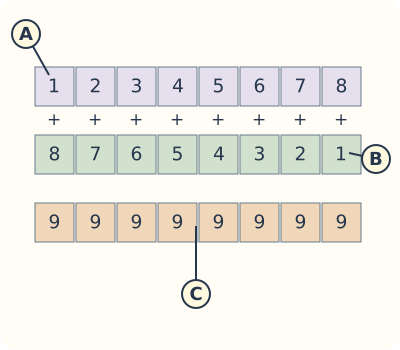
For 1 + 2 + ... + 8, pair 1 with 8, 2 with 7, 3 with 6 and 4 with 5. Four pairs each total 9, giving 36. A second copy in reverse order produces eight columns of 9, which count the original sum twice, so divide by 2. This reverse-copy method also works for an odd number of terms without pretending there are a whole number of pairs in one copy.
Use the arithmetic-sum conditions
For n terms with constant difference, S = n(first + last) ÷ 2. Both n and the endpoints matter. This formula sums an arithmetic sequence; it is not valid for every list with known endpoints. In the special list 1,2,...,n, first = 1 and last = n, giving n(n + 1) ÷ 2. A term is one entry; a sum adds all specified entries.
Odd layers build square numbers
Begin with one unit square. Add an L-shaped border of 3 to make 2 × 2, then 5 to make 3 × 3, then 7 to make 4 × 4. At stage n the added border has n units along one side and n − 1 along the other, totalling 2n − 1 without double-counting the corner. The sum of the first n positive odd numbers is n². The nth odd number itself is 2n − 1, a different expression.
A sum of two positive squares
To write N = a² + b², choose positive integers a and b and calculate both squares. For 50, 1² + 7² = 50 and 5² + 5² = 50; swapping a and b is not a new unordered representation. State whether zero is allowed: here it is not. Not every positive integer can be written this way. The source’s count of 35 values from 1 to 100 uses positive summands and counts each resulting value once.
What makes a normal magic square?
A normal order-m magic square uses each integer from 1 to m² exactly once, with every row, every column and both main diagonals having the same sum. Order means the number of rows or columns, not the total number of cells. Checking only the rows is insufficient. A grid with repeated numbers or a wrong diagonal is not a normal magic square just because one row adds correctly.
Construct and check order three
A normal 3 × 3 square uses 1 to 9 with centre 5 and line sum 15. One arrangement is 8,1,6 / 3,5,7 / 4,9,2. Corners are even in this arrangement and rotations or reflections give related valid arrangements. Check all three rows, all three columns and both diagonals. Adding the same constant c to every cell raises each line sum by 3c, but the new entries no longer form the normal 1-to-9 square.
Follow a four-by-four construction
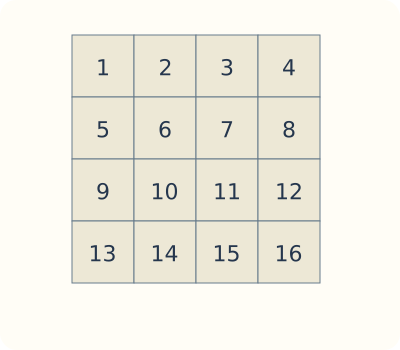
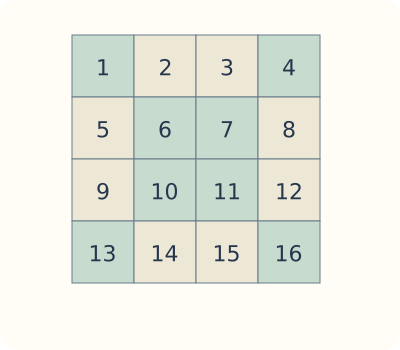
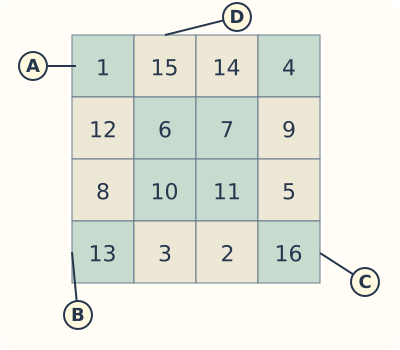
Write 1 to 16 row by row. In our chosen method, keep the eight positions on the two main diagonals. Replace every other entry x by 17 − x. The completed square is 1,15,14,4 / 12,6,7,9 / 8,10,11,5 / 13,3,2,16. Each row, column and main diagonal totals 34. The source uses another valid diagonal-complement orientation; do not mix the two procedures halfway through.
Understand the magic constant and try order five
The total of 1 to m² is m²(m² + 1) ÷ 2. Dividing it among m equal row sums gives the normal magic constant m(m² + 1) ÷ 2. For m = 5 it is 65. For an odd-order extension, place 1 in the top middle, move up-right with edge wrapping for the next value, and move down one from the previous cell when the next cell is occupied. This method is for odd orders; do not apply it to order four. Verify the supplied order-five table independently.
Worked example
For the first 12 positive odd numbers, the last is 23. The arithmetic sum gives 12 × (1 + 23) ÷ 2 = 144. The square diagram gives 12² = 144. Two routes agree because they count the same specified total.
State the rule and define the position variable before calculating.
Show the labelled figure, substitution and arithmetic; keep one figure separate from a sum of figures.
Check a small case and explain the result, then compare with the model response.
Keep the positive-integer convention visible
Natural number conventions differ. In the two-square search this companion requires a,b ≥ 1 and treats (a,b) and (b,a) as the same pair. The source count 35 is verified for that convention.
Different constructions can give different valid orientations
The source’s order-four diagonal replacement gives a rotated/complemented arrangement. This companion teaches a single keep-diagonals method and verifies it; either valid finished square still needs every check.
Arithmetic sum: reverse, add, divide by two
This counts all n terms in a constant-difference list, not a single nth term.
S = n(first + last) ÷ 2
1 + 2 + ... + n = n(n + 1) ÷ 2
S
Sum of all specified terms.
n
Number of terms, a positive integer.
first / last
Endpoints of the specified arithmetic list.
For 1 to 8, first = 1, last = 8, n = 8.
Two opposite copies make eight columns of 9.
2S = 8 × 9 = 72, so S = 36.
Check directly or pair (1,8), (2,7), (3,6), (4,5).
A list with changing differences, such as square numbers, does not meet this arithmetic-sum condition.
Odd borders: an nth term and a total
The new L-shaped border has two arms sharing one corner. The full figure is a square.
At n = 12, the last term is 23 and the total is 144.
Do not substitute 2n − 1 when the task asks for the sum, or n² when it asks for one odd term.
Two positive-square representations
Each pair is unordered and both entries must be at least 1.
Two positive-square representations
Target
One representation
Another representation
50
1² + 7² = 1 + 49
5² + 5² = 25 + 25
65
1² + 8² = 1 + 64
4² + 7² = 16 + 49
130
3² + 11² = 9 + 121
7² + 9² = 49 + 81
170
1² + 13² = 1 + 169
7² + 11² = 49 + 121
185
4² + 13² = 16 + 169
8² + 11² = 64 + 121
325
1² + 18² = 1 + 324
6² + 17² = 36 + 289; also 10² + 15²
Reversing the same pair is not a new representation. Not every integer has such a representation.
The normal magic constant
Sum the entries once, then divide by the number of equal row sums.
M = m(m² + 1) ÷ 2
m
Order: the number of rows and columns.
m²
Number of cells, using each integer 1 through m² once.
M
Required sum along any row, column or main diagonal.
Total of 1 through m² is m²(m² + 1) ÷ 2.
There are m equal row sums, so divide the total by m.
Order 3: 3 × 10 ÷ 2 = 15.
Order 4: 4 × 17 ÷ 2 = 34; order 5: 5 × 26 ÷ 2 = 65.
Equal totals are necessary but not enough: check distinct entries and both main diagonals too.
Build a four-by-four magic square step by step
Choose each stage or play the finite sequence. In this method the main-diagonal positions are kept and every other entry is complemented.
All stages: readable static alternative
1 · Fill the grid with 1 to 16: Write consecutive integers from left to right in each row. At this stage the grid is not a magic square.
2 · Keep both main diagonals: The highlighted diagonal positions stay fixed. Replace each unhighlighted value x with 17 − x; for example 2 becomes 15.
3 · Verify the completed square: Check all four rows, four columns and both main diagonals sum to 34. Check the integers 1 to 16 each occur exactly once.
No autoplay. Step buttons and all three static stages remain available. The two-second teaching pace is illustrative; reduced motion disables automatic playback.
Order-five extension: verify the supplied grid
Use the up-right wrapping rule for odd order; if the next cell is occupied, move down one from the previous cell.
Order-five extension: verify the supplied grid
Row
Column 1
Column 2
Column 3
Column 4
Column 5
1
17
24
1
8
15
2
23
5
7
14
16
3
4
6
13
20
22
4
10
12
19
21
3
5
11
18
25
2
9
Each row and column and both main diagonals total 65, with 1 to 25 used once. This extension method is not for even order.
Explore the mathematical figures
Match each letter to its explanation. Read the quantities, units and relationships, then check the counts or equations. These are original teaching models.
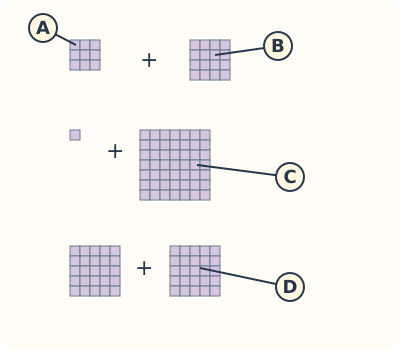
Two opposite copies count the sum twice
Columns make the endpoint pairing visible. Explain why two copies require division by two.
A · First copy
This row adds to S = 1 + 2 + ... + 8.
B · Reverse copy
Reordering adds the same values, so this row also totals S.
C · Eight columns of nine
The combined total is 2S = 8 × 9 = 72; dividing by two gives S = 36.
Original values and layout. The method generalises to an arithmetic list; it is not an endpoint formula for arbitrary non-linear lists.
Explore the mathematical figures
Match each letter to its explanation. Read the quantities, units and relationships, then check the counts or equations. These are original teaching models.
Odd borders grow a square
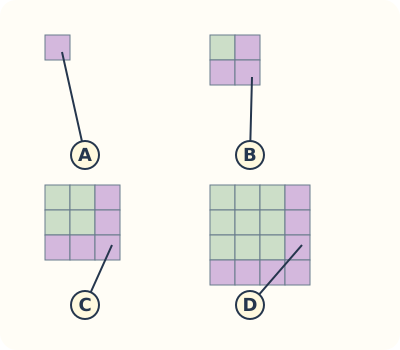
At stage n, the border has 2n − 1 cells while the total square contains n². Those are different quantities.
A · First odd layer
One cell forms 1².
B · Next border
Three added cells turn 1² into 2² = 4.
C · Five more
A new five-cell L extends 2² to 3² = 9.
D · Seven more
The next border extends 9 to 4² = 16; the corner is counted once.
Original unit-square count models, not a measured physical area. The new border is the bottom row plus right column with their corner counted once.
Explore the mathematical figures
Match each letter to its explanation. Read the quantities, units and relationships, then check the counts or equations. These are original teaching models.
Count two square blocks before adding their areas
Square the side counts, then add areas. The area of two separate squares is not generally the square of their combined side lengths.
A · Nine units
The first square is 3² = 9.
B · Sixteen units
The second is 4² = 16; together they give 25.
C · First representation of fifty
1² + 7² = 1 + 49 = 50.
D · A distinct second pair
5² + 5² = 25 + 25 = 50. Swapping one pair does not create a new pair.
Original square-area extension to the source numerical examples. Both side counts are positive integers and all cell units are equal within this plate.
Explore the mathematical figures
Match each letter to its explanation. Read the quantities, units and relationships, then check the counts or equations. These are original teaching models.
Check the three-by-three square in every direction
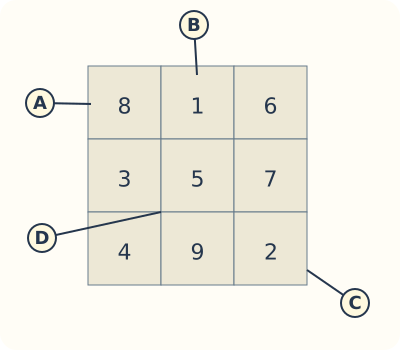
A row-only check cannot certify a magic square. Verify all eight lines and the distinct entry set.
A · Row check
8 + 1 + 6 = 15. Check the other two rows too.
B · Column check
1 + 5 + 9 = 15. All three columns must agree.
C · Main diagonal
8 + 5 + 2 = 15; the other main diagonal 6 + 5 + 4 also totals 15.
D · Centre
Five is the centre when the normal square uses 1 to 9. Each entry occurs exactly once.
Original orientation and layout of a standard magic square. Rotations and reflections can also be valid; order three means three rows, not three cells.
Explore the mathematical figures
Match each letter to its explanation. Read the quantities, units and relationships, then check the counts or equations. These are original teaching models.
A completed four-by-four square
Compare with the controlled construction sequence. This keep-diagonals method must not be mixed with a complement-diagonals method mid-construction.
A · Row sum
1 + 15 + 14 + 4 = 34; verify all four rows.
B · Column sum
1 + 12 + 8 + 13 = 34; verify all four columns.
C · Kept diagonal
1 + 6 + 11 + 16 = 34. The other main diagonal also totals 34.
D · Complemented cell
The original off-diagonal value 2 became 17 − 2 = 15.
Original arrangement using the standard complement property. Entries 1 to 16 appear once; the uncompleted seed grid is not magic.
Your written practice
Show your working on paper. Check your answer, then choose Next.
Show model answer and explanation
36
8 × 9 ÷ 2 = 36.
Show model answer and explanation
120
15 × 16 ÷ 2 = 120.
Show model answer and explanation
155
10 × (2 + 29) ÷ 2 = 155.
Show model answer and explanation
144
The sum is 12².
Show model answer and explanation
23
2 × 12 − 1 = 23; it is not the sum 144.
Show model answer and explanation
9
25 − 16 = 9, the fifth odd border.
Show model answer and explanation
7
50 − 1 = 49 = 7².
Show model answer and explanation
7
65 − 16 = 49 = 7².
Show model answer and explanation
15
Each row, column and main diagonal has this sum.
Show model answer and explanation
5
The centre is 5 when the entries are 1 to 9.
Show model answer and explanation
34
The total 136 is divided among four equal rows.
Show model answer and explanation
5
17 − 12 = 5; diagonal positions are kept in this method.
Show model answer and explanation
16
4 × 4 = 16, not four.
Show model answer and explanation
65
5 × (25 + 1) ÷ 2 = 65.
Show model answer and explanation
27
Each line contains three entries, so it increases by 3 × 4 = 12.
Write in your own words. A guardian or teacher should review this response.
Show model answer and explanation
Opposite endpoints make four pairs of 9, giving 36. Alternatively, two opposite copies give eight columns of 9, so 2S = 72 and S = 36.
Explain why division by 2 is needed.
Write in your own words. A guardian or teacher should review this response.
Show model answer and explanation
Write one copy forwards and one backwards. Each of n columns sums to n + 1, so 2S = n(n + 1) and S = n(n + 1)/2.
Two copies make the derivation work for odd as well as even n.
Write in your own words. A guardian or teacher should review this response.
Show model answer and explanation
These are squares, with non-constant differences, so the arithmetic-sum formula does not apply. Direct addition gives 1 + 4 + 9 + 16 = 30.
Check the formula’s conditions before calculating.
Write in your own words. A guardian or teacher should review this response.
Show model answer and explanation
Successive L-shaped borders of 1,3,5,... build a square with n unit cells along each side. Its area count is n × n. The new border adds n + (n − 1) cells, avoiding double-counting the corner.
Connect the border count to the total square, not just memorise a formula.
Write in your own words. A guardian or teacher should review this response.
Show model answer and explanation
The nth term is 2n − 1, so the eighth odd number is 15. The sum is n², so the first eight total 64.
Use both expressions and say what each measures.
Write in your own words. A guardian or teacher should review this response.
Show model answer and explanation
130 = 3² + 11² = 7² + 9². Each pair sums to 130, and swapping the order of one pair would not create a third representation.
Check all four squares and distinguish a new pair from a swap.
Write in your own words. A guardian or teacher should review this response.
Show model answer and explanation
325 = 1² + 18² = 6² + 17² = 10² + 15². The totals are 1 + 324, 36 + 289 and 100 + 225.
All summands must be positive and pairs distinct.
Write in your own words. A guardian or teacher should review this response.
Show model answer and explanation
List a² + b² for positive a ≤ b while the sum is at most 100, then remove duplicate totals. Allowing zero would introduce some perfect-square values that the positive-only definition excludes.
Use an explicit convention and count values rather than ordered pairs.
Write in your own words. A guardian or teacher should review this response.
Show model answer and explanation
For 8,1,6 / 3,5,7 / 4,9,2, every row and column sums to 15; diagonals 8 + 5 + 2 and 6 + 5 + 4 also sum to 15. Every number 1 to 9 occurs once.
Check all eight lines and distinct entries.
Write in your own words. A guardian or teacher should review this response.
Show model answer and explanation
Its columns or main diagonals may differ, or entries may repeat or lie outside 1 to 9. Check every defining condition.
Give a concrete possible failure, not an unsupported certificate.
Write in your own words. A guardian or teacher should review this response.
Show model answer and explanation
Fill 1 to 16 rowwise, identify both diagonals and keep those eight positions. Complement each other value using 17 − x, then check all rows, columns and both main diagonals total 34.
Do not complement diagonal entries in a method that says keep them.
Write in your own words. A guardian or teacher should review this response.
Show model answer and explanation
Each three-cell line gains 12, so its sum changes from 15 to 27. Equal line sums are preserved but the entries are now 5 to 13, so it is not normal using 1 to 9.
Separate the magic property from the normal-entry convention.
Write in your own words. A guardian or teacher should review this response.
Show model answer and explanation
The total of 1 to m² is m²(m² + 1)/2. Divide by m equal row sums to obtain m(m² + 1)/2. At m = 4, 4 × 17 / 2 = 34.
Name order, total entries and row count.
Write in your own words. A guardian or teacher should review this response.
Show model answer and explanation
Use up-right wrapping for an empty next cell and one step down from the previous cell if blocked. A supplied valid result is 17,24,1,8,15 / 23,5,7,14,16 / 4,6,13,20,22 / 10,12,19,21,3 / 11,18,25,2,9. Check all rows, columns and both main diagonals total 65.
Also check the integers 1 to 25 each occur exactly once; this odd-order method is not for order four.
Write in your own words. A guardian or teacher should review this response.
Show model answer and explanation
Choose a swap, recompute affected rows, columns and diagonals, and identify a failed condition. Some special swaps can preserve some lines, so check rather than assume.
Different valid counterexamples are accepted after human review.
Progress and browser storage
Notebook challenge, sources and further study
Your pattern notebook
Make a pairing proof, a coloured odd-border square and a checked magic square on paper.
Review with a guardian or teacher
Define each variable and distinguish a single term from a sum.
Check every row, column and main diagonal as well as distinct entries.
Explain a formula condition or counterexample and ask for review of the construction.
Keep your work on paper or in a local file. This page does not upload it or automatically grade the project.
Chapter companion and further study
This original Kidemy practice follows the topic order of 2026 Class 8 Mathematics · English Version, chapter 1, printed pages 1–11. It does not replace the complete chapter or its practical teaching.
Use the other two companion parts and review the complete source exercises independently.
Explanations, constructions and open alternatives need human review. Original companions for all 11 chapter headings are available; independent source exercises and full working still need review.
Teacher-led lessons, schedules and prices for this outline are upcoming. You can use any starter practice above now without booking.
Your next step
Solo practice works without an account. Sign in to save a practice record to your learner profile.
Keep practising
Exact lesson links and related activities are labelled separately. Return-to-course links retain your selected learning path.