2026 Class 8 Mathematics · English Version · Chapter 1 · Chapter companion part
Chapter 1A: Sequence rules, primes and digit reasoning
Describe repeated and growing patterns, apply an explicit sequence rule and explain prime sieving and digit reversals.
About this lesson and its coverage
Class 8 English Version: part A of the chapter 1 companion. Eight teaching sections, 30 written tasks and a notebook challenge. Selected companion coverage, not complete textbook coverage; use all three parts and review independent proofs and drawings with a teacher.
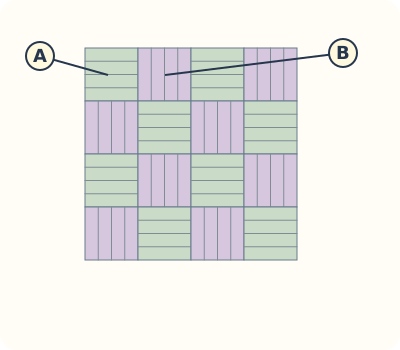
A pattern may repeat a tile orientation, add a fixed amount or follow another stated relationship. Describe what repeats or changes, not merely that the picture looks nice. A linear number pattern in this chapter has a constant difference between consecutive terms. A finite list can fit more than one continuation rule. Our automatically checked questions state the intended rule; a different well-explained continuation belongs in open review.
Read a number triangle
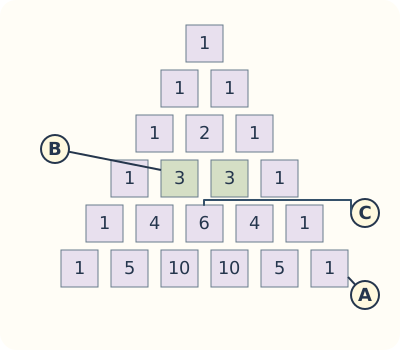
In the supplied triangle each outside edge is 1 and each interior entry is the sum of the two entries immediately above it. For example the row 1, 3, 3, 1 is followed by 1, 4, 6, 4, 1. Trace the two parents of the 6: 3 + 3. This is commonly called Pascal’s triangle. A row number and the value of an entry are different things; state whether you count the top row as row zero or row one.
Fixed addition and doubling are different rules
For the rule start at 4 and add 6, the terms are 4, 10, 16, 22, 28. Each difference is 6. For start at 3 and double, the terms are 3, 6, 12, 24, 48: the multiplier is fixed but the differences grow. Doubling is not a linear constant-difference pattern. A useful written answer names the starting value and operation, then applies it consistently.
Square and sum-of-previous-two patterns
The positive square numbers 1, 4, 9, 16, 25 are n² for n = 1, 2, 3, 4, 5. Their consecutive differences are 3, 5, 7, 9. For a Fibonacci-type rule, give two starting values and make every next term the sum of the previous two. Starting 2, 3 gives 2, 3, 5, 8, 13, 21. These are different rules; do not call every increasing list linear.
Prime means exactly two positive divisors
A prime is a whole number greater than 1 whose only positive divisors are 1 and itself. The number 1 is neither prime nor composite; a composite whole number greater than 1 has additional positive divisors. The source’s prime sentence omits itself, so read it with this correction. Two is the only even prime. Odd does not automatically mean prime: 9 = 3 × 3 is composite.
Use the sieve without crossing out the prime
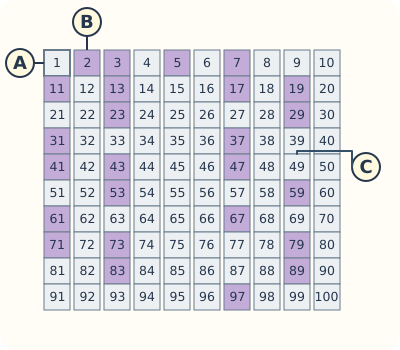
For a sieve from 1 to 100, exclude 1, keep 2 and cross out its proper multiples, then keep 3, 5 and 7 while crossing their remaining multiples. Starting at p² avoids repeating smaller multiples already crossed by smaller primes. Every composite up to 100 has a prime factor no larger than 10, so testing prime bases 2, 3, 5 and 7 is sufficient. There are 25 primes in this interval; that is a count for this exact range, not a prediction about any other interval.
Two-digit reversals reveal place value
Let a be the tens digit (1–9) and b the units digit (0–9). The number is 10a + b and its reversal has value 10b + a, even when b = 0. Adding gives 11(a + b), a multiple of 11. Their signed difference is 9(a − b); taking larger minus smaller gives 9 times the non-negative digit difference. Equal digits give zero, which is divisible by 9; no nonzero quotient is promised.
Three-digit reversal cancels the middle
For digits a, b, c, write the original value as 100a + 10b + c and the reversal as 100c + 10b + a. Their difference is 99(a − c); the middle-digit terms cancel. Example: 743 − 347 = 396 = 99 × 4. A reversal beginning with zero still has a numeric value, such as 120 → 021 = 21. This is a place-value proof, not a calculator coincidence.
Worked example
For 46 and 64, adding gives 110 = 11 × 10. The place-value explanation is 11 × (4 + 6). Testing one example illustrates the rule; the algebra explains why it holds for all allowed digits.
State the rule and define the position variable before calculating.
Show the labelled figure, substitution and arithmetic; keep one figure separate from a sum of figures.
Check a small case and explain the result, then compare with the model response.
Source wording and correction
Printed page 2 omits itself in its prime definition and says cross out all multiples. Keep the chosen prime and cross its proper multiples; a prime has divisors 1 and itself.
Another triangle observation
Adding a complete Pascal row gives powers of 2 when rows start with row zero: 1,2,4,8,16. This is an additional observation; interior entries still follow the two-parent sum rule.
A shifted sequence needs its own rule
For the printed 4, 4, 5, 6, 8, 11, subtract 3 from every term to obtain 1, 1, 2, 3, 5, 8. Continuing that Fibonacci rule gives 13, then adding 3 back gives 16. Equivalently each new original term is the previous two added, minus 3: 8 + 11 − 3 = 16. Simply adding 8 + 11 gives 19 and fails the earlier terms. A finite prefix can fit other rules, so state which rule you use and review alternatives with a teacher.
Same list format, different rules
State the starting values and the rule before deciding what comes next.
Same list format, different rules
Rule
Early terms
How to check
Start 4; add 6
4, 10, 16, 22, 28
Every difference is 6
Start 3; double
3, 6, 12, 24, 48
Every term is twice its predecessor
Positive squares n²
1, 4, 9, 16, 25
Differences are 3, 5, 7, 9
Start 2,3; sum previous two
2, 3, 5, 8, 13
Each new term adds two previous terms
A finite prefix can admit other rules. These rows explicitly choose a rule; different justified alternatives belong in open review.
The retained primes from 1 to 100
Use the list as a text alternative to the coloured grid. Explain one retained or excluded value with factors.
The retained primes from 1 to 100
Interval
Retained primes
1–20
2,3,5,7,11,13,17,19
21–40
23,29,31,37
41–60
41,43,47,53,59
61–80
61,67,71,73,79
81–100
83,89,97
There are 25 values in this exact range. One is excluded, and two is retained. This is a completed sieve count, not an estimate for another interval.
Two-digit reversal: addition and subtraction
Use place value to explain why the divisibility rule holds for every allowed digit pair.
(10a + b) + (10b + a) = 11(a + b)
(10a + b) − (10b + a) = 9(a − b)
a
Tens digit, from 1 to 9.
b
Units digit, from 0 to 9.
Choose a = 4 and b = 6: the values are 46 and 64.
Their sum is 110 = 11 × (4 + 6).
For a non-negative difference, subtract 46 from 64: 18 = 9 × 2.
If a digit is zero, interpret the leading-zero reversal as its ordinary numeric value.
The signed algebraic difference may be negative; larger minus smaller gives its non-negative magnitude. Equal digits give zero.
Three-digit reversal: the middle cancels
Write each digit at its actual place value, then simplify before choosing numbers.
(100a + 10b + c) − (100c + 10b + a) = 99(a − c)
a
Hundreds digit, from 1 to 9.
b
Tens digit, from 0 to 9.
c
Units digit, from 0 to 9.
Subtract the matching 10b terms: they cancel.
100a − a = 99a and c − 100c = −99c.
For 743 and 347, the larger-minus-smaller difference is 396.
396 ÷ 99 = 4, agreeing with 7 − 3.
The proof concerns numeric values. It still works for a leading-zero reversal and gives zero for a palindrome.
Explore the mathematical figures
Match each letter to its explanation. Read the quantities, units and relationships, then check the counts or equations. These are original teaching models.
Describe an alternating tile rule
Describe both the block’s internal orientation and how the orientations alternate across rows and columns.
A · Horizontal block
Parallel strips run left to right in this block.
B · Vertical block
The neighbouring block turns the strip direction through a right angle.
Original repeat arrangement, not a photograph or copied textile design. Colours support reading the rule; they are not the rule itself.
Explore the mathematical figures
Match each letter to its explanation. Read the quantities, units and relationships, then check the counts or equations. These are original teaching models.
A number triangle built from two parents
Trace the two parents before computing an interior entry. The top is row zero here; another convention must be stated explicitly.
A · Edge
Every outside entry is 1 in this construction.
B · Two parents
The highlighted parent entries 3 and 3 add to make 6 below.
C · Interior entry
The child 6 is a sum, not the next number in a simple counting list.
Original layout of a standard mathematical construction. A finite row does not establish a unique rule unless that rule is supplied.
Explore the mathematical figures
Match each letter to its explanation. Read the quantities, units and relationships, then check the counts or equations. These are original teaching models.
Sieve from 1 to 100: retain the primes
The completed grid retains 25 primes. Reproduce the elimination using bases 2,3,5,7 and explain why a value is excluded.
A · Neither prime nor composite
One has only one positive divisor and is excluded from the prime list.
B · Retained prime
Two has exactly two positive divisors, 1 and 2. Keep the base while crossing proper multiples.
C · A square is composite
49 = 7 × 7. Crossing multiples from 7² catches it.
Original completed grid for the stated interval. Colour alone is not required: the adjacent text defines the highlighted cases and the panel lists the retained primes.
Your written practice
Show your working on paper. Check your answer, then choose Next.
Show model answer and explanation
34
28 + 6 = 34; the rule is explicitly stated.
Show model answer and explanation
6
Every consecutive increase is six.
Show model answer and explanation
48
24 × 2 = 48.
Show model answer and explanation
36
6² = 36.
Show model answer and explanation
21
The previous terms are 8 and 13; 8 + 13 = 21.
Show model answer and explanation
10
The entry is the sum of the two parents.
Show model answer and explanation
2
They are 1 and the prime itself.
Show model answer and explanation
neither
One is not greater than one and has only one positive divisor.
Show model answer and explanation
2
Every larger even number has divisor 2 as well as 1 and itself.
Show model answer and explanation
49
7² = 49; smaller multiples have smaller prime factors.
Show model answer and explanation
composite
The stated factorisation supplies divisors besides 1 and 91.
Show model answer and explanation
10
110 ÷ 11 = 10, also the digit sum 4 + 6.
Show model answer and explanation
5
45 ÷ 9 = 5, also the digit difference 8 − 3.
Show model answer and explanation
4
396 ÷ 99 = 4.
Show model answer and explanation
25
This counts primes in the stated interval only.
Write in your own words. A guardian or teacher should review this response.
Show model answer and explanation
Name the two orientations and the arrangement rule. State which orientation comes first and how neighbouring blocks alternate. A useful instruction describes relationships, not only colours.
Check that another learner can reproduce your chosen repeat.
Write in your own words. A guardian or teacher should review this response.
Show model answer and explanation
Different rules can agree on a finite prefix and then diverge. State a rule, test it on all given terms and explain the next term under that rule; ask for clarification if the question requires one unique answer without enough information.
Do not mark every different but justified continuation wrong.
Write in your own words. A guardian or teacher should review this response.
Show model answer and explanation
Rows zero to four are 1; 1,1; 1,2,1; 1,3,3,1; 1,4,6,4,1. Edges are 1 and each interior number sums its two parents.
Check row convention, both edges and one explained addition.
Write in your own words. A guardian or teacher should review this response.
Show model answer and explanation
The first adds 6 at every step and is linear in the chapter’s sense. The second multiplies by 2, so its successive differences are 3,6,12 and are not constant.
Name both operations and show the difference calculation.
Write in your own words. A guardian or teacher should review this response.
Show model answer and explanation
The next square is 6² = 36. The differences between consecutive positive squares are 3,5,7,9,11, so 25 + 11 = 36.
Use two consistent routes, not a bare answer.
Write in your own words. A guardian or teacher should review this response.
Show model answer and explanation
The next ten terms are 55,89,144,233,377,610,987,1597,2584,4181. For example 21 + 34 = 55 and 34 + 55 = 89.
Each new value must sum the previous two; check all ten terms.
Write in your own words. A guardian or teacher should review this response.
Show model answer and explanation
A prime greater than 1 has exactly two positive divisors: 1 and itself. Omitting itself would wrongly exclude every prime.
Define the term and use an example such as 7.
Write in your own words. A guardian or teacher should review this response.
Show model answer and explanation
Two is the selected prime. Cross proper multiples beginning at 4, while retaining the base itself. Similarly keep later prime bases while excluding their composite multiples.
Distinguish the base from its proper multiples.
Write in your own words. A guardian or teacher should review this response.
Show model answer and explanation
A composite number has a factor pair with at least one factor no larger than its square root. Up to 100 that smaller factor is at most 10, and any prime factor there is 2,3,5 or 7.
Explain the factor-pair argument; do not simply cite the finished grid.
Write in your own words. A guardian or teacher should review this response.
Show model answer and explanation
For example 15 = 3 × 5. It is odd but has divisors 3 and 5 as well as 1 and 15.
A different correct example is acceptable with its factors.
Write in your own words. A guardian or teacher should review this response.
Show model answer and explanation
(10a + b) + (10b + a) = 11a + 11b = 11(a + b). The sum is therefore divisible by 11.
Define both digits and connect factor 11 to divisibility.
Write in your own words. A guardian or teacher should review this response.
Show model answer and explanation
The signed difference is (10a + b) − (10b + a) = 9(a − b). Larger minus smaller makes the result non-negative, with magnitude 9 times the digit difference.
Handle a smaller or equal digit without a negative-length interpretation.
Write in your own words. A guardian or teacher should review this response.
Show model answer and explanation
(100a + 10b + c) − (100c + 10b + a) = 99(a − c). The two 10b terms cancel, leaving a multiple of 99.
Give the place values and the cancellation, not just a tested number.
Write in your own words. A guardian or teacher should review this response.
Show model answer and explanation
The reversal of 120 is written 021 but has value 21; the difference is 99. A palindrome equals its reversal, so the difference is 0, also divisible by 99.
Leading-zero value and zero difference must both be handled.
Write in your own words. A guardian or teacher should review this response.
Show model answer and explanation
A fixed-rule example can start at 5 and add 4. An open example can show a prefix and ask learners to propose and test a continuation rule. The open response needs human review.
Separate a uniquely specified calculation from creative rule-making.
Progress and browser storage
Notebook challenge, sources and further study
Your pattern notebook
Build a small sieve and a sequence-rule card set. Include a written digit-reversal proof.
Review with a guardian or teacher
Exclude 1, retain prime bases and give a factor reason for one crossed-out value.
State initial values and operations, with at least one non-linear example.
Explain place value and one evidence limit; do not treat a finite prefix as a unique rule.
Keep your work on paper or in a local file. This page does not upload it or automatically grade the project.
Chapter companion and further study
This original Kidemy practice follows the topic order of 2026 Class 8 Mathematics · English Version, chapter 1, printed pages 1–11. It does not replace the complete chapter or its practical teaching.
Use the other two companion parts and review the complete source exercises independently.
Explanations, constructions and open alternatives need human review. Original companions for all 11 chapter headings are available; independent source exercises and full working still need review.
Teacher-led lessons, schedules and prices for this outline are upcoming. You can use any starter practice above now without booking.
Your next step
Solo practice works without an account. Sign in to save a practice record to your learner profile.
Keep practising
Exact lesson links and related activities are labelled separately. Return-to-course links retain your selected learning path.