2026 Class 8 Mathematics · English Version · Chapter 11 · Chapter companion part
Chapter 11D: Median, mode and interpreting a summary
Find middle and most-frequent values, track ranks through frequency tables and explain which summary answers the question.
About this lesson and its coverage
Class 8 English Version: part D of the Chapter 11 companion. Eight teaching sections and 30 original written tasks. Selected companion coverage, not complete textbook coverage; use all four parts. Written interpretation, chart drawing and complete working need guardian or teacher review.
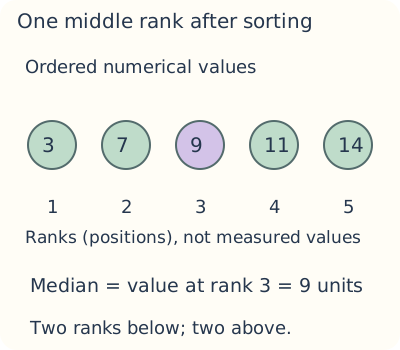
The median is the middle value of an ordered numerical list, using the mean of the two middle values when its count is even. It separates ranks into lower and upper halves. For 3,7,9,11,14, the third value 9 is the median: two records are on either side. Nine is a value, while third is a position. A median does not guarantee half the records are strictly smaller when repeated values occur.
Locate positions before reading their values
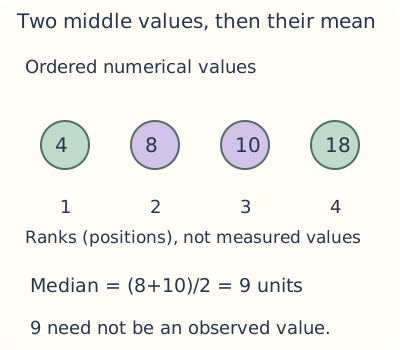
For odd count n, the middle position is(n+1)/2. For even n, use positions n/2 and n/2+1, then average their values. Sorted 4,8,10,18 has middle values 8 and 10, so median 9 even though 9 is not a recorded value. Our ten session lengths have values 18 at positions 5 and 6, giving median 18 minutes. Sort first; the middle entries of the original unsorted writing order need not be its median.
Cumulative frequency maps values to ranks
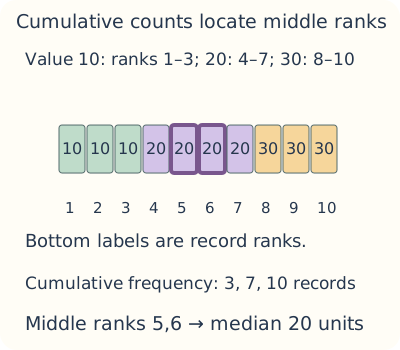
Cumulative frequency is the running count up to and including each ascending value. For values 10,20,30 with frequencies 3,4,3, cumulative counts are 3,7,10. Thus 10 occupies ranks 1–3,20 ranks 4–7,30 ranks 8–10. With ten records, middle ranks 5 and 6 both equal 20, so the median is 20 units. Cumulative frequency counts records, unlike the signed running differences in the source’s assumed-mean shortcut.
A grouped table may hide the exact median
Exact-value frequency tables preserve values; interval tables may reveal only the class containing a middle rank. The source’s printed page 182 exact value 75 has frequency 15 after cumulative 24, so it occupies ranks 25–39, not 25–29 as its observation states. For a grouped class 15–19 containing a middle position, that rank’s exact value is not automatically 17. Without within-class data, report the class or an explicitly additional interpolation assumption, not a fabricated exact median.
Mode is the most frequent value
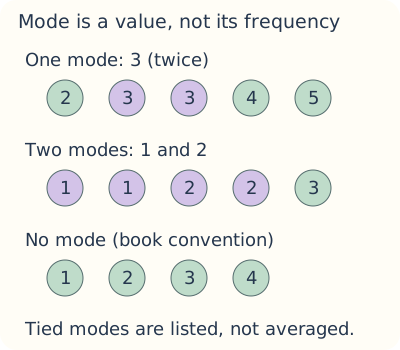
A mode is a value occurring most often. For 2,3,3,4,5 the mode is 3 because it appears twice, more than any other. Its frequency is 2; the mode is not 2. In1,1,2,2,3, both 1 and 2 share the greatest count, so there are two modes and their average is not a replacement mode. If every value occurs once, this lesson follows the book’s convention and reports no mode; do not report zero as an observed modal value.
A modal class is a group, not an exact mode
For equal-width classes 10–14,15–19,20–24,25–29 with frequencies 3,4,2,1, the modal class is 15–19 because four observations is the greatest class count. It does not prove an exact mode of 17 or 18. In our known raw list the exact mode happens to be18 with frequency 3, but the grouped counts alone do not reveal that. If largest class counts tie, report all tied groups under this equal-width convention.
Choose the summary to fit the question
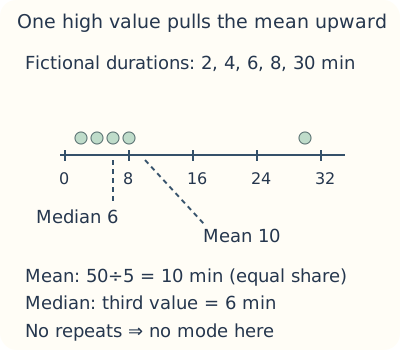
For invented values 2,4,6,8,30 minutes, the mean is 10 minutes because total 50 is shared over five records; the median is 6 minutes because it is the third sorted value. There is no mode under our no-repeats convention. The large 30 raises the mean above most listed values. Neither summary is automatically wrong: the mean answers an equal-total question, while the median answers a middle-rank question. Report the distribution and question alongside the chosen summary.
Explain results and respect their limits
A roll number is an identifier, not a measurement of achievement. The source’s roll-number activity can practise sorting and middle positions, but its numerical median has no ability meaning. Also, source Exercise 4 says40 records but visibly lists39; Exercise12 lists40 and is different. Keep that source gap explicit instead of inventing the missing record or reusing an answer key. A useful report names the records, unit, summary meaning, calculation and collection limits. The app checks requested numeric values only; chart accuracy and reasoning need guardian or teacher review.
Worked example
For 12,14,14,16,18,18,18,20,22,28 minutes, mean, median and mode all equal 18 minutes for different reasons: total/count, middle ranks and greatest repetition. That agreement describes this fictional list only.
Name the observations, unit, total and question. Explain what the requested summary or chart measures.
Show sorting, counts, boundaries or a fully labelled calculation. State whether the result is exact for the listed records or a grouped estimate.
Check totals, positions, units and arithmetic. Explain the result in context and say what the data cannot establish.
The source rank block is longer
Value 75 with frequency 15 after cumulative 24 spans ranks 25–39. The printed 25–29 observation is wrong, although its median 75 remains correct.
Similar lists can need different keys
Source Exercise4 claims40 records but lists39; Exercise12 has a different40-value list. Do not invent a missing record. Check the exact list and tied modes separately.
Values, frequencies, cumulative counts and ranks
Fictional exact-value table; repeated records remain counted.
Values, frequencies, cumulative counts and ranks
Value (units)
Frequency
Cumulative count
Ranks occupied
10
3
3
1–3
20
4
7
4–7
30
3
10
8–10
Ranks 5 and 6 lie in the 20-unit block, so the median is 20 units. The cumulative column counts records up to each value and ends at 10.
Unique, tied and absent modes
The mode is the most frequent value. This lesson uses the book’s no-repeat convention.
Unique, tied and absent modes
List
Mode result
Frequency explanation
2,3,3,4,5
3
3 occurs twice; others once
1,1,2,2,3
1 and 2
Both tie at two occurrences
1,2,3,4
No mode
All occur once
Do not average tied modes:1.5 is not a replacement mode of the second list. No mode does not mean zero is a modal value.
A high value changes one summary much more
Fictional session durations in minutes; no repeated value occurs in either list.
A high value changes one summary much more
List (minutes)
Mean (minutes)
Median (minutes)
Mode
2,4,6,8,30
10
6
None under stated convention
2,4,6,8,300
64
6
None under stated convention
The mean is total/count and rises when the high value increases. The median stays at the third rank. Its unchanged value does not mean the distributions are identical or that a large record can be ignored.
Find median positions, then observed values
The numerical list must be sorted first and contain n>0 records.
Odd n: read rank(n+1)/2
Even n: average values at ranks n/2 and n/2+1
4,8,10,18 ⇒ (8+10)/2=9 units
rank
A position in the sorted list, not the measured value.
n
Total record count including repeats.
9 units
The median value, which need not itself occur in an even list.
Sort without deleting repeats.
Count records and choose odd or even rule.
Read the value at each required rank.
Average the two middle values only when needed.
Tied values can straddle the middle, so exactly half the records need not be strictly below the median.
Find an entire frequency-table rank block
A value has frequency f after a previous cumulative count C.
First rank=C+1
Last rank=C+f
C=24, f=15 ⇒ ranks 25–39
C
Count of records before this value.
f
How many times this exact value occurs.
25–39
Fifteen inclusive positions, correcting the source’s25–29 claim.
Add one to the preceding cumulative count.
Add the frequency to find the final rank.
Check last−first+1=f.
Locate both median ranks in the correct block.
In printed Example 7, value 75 occupies ranks 25–39. Its median 75 remains valid because the two middle ranks 25 and 26 both lie in that block.
Explore the mathematical figures
Match each letter to its explanation. Read the quantities, units and relationships, then check the counts or equations. These are original teaching models.
Separate middle rank from its value
For n=5, middle rank(n+1)/2=3 contains 9. The median describes the middle of these numerical records.
Ordered numerical values
Sorting determines their ranks before choosing the middle.
Ranks (positions)
The third position is a location in the ordered list, not the observed value 3.
Median
The highlighted value 9 leaves two ranks on each side.
Original diagram using fictional classroom records, not measured personal information or current statistics. Read the quantities, units and conventions beside the figure; colour alone does not carry the meaning.
Explore the mathematical figures
Match each letter to its explanation. Read the quantities, units and relationships, then check the counts or equations. These are original teaching models.
Average the two middle values
Use the values at ranks n/2 and n/2+1. Averaging the positions instead would give 2.5, which does not answer the value question.
Ordered numerical values
The observed values are 4,8,10,18.
Ranks (positions)
Central locations are 2 and 3, whose values are 8 and 10.
Median
(8+10)/2=9 units;9 need not appear as a raw record.
Original diagram using fictional classroom records, not measured personal information or current statistics. Read the quantities, units and conventions beside the figure; colour alone does not carry the meaning.
Explore the mathematical figures
Match each letter to its explanation. Read the quantities, units and relationships, then check the counts or equations. These are original teaching models.
Find median ranks in a frequency table
Cumulative frequency identifies an entire rank block. A value with count 15 after cumulative 24 would occupy ranks 25–39, correcting the source’s25–29 observation.
Value 10
Ranks 1–3: three records, cumulative count 3.
20: 4–7
Four records extend the cumulative count to 7.
30: 8–10
The final three records give total 10.
record ranks
Bottom labels are positions, not additional values.
median 20
Middle ranks 5 and 6 both contain 20, so their average is 20 units.
Original diagram using fictional classroom records, not measured personal information or current statistics. Read the quantities, units and conventions beside the figure; colour alone does not carry the meaning.
Explore the mathematical figures
Match each letter to its explanation. Read the quantities, units and relationships, then check the counts or equations. These are original teaching models.
Read unique, tied and absent modes
A mode is an observed value, while its frequency is how often it appears. Do not report a fictitious zero modal value when saying no mode.
One mode
3 occurs twice, more often than the other values.
Two modes
1 and 2 tie at two occurrences each. Their average is not a replacement mode.
No mode
All values occur once; this follows the book’s no-repeat convention.
Original diagram using fictional classroom records, not measured personal information or current statistics. Read the quantities, units and conventions beside the figure; colour alone does not carry the meaning.
Explore the mathematical figures
Match each letter to its explanation. Read the quantities, units and relationships, then check the counts or equations. These are original teaching models.
Explain why mean and median can differ
The high 30-minute value raises the mean above most records. The median stays at the middle rank. Neither summary alone describes the entire distribution or establishes an ideal duration.
Mean 10
Total 50/5=10 minutes per record, the equal-share summary.
Median 6
The third sorted duration is 6 minutes, the middle-rank summary.
No repeats
There is no mode under the stated no-repeat convention.
Original diagram using fictional classroom records, not measured personal information or current statistics. Read the quantities, units and conventions beside the figure; colour alone does not carry the meaning.
Your written practice
Show your working on paper. Check your answer, then choose Next.
Show model answer and explanation
9
There are five sorted values; the third is 9 with two records on each side.
Show model answer and explanation
9
The middle values 8 and 10 average to 9, whether or not 9 is itself recorded.
Show model answer and explanation
5
The positions are 10/2=5 and 6; position is not the observed value.
Show model answer and explanation
18
The fifth and sixth sorted values are both 18 minutes.
Show model answer and explanation
8
The expanded list 4,8,8,12 has middle values 8 and 8, so median 8.
Show model answer and explanation
7
3+4=7 records have values at most 20.
Show model answer and explanation
20
Middle ranks 5 and 6 lie in the value 20 group, which occupies ranks 4–7.
Show model answer and explanation
3
Value 3 occurs twice; all other values occur once.
Show model answer and explanation
2
Values 1 and 2 tie at frequency 2, so there are two modes.
Show model answer and explanation
3
18 occurs in three session records; this asks its frequency, not its value.
Show model answer and explanation
0
Every value occurs once, so we report no mode. The count of modes is 0; this does not say the modal value is 0.
Show model answer and explanation
15
The largest count 4 is in 15–19, whose lower limit is 15. Its exact within-class mode is unknown from these counts alone.
Show model answer and explanation
6
The third of five sorted durations is 6 minutes; the large 30 does not change that middle position.
Show model answer and explanation
10
Total 50 over five records gives 10 minutes per record; the large 30 raises this equal-share summary.
Show model answer and explanation
10
(19+1)/2=10: the tenth position, whose observed value must still be read.
Write in your own words. A guardian or teacher should review this response.
Show model answer and explanation
There are five ordered records. Middle position(5+1)/2=3 contains value 9, leaving two ranks below and two above. Position 3 and value 9 answer different questions.
Name both and interpret the middle split.
Write in your own words. A guardian or teacher should review this response.
Show model answer and explanation
An even list has two central values, at ranks 2 and 3. Their mean(8+10)/2=9 is the conventional median. The median need not be an observed value.
Do not average the positions instead of the values.
Write in your own words. A guardian or teacher should review this response.
Show model answer and explanation
Sort to 3,7,9,11,14, then take middle value 9. The original third entry 11 is only a writing-order position, not the median of the observations.
Keep all five records while sorting.
Write in your own words. A guardian or teacher should review this response.
Show model answer and explanation
Cumulative counts are 3,7,10. Value 10 occupies ranks 1–3,20 occupies 4–7 and 30 occupies 8–10. The total 10 checks the count and ranks 5,6 give median 20 units.
Explain that cumulative counts never decrease and end at the total.
Write in your own words. A guardian or teacher should review this response.
Show model answer and explanation
Its frequency is 15 after a cumulative count 24, so its ranks are 25 through 39 inclusive. That is 15 positions. The source’s median 75 remains correct because ranks 25 and 26 both lie in that block.
Show the inclusive rank count and distinguish the typo from the median result.
Write in your own words. A guardian or teacher should review this response.
Show model answer and explanation
The median class is 15–19, but the exact central record values are hidden. A midpoint 17 is a possible estimate only under an additional stated convention, not a recovered exact median.
Do not invent within-class observations.
Write in your own words. A guardian or teacher should review this response.
Show model answer and explanation
Three is the observed value with the largest count. Two says how many times 3 appears. Reporting 2 as the mode would confuse the value column with the frequency column.
Use a value/frequency table to keep their roles separate.
Write in your own words. A guardian or teacher should review this response.
Show model answer and explanation
Values 1 and 2 each occur twice, more than 3. Both are modes. Their average 1.5 occurs zero times and is not a replacement modal value.
State the tie and both frequencies.
Write in your own words. A guardian or teacher should review this response.
Show model answer and explanation
Every value occurs once, so none is repeated more often. Following the book, say no mode. Zero can count how many modes we report here, but it is not an observed modal value.
Use words for the conclusion and avoid a fictitious zero record.
Write in your own words. A guardian or teacher should review this response.
Show model answer and explanation
The interval 15–19 contains four sessions, the largest grouped count. The raw list shows 18 occurs three times and is the exact mode. Grouped counts alone establish only the modal class, not that 18 is the exact mode.
State which information comes from which presentation.
Write in your own words. A guardian or teacher should review this response.
Show model answer and explanation
The mean is 50/5=10 minutes, the equal-share amount. The median is the third value 6 minutes. There is no repeated value, so no mode under the book convention. The large 30 raises the mean; each summary answers a different question about these invented durations.
Explain the meaning and limitation of every reported result.
Write in your own words. A guardian or teacher should review this response.
Show model answer and explanation
The new mean is 320/5=64 minutes, greatly increased by the high value. The median remains 6 minutes because the middle rank is unchanged. No mode is reported because all five values remain distinct.
Do not infer that the unchanged median means the whole distribution is unchanged.
Write in your own words. A guardian or teacher should review this response.
Show model answer and explanation
Roll numbers identify records. Their numerical order can practise median positions, but the labels do not measure knowledge, effort or achievement. Renumbering could change their median without any learner changing.
Separate a sorting exercise from a meaningful educational conclusion.
Write in your own words. A guardian or teacher should review this response.
Show model answer and explanation
Printed Exercise4 says40 values, but only39 are listed. Exercise12 lists40; compared with Exercise4 it removes one156 and adds136 and154. The intended missing Exercise4 value is not given, so report the incomplete source rather than invent a 40th observation or reuse the other key.
Identify the source list rather than copying another answer key.
Write in your own words. A guardian or teacher should review this response.
Show model answer and explanation
The listed ten durations total 180 minutes. Mean 18 minutes is their equal share; median 18 is the average of middle ranks 5 and 6; mode 18 is the most frequent duration, appearing three times. Agreement here does not make18 a universal target or justify claims about unobserved learners. Durations measure time; roll numbers merely identify records.
State records, units, calculations, interpretations and a limitation.
Progress and browser storage
Notebook challenge, sources and further study
Your data detective notebook
Compare a full list with its grouped presentation.
Review with a guardian or teacher
Find the mean, median and every mode of one invented list.
Build value/frequency/cumulative columns and explain ranks.
State what interval grouping hides and review the report with a guardian or teacher.
Keep your work on paper or in a local file. This page does not upload it or automatically grade the project.
Chapter companion and further study
This original Kidemy practice follows the topic order of 2026 Class 8 Mathematics · English Version, chapter 11, printed pages 171–187. It does not replace the complete chapter or its practical teaching.
Original companions teach the mapped methods rather than reproduce every exact printed question. Review independent written solutions, measurements and chart construction.
Chapter headings across the book now have original companions. This does not certify every textbook exercise or other Class 1–8 subject; those audits remain separate.
Teacher-led lessons, schedules and prices for this outline are upcoming. You can use any starter practice above now without booking.
Your next step
Solo practice works without an account. Sign in to save a practice record to your learner profile.
Keep practising
Exact lesson links and related activities are labelled separately. Return-to-course links retain your selected learning path.