2026 Class 8 Mathematics · English Version · Chapter 3 · Chapter companion part
Chapter 3A: Units, conversions and careful measuring
Choose units, convert lengths and masses, use measuring tools and explain exact factors and measurement limits.
About this lesson and its coverage
Class 8 English Version: part A of the Measurement companion. Eight sections, 30 written tasks and a notebook challenge. Selected companion coverage, not complete textbook coverage. Use all four parts for the mapped chapter methods; these fresh tasks do not reproduce every printed question. Drawings and explanations need guardian or teacher review.
Measurement compares a quantity with a chosen unit. A length of 2 m is twice one metre; an area of 2 m² covers two unit squares; a volume of 2 m³ fills two unit cubes. Those three quantities cannot be added. Counts such as 12 books are distinct from measurements such as 12 kg. State both the value and the unit in every written answer.
Read prefixes from their meaning
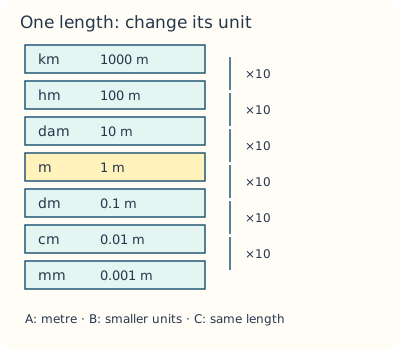
For length, km, hm, dam, m, dm, cm, mm follow factors of ten. Kilo means 1000, hecto 100, deca 10, deci one tenth, centi one hundredth and milli one thousandth of the named unit. A smaller unit requires more units for the same quantity: 2.35 m = 235 cm. Do not count columns blindly when the units are squared or cubed.
Combine mixed lengths in one unit
For 2 km 35 m 6 cm, convert to metres: 2000 + 35 + 0.06 = 2035.06 m. Keep absent places as zero rather than joining the digits. A runner completing 18 laps of a 250 m track travels 4500 m = 4.5 km. A wheel with circumference 2.5 m makes 600 full turns over 1500 m if there is no slipping.
International length conversions can be exact
The international inch is exactly 2.54 cm; the foot is 12 inches = 0.3048 m; the yard is 3 feet = 0.9144 m. A statute mile is 1760 yards = 1609.344 m and a furlong is 220 yards. The modern international nautical mile is 1852 m. Keep the kind of mile explicit. A rounded reciprocal, such as 39.37 inches per metre, is approximate even when the underlying definition is exact.
Mass, capacity and the SI base units
SI means International System of Units. The length base unit is metre and the mass base unit is kilogram. Grams and kilograms measure mass; weight is a force measured in newtons. School problems often say weight when they give mass in kg: interpret the quantity and label it carefully. One tonne is 1000 kg and a quintal in this chapter is 100 kg. One litre (L), accepted for use with SI, is one cubic decimetre; 1000 mL = 1 L.
Read a ruler and a balance
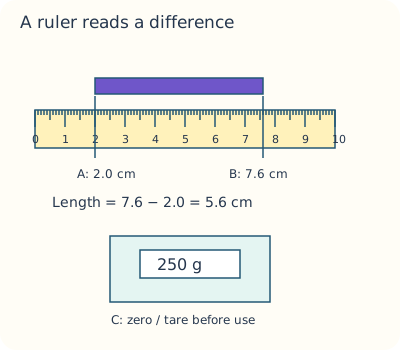
Align the ruler zero, not a damaged edge, with the start. If an object runs from 2.0 cm to 7.6 cm, length is 7.6 − 2.0 = 5.6 cm. A ruler divided in millimetres cannot justify many extra decimal places. Read a pointer or liquid scale at eye level to reduce parallax, an apparent shift caused by viewing from an angle. Zero or tare a balance before using it, and state the instrument unit.
Estimate, measure and compare
Estimate a box capacity, then measure its internal dimensions or use a graduated vessel. If your estimate is 480 mL and the measured value is 525 mL, the estimate is 45 mL low; the absolute difference is 45 mL. The measured value is a reference reading with limited precision, not automatically an exact truth. Divide a stated 2.4-tonne store equally among 80 bags: 2400/80 = 30 kg per bag. Measure books or classroom objects without uploading anyone’s body data.
Notice the source corrections
Printed page 31 says 1 yard = 0.9144 cm. Its unit is a typo: use 0.9144 m = 91.44 cm. The nearby claim that British–metric relations cannot be exact is not true for the international inch and yard. Its 6080-foot nautical mile is not the modern definition of 1852 m. Page 30 describes historical metre standards; today the metre uses the fixed speed of light in vacuum. Keep a source’s stated rounded factor when a question explicitly asks for it, label that approximation and distinguish it from the modern exact factor.
Worked example
To convert 5 feet 6 inches, first count inches: 5 × 12 + 6 = 66. Then 66 × 2.54 = 167.64 cm. This is an exact conversion of the stated length, although an actual tape reading has its own measurement limits.
Name the quantity and required unit. Draw and label the dimensions; identify given assumptions.
Convert all dimensions to compatible units before substituting. Show why the formula applies.
Check arithmetic, units and the physical meaning. Use the model answer to correct your written working.
Measuring is not digit shifting alone
A factor must refer to the named quantity. For area and volume, square or cube the length factor; those rules are taught in the next parts.
Checked standards
International factors and the modern metre were checked against NIST’s SI Units – Length and Guide to the SI, chapters 5 and appendix B.8, on 22 October 2026. No third-party artwork is copied.
Read the metric prefix by its factor
These factors apply to the named unit before any square or cube is taken.
Read the metric prefix by its factor
Prefix
Symbol
Factor
Length example
kilo
k
1000
1 km = 1000 m
hecto
h
100
1 hm = 100 m
deca
da
10
1 dam = 10 m
no prefix
—
1
1 m
deci
d
0.1
1 dm = 0.1 m
centi
c
0.01
1 cm = 0.01 m
milli
m
0.001
1 mm = 0.001 m
For 2.35 m, divide by 0.01 m per cm to get 235 cm. The letter m is metre as a whole unit, but milli when used as a prefix in mm.
Common length relations
International length definitions; reciprocal decimal approximations must be labelled.
Common length relations
Unit relation
Value
Status
1 foot
12 inches = 0.3048 m
Exact
1 yard
3 feet = 36 inches = 0.9144 m
Exact
1 furlong
220 yards = 201.168 m
Exact
1 statute mile
1760 yards = 8 furlongs = 1609.344 m
Exact
1 nautical mile
1852 m
Modern international definition
1 metre
about 39.37 inches
Rounded reciprocal
Three yards are 3 × 0.9144 = 2.7432 m. Do not use the source’s 0.9144 cm typo or confuse statute and nautical miles.
Mass and liquid-capacity ladders
Use the same six prefix meanings, while keeping mass and volume separate.
Mass and liquid-capacity ladders
Kind
Larger to smaller
Numerical factor
Mass
kg → hg → dag → g → dg → cg → mg
×10 at every adjacent step
Mass
1 quintal → kg
100
Mass
1 tonne → kg
1000
Liquid capacity
kL → hL → daL → L → dL → cL → mL
×10 at every adjacent step
Capacity bridge
1 L → cm³
1000
For 3 kg 45 g, write 3000 + 45 = 3045 g. For 2 L 75 mL, write 2000 + 75 = 2075 mL. Adding grams to litres is not a unit conversion.
Use conversion factors that cancel
A ratio expressing the same length has value one; it changes the unit without changing the physical length.
Length in cm = length in inches × 2.54
Mixed length = converted component 1 + component 2 + ...
Absolute difference = |estimate − reference|
2.54
Exact centimetres per international inch.
estimate / reference
Two readings of the same quantity in the same unit.
| |
Absolute value: the non-negative size of a difference.
For 5 ft 6 in, first compute 5 × 12 + 6 = 66 in.
66 in × (2.54 cm/in) = 167.64 cm; inches cancel.
For estimate 480 mL and reference 525 mL, the signed difference is −45 mL.
Its absolute size is 45 mL; describe the estimate as low.
An exact unit factor does not make a ruler reading infinitely precise. Give only the precision justified by the measurement or task.
Explore the mathematical figures
Match each letter to its explanation. Read the quantities, units and relationships, then check the counts or equations. These are original teaching models.
One length, seven unit names
Read the unit symbol and factor together. Count only adjacent steps in this length ladder; square and cube factors apply to area and volume.
A · Base unit
The metre box marks a factor of 1.
B · Smaller units
One centimetre is 0.01 m, so 2.35 m contains 235 centimetres.
C · A quantity stays the same
The numeral changes when the unit changes; the physical length does not.
Original conversion schematic. Box positions are not proportional distances. The prefix m in mm means milli; the final m means metre.
Explore the mathematical figures
Match each letter to its explanation. Read the quantities, units and relationships, then check the counts or equations. These are original teaching models.
Read the difference and zero the scale
Practise reading the labelled ruler and explain why the far endpoint alone is not the length. Read real tools at eye level and record their smallest division.
A · Start at 2.0
The object is not aligned with the zero, so record the start.
B · End at 7.6
Subtract start from end: 7.6 − 2.0 = 5.6 cm.
C · Zero or tare
The balance’s 250 g is an invented example display. Remove the container’s mass using tare before measuring its contents.
Original schematic, not a calibrated on-screen measuring tool. Never measure a real object against the phone picture; zoom changes its physical size.
Your written practice
Show your working on paper. Check your answer, then choose Next.
Show model answer and explanation
235
2.35 × 100 = 235 cm.
Show model answer and explanation
0.48
480/1000 = 0.48 m.
Show model answer and explanation
2035.06
2000 + 35 + 0.06 = 2035.06 m.
Show model answer and explanation
4.5
18 × 250 = 4500 m = 4.5 km.
Show model answer and explanation
600
1500/2.5 = 600 turns.
Show model answer and explanation
15.24
6 × 2.54 = 15.24 cm.
Show model answer and explanation
2.7432
3 × 0.9144 = 2.7432 m.
Show model answer and explanation
3218.688
2 × 1609.344 = 3218.688 m.
Show model answer and explanation
3704
2 × 1852 = 3704 m.
Show model answer and explanation
2400
2.4 × 1000 = 2400 kg.
Show model answer and explanation
30
2400/80 = 30 kg per bag.
Show model answer and explanation
300
3 × 100 = 300 kg.
Show model answer and explanation
5.6
Subtract the starting reading: 7.6 − 2.0 = 5.6 cm.
Show model answer and explanation
45
525 − 480 = 45 mL; the estimate is low.
Show model answer and explanation
2075
2000 + 75 = 2075 mL.
Write in your own words. A guardian or teacher should review this response.
Show model answer and explanation
Metres measure length while square metres measure area. A unit square has two length dimensions; the equal numeral 3 does not make the quantities interchangeable.
Name the quantities and show a line and a unit square.
Write in your own words. A guardian or teacher should review this response.
Show model answer and explanation
km → hm → dam → m → dm → cm → mm. Each move towards the smaller unit multiplies the numerical value by 10; reverse moves divide by 10.
Use correct symbols and explain that the physical length does not change.
Write in your own words. A guardian or teacher should review this response.
Show model answer and explanation
4007.009 m and 4007009 mm. Convert components separately: 4000 + 7 + 0.009 m.
Check the empty centimetre place and do not concatenate mixed-unit numerals.
Write in your own words. A guardian or teacher should review this response.
Show model answer and explanation
25 × 320 = 8000 m = 8 km. This uses track length per lap, not its diameter or enclosed area.
Show the multiplication and both units.
Write in your own words. A guardian or teacher should review this response.
Show model answer and explanation
One yard is 36 inches; 36 × 2.54 cm = 91.44 cm = 0.9144 m. The printed centimetre label is wrong.
Identify the source typo explicitly rather than silently changing the number.
Write in your own words. A guardian or teacher should review this response.
Show model answer and explanation
100/2.54 = 5000/127 inches, an exact rational value with a non-terminating decimal. Rounding it gives 39.37. Exact definitions and rounded displayed reciprocals can coexist.
Distinguish the exact ratio from its decimal approximation.
Write in your own words. A guardian or teacher should review this response.
Show model answer and explanation
An international statute mile is 1609.344 m, a nautical mile is 1852 m, and a furlong is 220 yards = 201.168 m. Eight furlongs make a statute mile.
State the mile type and avoid the source’s obsolete 6080-foot value as a modern definition.
Write in your own words. A guardian or teacher should review this response.
Show model answer and explanation
Kilogram is a unit of mass. Weight is gravitational force measured in newtons; its value depends on gravitational acceleration. A classroom word problem may use weight informally, but the unit identifies its mass calculation.
Do not numerically convert to newtons without a specified gravitational model.
Write in your own words. A guardian or teacher should review this response.
Show model answer and explanation
Check zero and divisions, align the tape straight along the chosen edge, read at eye level, record unit and instrument resolution, and repeat. Compare the readings and discuss any disagreement rather than inventing precision.
A real observation is needed; a model sentence is not a fabricated measurement.
Write in your own words. A guardian or teacher should review this response.
Show model answer and explanation
Tare the empty pan or container. Weigh the five books together, record kg or g and scale divisions, and compare with the sum of individual readings if available. Small differences may arise from rounding.
Use actual classroom readings, identify tare and avoid invented observed data.
Write in your own words. A guardian or teacher should review this response.
Show model answer and explanation
The estimate is 0.12 m = 12 cm low. The reference comes from a measuring tool and has limited precision; the difference is not proof that the tool is exact.
Explain direction, unit and the role of the reference reading.
Write in your own words. A guardian or teacher should review this response.
Show model answer and explanation
3000 + 45 = 3045 g = 3.045 kg. Three kilograms and forty-five grams is not 3.45 kg.
Show the conversion and a reverse check.
Write in your own words. A guardian or teacher should review this response.
Show model answer and explanation
The current metre is linked to the fixed speed of light in vacuum and the second; a platinum-iridium bar was an earlier physical standard. The book’s historical account should not be presented as today’s definition.
A plain explanation is sufficient; no need to memorise a long constant for this exercise.
Write in your own words. A guardian or teacher should review this response.
Show model answer and explanation
U.S. liquid and Imperial gallons/fluid ounces have different sizes. A unit name without the system does not determine one universal litre conversion. Ask for the convention or use the task’s explicit factor.
Do not confuse fluid ounces of volume with ounces of mass.
Write in your own words. A guardian or teacher should review this response.
Show model answer and explanation
Columns should include container, estimated capacity in mL, measured reference in mL, absolute difference and whether the estimate was high or low. Fill it from real measurements and name the tool.
Review the arithmetic and reading precision; no made-up measurement is required.
Progress and browser storage
Notebook challenge, sources and further study
Your measurement notebook
Make a unit ladder and a table of three estimated and measured classroom objects.
Review with a guardian or teacher
Record instrument divisions, zero checks, quantities and units.
Show one mixed-unit and one international conversion with factors that cancel.
Explain a source correction and distinguish exact conversion from limited measurement.
Keep your work on paper or in a local file. This page does not upload it or automatically grade the project.
Chapter companion and further study
This original Kidemy practice follows the topic order of 2026 Class 8 Mathematics · English Version, chapter 3, printed pages 29–47. It does not replace the complete chapter or its practical teaching.
Compare the companion methods with the source exercises and have full written solutions reviewed. Local land factors are stated classroom conventions, not a property-survey service.
Some source questions omit conditions or use rounded factors. Our finite-answer tasks state the needed assumptions. Later Class 8 mathematics chapters remain in preparation.
Teacher-led lessons, schedules and prices for this outline are upcoming. You can use any starter practice above now without booking.
Your next step
Solo practice works without an account. Sign in to save a practice record to your learner profile.
Keep practising
Exact lesson links and related activities are labelled separately. Return-to-course links retain your selected learning path.