2026 Class 8 Mathematics · English Version · Chapter 10 · Chapter companion part
Chapter 10C: Pi, circumference and circle area
Explain pi through measured ratios, choose approximations explicitly, and derive/use circumference and area with correct units.
About this lesson and its coverage
Class 8 English Version:part C of the chapter10 companion. Eight teaching sections and30 original written tasks. Selected companion coverage,not complete textbook coverage; use all four parts. General proofs,exact pi expressions,compass drawings and practical measurements need guardian or teacher review.
For an ideal Euclidean circle, the ratio C/d is one fixed number called pi,π. A ratio compares quantities by division; C/d says how many diameter-lengths make one circumference. It has no unit because both lengths use the same unit. π≈3.14159… is irrational:its decimal neither terminates nor repeats. Neither3.14 nor22/7 is exactlyπ. A finite checked task states the approximation to use.
Measure consistently and record the ratio
Wrap string or a flexible tape around a circular rim and measure a straight diameter through the centre, in the same unit. Divide measured C by d. Close but unequal experimental ratios reflect drawing and measurement limits, not different ideal values of π. The source table uses circumference/diameter although one activity sentence says radius. For radius the ratio is C/r=2π. Also22/7=3.142857…;3.142 is a truncation, while rounding it to 3 decimal places gives 3.143.
Use the input as a radius or diameter
Circumference C=πd=2πr. For diameter 12 cm, use π≈3.14 to obtain37.68 cm. The source Example1 starts with diameter 10 but calls it radius 10 in its final sentence;31.4 cm uses diameter 10. If radius were10, the same approximation would give62.8 cm. Always label the supplied dimension before multiplying.
Work backwards without losing the factor2
From a circumference find d=C/π and r=C/(2π). For C=88 cm and π≈22/7, r=14 cm under that convention. The formula contains division by 2 only when the requested quantity is radius. Keep exact symbolicπ when no numerical approximation is requested. A value computed with a stated approximation is not a measurement guaranteed exact in the real world.
A full wheel turn covers one circumference
Without slipping, distance=number of turns×circumference. For diameter 70 cm and π≈22/7, a turn covers220 cm; five turns cover1100 cm=11 m. Two loops of garden fencing likewise need twice the circumference, before any stated joining allowance. Cost=required length×price per length in matching units. The wheel’s radius is not the distance travelled in a turn.
More sectors explain the area formula
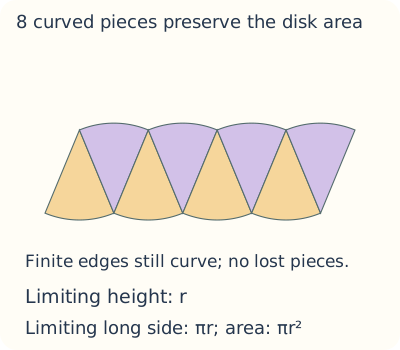
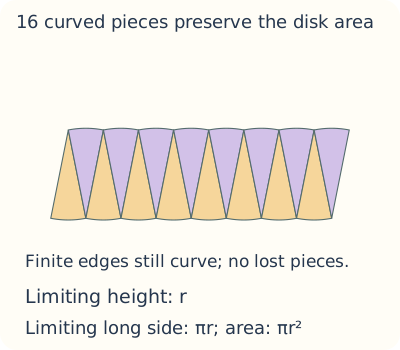
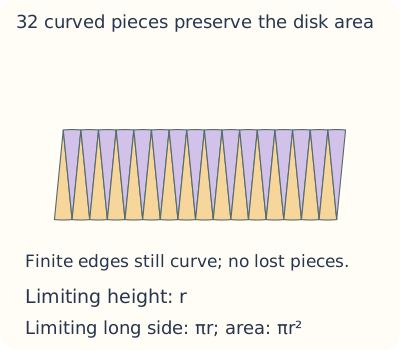
Cut a disk into an even number of equal sectors and alternate their directions. Eight pieces make a scalloped strip;16 or32 have shallower curved bulges. The pieces preserve area exactly, but no finite strip is an exact rectangle. As the sectors become narrower, its limiting height isr and limiting long side is half the circumference,πr. This motivates area A=(πr)r=πr²; do not replace actual curved sectors by triangles and pretend their areas are equal.
Area uses square units and can be bounded on a grid
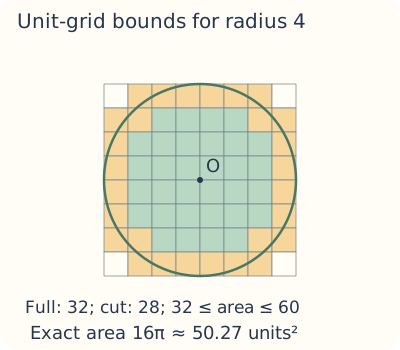
A disk of radius r has area πr². For r=7 cm and π≈22/7, this gives 154 cm². Count fully enclosed grid squares for a lower bound and every square with interior overlap for an upper bound. Boundary-cut squares need partial areas for a closer estimate. For the radius 4 unit-grid model, the full/cut counts are supplied beside the diagram; the exact area 16π lies between the bounds. Counting only square centres is an estimate, not an exact area proof.
Reverse area and compare size changes
If A=81πcm², then r²=81 and the positive radius is 9 cm. If radius doubles, circumference doubles but area becomes 4 times as large because(2r)²=4r². A unit-radius disk has area π square units. Convert lengths before squaring:1 m²=10,000 cm². In written work, name whether a number is length, area, ratio or a coefficient of π.
Worked example
For diameter 10 cm, radius 5 cm, C≈31.4 cm and A≈78.5 cm² whenπ≈3.14. The two results count different things and carry different units.
Name the centre, radii, chord endpoints and required length or area. State the chosen pi approximation and all units.
Draw the labelled model. Give reasons for congruence, perpendicular distance, sector rearrangement or included cylinder faces before calculating.
Check existence, radius versus diameter, positive roots and units. Numeric checks assess the requested value only; proofs, drawings and measurements need guardian or teacher review.
The source radius word is inconsistent
The worked31.4 cm answer follows diameter 10 cm. Radius10 cm would require a different circumference.
Finite pieces preserve area without making an exact rectangle
Curved sector arcs remain visible in our models; increasing their number illustrates the limiting argument.
Measure three circles consistently
Example readings are idealised arithmetic under π≈3.14, not collected observations.
Measure three circles consistently
Radius (cm)
Diameter (cm)
Circumference (cm)
C/d
2
4
12.56
3.14
3
6
18.84
3.14
5
10
31.40
3.14
Actual ruler/string ratios vary with measurement error. π is C/d; C/r=2π. The source’s22/7=3.142 entry truncates the number:22/7 rounds to 3.143 at 3 decimal places, whereas π rounds to 3.142.
Boundary and filled area have different units
Diameter10 cm means radius 5 cm. Use π≈3.14.
C=πd=3.14×10=31.4 cm
A=πr²=3.14×5²=78.5 cm²
C
Length of one complete boundary.
A
Area of the disk.
d=2r
Check radius versus diameter first.
Label the supplied diameter.
Halve it for the area radius.
Keep cm and cm² distinct.
Reinsert into both formulas.
Source Example1 says diameter 10 initially but radius 10 in its conclusion. The31.4 result uses the diameter; a radius 10 would give62.8 cm.
From curved sectors to the area formula
Move through four stages manually. The pieces stay genuine sectors with equal total area.
All stages: readable static alternative
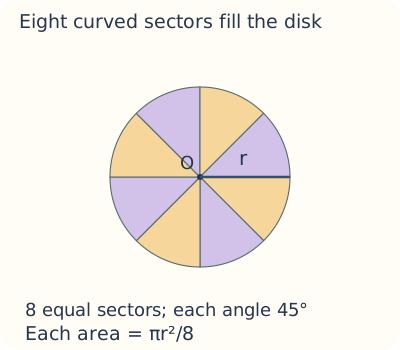
1 · Divide the disk into 8 sectors: Each angle is 45°. Every piece is bounded by two radii and one circular arc.
2 · Alternate the 8 pieces: All pieces fit into one scalloped strip without changing their area. Curved edges remain.
3 · Compare16 narrower pieces: Smaller angles give shallower bulges. The strip still is not an exact rectangle.
4 · Compare32 pieces and the limit: As pieces become narrower, height approaches r and the long side approaches πr. The limiting area is πr²;32 is still finite.
No autoplay. Static stages, manual replay and reduced-motion support remain available.
Grid bounds: guarantees and estimates
Radius4 unit-grid model; squares touching only at a point have no positive overlap.
Grid bounds: guarantees and estimates
Count or calculation
Meaning
Square units
32 full cells
Certain covered area: lower bound
32
28 cut cells
Count each as at most one
28
32+28
Upper bound
60
16π
Exact ideal disk area
≈50.27
A bound guarantees the area lies between32 and 60. Counting half of every cut cell gives an estimate46, which need not equal the exact area. The separate practice count40 full/20 cut is invented and clearly labelled.
Explore the mathematical figures
Match each letter to its explanation. Read the quantities, units and relationships, then check the counts or equations. These are original teaching models.
Start with eight genuine sectors
Each sector has angle 45° and area πr²/8. The curved edges remain circular arcs in every rearrangement.
O
Common sector apex before moving pieces.
r
Radius from O to the rim; every piece has this same radius.
Original geometry, not copied artwork. Curved sectors retain their arcs. Perspective cylinders are explicitly schematic; the separate cut layout uses one length scale.
Explore the mathematical figures
Match each letter to its explanation. Read the quantities, units and relationships, then check the counts or equations. These are original teaching models.
Rearrange thirty-two curved sectors
Every piece has the same area as before moving. The finite strip is not an exact rectangle; the limiting rectangular area explains πr².
r
The limiting height, approached as sectors get narrower.
πr
The limiting long side, half of the full circumference.
Original geometry, not copied artwork. Curved sectors retain their arcs. Perspective cylinders are explicitly schematic; the separate cut layout uses one length scale.
Explore the mathematical figures
Match each letter to its explanation. Read the quantities, units and relationships, then check the counts or equations. These are original teaching models.
Bound disk area with unit squares
There are 32 full and 28 cut cells: 32≤area≤60 square units. Exact area 16π≈50.27 lies between. A point-only touch contributes no cell area.
O
Disk centre at a grid intersection.
Full
Every point of each green unit square is inside or on the disk.
cut
Each amber square has positive interior overlap but is not wholly inside.
Original geometry, not copied artwork. Curved sectors retain their arcs. Perspective cylinders are explicitly schematic; the separate cut layout uses one length scale.
Your written practice
Show your working on paper. Check your answer, then choose Next.
Show model answer and explanation
3.14
31.4/10=3.14; this measured ratio approximatesπ.
Show model answer and explanation
6.28
C/r=2π, so 2×3.14=6.28; using radius instead of diameter doubles the ratio.
Show model answer and explanation
37.68
C=3.14×12=37.68.
Show model answer and explanation
44
2×22/7×7=44 under the stated approximation.
Show model answer and explanation
14
88/(2×22/7)=14.
Show model answer and explanation
20
62.8/3.14=20.
Show model answer and explanation
11
One turn220 cm; five turns1100 cm=11 m.
Show model answer and explanation
1760
Circumference44 m, two loops88 m, cost88×20=1760, no extra allowance.
Show model answer and explanation
22.5
360/16=22.5.
Show model answer and explanation
154
22/7×49=154.
Show model answer and explanation
78.5
Radius5 cm;3.14×25=78.5.
Show model answer and explanation
9
r²=81; choose the positive root9.
Show model answer and explanation
4
Area is proportional to radius squared:2²=4.
Show model answer and explanation
1
A=π×1²=1π square units.
Show model answer and explanation
60
Count every cut square as at most 1:40+20=60. This is a stated count, not the separate radius 4 diagram.
Write in your own words. A guardian or teacher should review this response.
Show model answer and explanation
It is circumference divided by diameter, so it measures how many diameter-lengths fit one complete boundary. Both lengths use one unit, which cancels. The ideal ratio is constant;3.14 and 22/7 are approximations.
State numerato r, denominator and meaning rather than only quoting a decimal.
Write in your own words. A guardian or teacher should review this response.
Show model answer and explanation
Record circle label, radius, diameter, circumference and C/d with units on the lengths. Checkd≈2r. Repeat careful string/ruler measurements; ratios should approachπ within practical error. Do not label C/r asπ.
Use your own measurements and discuss the limits of the instruments.
Write in your own words. A guardian or teacher should review this response.
Show model answer and explanation
22/7=3.142857… exactly as a recurring decimal.3.142 cuts off digits; rounding22/7 to 3 decimal places gives 3.143.π itself differs from 22/7 and rounds to 3.142 at 3 decimal places.
Keep the rational approximation, the truncation and π itself separate.
Write in your own words. A guardian or teacher should review this response.
Show model answer and explanation
Its input diameter 10 cm gives 31.4 cm whenπ≈3.14. The conclusion mistakenly says radius 10 cm, which would instead give62.8 cm. Keep the stated diameter for the worked arithmetic and show the wording error.
Do not silently change the input dimension.
Write in your own words. A guardian or teacher should review this response.
Show model answer and explanation
d=88÷(22/7)=28 cm; r=14 cm. Reinsert2×22/7×14=88. Calling28 the radius would double the implied circumference.
Show both inverses and the check.
Write in your own words. A guardian or teacher should review this response.
Show model answer and explanation
Circumference220 cm is the distance per full revolution. Five turns give1100 cm=11 m. Slipping changes the travelled-distance relationship, so no-slip is a required assumption.
Convert centimetres to metres after calculating consistently.
Write in your own words. A guardian or teacher should review this response.
Show model answer and explanation
One loop44 m; two loops88 m; cost 1760 BDT. This excludes knots, waste and overlaps unless an allowance is supplied.
Name what each intermediate length counts.
Write in your own words. A guardian or teacher should review this response.
Show model answer and explanation
The outer edges remain circular arcs, so there are scallops and slightly slanted end edges. More, narrower sectors reduce those features. Area is preserved by moving the pieces; the rectangular dimensionsπr andr describe the limiting shape.
Do not claim32 pieces make every boundary perfectly straight.
Write in your own words. A guardian or teacher should review this response.
Show model answer and explanation
Alternating narrow sectors creates a strip whose limiting long side is half the circumference,πr, and limiting height isr. The pieces preserve disk area; the limiting rectangle gives πr×r=πr².
Identify why half the boundary, not the whole circumference, forms a long side.
Write in your own words. A guardian or teacher should review this response.
Show model answer and explanation
r=10/2=5 cm. A=3.14×5²=78.5 cm². Radius must be squared and the result measures covered area, not boundary length.
Show the diameter-to-radius conversion.
Write in your own words. A guardian or teacher should review this response.
Show model answer and explanation
Count fully inside squares for the lower bound. Add every boundary-cut square for an upper bound, ignoring squares that touch only at an edge or point. Partial boundary fractions can improve the estimate; the exact curve area need not be an integer.
State a counting rule before comparing an estimate with πr².
Write in your own words. A guardian or teacher should review this response.
Show model answer and explanation
The area is at least40 and at most60 square units. Treating every cut square as one-half gives an estimate50, but their actual fractions need not all be halves. This count is not asserted for a particular radius unless specified.
Explain what a bound guarantees and what an estimate does not.
Write in your own words. A guardian or teacher should review this response.
Show model answer and explanation
C=2πr becomes3C. A=πr² becomes9A. One formula has one factor of length and the other has two.
Use formulas or a scaled diagram, not a guess that both triple.
Write in your own words. A guardian or teacher should review this response.
Show model answer and explanation
Divide by π to getr²=81; positive radius 9 cm. Theπ cancels exactly, so an approximate decimal for π is unnecessary.
Do not introduce rounding when it is not needed.
Write in your own words. A guardian or teacher should review this response.
Show model answer and explanation
Use π≈22/7. The calculation is exact arithmetic under the stated approximation, but the ideal circumference uses irrational π and a measured radius also has instrument error. State the convention or leave the result as a multiple of π.
Separate mathematical exactness, chosen approximation and physical measurement.
Progress and browser storage
Notebook challenge, sources and further study
Your circle and cylinder notebook
Measure three circles and explain an area rearrangement.
Review with a guardian or teacher
Use one length unit and labelr, d, C separately.
Keep original measurements distinct from calculated approximations.
Compare8,16,32 curved-sector strips and grid bounds.
Keep your work on paper or in a local file. This page does not upload it or automatically grade the project.
Chapter companion and further study
This original Kidemy practice follows the topic order of 2026 Class 8 Mathematics · English Version, chapter 10, printed pages 159–170. It does not replace the complete chapter or its practical teaching.
Original tasks teach the mapped methods rather than reproduce every exact printed question. Review independent full proofs and constructions.
Historical pi biography claims are outside this mathematical-method crosswalk. Original companions for all 11 chapter headings are available; independent source exercises and full working still need review.
Teacher-led lessons, schedules and prices for this outline are upcoming. You can use any starter practice above now without booking.
Your next step
Solo practice works without an account. Sign in to save a practice record to your learner profile.
Keep practising
Exact lesson links and related activities are labelled separately. Return-to-course links retain your selected learning path.