2026 Class 8 Mathematics · English Version · Chapter 10 · Chapter companion part
Chapter 10D: Rings, composite boundaries and cylinder surfaces
Choose the correct circular region or boundary and derive curved, open and closed cylinder surface areas from their parts.
About this lesson and its coverage
Class 8 English Version:part D of the chapter10 companion. Eight teaching sections and30 original written tasks. Selected companion coverage,not complete textbook coverage; use all four parts. General proofs,exact pi expressions,compass drawings and practical measurements need guardian or teacher review.
An annulus is the region between concentric circles with outer radius R and inner radius r, where R>r≥0. Its area is π(R²−r²), notπ(R−r)². Ring width w=R−r, so R=r+w when width is given. The source Example4 text uses radii 9 and 4, but its inner picture label says8. Withπ≈3.14, the text gives 204.10 cm²; the picture readingr=8 gives 53.38 cm². Show the discrepancy before choosing an interpretation.
State whether a labelled length is width or radius
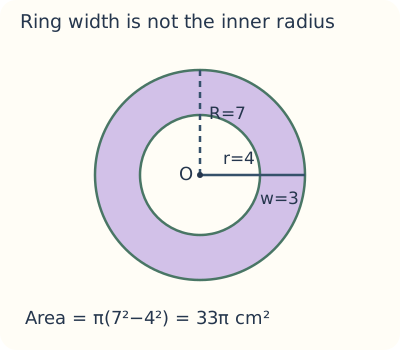
In the source creative ring, the inner radius is 3 m and a2 m label lies across the surrounding band. Reading2 m as band width gives outer radius 5 m. Reading it as outer radius would be inconsistent because2<3. For fresh inner radius 4 m, width3 m, the outer radius is 7 m and ring area 33πm². At50 BDT/m², cost is 1650πBDT; underπ≈3.14 that is 5181 BDT.
An outer perimeter excludes internal joins
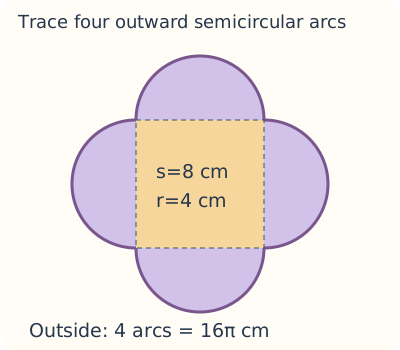
Attach an outward semicircle to every side of a square of sides. Each semicircle has radiuss/2 and arc length πs/2. The outer boundary is four arcs, total2πs. The square sides are internal joins and are not added to that perimeter. Area is a different question:the square plus four non-overlapping semicircular disks gives s²+πs²/2. Verify that the added regions do not overlap before adding areas.
Subtract only the stated non-overlapping cutouts
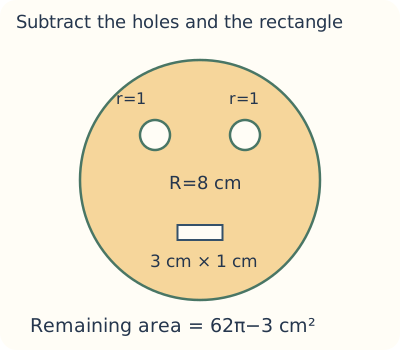
For a radius 8 cm board with two radius 1 cm circular holes and one3 cm-by 1 cm rectangle removed, the remaining area is 64π−2π−3=62π−3 cm². This assumes all cutouts lie inside and do not overlap. The source mouth picture looks oval while its written data specify a rectangle; use the stated rectangle dimensions and record that the illustration is schematic. Do not invent an ellipse formula for rectangular data.
Rotating a rectangle defines a right cylinder
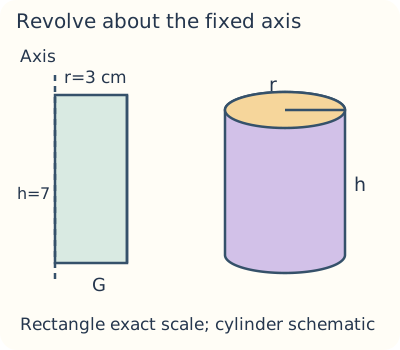
Rotate a rectangle about one fixed side of height h; the other dimensionr becomes the cylinder radius. The fixed side is the axis and the opposite rotating side is a generator of lengthh. A right circular cylinder has circular parallel bases and an axis perpendicular to them. The resulting radius isr, not the circumference of a rolled sheet. Rotating a square of sides givesr=h=s.
Cut the curved wall into a rectangle
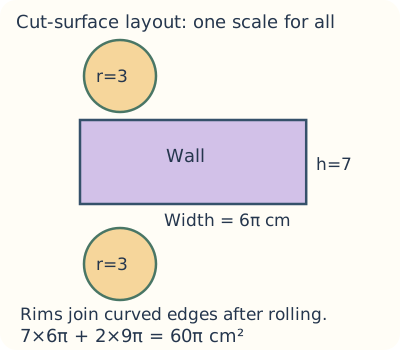
Cut along one straight generator and unroll the wall. The rectangle has height h and width equal to base circumference2πr. Curved surface area is 2πrh. A cut-surface layout shows this rectangle plus two disks of radius r for a closed cylinder. Each disk rim joins one long rectangle edge after rolling; they are not flat polygon faces hinged along straight shared edges. Perspective circles may look elliptical in the drawing, but represent circular bases.
Count curved wall and the requested caps
A closed cylinder has area 2πrh+2πr²=2πr(h+r). An open-top cylinder with one base has2πrh+πr². A wall only has2πrh. These ideal areas ignore thickness, glue tabs, waste and interior/exterior double coating unless specified. Surface area is in square units; volumeπr²h is a different quantity and is not the surface-area formula.
Keep conditions, pi convention and units visible
Use one length unit before squaring or multiplying. Check R>r for a ring, d=2r for a circle, and whether a cylinder task requests wall, one cap or two. Forr=3 cm, h=7 cm with π≈3.14, the curved area is 131.88 cm², one-base total 160.14 cm² and closed total 188.40 cm². A cost multiplies area by price per square unit; do not charge a surface rate per cubic unit.
Worked example
A radius 3 cm, height7 cm cylinder has wall area 42π and each cap9πcm². Wall, one-base and closed totals are 42π,51π,60π cm² respectively. Underπ≈3.14 they are 131.88,160.14,188.40 cm².
Name the centre, radii, chord endpoints and required length or area. State the chosen pi approximation and all units.
Draw the labelled model. Give reasons for congruence, perpendicular distance, sector rearrangement or included cylinder faces before calculating.
Check existence, radius versus diameter, positive roots and units. Numeric checks assess the requested value only; proofs, drawings and measurements need guardian or teacher review.
Source ring labels conflict
Example4 has inner 4 in its text and inner 8 in its picture. The two interpretations and their different answers remain visible.
Circular caps are not flat straight-edge hinges
The two disks close curved rims after the rectangular wall is rolled. Our diagram is a dimension-matched cut layout.
Resolve the conflicting source ring labels
Example4 uses outer radius 9; compare the text and image readings using π≈3.14.
Resolve the conflicting source ring labels
Reading
Area expression
Area in cm²
Text inner radius 4
π(81−16)=65π
204.10
Image inner radius 8
π(81−64)=17π
53.38
These are incompatible inputs, not two correct answers for the same fixed ring. State which reading is being used. In creative5, inner radius 3 plus band width2 instead gives outer radius 5.
Choose which cylinder faces to include
Radius3 cm and height7 cm; ideal surfaces have no thickness or joining allowance.
Choose which cylinder faces to include
Surface
Exact area (cm²)
Using π≈3.14 (cm²)
Wall only
42π
131.88
One cap
9π
28.26
Wall + one cap
51π
160.14
Wall + two caps
60π
188.40
The difference between adjacent totals is a physical circular cap. Volume uses cubic units and is a different calculation.
Closed-cylinder area from separate pieces
One wall rectangle plus two circular caps.
A=2πrh+2πr²
=2πr(h+r)
r=3, h=7 ⇒ A=60π cm²
2πr
Wall rectangle width, equal to a cap circumference.
h
Wall rectangle height.
πr²
Area of each of two caps.
Unroll one generator cut into a rectangle.
Match its long edge to one full rim.
Add the requested number of caps.
Keep square units and the chosen π convention.
The cut layout uses exact width6π cm≈18.85 cm. With the convention π≈3.14 the calculated width is 18.84 cm; do not confuse the approximation with exact π.
From rotating rectangle to cylinder surfaces
Compare the generating rectangle, the cylinder and the cut surface pieces.
All stages: readable static alternative
1 · Fix the 7 cm axis: Rotate the 3 cm width around this axis. It creates radius 3 cm, not a3 cm circumference.
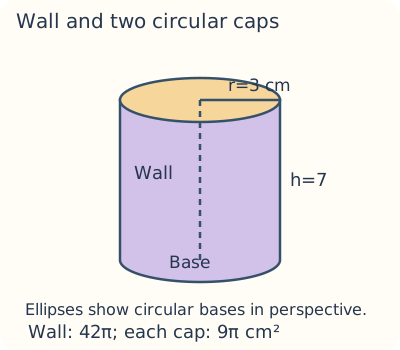
2 · Identify wall and caps: The generator has height7 cm. Each circular cap has radius 3 cm. The perspective ellipses represent circles.
3 · Lay out the cut pieces: The wall is 7 by 6π cm, and both disks have radius 3 cm. All cut pieces share one scale. Their curved rims join only after rolling.
Manual stages; no autoplay. The disks are separate cut pieces, not straight-edge hinged polygon faces.
Explore the mathematical figures
Match each letter to its explanation. Read the quantities, units and relationships, then check the counts or equations. These are original teaching models.
Separate ring width and radius
Ring area is π(7²−4²)=33π cm², not π×3². The source’s conflicting inner labels are explained beside the lesson.
O
Common centre of the two circles.
r=4
Centre-to-inner-boundary distance.
w=3
Band thickness from the inner to the outer boundary along a radius.
R=7
Outer radius r+w.
Original geometry, not copied artwork. Curved sectors retain their arcs. Perspective cylinders are explicitly schematic; the separate cut layout uses one length scale.
Explore the mathematical figures
Match each letter to its explanation. Read the quantities, units and relationships, then check the counts or equations. These are original teaching models.
Follow the outer arcs of a flower
The outside is four half-circumferences:16π cm. Area is the square64 plus semicircle area 32π cm². The outward pieces meet only at square corners.
s=8
A dashed square side is an internal join, not outer perimeter.
r=4
Each semicircle radius is half that side.
Original geometry, not copied artwork. Curved sectors retain their arcs. Perspective cylinders are explicitly schematic; the separate cut layout uses one length scale.
Explore the mathematical figures
Match each letter to its explanation. Read the quantities, units and relationships, then check the counts or equations. These are original teaching models.
Remove exactly the given shapes
The disjoint holes are fully inside the board. Remaining area 64π−2π−3=62π−3 cm²; the source oval-looking mouth does not override rectangular dimensions.
R=8
Outer disk radius, measured in the same unit as the cutouts.
r=1
Both circular holes have this radius.
3 cm × 1 cm
Literal rectangular cutout; its area is 3 cm².
Original geometry, not copied artwork. Curved sectors retain their arcs. Perspective cylinders are explicitly schematic; the separate cut layout uses one length scale.
Explore the mathematical figures
Match each letter to its explanation. Read the quantities, units and relationships, then check the counts or equations. These are original teaching models.
Rotate a rectangle about its side
Revolving a radius-wide rectangle differs from rolling a circumference-wide sheet. The cylinder axis is perpendicular to its circular bases.
Axis
Fixed side becomes the cylinder height7 cm.
r=3
Rectangle width sweeps a circle of radius 3 cm.
G
The opposite side is a generato r, sweeping the curved wall.
h
Cylinder height equals the fixed side; the perspective cylinder is not drawn to scale.
Original geometry, not copied artwork. Curved sectors retain their arcs. Perspective cylinders are explicitly schematic; the separate cut layout uses one length scale.
Explore the mathematical figures
Match each letter to its explanation. Read the quantities, units and relationships, then check the counts or equations. These are original teaching models.
Count wall and caps separately
Wall only, one-base and closed totals are 42π,51π,60π cm². The drawn ellipses represent circles, not elliptical bases.
r=3
Circular base radius; perspective makes its drawing elliptical.
h=7
Height along a generator and the axis.
Wall
Curved surface with area 2πrh=42π cm².
Base
Each cap has area πr²=9π cm².
Original geometry, not copied artwork. Curved sectors retain their arcs. Perspective cylinders are explicitly schematic; the separate cut layout uses one length scale.
Explore the mathematical figures
Match each letter to its explanation. Read the quantities, units and relationships, then check the counts or equations. These are original teaching models.
Match a wall sheet to two circular caps
Closed total is 42π+18π=60π cm². This is a cut layout: the rims join curved edges after rolling, not straight hinge lines in the flat page.
r=3
Both cap disks use radius 36 pixels at the shared scale.
Wall
Rectangle area 7×6π=42π cm².
h=7
Rectangle short dimension is the cylinder height.
Width
Long dimension equals the circumference of either cap, approximately18.85 cm.
Original geometry, not copied artwork. Curved sectors retain their arcs. Perspective cylinders are explicitly schematic; the separate cut layout uses one length scale.
Your written practice
Show your working on paper. Check your answer, then choose Next.
Show model answer and explanation
103.62
3.14×(49−16)=103.62.
Show model answer and explanation
7
R=r+w=4+3.
Show model answer and explanation
33
R²−r²=49−16=33.
Show model answer and explanation
5181
Area33×3.14=103.62 m²; cost×50=5181.
Show model answer and explanation
50.24
Four half-circumferences total2πs=2×3.14×8=50.24.
Show model answer and explanation
32
Each radius 4 semicircle has area 8π; four give32π.
Show model answer and explanation
191.68
62×3.14−3=191.68.
Show model answer and explanation
3
The other rectangle dimension becomes the radius.
Show model answer and explanation
7
The fixed axis side becomes its height.
Show model answer and explanation
131.88
2×3.14×3×7=131.88.
Show model answer and explanation
18.84
The width is 2πr=18.84, not the diameter 6.
Show model answer and explanation
188.4
131.88+2×28.26=188.4.
Show model answer and explanation
160.14
131.88+28.26=160.14.
Show model answer and explanation
56.52
2πr²=2×3.14×9=56.52.
Show model answer and explanation
200
0.02×10,000=200 cm².
Write in your own words. A guardian or teacher should review this response.
Show model answer and explanation
Subtract the inner disk area from the outer disk. Squaring the width instead would describe a different disk and omit the cross term. For R=7, r=4, the coefficient is 49−16=33, not9.
Name both complete disks and their common centre.
Write in your own words. A guardian or teacher should review this response.
Show model answer and explanation
The text says R=9, r=4, so area 65π≈204.10 cm² underπ≈3.14. The image says inner 8, which would give17π≈53.38 cm². State which input you use; the two readings cannot be silently combined.
Retain the discrepancy alongside the corrected calculation.
Write in your own words. A guardian or teacher should review this response.
Show model answer and explanation
If2 m is band width, outer radius is 3+2=5 m and ring area(25−9)π=16πm². If2 m is interpreted as the outer radius, the geometry contradicts inner 3 m. Use and state the width reading.
Identify exactly where the labelled segment lies.
Write in your own words. A guardian or teacher should review this response.
Show model answer and explanation
R=7 m. Areaπ(49−16)=33π≈103.62 m². Cost=103.62×50=5181 BDT, under the stated approximation and no extra waste.
Keep radius, width, area and price units distinct.
Write in your own words. A guardian or teacher should review this response.
Show model answer and explanation
Each has radius 4 cm and arc length 4πcm. Four arcs give16πcm≈50.24 cm ifπ≈3.14. The four square sides are internal joins, so they do not add32 cm to the outer boundary.
Trace the exterior boundary once.
Write in your own words. A guardian or teacher should review this response.
Show model answer and explanation
The perimeter is 16πcm. The region area is square64 plus four half-disks totalling32π, so 64+32πcm². The attached disks lie outside different square sides and meet only at corner points.
Use area for filled regions and arc length for the boundary.
Write in your own words. A guardian or teacher should review this response.
Show model answer and explanation
Outer disk64π minus two circles2π minus rectangle3 gives 62π−3 cm². The result assumes disjoint cutouts fully inside; overlaps must not be subtracted twice.
Explain the assumptions and why the source oval-looking drawing does not override its rectangular dimensions.
Write in your own words. A guardian or teacher should review this response.
Show model answer and explanation
The fixed7 cm side is the axis, height7 cm. The perpendicular3 cm width sweeps a radius 3 cm, while its opposite7 cm side sweeps the curved wall as a generator.
Do not confuse revolution of a radius-width rectangle with rolling an18.84 cm-wide wall sheet.
Write in your own words. A guardian or teacher should review this response.
Show model answer and explanation
A generator cut opens the wall to a rectangle of height h and width2πr, the base circumference. Their product2πrh is the curved area. The straight diameter 2r would be too short for the unrolled width.
Label both rectangle dimensions and their units.
Write in your own words. A guardian or teacher should review this response.
Show model answer and explanation
Use a rectangle7 cm high and 6πcm wide, plus two separate disks of radius 3 cm. The rectangle wraps once, and each disk circumference matches a rim. This is a cut layout, not a cuboid-style net with straight-edged cap hinges.
Explain the curved joins and exclude tabs/thickness unless given.
Write in your own words. A guardian or teacher should review this response.
Show model answer and explanation
The wall contributes2πrh. Two caps add2πr² for closed total2πr(h+r). One cap addsπr² for open-top total2πrh+πr². No caps leaves only the wall.
Name the number of included circular faces.
Write in your own words. A guardian or teacher should review this response.
Show model answer and explanation
Wall 131.88 cm²; each cap 28.26 cm²; one-base 160.14 cm²; closed 188.40 cm². Differences of 28.26 or56.52 correspond to one or two actual caps.
Check area differences against the component faces.
Write in your own words. A guardian or teacher should review this response.
Show model answer and explanation
Convert0.03 m to 3 cm, then 2×3.14×3×7=131.88 cm². Alternatively convert7 cm to 0.07 m and obtain0.013188 m², which equals131.88 cm².
Convert before multiplying and check squared-unit conversion.
Write in your own words. A guardian or teacher should review this response.
Show model answer and explanation
Radius and height are both4 cm. Closed area 2π×4×(4+4)=64πcm². The generator has length 4 cm; the base diameter is 8 cm.
Keep the axis side, radius and diameter distinct.
Write in your own words. A guardian or teacher should review this response.
Show model answer and explanation
State whether a supplied length is radius, diameter or width; mark all included regions/faces; choose or retain π; convert units; calculate area or length as requested; then multiply by the matching price rate. Verify existence and cutout overlap assumptions.
Apply the checklist to one ring and one cylinder example.
Progress and browser storage
Notebook challenge, sources and further study
Your circle and cylinder notebook
Build one circular-region budget and one cylinder cut layout.
Review with a guardian or teacher
Mark outer/inner radii or the generator and axis.
Show every included face or removed region once.
Keep exactπ expressions beside approximations and explain assumptions.
Keep your work on paper or in a local file. This page does not upload it or automatically grade the project.
Chapter companion and further study
This original Kidemy practice follows the topic order of 2026 Class 8 Mathematics · English Version, chapter 10, printed pages 159–170. It does not replace the complete chapter or its practical teaching.
Original tasks teach the mapped methods rather than reproduce every exact printed question. Review independent full proofs and constructions.
Historical pi biography claims are outside this mathematical-method crosswalk. Original companions for all 11 chapter headings are available; independent source exercises and full working still need review.
Teacher-led lessons, schedules and prices for this outline are upcoming. You can use any starter practice above now without booking.
Your next step
Solo practice works without an account. Sign in to save a practice record to your learner profile.
Keep practising
Exact lesson links and related activities are labelled separately. Return-to-course links retain your selected learning path.