Show model answer and explanation
reflect
The Moon is visible mainly by reflected sunlight.
Class 6 · English Version · General science
2026 Class 6 Science · English Version · Chapter 9 · Chapter companion part
Use straight-line light, reflection and refraction to explain familiar observations.
Class 6 English Version chapter companion with expanded teaching, 20 written tasks and a notebook challenge. Further independent assessment and teacher-reviewed practical work remain; this is not complete textbook coverage.
Open this topic in Skills Lab →
A luminous source emits light; a non-luminous object is seen when light from it reaches an eye after reflection. In a uniform transparent medium, a ray model shows light travelling in straight lines. Opaque materials block direct transmission; transparent materials transmit light clearly and translucent materials scatter transmitted light.
A mirror reflects light. The angle of incidence equals the angle of reflection, measured from the normal, an imaginary line perpendicular to the surface. An opaque object blocks light and can cast a shadow. Source size and geometry affect shadow sharpness and size; a shadow is not a reflection.
Light can change direction when passing between transparent media because its speed changes; this is refraction. A pencil in water may appear bent even when it is straight. White light can be separated into colours by dispersion; different colours can bend by different amounts.
Draw a source, object and screen with straight ray arrows. Use room light and paper models. Never look at the Sun, aim bright lamps into eyes or use lasers for this lesson. A diagram should identify what is observed and what the model predicts.
A luminous source emits light; a surface can reflect or absorb incoming light, and some materials transmit it. To see a non-luminous object, reflected light must reach the eye. The ray model assumes straight-line travel within a uniform medium. Absorbed light can transfer energy to a material. Sources include the Sun, electric lamps and light-producing chemical reactions; their energy sources need to be considered separately.
A smooth surface can reflect parallel incident rays in a coordinated direction, forming a clear image. A rough surface scatters reflections in many directions because its small surface regions have different orientations. The reflection law still applies locally. Diffuse reflection helps you see a page from different positions; it does not mean rough surfaces reflect no light.
The normal is perpendicular to the reflecting surface. Angles of incidence and reflection are measured from that normal, not the surface. A plane mirror forms an upright virtual image of the same size, at the same perpendicular distance behind the mirror as the object is in front. “Virtual” means the reflected rays only appear to come from that position. Writing can look laterally inverted: a side-to-side reversal in the viewed image.
A still water surface can act approximately like a mirror; disturbed water gives a less stable image. Reflection, absorption and transmission answer different questions. A diagram should show arrow direction and label the object, mirror, image and normal. Use ordinary room light and supplied ray diagrams; do not look at the Sun or use lasers for this practice. Refraction and dispersion in the companion are related enrichment beyond the main reflection focus of this source chapter.
A ray reaches a mirror at 30° to the normal. It reflects at 30° to that normal, not 30° to the mirror surface. The normal meets the mirror at 90°.
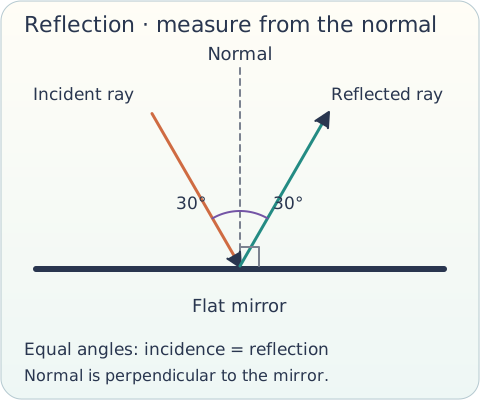
Reflection angles are measured from the normal. Using the surface instead changes the angle being described and can give a wrong ray diagram.
An incident ray makes 40° with a flat mirror surface. Its angle to the normal is 90 − 40 = 50°, so the reflected ray also makes 50° with the normal.
A toy is 1.2 m in front of a plane mirror. Its image appears 1.2 m behind it; object-to-image separation is 2.4 m. That separation is not the distance from the toy to the mirror.
Show your working on paper and enter your answer here. If it does not match, compare the model and try again.
reflect
The Moon is visible mainly by reflected sunlight.
35
The two angles to the normal are equal.
refraction
Direction may change because light travels at different speeds.
transparent
It transmits light with little scattering in this model.
dispersion
Different colours bend by different amounts.
Write in your own words. A guardian or teacher should review this response.
Light from a source reflects from the book and enters the eye.
Include source, book and eye in the path.
Write in your own words. A guardian or teacher should review this response.
A shadow is a region where an object blocks light; a mirror image is formed by reflected rays.
Describe the different mechanisms.
Write in your own words. A guardian or teacher should review this response.
Light from the underwater part refracts as it leaves water, changing its apparent position.
State that appearance changes without the pencil bending.
Apply the idea in a new situation and explain your method. Open writing needs a guardian or teacher to review it.
25
For a plane mirror the two angles to the normal are equal.
60
The normal is 90° to the surface, so 90 − 30 = 60°.
1.5
The image is the same perpendicular distance behind the mirror.
4
2 m to the mirror plus 2 m behind it gives 4 m.
diffuse reflection
Different small surface orientations scatter the reflected rays.
virtual
The rays appear to come from behind the mirror.
Write in your own words. A guardian or teacher should review this response.
The page diffusely reflects light into many directions, so some reflected light reaches each pupil’s eyes.
Connect source, surface and eyes.
Write in your own words. A guardian or teacher should review this response.
Each small region reflects according to its local normal; different local orientations send rays in different directions.
Distinguish local reflection from the overall scattered pattern.
Write in your own words. A guardian or teacher should review this response.
The incidence angle is defined from the normal, which is perpendicular to the surface. The two reference angles add to 90°.
State the reference line and its relationship to the surface.
Write in your own words. A guardian or teacher should review this response.
The dark surface can absorb much of the incident light and gain energy; the mirror directs much of it into reflected rays under the given conditions.
Avoid claiming any real surface absorbs or reflects absolutely all light.
Write in your own words. A guardian or teacher should review this response.
The virtual image appears behind the mirror at the same perpendicular distance as the object is in front.
Distinguish the mirror surface from the apparent image position.
Write in your own words. A guardian or teacher should review this response.
Show light reaching the book, reflecting to the mirror, then reflecting into the eye; use arrow directions and a normal at the mirror.
Include the complete light path without reversing the arrows.
Draw two reflection diagrams: one angle given from the normal and one from the surface. Add a plane-mirror object/image diagram with distances and explain why a rough page is visible from several positions.
Keep your work on paper or in a local file. This page does not upload it or automatically grade the project.
This original Kidemy practice follows the topic order of 2026 Class 6 Science · English Version, chapter 9, printed pages 85–95. It does not replace the complete chapter or its practical teaching.
Official book catalogue and source →
Teacher-led lessons, schedules and prices for this outline are upcoming. You can use any starter practice above now without booking.
Solo practice works without an account. Sign in to save a practice record to your learner profile.
Exact lesson links and related activities are labelled separately. Return-to-course links retain your selected learning path.