Show model answer and explanation
star
The Sun produces energy as a star.
Class 6 · English Version · General science
2026 Class 6 Science · English Version · Chapter 12 · Chapter companion part
Relate Earth’s systems and layers to landforms, rocks, soil and natural change.
Class 6 English Version chapter companion with expanded teaching, 20 written tasks and a notebook challenge. Further independent assessment and teacher-reviewed practical work remain; this is not complete textbook coverage.
Open this topic in Skills Lab →
The Sun is a star, Earth is a planet and the Moon is Earth’s natural satellite. Earth rotates on its axis and orbits the Sun; these are different motions. Scientific explanations of Earth’s early history use evidence and can be refined. A model of formation is not something directly witnessed in a classroom.
The atmosphere is the surrounding gas envelope; the hydrosphere includes water; the biosphere includes living things. The solid Earth includes rock and soil. These systems interact: rain weathers rock, plants affect soil and water can transport particles. Continents and oceans describe major surface regions.
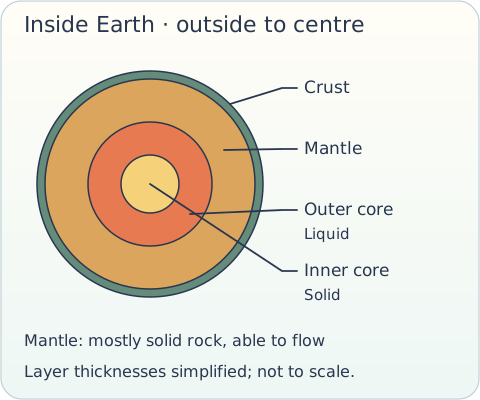
Earth has crust, mantle and core, with a liquid outer core and solid inner core. The lithosphere is broken into slowly moving tectonic plates. Plate interactions can cause mountain building, earthquakes and volcanic activity. The mantle is mostly solid rock that can flow over very long times; it is not an open underground ocean of liquid magma.
Weathering breaks or changes rock in place; erosion moves material. Soil develops from weathered mineral material mixed with organic matter, water, air and organisms. Texture and composition affect how it holds water. Protect soil from erosion with suitable plant cover and drainage. For earthquake safety, follow local school guidance; practise with a guardian rather than entering damaged structures.
The Big Bang model describes the early expansion of the universe, not an ordinary explosion into an already empty surrounding space. The solar system formed much later from a cloud of gas and dust under gravity. Earth grew as material accumulated. Heating and differentiation—materials separating into layers, with denser material sinking—helped form its interior; later cooling shaped the surface. These are evidence-based models, not events directly repeated in a classroom.
The Sun is a star that emits light; Earth is a planet orbiting the Sun; the Moon is a natural satellite orbiting Earth. The Moon is seen mainly by reflected sunlight. Apparent size depends on distance as well as actual size. Earth’s liquid water, atmosphere and energy supply support the life we know. Rotation about an axis and orbital movement must be described separately.
The lithosphere includes the crust and rigid uppermost mantle and is divided into moving plates. A fault is a fracture where rocks can move relative to each other. Stress can build, and sudden movement releases energy as an earthquake. Many volcanoes occur near plate boundaries, but not all. Molten rock below ground is magma; at the surface it is lava. The mantle is mostly solid rock capable of very slow flow.
Weathering breaks down or changes rock in place; erosion transports material. Soil contains mineral particles, organic material, air, water and organisms. Humus is decomposed organic material; it is not the whole soil. Vegetation and suitable land use can reduce erosion. Rocks and minerals supply useful materials, while fossil fuels formed from ancient living material over long times. Use supplied maps/samples and school safety guidance; do not enter quarries, damaged structures or hazardous sites.
Rain can enter a crack and help weather a rock. Running water can then carry the loosened particles elsewhere: weathering makes material, while erosion moves it.
Weathering and erosion are related but different processes. Also, “mantle” is not a synonym for liquid magma throughout Earth.
In a three-body drawing, Earth orbits the Sun and the Moon orbits Earth. Draw an additional curved arrow on Earth to show rotation. One arrow should not silently represent all three movements.
Weathering creates smaller mineral particles; dead organic material decomposes; organisms mix material and water/air occupy spaces. Soil formation is a combined process, not simply turning one whole rock instantly into ready-to-use soil.
Show your working on paper and enter your answer here. If it does not match, compare the model and try again.
star
The Sun produces energy as a star.
crust
The crust is outside the mantle.
hydrosphere
Hydro- refers to water.
erosion
Weathering acts in place; erosion transports material.
liquid
The outer core is liquid; the inner core is solid.
Write in your own words. A guardian or teacher should review this response.
Rotation is spinning on its axis; orbit is movement around the Sun.
Name the axis and the object orbited.
Write in your own words. A guardian or teacher should review this response.
Roots can help hold soil and plant cover can reduce the impact of rain and slow runoff.
Connect vegetation to reduced erosion, without claiming it prevents every landslide.
Write in your own words. A guardian or teacher should review this response.
Much evidence is indirect, including how seismic waves travel; models combine evidence to explain regions we cannot directly visit.
Distinguish an evidence-based model from direct viewing.
Apply the idea in a new situation and explain your method. Open writing needs a guardian or teacher to review it.
mantle
The mantle lies below the crust and above the core.
lava
The name changes when molten rock reaches the surface.
weathering
Weathering acts in place; erosion transports material.
plate tectonics
Tectonic plates are pieces of lithosphere.
satellite
It orbits Earth rather than being a star.
humus
Humus is one soil component.
Write in your own words. A guardian or teacher should review this response.
The universe’s early expansion precedes the later formation of stars, the solar system and Earth from accumulating material.
Keep the sequence of models clear without claiming a classroom observation.
Write in your own words. A guardian or teacher should review this response.
Apparent size depends on distance; a much larger object can look small when it is much further away.
Connect appearance to both size and distance without inventing a volume ratio.
Write in your own words. A guardian or teacher should review this response.
Stress builds in rocks and is released when they slip, sending energy through the Earth.
Distinguish slow plate motion from the sudden release.
Write in your own words. A guardian or teacher should review this response.
The crust is the outer rocky layer; the lithosphere includes crust and the rigid uppermost mantle.
Do not treat the two names as exact synonyms.
Write in your own words. A guardian or teacher should review this response.
Weathering supplies mineral particles, decomposition contributes organic material, and water, air and organisms interact within the soil.
Name components and explain how they contribute.
Write in your own words. A guardian or teacher should review this response.
Maps, photographs and safe samples can address the question while those places have hazards requiring professional control.
Choose evidence appropriate to a learner and follow school/guardian guidance.
Prepare a four-part Earth page: formation sequence, Sun/Earth/Moon motion diagram, labelled Earth layers/plates, and a soil-formation flow chart. Explain one condition supporting known life on Earth, an evidence limit in the formation model and one way to protect soil.
Keep your work on paper or in a local file. This page does not upload it or automatically grade the project.
This original Kidemy practice follows the topic order of 2026 Class 6 Science · English Version, chapter 12, printed pages 120–130. It does not replace the complete chapter or its practical teaching.
Official book catalogue and source →
Teacher-led lessons, schedules and prices for this outline are upcoming. You can use any starter practice above now without booking.
Solo practice works without an account. Sign in to save a practice record to your learner profile.
Exact lesson links and related activities are labelled separately. Return-to-course links retain your selected learning path.