Show model answer and explanation
fulcrum
A lever turns about its fulcrum.
Class 6 · English Version · General science
2026 Class 6 Science · English Version · Chapter 11 · Chapter companion part
Explain what forces can change and how simple machines trade force and distance.
Class 6 English Version chapter companion with expanded teaching, 20 written tasks and a notebook challenge. Further independent assessment and teacher-reviewed practical work remain; this is not complete textbook coverage.
Open this topic in Skills Lab →
A force is a push or pull from an interaction. Forces can change speed, direction or shape. Balanced forces have zero resultant force; an object may then stay at rest or continue at constant velocity. Gravity and friction are examples of forces, not supplies of endless energy.
A lever turns about a pivot (fulcrum). The turning effect depends on force and perpendicular distance from the pivot. For balance in an ideal simple model, effort × effort arm = load × load arm. In a first-class lever the pivot lies between effort and load; in a second-class lever the load is between; in a third-class lever the effort is between.
An inclined plane can reduce the force needed by increasing the distance moved. A fixed pulley mainly changes force direction in an ideal model. Some movable-pulley arrangements provide force advantage. A wheel and axle uses different radii to change force and turning effect. Friction makes real machines less efficient than ideal models.
Bones can act as levers, joints as pivots and muscles supply effort. A simple machine does not create energy. Use diagrams or lightweight paper models here; do not lift people, balance weights on a body or use sharp tools for a child activity.
A resultant force is the combined force after direction is considered. Force is measured in newtons (N). Opposite forces of 12 N east and 7 N west give 5 N east. Zero resultant force means no change in velocity, not necessarily no motion. Forces can also deform a body. Diagrams should use arrows with direction and stated magnitudes rather than infer forces from appearance alone.
Classify by the positions of pivot, effort and load. A first-class lever has the pivot between the other two; a second-class lever has the load between them; a third-class lever has the effort between them. Scissors can act as first-class levers, a wheelbarrow as a second-class lever, and a simplified forearm raised by a biceps as a third-class lever. Use the actual arrangement, not the tool name alone.
For an ideal balanced lever, effort × perpendicular effort arm = load × perpendicular load arm. Mechanical advantage is load force divided by effort force: it describes a force ratio and has no unit. Moving the effort further from the pivot can reduce the balancing force, while its point moves through a larger distance. A fixed pulley mainly changes direction; the number of supporting rope sections matters for other arrangements.
A wheel and axle uses different turning radii; a ramp spreads a rise over a longer path. These do not create energy. Efficiency compares useful energy/work output with input, often as a percentage. The joule (J) is a unit of energy or work. Efficiency differs from the load/effort force ratio, even where older source wording mixes the labels. Use drawings and light safe models; sharp tools, body-loading and lifting people are unnecessary.
An ideal lever has effort arm 30 cm and load arm 10 cm. To balance a 60 N load, effort = (60 × 10) ÷ 30 = 20 N. The smaller force moves through a greater distance.
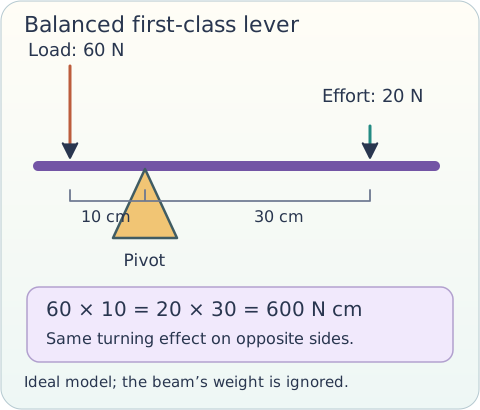
A longer effort arm can reduce balancing force, but a machine is not an energy source. A fixed pulley and a movable-pulley arrangement do not have the same effect.
An ideal lever balances a 60 N load 15 cm from the pivot with effort 45 cm away. Effort = 60 × 15 ÷ 45 = 20 N. The force advantage is 60 ÷ 20 = 3: load force is three times effort force in this model.
A machine supports a 40 N load with 10 N effort, so its mechanical advantage is 4. If 100 J enters and 80 J is useful output, efficiency is 80%. Four times the force does not mean 400% efficiency, because movement distances also matter.
Show your working on paper and enter your answer here. If it does not match, compare the model and try again.
fulcrum
A lever turns about its fulcrum.
20
Effort × 20 = 40 × 10, so effort = 20 N.
pivot
The pivot or fulcrum is in the middle.
load
The load is between the other two.
inclined plane
A ramp trades a longer path for a smaller force in an ideal model.
Write in your own words. A guardian or teacher should review this response.
The smaller force acts over a longer distance. In the ideal model, energy transferred to raise the load is unchanged.
Connect force, distance and height; real friction may add work.
Write in your own words. A guardian or teacher should review this response.
It changes the direction of effort, letting a person pull down to lift a load. It does not by itself halve the required force.
Do not confuse fixed and movable arrangements.
Write in your own words. A guardian or teacher should review this response.
It transfers energy and trades force for distance or changes direction; friction can dissipate energy, but no energy is created.
Explain the trade-off rather than promising an effortless lift.
Apply the idea in a new situation and explain your method. Open writing needs a guardian or teacher to review it.
5
12 − 7 = 5 N east; the question asks for its magnitude.
20
60 × 15 ÷ 45 = 20 N.
4
40 ÷ 10 = 4: the load force is four times the effort force.
80
80 ÷ 100 × 100 = 80%; useful output is four fifths of the input.
effort
The applied effort lies between pivot and load.
wheel and axle
The connected parts rotate together.
Write in your own words. A guardian or teacher should review this response.
With zero resultant force its velocity need not change; it may continue at constant velocity.
Do not confuse no acceleration with necessarily being stationary.
Write in your own words. A guardian or teacher should review this response.
The longer perpendicular effort arm provides the same turning effect with less force, while that point moves further.
Mention both arm length and the distance trade-off.
Write in your own words. A guardian or teacher should review this response.
The wheel/axle is the pivot, the load lies between it and the handles where effort is applied.
Identify all three positions in the chosen model.
Write in your own words. A guardian or teacher should review this response.
A fixed pulley mainly changes direction; an ideal two-support arrangement shares the load between two sections, though rope must move further.
State the arrangement and ideal assumption instead of claiming all pulleys halve force.
Write in your own words. A guardian or teacher should review this response.
Mechanical advantage compares forces; efficiency compares useful energy/work output with input. Distances and losses make these different comparisons.
Define both quantities in plain language.
Write in your own words. A guardian or teacher should review this response.
The elbow is the pivot, biceps applies effort between elbow and hand, and the hand-held load is further from the elbow.
Use a diagram; do not place weights on a learner’s body.
Draw one example of each lever class, label pivot/effort/load and solve the supplied balanced-lever calculation. Add a ramp or pulley comparison and explain force advantage separately from efficiency. Use diagrams rather than sharp tools or body-loading.
Keep your work on paper or in a local file. This page does not upload it or automatically grade the project.
This original Kidemy practice follows the topic order of 2026 Class 6 Science · English Version, chapter 11, printed pages 109–119. It does not replace the complete chapter or its practical teaching.
Official book catalogue and source →
Teacher-led lessons, schedules and prices for this outline are upcoming. You can use any starter practice above now without booking.
Solo practice works without an account. Sign in to save a practice record to your learner profile.
Exact lesson links and related activities are labelled separately. Return-to-course links retain your selected learning path.