2026 Class 8 Mathematics · English Version · Chapter 8 · Chapter companion part
Chapter 8A: Names, angles and diagonal properties
Classify quadrilaterals from their conditions and explain angle, side and diagonal properties without trusting appearance.
About this lesson and its coverage
Class 8 English Version: part A of the chapter 8 companion. Eight teaching sections, 30 written tasks and a notebook challenge. Selected companion coverage, not complete textbook coverage; use all five parts. Independent proofs, compass work, drawings and nets require guardian or teacher review.
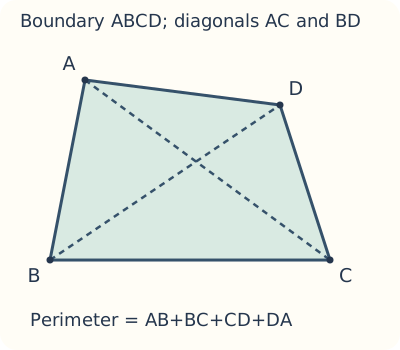
A simple quadrilateral has four straight sides forming a closed boundary without crossings. Name ABCD around its boundary: sides AB, BC, CD, DA; diagonals AC, BD join opposite vertices. AB and CD are opposite sides; AB and BC are adjacent. Perimeter adds only the four boundary lengths. Our construction models are convex: each interior angle is less than 180°. A crossed bow-tie drawing is not one of these models.
Special figures belong to larger families
A parallelogram has two pairs of opposite parallel sides. A rectangle is a parallelogram with a right angle; all four are then right. A rhombus has four equal sides and opposite sides parallel. A square is both a rectangle and a rhombus. A tilted square remains a square. Equal adjacent sides alone do not make an arbitrary quadrilateral a rhombus unless all four are equal.
State the trapezium and kite convention
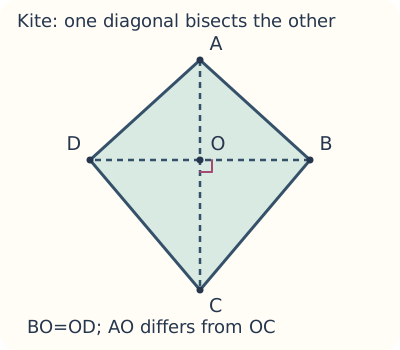
Here trapezium means exactly one pair of opposite parallel sides. Some texts use at least one pair, which also includes parallelograms: name that convention before judging the source activity. Here a kite has two adjacent equal-side pairs of different lengths, so a rhombus is excluded. Its symmetry diagonal bisects the other at a right angle, but the other diagonal need not bisect it. Mutual bisection is not a property of every kite. For unequal side lengths pk, qk, the perimeter is2(p+q)k; a ratio question first finds k from the stated perimeter.
A diagonal explains the 360-degree sum
A diagonal inside a convex quadrilateral divides it into two triangles. Each triangle has angle sum 180°, giving 360° altogether. The split angles at the diagonal endpoints recombine to the full quadrilateral angles. Four right angles means 4×90°, not four degrees. For an ordinary concave simple quadrilateral use an internal diagonal and include its reflex interior angle.
A parallelogram has supplementary neighbours
Opposite angles are equal because parallel sides give equal alternate angles. Adjacent interior angles sum to 180° along a transversal. If angle A=68°, then C=68° and B=D=112°. Opposite sides have equal lengths. A general parallelogram need not have equal diagonals, right angles or four equal sides; a picture that looks nearly rectangular proves none of these.
Bisection means equal halves of the same diagonal
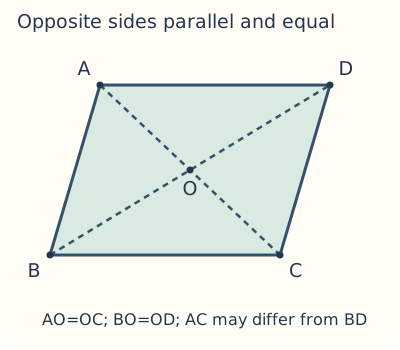
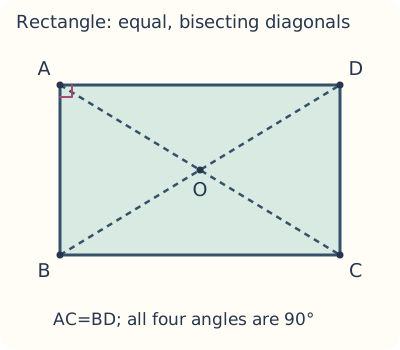
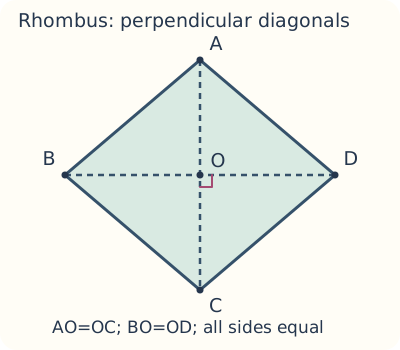
In a parallelogram, AC and BD meet at O with AO=OC and BO=OD. This does not imply AO=BO: the two diagonals may differ. In a rectangle the diagonals are also equal, so all four half-diagonal lengths are equal. In a rhombus the diagonals are perpendicular but generally unequal. A square has both additional properties.
Angle bisectors halve angles, not sides
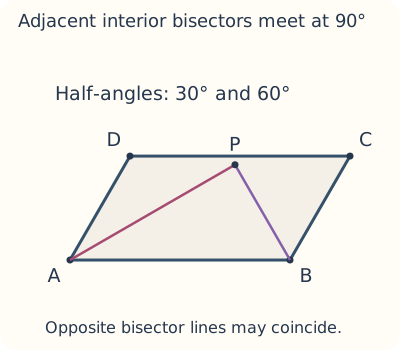
Opposite interior angles of a parallelogram are equal. Their bisector lines are parallel, or can coincide in a rhombus; do not insist they are distinct in that case. Adjacent angles sum to 180°, so their halves sum to 90° and the adjacent bisectors are perpendicular. This concerns interior bisectors, not arbitrary lines passing through the vertices.
A measured sketch is evidence to check
Use markings and stated givens as the conditions. A rectangle can be verified by three right angles in a simple quadrilateral, or by first proving a parallelogram and then equal diagonals. Equal diagonals alone do not suffice: an isosceles trapezium can have them. A square needs both right-angle and equal-side information. A physical slab has measurement tolerances, so distinguish a mathematical proof from an approximate construction check.
Worked example
In parallelogram ABCD with A=68°, C=68° and B=D=112°. If AC=14 and BD=10, their halves are 7 and 5; bisection does not make the diagonals equal.
Name the figure in cyclic vertex order and state every given length, angle and assumption.
Draw a labelled model; give a reason for each proof, area calculation or construction step. Check that the data can form the required figure.
Verify the original conditions, units and vertex order. Numeric checks assess the requested value only; proofs, nets and constructions need guardian or teacher review.
Source wording needs a convention
The source trapezium activity depends on whether a pair means exactly one or at least one. This lesson states exactly one and explains the alternative.
The kite exception matters
Perpendicular diagonals do not by themselves imply mutual bisection. A general kite supplies a counterexample.
Which properties are guaranteed?
All entries concern nondegenerate figures; a square belongs to both special families.
Which properties are guaranteed?
Family
Opposite sides parallel
Four equal sides
Four right angles
Diagonals
Parallelogram
Both pairs
Not required
Not required
Bisect
Rectangle
Both pairs
Not required
Yes
Equal and bisect
Rhombus
Both pairs
Yes
Not required
Perpendicular and bisect
Square
Both pairs
Yes
Yes
Equal, perpendicular, bisect
Kite here
Not required
No: pair lengths differ
Not required
Perpendicular; one bisects the other
Trapezium here
Exactly one pair
Not required
Not four
No general bisection rule
A condition marked not required can hold in a special case only if the definitions allow that special case. Our kite/trapezium conventions exclude rhombi/parallelograms respectively.
Adjacent and opposite angles
For parallelogram ABCD with A=68°.
C = A = 68°
B = D = 180°−68° = 112°
68+112+68+112 = 360°
A, C
Opposite equal angles.
B, D
The other equal pair.
Use parallel lines for opposite-angle equality.
Use the same-side interior-angle sum for adjacent angles.
Check the four-angle total.
These angle facts alone do not assert that the diagonals are equal.
Explore the mathematical figures
Match each letter to its explanation. Read the quantities, units and relationships, then check the counts or equations. These are original teaching models.
Read the boundary before the diagonals
Trace AB, BC, CD, DA in cyclic order. AC and BD connect opposite vertices.
A
A meets sides DA and AB.
B
B meets AB and BC.
C
C is opposite A; AC is a diagonal.
D
D is opposite B; BD is the other diagonal.
Original labelled mathematical model, not copied source artwork. Verify stated conditions rather than judging shape from appearance.
Explore the mathematical figures
Match each letter to its explanation. Read the quantities, units and relationships, then check the counts or equations. These are original teaching models.
A parallelogram bisects both diagonals
Compare halves within each diagonal: AO=OC and BO=OD.
A
A is an endpoint of diagonal AC.
B
B is an endpoint of diagonal BD.
C
C is opposite A with OC=OA.
D
D is opposite B with OD=OB.
O
O is the common midpoint of AC and BD.
Original labelled mathematical model, not copied source artwork. Verify stated conditions rather than judging shape from appearance.
Explore the mathematical figures
Match each letter to its explanation. Read the quantities, units and relationships, then check the counts or equations. These are original teaching models.
Rectangle diagonals are equal and bisected
Prove ABD≅DCA by SAS, then infer BD=CA; parallelism supplies mutual bisection.
A
A is a right-angle corner.
B
B matches C in triangles ABD, DCA.
C
C is opposite A; AC is one diagonal.
D
D is opposite B; BD has the same length as AC.
O
O halves both equal diagonals, so all four portions are equal.
Original labelled mathematical model, not copied source artwork. Verify stated conditions rather than judging shape from appearance.
Explore the mathematical figures
Match each letter to its explanation. Read the quantities, units and relationships, then check the counts or equations. These are original teaching models.
Rhombus diagonals are perpendicular
SSS on two half-triangles gives equal adjacent supplementary angles, each90°.
A
A lies on the vertical diagonal AC.
B
B lies on the horizontal diagonal BD.
C
C is opposite A with OC=OA.
D
D is opposite B with OD=OB.
O
O is the perpendicular crossing and midpoint of both diagonals.
Original labelled mathematical model, not copied source artwork. Verify stated conditions rather than judging shape from appearance.
Explore the mathematical figures
Match each letter to its explanation. Read the quantities, units and relationships, then check the counts or equations. These are original teaching models.
A kite need not bisect both diagonals
One diagonal bisects the other; mutual bisection would add a stronger condition.
A
A is the nearer vertical endpoint of the symmetry diagonal.
B
B is a horizontal-diagonal endpoint.
C
C is farther from O than A.
D
D has OD=OB; BD is bisected.
O
O is a perpendicular crossing but is not the midpoint of AC.
Original labelled mathematical model, not copied source artwork. Verify stated conditions rather than judging shape from appearance.
Explore the mathematical figures
Match each letter to its explanation. Read the quantities, units and relationships, then check the counts or equations. These are original teaching models.
Adjacent bisectors are perpendicular
The two triangle angles sum to90°, leaving a right angle at P. Opposite supporting bisectors may coincide.
A
A has a 60° interior angle, halved to30°.
B
B has a 120° interior angle, halved to60°.
C
C is opposite A.
D
D is opposite B.
P
P is the intersection of adjacent interior bisectors; angle APB=90°.
Original labelled mathematical model, not copied source artwork. Verify stated conditions rather than judging shape from appearance.
Your written practice
Show your working on paper. Check your answer, then choose Next.
Show model answer and explanation
18
Add the four boundary lengths: 3+4+5+6.
Show model answer and explanation
2
Its two opposite-vertex joins are the diagonals.
Show model answer and explanation
90
360−75−85−110=90.
Show model answer and explanation
112
Adjacent angles sum to 180°.
Show model answer and explanation
68
Opposite angles are equal.
Show model answer and explanation
7
The diagonals bisect each other, so AO=14/2.
Show model answer and explanation
11
BD=2BO.
Show model answer and explanation
13
Rectangle diagonals are equal.
Show model answer and explanation
90
The diagonals meet perpendicularly.
Show model answer and explanation
26
Its four sides are equal: 4×6.5.
Show model answer and explanation
4
One right angle in a parallelogram forces all four.
Show model answer and explanation
6
Two sides are2k and two are3k, so10k=30, k=3 and2k=6.
Show model answer and explanation
34
Its interior bisector divides 68° into two equal 34° angles.
Show model answer and explanation
90
Half of two supplementary angles adds to 90°.
Show model answer and explanation
90
360−3×90=90.
Write in your own words. A guardian or teacher should review this response.
Show model answer and explanation
Sides AB, BC, CD, DA; diagonals AC, BD; adjacent AB, BC; opposite AB, CD. A different correct pair is acceptable.
Follow boundary order and exclude diagonals from perimeter.
Write in your own words. A guardian or teacher should review this response.
Show model answer and explanation
A square has four right angles and four equal sides. A 3-by-5 rectangle lacks four equal sides; a non-right rhombus lacks four right angles.
Give conditions and genuine counterexamples.
Write in your own words. A guardian or teacher should review this response.
Show model answer and explanation
With exactly one parallel-side pair, no. With at least one pair, yes. The source wording a pair does not resolve the convention on its own.
Name the convention; do not treat a terminology difference as a failed proof.
Write in your own words. A guardian or teacher should review this response.
Show model answer and explanation
A kite symmetry diagonal bisects the other at right angles. The reverse bisection need not hold. For vertices (0,3),(2,0),(0,−1),(−2,0), the vertical diagonal has unequal halves 3 and 1 at the crossing.
Identify which diagonal is bisected. This clarifies ambiguous source Exercise 8.2(1).
Write in your own words. A guardian or teacher should review this response.
Show model answer and explanation
Draw an internal diagonal, sum the two triangle angle sums, then recombine the two split endpoint angles. Total is 180°+180°=360°.
Show how each quadrilateral angle is counted once.
Write in your own words. A guardian or teacher should review this response.
Show model answer and explanation
A=C=68° by opposite-angle equality; B=D=112° by supplementary adjacent angles. They total 360°.
Include the two reasons and a check.
Write in your own words. A guardian or teacher should review this response.
Show model answer and explanation
Bisection compares halves within each diagonal. One diagonal could be 14 and the other 10, with half lengths 7 and 5.
Keep the two equalities separate.
Write in your own words. A guardian or teacher should review this response.
Show model answer and explanation
All four families have mutual bisection. Rectangle adds equal lengths; rhombus adds perpendicularity; square adds both. A general rectangle need not have perpendicular diagonals.
Use the property table and identify properties that are not universal.
Write in your own words. A guardian or teacher should review this response.
Show model answer and explanation
If adjacent angles are α and 180°−α, their halves sum to 90°. With the common side as transversal, the triangle between the bisectors has remaining angle 90°.
Use interior rays and show the half-angle calculation.
Write in your own words. A guardian or teacher should review this response.
Show model answer and explanation
Their supporting lines have the same direction; they can coincide in a rhombus, where a diagonal bisects both opposite angles. Distinct parallel lines is too strong without excluding that case.
Distinguish equal direction from two distinct lines.
Write in your own words. A guardian or teacher should review this response.
Show model answer and explanation
No. An isosceles trapezium can have equal diagonals without four right angles. First prove a parallelogram, then use equal diagonals, or use sufficient right-angle conditions.
State the missing premise and a counterexample.
Write in your own words. A guardian or teacher should review this response.
Show model answer and explanation
Three right interior angles imply the fourth is right. Alternatively establish opposite-side parallelism and equal diagonals; a parallelogram with equal diagonals is a rectangle. Real measurements have tolerance.
Do not claim equal diagonals alone are enough.
Write in your own words. A guardian or teacher should review this response.
Show model answer and explanation
Rotation changes its orientation, not its four equal side lengths or right angles. Diamond is a visual description, not a replacement for its mathematical conditions.
Use properties rather than page orientation.
Write in your own words. A guardian or teacher should review this response.
Show model answer and explanation
Let the unequal lengths be2k,3k. Each occurs twice, so2(2k+3k)=30 gives k=3; the lengths are6 cm,9 cm, each repeated. Their sum6+6+9+9 checks30.
Do not divide the perimeter by the ratio sum without accounting for both equal pairs.
Write in your own words. A guardian or teacher should review this response.
Show model answer and explanation
Its boundary crosses and does not enclose the same simple convex region. The intended interior angles and diagonal split must be defined differently. Our models require cyclic noncrossing vertices and nondegenerate triangles.
State the assumption that fails.
Progress and browser storage
Notebook challenge, sources and further study
Your quadrilateral geometry notebook
Make a property notebook with a labelled example and a counterexample.
Review with a guardian or teacher
Name every shape cyclically.
Give reasons for angle and diagonal claims.
Record the trapezium/kite convention.
Keep your work on paper or in a local file. This page does not upload it or automatically grade the project.
Chapter companion and further study
This original Kidemy practice follows the topic order of 2026 Class 8 Mathematics · English Version, chapter 8, printed pages 133–151. It does not replace the complete chapter or its practical teaching.
Compare these original method-based tasks with the independent source exercises. This companion does not reproduce every printed question.
Verify drawings with instruments and review full proof reasons. Original companions for all 11 chapter headings are available; independent source exercises and full working still need review.
Teacher-led lessons, schedules and prices for this outline are upcoming. You can use any starter practice above now without booking.
Your next step
Solo practice works without an account. Sign in to save a practice record to your learner profile.
Keep practising
Exact lesson links and related activities are labelled separately. Return-to-course links retain your selected learning path.