2026 Class 8 Mathematics · English Version · Chapter 5 · Chapter companion part
Chapter 5B: Adding, subtracting and checking numerators
Combine unlike algebraic fractions with justified common denominators and handle whole-numerator subtraction.
About this lesson and its coverage
Class 8 English Version: part B of the chapter 5 companion. Eight sections, 30 written tasks and a notebook project. Selected companion coverage, not complete textbook coverage; use all four parts. Numerical/coefficient answers are checked; equivalent symbolic forms, domains and proofs need guardian or teacher review.
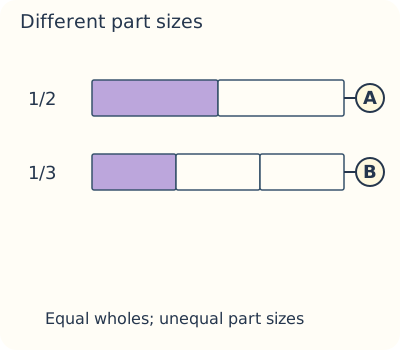
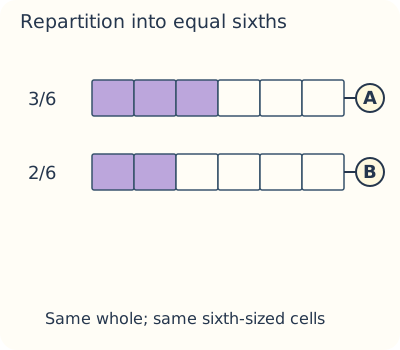
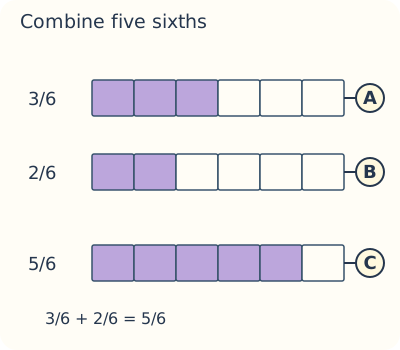
For a shared nonzero D, A/D + B/D = (A+B)/D. Different denominators need equivalent common-denominator forms first. The original strip model shows 1/2 + 1/3: repartition into sixths to obtain 3/6 + 2/6 = 5/6. Adding denominators would give 2/5, a different value. The same rule applies to algebraic denominators.
Numerical coefficients belong in the denominator inventory
For 1/(2x) + 1/(3x), use 6x, requiring x≠0. Numerators become 3 and 2, so the sum is 5/(6x). For x/6 + x/4, use 12 and obtain 2x/12 + 3x/12 = 5x/12. A common denominator changes the form, not the value; do not multiply a numerator without making the same denominator change.
Factor quadratic and cubic denominators
For 1/(x−2) + 1/(x+2), D=(x−2)(x+2)=x²−4 and the numerator is 2x. A cubic difference factors as x³−y³=(x−y)(x²+xy+y²). Thus the denominators x−y, x²+xy+y² and x³−y³ can all use x³−y³; the first two are not multiplied in again after the cubic already contains them.
Three fractions need all three numerator multipliers
For 1/[(x−1)(x−2)] + 1/[(x−2)(x−3)] + 1/[(x−3)(x−4)], use D=(x−1)(x−2)(x−3)(x−4). The new numerators are (x−3)(x−4), (x−1)(x−4) and (x−1)(x−2). Add them to 3x²−15x+18 = 3(x−2)(x−3). The final result is 3/[(x−1)(x−4)], but x=1,2,3,4 all stay excluded.
Subtract the complete numerator inside brackets
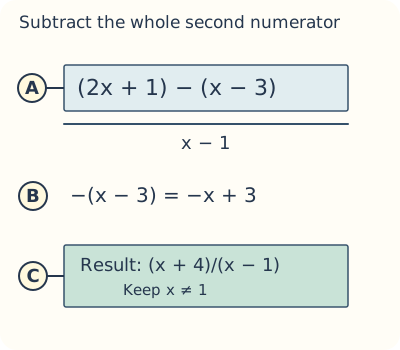
A/D − B/D = (A−B)/D. For (2x+1)/(x−1) − (x−3)/(x−1), subtract (x−3): 2x+1−x+3 = x+4. The result is (x+4)/(x−1), x≠1. Forgetting brackets incorrectly gives x−2. After an unlike-denominator rewrite the second numerator may be a product; subtract that entire product too.
Reducing first and combining first can agree
For x/(x−y)² − (x+y)/(x²−y²), the second fraction reduces to 1/(x−y), on x≠y,−y. Rewriting gives [x−(x−y)]/(x−y)² = y/(x−y)². Combining first over (x−y)²(x+y) gives the same result. Preserve the original exclusions even when the result has a shorter denominator.
Cyclic terms can cancel after a common rewrite
For (x−y)/[(y+z)(z+x)] + (y−z)/[(z+x)(x+y)] + (z−x)/[(x+y)(y+z)], use D=(x+y)(y+z)(z+x). The numerators become x²−y², y²−z² and z²−x². Their sum is zero. The expression equals zero only where D≠0; a zero result does not authorise division by zero in the original expression.
A changed printed numerator changes the answer
Source example 5(c) on printed page 82 asks 1/(a−2)+(a−2)/(a²+2a+4). The solution on page 83 instead uses a+2 in the second numerator. As stated, the common numerator is 2a²−2a+8 over a³−8. For the changed version it is 2a(a+1) over a³−8. At a=4 these give 4/7 and 5/7 respectively. They cannot be blended; label which expression you are solving.
Worked example
To subtract (x−3)/(x−1) from (2x+1)/(x−1), keep the common denominator and write [(2x+1)−(x−3)]/(x−1). Collect to (x+4)/(x−1), x≠1. At x=2 the original is 5−(−1)=6, agreeing with the result.
Record every original nonzero denominator and, for division, the nonzero divisor. Identify the operation and factor complete expressions.
Show a common denominator for addition/subtraction or a reciprocal for division. Cancel only complete common factors and preserve brackets.
Check a permitted numerical input and retain the original exclusions. Compare full written reasoning with the model; the automatic checker handles only the requested finite answer.
Equal values need equal part sizes
Adding denominators is not the fraction-addition rule. A common denominator lets numerators count pieces of one size.
Printed numerator conflict
Example 5(c) changes a−2 to a+2 between printed pages 82 and 83. Both worked versions are kept distinct in this companion.
Addition and subtraction share a denominator
The numerator operation changes, while the common denominator stays.
Addition and subtraction share a denominator
Expression
Common numerator
Result/domain
1/(x−2)+1/(x+2)
(x+2)+(x−2)=2x
2x/(x²−4), x≠±2
1/(x−2)−1/(x+2)
(x+2)−(x−2)=4
4/(x²−4), x≠±2
(2x+1)/(x−1)−(x−3)/(x−1)
2x+1−(x−3)=x+4
(x+4)/(x−1), x≠1
The subtraction bracket changes both signs of x−3. At x=2 the last expression is 6, not the value obtained by dropping that bracket.
Repartition before adding unlike fractions
Original equal-length strips show one half and one third of the same whole. Repartitioning changes the count of parts, not their total size.
All stages: readable static alternative
1 · Different part sizes: The first strip shades 1 of 2 parts; the second shades 1 of 3. Their whole lengths match, but individual part sizes differ.
2 · Use sixths for both: Half covers 3 equal sixths. One third covers 2 equal sixths. The six-cell scale is the same on both strips.
3 · Combine five sixths: 3/6 + 2/6 = 5/6. The lower result strip shades five of six cells; it does not add denominators.
No autoplay or sound is needed. Play/Pause, manual stage buttons, replay and all static stages remain available. Reduced motion disables timed playback; leaving the learning page pauses it.
Three successive-pair denominators
Cancel only after adding all complete new numerators.
At a=4, the two results are 4/7 and 5/7; the difference is real, not a rearrangement.
The companion preserves the source discrepancy and explains both. Do not quietly repair the question while using the other answer.
Explore the mathematical figures
Match each letter to its explanation. Read the quantities, units and relationships, then check the counts or equations. These are original teaching models.
Common sixths make unlike parts addable
Compare the equal wholes and identical cell sizes before adding cell counts. Use manual stages to see the repartition.
A · One half
Three of six equal cells represent 1/2.
B · One third
Two of the same sixth-sized cells represent 1/3.
C · Sum
Five of six cells represent 5/6; the whole length is unchanged.
Original numerical bridge to the algebraic common-denominator method; cells represent exact equal parts of one whole, not measured data.
Explore the mathematical figures
Match each letter to its explanation. Read the quantities, units and relationships, then check the counts or equations. These are original teaching models.
Subtract the complete second numerator
Read both signs after opening the bracket, then substitute x=2 to check the original value 6.
A · Complete numerator
Subtract the entire x−3, not just its first term.
B · Distribute −1
−(x−3)=−x+3.
C · Collect
2x+1−x+3=x+4; retain x≠1.
Original symbolic relationship guide; arrows are reasoning links, not a geometric scale.
Your written practice
Show your working on paper. Check your answer, then choose Next.
Show model answer and explanation
5
Repartition: 3/6 + 2/6 = 5/6.
Show model answer and explanation
5
The common numerators are 3 and 2, so n = 5.
Show model answer and explanation
5
2x + 3x = 5x over 12.
Show model answer and explanation
2
The numerator is (x+2)+(x−2)=2x.
Show model answer and explanation
1
1/2 + 2/4 = 1.
Show model answer and explanation
2
The denominators exclude 2 and −2.
Show model answer and explanation
4
1 − (−3) = 4.
Show model answer and explanation
6
5 − (−1) = 6, also (2+4)/(2−1).
Show model answer and explanation
4
(x+2)−(x−2)=4.
Show model answer and explanation
0
The first difference is exactly 4/(x²−4), so the total is zero.
Show model answer and explanation
0.25
The reduced result is y/(x−y)² = 1/4.
Show model answer and explanation
0
All pair sums are nonzero and the common numerator telescopes to zero.
Show model answer and explanation
3
Each missing-factor product contributes x²; total 3x²−15x+18.
Show model answer and explanation
32
2a²−2a+8 = 32, over a³−8 = 56.
Show model answer and explanation
40
2a(a+1) = 40, over 56. It is a different expression.
Write in your own words. A guardian or teacher should review this response.
Show model answer and explanation
Divide one whole into six equal parts. Half is three sixths, a third is two sixths and their sum is five sixths. The denominator names the common part size.
Draw equal wholes, labelled sixths and a total of five shaded cells.
Write in your own words. A guardian or teacher should review this response.
Show model answer and explanation
(4y²+5x)/(6x²y³), for x,y≠0. Multiply the first numerator by 2y² and the second by x.
Check all missing powers and avoid combining unlike numerator terms.
Write in your own words. A guardian or teacher should review this response.
Show model answer and explanation
2(x²+4)/(x³−8), for x³−8≠0. The common numerator is x²+2x+4+x(x−2)+4=2x²+8.
Use the cubic factorisation and show cancellation of the linear terms.
Write in your own words. A guardian or teacher should review this response.
Show model answer and explanation
2a(3a+5)/[(a+4)(a²−1)], for a≠−4,−1,1. The common numerator is 3a(a+1)+2a(a+4)+a(a−1)=6a²+10a.
Factor every denominator before finding multipliers.
Write in your own words. A guardian or teacher should review this response.
Show model answer and explanation
(a²+b²+c²−ab−bc−ca)/(abc), for abc≠0. The new numerators are a(a−b), b(b−c), c(c−a).
Do not assume every cyclic sum is zero; read its actual denominator pattern.
Write in your own words. A guardian or teacher should review this response.
Show model answer and explanation
3/[(x−1)(x−4)], for x≠1,2,3,4. The common numerator 3x²−15x+18 factors to 3(x−2)(x−3).
Retain the two cancelled exclusions as well as the final denominator roots.
Write in your own words. A guardian or teacher should review this response.
Show model answer and explanation
(x+4)/(x−1), x≠1. The bracket −(x−3) contributes −x+3.
Require the subtraction bracket before collecting.
Write in your own words. A guardian or teacher should review this response.
Show model answer and explanation
8ab/(a²−16b²), with a−4b and a+4b nonzero. Subtract (a−4b)² from a²+16b² in the common numerator.
Check the middle square term and both exclusions.
Write in your own words. A guardian or teacher should review this response.
Show model answer and explanation
2y/(x²−y²), on the original domain x−y≠0 and x³+y³≠0. The second fraction reduces to 1/(x+y); retain its original restrictions.
Use sum-of-cubes factors and subtraction parentheses.
Write in your own words. A guardian or teacher should review this response.
Show model answer and explanation
32/(x⁴−16), for x≠2,−2. First difference is 4/(x²−4); subtract over (x²−4)(x²+4), whose numerator is 32.
Do not confuse the final denominator x²+4 with x²−4.
Write in your own words. A guardian or teacher should review this response.
Show model answer and explanation
Over D=(x+y)(y+z)(z+x), numerators become x²−y²,y²−z²,z²−x². Their sum is zero when D≠0.
Show each missing factor and cancellation; include the domain.
Write in your own words. A guardian or teacher should review this response.
Show model answer and explanation
Reducing the second fraction first gives 1/(x−y), then y/(x−y)². Combining over (x−y)²(x+y) gives y(x+y) in the numerator and the same result. Require x−y≠0 and x+y≠0.
The two routes must keep the same original domain.
Write in your own words. A guardian or teacher should review this response.
Show model answer and explanation
(2a²−2a+8)/(a³−8), for a≠2 over the reals. The second numerator contributes (a−2)². At a=4 the value is 4/7.
Identify the a−2 numerator and do not borrow the changed solution.
Write in your own words. A guardian or teacher should review this response.
Show model answer and explanation
2a(a+1)/(a³−8), for a≠2 over the reals. The second numerator contributes (a−2)(a+2)=a²−4. At a=4 the value is 5/7.
Label this as the changed expression, not the original question.
Write in your own words. A guardian or teacher should review this response.
Show model answer and explanation
The correct rule is A/D−B/D, with D≠0. For A=8,B=2,D=3, both correct forms give 2, while 8/3−2 gives 2/3.
Explain why D divides the whole numerator, including B.
Progress and browser storage
Notebook challenge, sources and further study
Your algebraic-fraction notebook
Write an addition/subtraction audit using a strip model, a quadratic-denominator sum and a cyclic cancellation proof.
Review with a guardian or teacher
Show numerator multipliers and all subtraction brackets.
State original restrictions even after a zero result or factor cancellation.
Check one permitted input and compare both printed numerator variants separately.
Keep your work on paper or in a local file. This page does not upload it or automatically grade the project.
Chapter companion and further study
This original Kidemy practice follows the topic order of 2026 Class 8 Mathematics · English Version, chapter 5, printed pages 77–100. It does not replace the complete chapter or its practical teaching.
Fresh tasks map the chapter methods rather than reproduce every printed question. Keep full working and review source exercises and alternative equivalent forms with a guardian or teacher.
A cancelled denominator remains excluded. A divisor must also be nonzero. Later Class 8 chapters remain in preparation.
Teacher-led lessons, schedules and prices for this outline are upcoming. You can use any starter practice above now without booking.
Your next step
Solo practice works without an account. Sign in to save a practice record to your learner profile.
Keep practising
Exact lesson links and related activities are labelled separately. Return-to-course links retain your selected learning path.