2026 Class 8 Mathematics · English Version · Chapter 5 · Chapter companion part
Chapter 5D: Mixed fractions, cyclic reasoning and error audits
Simplify multi-step algebraic fractions, justify domains and test source claims with exact reasoning.
About this lesson and its coverage
Class 8 English Version: part D of the chapter 5 companion. Eight sections, 30 written tasks and a notebook project. Selected companion coverage, not complete textbook coverage; use all four parts. Numerical/coefficient answers are checked; equivalent symbolic forms, domains and proofs need guardian or teacher review.
A large division sign between two bracketed sums divides one complete result by another. For (1/2+1/3)÷(1/2−1/3), the sums are 5/6 and 1/6, so the quotient is 5. In algebra, combine each bracket first or use a common denominator deliberately; never flip only the final term of a sum.
Multiplication and division share priority
At one bracket level, process multiplication and division from left to right unless parentheses say otherwise. A÷B×C means (A÷B)×C, not A÷(B×C). For 12÷3×2 the result is 8, while 12÷(3×2)=2. A fraction bar groups its complete numerator and denominator; draw the bars and brackets before transforming a mixed expression.
Use a shared denominator inside a quotient
Let U=x/(x+y)+y/(x−y) and V=x/(x−y)−y/(x+y). Both simplify to (x²+y²)/(x²−y²). Thus U/V=1 where x²−y²≠0 and V≠0. For real x,y the first condition already prevents x²+y²=0, but state the divisor condition before using that fact. Equal-looking final brackets do not justify ignoring their original domains.
A quadratic/quartic ladder prevents excessive expansion
(1−x+x²)(1+x+x²)=1+x²+x⁴: write it as (1+x²)²−x². Therefore 1/(1−x+x²)−1/(1+x+x²)=2x/(1+x²+x⁴). The denominator is positive for real x because (x²+1/2)²+3/4>0. The related successive difference 1/(x−1)−1/(x+1)−2/(x²+1)−4/(x⁴+1)=8/(x⁸−1), for real x≠±1. Changing the last minus to plus changes the numerator to 8x⁴.
Read the exact cyclic denominator pattern
For D=(x−y)(y−z)(z−x), the sum y/[(x−y)(y−z)] + x/[(z−x)(x−y)] + z/[(y−z)(z−x)] has numerator y(z−x)+x(y−z)+z(x−y)=0. Changing the numerators to x−y,y−z,z−x over the complementary two-factor denominators instead gives a sum of three squares over D, not generally zero. Pairwise differences must all be nonzero.
Recognise cube expressions before dividing
Use x³+y³+3xy(x+y)=(x+y)³ and x³−y³−3xy(x−y)=(x−y)³. Also (x+y)²−4xy=(x−y)² and (x−y)²+4xy=(x+y)². Replacing these complete expressions turns a complicated quotient into x²−y², for x−y≠0 and x+y≠0. A companion using a,b in an analogous expression must keep those letters consistent; a variable name is not decoration.
A multi-part task reuses data but each part needs its own reasoning
For F=(a⁴−b⁴)/(a−b)², factor to (a+b)(a²+b²)/(a−b), a≠b. Multiplying F by (a−b)/(a³+b³) and (a+b)/(a³+b³) yields (a²+b²)/(a²−ab+b²)² on the common original domain. For a different part, divide F by [(a³+a²b+ab²+b³)/((a+b)²−4ab)] and obtain a−b; adding a²/(a+b) gives (2a²−b²)/(a+b), with all original denominators and the divisor nonzero.
A requested proof can itself be false
Printed creative 6(b) defines A=1/(1−x+x²), B=1/(1+x+x²), C=1/(1+x²+x⁴), then requests 1/A−1/B−2x/C=0. At x=1, A=1 and B=C=1/3, so the stated left side is −8, not zero. The related identity A−B−2xC=0 is valid and follows from the quadratic/quartic factorisation. Keep the printed claim and correction distinct. Printed sample 3(iii) is a different case: its incorrect quotient is an assertion to reject inside a multiple-choice task, not a formula to accept.
Worked example
For A=1/(1−x+x²), B=1/(1+x+x²), C=1/(1+x²+x⁴), factor the common denominator to show A−B=2xC. At x=1 this reads 1−1/3=2/3. The printed reciprocal claim instead gives 1−3−6=−8, so it cannot be an identity.
Record every original nonzero denominator and, for division, the nonzero divisor. Identify the operation and factor complete expressions.
Show a common denominator for addition/subtraction or a reciprocal for division. Cancel only complete common factors and preserve brackets.
Check a permitted numerical input and retain the original exclusions. Compare full written reasoning with the model; the automatic checker handles only the requested finite answer.
Real and complex domains differ
These lessons use real variables unless stated otherwise. Positivity proofs for real quadratics do not claim they have no complex roots.
An assertion to reject is different from an erroneous solution
The sample quotient assertion is deliberately false inside a question. The creative reciprocal claim and the changed example numerator are source conflicts, recorded and explained rather than silently fixed.
Audit the operation before calculating
The original expressions define their own domains.
Audit the operation before calculating
Check
Question to ask
Example
Grouping
What is the entire divisor?
U÷(V+W) reverses the whole sum
Order
Which equal-priority operation comes first?
12÷3×2=8
Conditions
Can any original denominator or divisor be zero?
Cancelled roots stay excluded
Verification
Do two expressions agree at allowed inputs?
A counterexample disproves a universal claim
Numerical agreement at one point is a useful check, not a proof. Derive an identity by factorisation or distribution for all permitted inputs.
Use a power ladder instead of expanding everything
Each subtraction uses conjugates after the previous reduction.
Replace the two square expressions by (x−y)² and (x+y)².
Replace the last cubic by (x−y)³.
Cancel complete factors; at x=5,y=2 the result is 21.
These restrictions include a nonzero divisor; the polynomial result alone would hide them.
Counterexample and corrected identity are different evidence
Printed creative 6(b) is false as written; its related fraction identity can be proved.
A=1/(1−x+x²); B=1/(1+x+x²); C=1/(1+x²+x⁴)
At x=1: 1/A−1/B−2x/C = −8 ≠ 0
Correct related identity: A−B−2xC = 0
A / B / C
The three stated fractions, not their denominators.
x
Real; each defining denominator is positive.
At x=1, compute A=1, B=1/3, C=1/3.
The printed reciprocal expression is 1−3−6=−8.
For the corrected expression, A−B has common numerator 2x over 1+x²+x⁴.
Therefore A−B=2xC; subtracting 2xC gives zero.
A false universal statement needs only one valid counterexample. The corrected identity still requires its own algebraic derivation.
Explore the mathematical figures
Match each letter to its explanation. Read the quantities, units and relationships, then check the counts or equations. These are original teaching models.
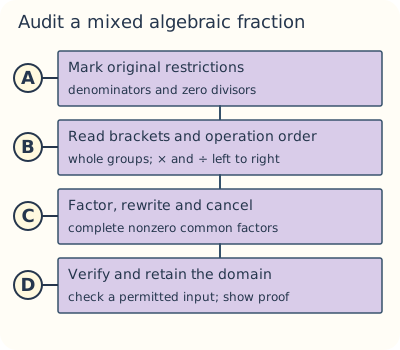
Four checks keep a mixed fraction valid
Use the guide to audit one mixed expression. A numerical spot-check can catch an error but cannot alone prove an identity.
A · Original domain
Include original denominators and any zero divisor.
B · Grouping and order
A fraction bar groups; multiplication/division share priority.
C · Factors
Show identities and missing multipliers before cancelling.
D · Check
Use permitted values and review the symbolic reasoning.
Original decision aid, not an automatic symbolic grading process or a guarantee that an arbitrary expression is valid.
Explore the mathematical figures
Match each letter to its explanation. Read the quantities, units and relationships, then check the counts or equations. These are original teaching models.
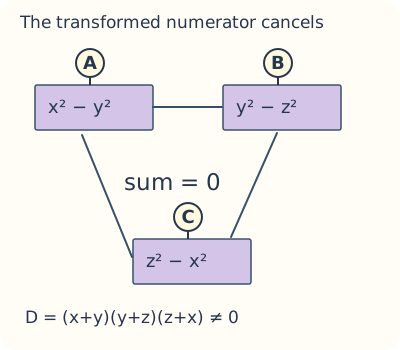
A cyclic sum needs its exact factor pattern
Match every original denominator to its missing factor. Only this stated pattern telescopes; other cyclic numerators may not sum to zero.
A · First transformed term
(x−y)(x+y)=x²−y².
B · Second
(y−z)(y+z)=y²−z².
C · Third
(z−x)(z+x)=z²−x²; all square terms cancel.
Original symbolic cycle. Arrow directions show cancellation relationships, not forces or a scaled triangle. Require all three pair sums nonzero.
Your written practice
Show your working on paper. Check your answer, then choose Next.
Show model answer and explanation
5
The complete bracket values are 5/6 and 1/6.
Show model answer and explanation
8
Multiplication and division have equal priority, so work left to right.
Show model answer and explanation
2
(3/2)/(3/4) = 2.
Show model answer and explanation
1
Both brackets are 17/15, so their quotient is 1.
Show model answer and explanation
2
The result is b/a = 2; the complete numerator factor is shared.
Show model answer and explanation
0
1 − 1/3 − 2/3 = 0.
Show model answer and explanation
-8
1 − 3 − 6 = −8. It is a counterexample to the printed equality.
Show model answer and explanation
0
1/3 − 1/7 − 4/21 = 0.
Show model answer and explanation
128
The plus-last-term form is 8x⁴/(x⁸−1), giving 128/255.
Show model answer and explanation
0
The common numerator y(z−x)+x(y−z)+z(x−y) cancels.
Show model answer and explanation
14
1 + 4 + 9 = 14; this changed cyclic pattern does not have zero numerator.
Show model answer and explanation
21
The quotient reduces to x²−y² = 25−4 = 21.
Show model answer and explanation
2
24/36 = 2/3, consistent with (x−3)/(x−2).
Show model answer and explanation
0.5
Factor C=(x+5)(x+7)/[(x+5)(x−1)]; the whole expression becomes 1/(x−3).
Show model answer and explanation
5
Original denominators exclude 3,4,−3,1; the divisor also excludes −4. Distinct values: −4,−3,1,3,4.
Write in your own words. A guardian or teacher should review this response.
Show model answer and explanation
1, requiring x²−y²≠0. Both brackets become (x²+y²)/(x²−y²); the divisor is nonzero since x²+y²=0 for real inputs would force x=y=0, already excluded.
Combine each whole bracket, then justify the divisor condition.
Write in your own words. A guardian or teacher should review this response.
Show model answer and explanation
(x+3)/(x−1), with x≠3,4,−3,−4,1. Reverse the middle fraction only; multiply the last fraction as written.
Factor, respect left-to-right operations and retain all five exclusions.
Write in your own words. A guardian or teacher should review this response.
Show model answer and explanation
b/a, requiring a,b≠0. The brackets are (a²+ab+b²)/(ab) and (a²+ab+b²)/b². For real a,b not both zero, a²+ab+b² is positive.
Use complete brackets and show why the shared numerator is nonzero.
Write in your own words. A guardian or teacher should review this response.
Show model answer and explanation
Use U=1+x²: (U−x)(U+x)=U²−x²=1+x²+x⁴.
Name the complete conjugate term and check the powers.
Write in your own words. A guardian or teacher should review this response.
Show model answer and explanation
0 for all real x. The first difference has numerator 2x over 1+x²+x⁴. Both quadratics and the quartic are positive over the reals, so no real exclusions arise.
Show the common denominator and the reason no real denominator vanishes.
Write in your own words. A guardian or teacher should review this response.
Show model answer and explanation
8/(x⁸−1), for real x≠±1. The first pair gives 2/(x²−1); subtracting the next term gives 4/(x⁴−1); subtracting the last gives 8/(x⁸−1).
Show the successive conjugate products instead of uncontrolled expansion.
Write in your own words. A guardian or teacher should review this response.
Show model answer and explanation
8x⁴/(x⁸−1), for real x≠±1. After the first three terms give 4/(x⁴−1), adding 4/(x⁴+1) produces numerator 8x⁴.
Do not reuse the minus-version numerator; recheck the final sign.
Write in your own words. A guardian or teacher should review this response.
Show model answer and explanation
Use D=(x−y)(y−z)(z−x)≠0. The numerator is yz−xy+xy−xz+xz−yz=0.
Write all three missing factors and retain pairwise distinctness.
Write in your own words. A guardian or teacher should review this response.
Show model answer and explanation
[(x−y)²+(y−z)²+(z−x)²]/[(x−y)(y−z)(z−x)], for pairwise distinct inputs. At x=1,y=2,z=4 it is 14/6=7/3, not zero.
Read the numerator pattern rather than assuming cyclic implies zero.
Write in your own words. A guardian or teacher should review this response.
Show model answer and explanation
x²−y², with x−y≠0 and x+y≠0. Rewrite as (x+y)³/(x−y)² ÷ [(x+y)²/(x−y)³], then multiply the reciprocal.
Show the identities and include the nonzero divisor condition.
Write in your own words. A guardian or teacher should review this response.
Show model answer and explanation
(a²+b²)/(a²−ab+b²)², on a−b≠0 and a³+b³≠0. Factor a⁴−b⁴=(a−b)(a+b)(a²+b²) and both cube sums.
Carry the original restrictions even though a−b cancels.
Write in your own words. A guardian or teacher should review this response.
Show model answer and explanation
(2a²−b²)/(a+b). The divisor numerator factors to (a+b)(a²+b²), its denominator is (a−b)², and the quotient is a−b. Require all original denominators and (a+b)(a²+b²) nonzero.
Separate the division from the subsequent addition and justify each cancellation.
Write in your own words. A guardian or teacher should review this response.
Show model answer and explanation
Factor C=(x+5)(x+7)/[(x+5)(x−1)]. Reverse (x²−9)/(x−1), then cancel to 1/(x−3). Require x≠−7,−5,1,3,−3.
State the two divisor zeros as well as all original denominator roots.
Write in your own words. A guardian or teacher should review this response.
Show model answer and explanation
The printed claim is false: x=1 gives −8. The valid related identity is A−B−2xC=0, from the common-denominator difference. These are different statements; no proof can establish the printed equality for every real x.
Distinguish the printed error, counterexample and independently derived correction.
Write in your own words. A guardian or teacher should review this response.
Show model answer and explanation
The quotient is (a−b)/(a+b), requiring a+b≠0, a−b≠0 and a≠0. The printed sample offers its incorrect assertion for rejection; it is not a taught identity.
Compute the quotient and distinguish a deliberately false option from a source solution error.
Progress and browser storage
Notebook challenge, sources and further study
Your algebraic-fraction notebook
Produce a mixed-expression audit with one bracketed quotient, one power ladder and one source-claim check.
Review with a guardian or teacher
Record complete original domains and process multiplication/division in the stated order.
Show each identity substitution and verify both numerator and denominator.
Give a valid counterexample to a false claim and a separate derivation of any corrected statement.
Keep your work on paper or in a local file. This page does not upload it or automatically grade the project.
Chapter companion and further study
This original Kidemy practice follows the topic order of 2026 Class 8 Mathematics · English Version, chapter 5, printed pages 77–100. It does not replace the complete chapter or its practical teaching.
Fresh tasks map the chapter methods rather than reproduce every printed question. Keep full working and review source exercises and alternative equivalent forms with a guardian or teacher.
A cancelled denominator remains excluded. A divisor must also be nonzero. Later Class 8 chapters remain in preparation.
Teacher-led lessons, schedules and prices for this outline are upcoming. You can use any starter practice above now without booking.
Your next step
Solo practice works without an account. Sign in to save a practice record to your learner profile.
Keep practising
Exact lesson links and related activities are labelled separately. Return-to-course links retain your selected learning path.