Two lines share P=(4,2)
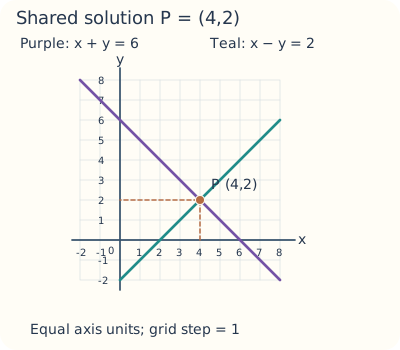
- x axis
- Horizontal coordinate, read first.
- y axis
- Vertical coordinate, read second.
- P · Shared pair
- 4+2=6 and 4−2=2.
Original exact coordinate construction, equal units on both axes. Lines continue beyond the displayed window.
Class 8 · English Version · Mathematics
2026 Class 8 Mathematics · English Version · Chapter 6 · Chapter companion part
Plot two linear equations with labelled axes and tables, read their shared coordinates and distinguish unique, parallel and coincident cases.
Class 8 English Version: part D of the chapter 6 companion. Eight teaching sections, 30 written tasks and a notebook challenge. Selected companion coverage, not complete textbook coverage; use all four parts. Numeric checks cover only the requested value; full equations, graphs, conditions and explanations need guardian or teacher review.
Open this topic in Skills Lab →
The horizontal coordinate x is sometimes called the abscissa; the vertical coordinate y is the ordinate. Both words name coordinates, not extra quantities. The origin is (0,0). For (−3,2), move left 3 and up 2; it lies in quadrant II. Quadrants I,II,III,IV have sign pairs (+,+),(−,+),(−,−),(+,−). A point on an axis is not inside a quadrant.
For x+y=6, write y=6−x. At x=0,2,4,6 the y-values are 6,4,2,0. For x−y=2, write y=x−2: at the same x-values y=−2,0,2,4. Each row must be calculated from its own equation. A value table lists points; it does not join them into a graph or by itself prove which two lines share a point.
Draw perpendicular x and y axes and mark the origin. Use a consistent stated scale along each axis; the original companion graphs use equal units horizontally and vertically. Plot at least two distinct accurate points for each straight line, check another point and extend the line beyond its chosen points within the displayed window. A straight line can include infinitely many real points, not only the integer entries in the table.
The lines y=6−x and y=x−2 cross at P=(4,2). Dashed projections identify x=4 and y=2. Check 4+2=6 and 4−2=2. This is a shared pair, not one x-value chosen from the first line and a separate y-value chosen from the second. The intersection is exact for these equations; a hand-drawn graph alone has limited reading precision.
The pair x+y=1 and x−y=2 has solution (1.5,−0.5). Plot fractions using the declared subdivision scale rather than rounding the point to (2,0). For x=y and x+2y=−12, the shared point is (−4,−4), in quadrant III. A graph window must contain the relevant intersection; no crossing inside a small window does not prove the lines never cross.
A y-axis intercept has x=0. For 2x+3y=12 it is (0,4). An x-axis intercept has y=0, giving (6,0). These two points define this line. The vertical line x=2 and horizontal line y=3 intersect at (2,3) and are valid linear equations, even though x=2 cannot be rearranged as a single y-value for every x.
Two distinct non-parallel lines have one shared point. Distinct parallel lines such as y=x+1 and y=x−2 have no shared point. Equations y=x+1 and 2y=2x+2 draw the same line and have infinitely many shared points. The source notes the parallel case; add the coincident case so the usual one-crossing description is not read as universal.
First form correct equations, then use a table and graph to locate a candidate. Substitute that pair into both originals. If graph and algebra differ, check axis scale, coordinate order, points, signs and reading accuracy. For 3x+2y=12 and x−y=−1, (2,3) satisfies both and should be their crossing. Graph construction and explanation need a guardian or teacher to review; a numeric match checks only the asked coordinate.
For x+y=6 and x−y=2, plot y=6−x and y=x−2 on the same grid. Their common point is (4,2), verified by 4+2=6 and 4−2=2.
A candidate must satisfy both original equations with one ordered pair.
Lines continue outside the drawing. Prove a no-solution claim with their relationship or algebra, not an empty visible crop.
Prepare each y from its own equation, then plot the two sets on the same axes.
| x | y=6−x | y=x−2 |
|---|---|---|
| −2 | 8 | −4 |
| 0 | 6 | −2 |
| 2 | 4 | 0 |
| 4 | 2 | 2 |
| 6 | 0 | 4 |
The matching row at x=4 gives the common pair (4,2). Another pair of lines might meet between the sampled x-values.
These equations are x+y=1 and x−y=2.
| x | y=1−x | y=x−2 |
|---|---|---|
| 0 | 1 | −2 |
| 1 | 0 | −1 |
| 1.5 | −0.5 | −0.5 |
| 2 | −1 | 0 |
| 3 | −2 | 1 |
Half-unit grid divisions locate the exact shared point. Integer-only sampling would skip that exact row.
For x+y=6 and x−y=2, add the equations.
2x=8; x=4; y=2 4+2=6 4−2=2
Graph construction quality needs human review. A numeric coordinate match is not a grade for the drawing.
The original graph is added in deliberate stages. Its scale is equal on both axes; integer grid steps are one unit.
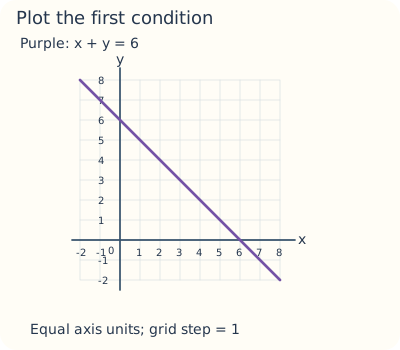
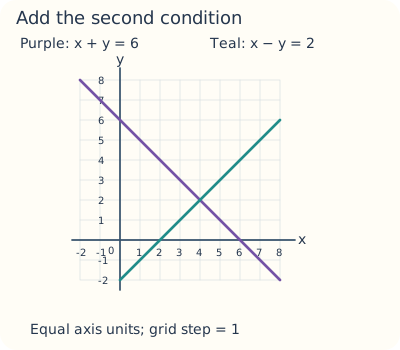
No autoplay or sound is needed. Play/Pause, manual stages, replay and all static stages remain available. Reduced motion disables timed playback; leaving the page pauses it.
Match each letter to its explanation. Read the quantities, units and relationships, then check the counts or equations. These are original teaching models.
Original exact coordinate construction, equal units on both axes. Lines continue beyond the displayed window.
Match each letter to its explanation. Read the quantities, units and relationships, then check the counts or equations. These are original teaching models.
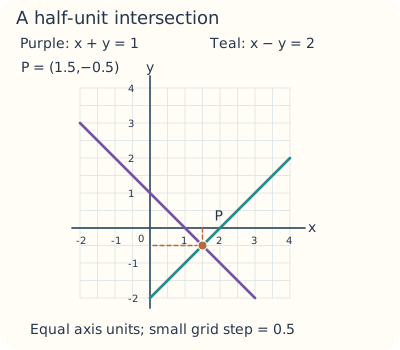
Original exact graph. Its coordinate values are not uncertain measurements; a hand copy can still have drawing and reading error.
Match each letter to its explanation. Read the quantities, units and relationships, then check the counts or equations. These are original teaching models.
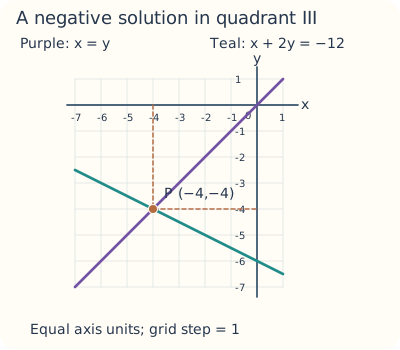
Original exact coordinate graph with equal one-unit spacing. The full lines continue beyond the window.
Show your working on paper. Check your answer, then choose Next.
-3
An ordered pair lists horizontal x before vertical y.
2
The second coordinate is the vertical value.
3
Both coordinates are negative, placing it in quadrant III.
4
6−2=4.
-2
0−2=−2, so this point is below the origin.
4
Adding the equations gives 2x=8.
2
With x=4, y=6−4=2; both lines share this point.
1.5
Adding gives 2x=3, x=1.5.
-0.5
y=1−1.5=−0.5; rounding would change the solution.
-4
3x=−12 gives x=y=−4.
4
Set x=0; 3y=12.
6
Set y=0; 2x=12.
3
Every point on y=3 has y-coordinate 3; the shared pair is (2,3).
0
Equal gradient and different intercepts give distinct parallel lines.
2
At (2,3), 6+6=12 and 2−3=−1.
Write in your own words. A guardian or teacher should review this response.
They lie in quadrant II, quadrant IV, the positive y-axis and quadrant III respectively. Points on axes do not belong to an open quadrant.
Use signs and coordinate order, with labelled axes.
Write in your own words. A guardian or teacher should review this response.
For y=6−x use 6,4,2,0. For y=x−2 use −2,0,2,4. Label both x and y rows and retain the equation for each table.
Check at least one pair in its original equation.
Write in your own words. A guardian or teacher should review this response.
Plot the table pairs on one stated-scale grid. Draw two straight lines; mark P=(4,2). Show projections to x=4,y=2 and label both equations.
Review axis labels, scale, accurate points, straight lines and the shared point.
Write in your own words. A guardian or teacher should review this response.
The point belongs to each line, meaning its coordinates satisfy each equation. Directly, 4+2=6 and 4−2=2. The x and y values come from the same point.
Give both numerical checks and the geometric interpretation.
Write in your own words. A guardian or teacher should review this response.
Use a scale that shows halves. The intersection is (1.5,−0.5), since 1.5−0.5=1 and 1.5−(−0.5)=2. A rounded point such as (2,0) fails the first equation.
Distinguish exact half-unit plotting from approximate hand reading.
Write in your own words. A guardian or teacher should review this response.
Substitute x=y to get 3y=−12, so (x,y)=(−4,−4). Draw a window containing quadrant III, plot both lines and mark their crossing there.
Do not restrict the graph to positive coordinates.
Write in your own words. A guardian or teacher should review this response.
Set y=0 to get (6,0), and x=0 to get (0,4). Plot these distinct points and draw their straight line. Check any additional point, such as (3,2).
State which coordinate is zero at each axis.
Write in your own words. A guardian or teacher should review this response.
x=2 is vertical, containing all pairs with first coordinate 2. y=3 is horizontal, containing all pairs with second coordinate 3. They meet at (2,3).
Do not exclude a vertical equation because it is not in y=mx+c form.
Write in your own words. A guardian or teacher should review this response.
Equating gives x+1=x−2, or 1=−2, impossible. Their lines have the same gradient and distinct intercepts, so they are parallel and distinct.
The conclusion is about the complete lines, not just a cropped plot.
Write in your own words. A guardian or teacher should review this response.
Dividing the second by 2 gives the first. Both graphs coincide, and every (x,x+1) is shared, so there are infinitely many solutions.
Identify a repeated condition rather than inventing a unique crossing.
Write in your own words. A guardian or teacher should review this response.
The lines may cross beyond the displayed ranges. Expand the window or use algebra to determine their intersection or prove parallel distinct lines. A crop is not the whole plane.
Give an example of two non-parallel lines whose crossing is outside a chosen window.
Write in your own words. A guardian or teacher should review this response.
Use y=(12−3x)/2 and y=x+1. They cross at (2,3). Check 3×2+2×3=12 and 2−3=−1.
Include a table for each line and a labelled common point.
Write in your own words. A guardian or teacher should review this response.
The abscissa is the horizontal x-coordinate 4. The ordinate is the vertical y-coordinate −2. The terms name the two coordinates of the same point.
Use plain directional language alongside the vocabulary.
Write in your own words. A guardian or teacher should review this response.
Check plotted points, line thickness, axis scales and the readout. Substitute (2,3) in both original equations. A hand-drawn graph can have reading error; do not replace a verified exact pair by a rounded visual estimate.
Explain the evidence limit and the correction, not just which answer is preferred.
Write in your own words. A guardian or teacher should review this response.
Examples: y=x and y=−x cross once at (0,0); y=x and y=x+1 have none; y=x and 2y=2x coincide and have infinitely many. Verify each relationship.
Different valid examples are acceptable with labelled plots and algebraic reasons.
Make a graph portfolio containing a positive crossing, a negative or fractional crossing, a parallel pair and a coincident pair.
Keep your work on paper or in a local file. This page does not upload it or automatically grade the project.
This original Kidemy practice follows the topic order of 2026 Class 8 Mathematics · English Version, chapter 6, printed pages 101–120. It does not replace the complete chapter or its practical teaching.
Official book catalogue and source →
Teacher-led lessons, schedules and prices for this outline are upcoming. You can use any starter practice above now without booking.
Solo practice works without an account. Sign in to save a practice record to your learner profile.
Exact lesson links and related activities are labelled separately. Return-to-course links retain your selected learning path.
Play this exact lesson in Skills Lab →