Two scaled rows cancel one variable
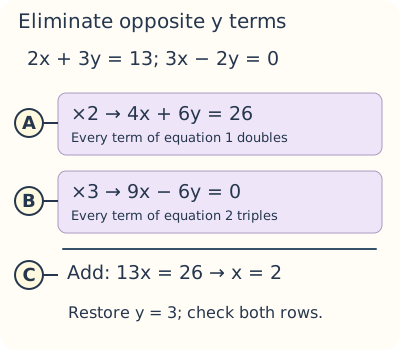
- A · First whole row
- 2(2x+3y)=2×13 gives 4x+6y=26.
- B · Second whole row
- 3(3x−2y)=0 gives 9x−6y=0.
- C · Add
- The +6y and −6y sum to zero; x remains.
Original algebra schematic. Cancellation does not assert y=0.
Class 8 · English Version · Mathematics
2026 Class 8 Mathematics · English Version · Chapter 6 · Chapter companion part
Scale complete equations, cancel a variable correctly and identify when a pair has one, no or infinitely many solutions.
Class 8 English Version: part B of the chapter 6 companion. Eight teaching sections, 30 written tasks and a notebook challenge. Selected companion coverage, not complete textbook coverage; use all four parts. Numeric checks cover only the requested value; full equations, graphs, conditions and explanations need guardian or teacher review.
Open this topic in Skills Lab →
Multiplying ax+by=c by a fixed nonzero k gives kax+kby=kc. Both equations have the same solution set because division by k recovers the original. For 2x+3y=13, multiplying by 2 gives 4x+6y=26. Leaving the right side at 13 is not an equivalent equation. Multiplication by zero erases the condition and is not reversible.
For 3x−2y=8 and x+y=6, multiply the second equation by 2 to get 2x+2y=12. Add the two equations: 5x=20, so x=4. Then y=2. The eliminated y has not been assigned zero; its opposite terms cancel because both conditions hold for the solution.
For 2x+3y=13 and 5x+3y=25, subtract the entire first equation from the second: 3x=12, so x=4,y=5/3. The signs of every subtracted term and the right-hand side change. Addition would give 7x+6y=38 and would not eliminate y.
For 2x+3y=13 and 3x−2y=0, multiply the first equation by 2 and the second by 3. The new pair is 4x+6y=26 and 9x−6y=0. Adding gives 13x=26, x=2 and y=3. The least common multiple of 3 and 2 is 6; another nonzero common multiple also works.
For x/2+2/y=3 and x/3−1/y=1, require y≠0 and set v=1/y. Multiplying by 2 and 3 gives x+4v=6 and x−3v=3. Subtract to get 7v=3, so v=3/7, y=7/3 and x=30/7. A zero x is not automatically forbidden here: only y appears in a denominator.
In ax+by=c and dx+ey=f, a,b,c,d,e,f are fixed numbers for a chosen system. Elimination gives (ae−bd)x=ce−bf. The coefficient D=ae−bd is called the determinant of this two-by-two coefficient array; here it tells whether division gives one x. If D≠0, x=(ce−bf)/D and y=(af−cd)/D. This is a derived extension, not a reason to skip the elimination explanation.
The equations x+y=5 and 2x+2y=10 describe the same line and have infinitely many pairs. Changing the last 10 to 12 gives a contradiction 0=2, so there is no solution. A zero elimination coefficient does not itself decide which case applies. For ax+by=ab and bx+ay=ab, dividing by a−b or a+b requires those values nonzero; inspect a=b or a=−b separately.
On printed page 107 the source prose names equation (1) twice, but the calculation multiplies equation (1) by 3 and equation (2) by 4. Follow the explicitly identified equations and their full new rows. Substitution and elimination must agree on the same original system; different results signal an arithmetic, sign, copying or domain error, not competing mathematical truths.
For 3x+2y=18 and 2x−3y=−1, multiply the first by 3 and second by 2. Their sum is 13x=52. Thus x=4,y=3; check 12+6=18 and 8−9=−1.
When subtracting an equation, change every sign in that row, including its constant.
D here is a computed coefficient controlling division. D=0 needs inspection of the right sides; it is not an answer or an automatic verdict.
Multiply the first equation by 2 and the second by 3.
2x+3y=13; 3x−2y=0 4x+6y=26; 9x−6y=0 13x=26; x=2; y=3
On source printed page 107 the multiplier prose repeats equation (1); the displayed arithmetic actually uses two different original equations.
The first condition is x+y=5. Compare these complete second conditions.
| Second equation | Subtract twice the first | Meaning |
|---|---|---|
| 2x+2y=10 | 0=0 | Same line; infinitely many pairs |
| 2x+2y=12 | 0=2 | Contradiction; no pair |
| 2x−y=1 | A nonzero variable coefficient remains | One pair, (2,3) |
A zero variable coefficient alone does not distinguish a repeated condition from a contradiction.
Here a,b are fixed while x,y are solved.
ax+by=ab; bx+ay=ab (a−b)(x−y)=0 (a+b)(x+y)=2ab x=y=ab/(a+b), if a−b≠0 and a+b≠0
For a=b=2 the pair repeats x+y=2. For a=2,b=−2 it gives a contradiction. The divided generic formula cannot decide those cases.
Match each letter to its explanation. Read the quantities, units and relationships, then check the counts or equations. These are original teaching models.
Original algebra schematic. Cancellation does not assert y=0.
Match each letter to its explanation. Read the quantities, units and relationships, then check the counts or equations. These are original teaching models.
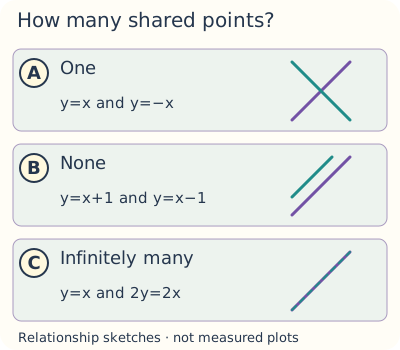
Original relationship sketches, not coordinate plots to be measured. Coincident case extends the source’s parallel-line remark.
Show your working on paper. Check your answer, then choose Next.
26
Two multiplies 13 as well as both variable terms.
-9
−3×3=−9; the whole row changes.
2
Multiply the second equation by 2.
4
Adding the first equation to twice the second gives 5x=20.
2
At x=4, y=6−4=2; 12−4=8.
3
5−2=3 and 3y−3y=0.
12
25−13=12; subtract the complete right-hand side too.
6
Matching magnitudes 6 allow opposite signs to cancel.
2
Twice the first plus three times the second gives 13x=26.
3
6−2y=0 gives y=3.
7
The scaled rows differ by 7/y=3.
-13
2×(−2)−3×3=−4−9=−13; it is nonzero.
0
Twice the first requires the second right-hand side to be 10, not 12.
2
The second is a(x+y)=10; it agrees at a=2.
3
The unique solution is x=y=ab/(a+b)=2/3.
Write in your own words. A guardian or teacher should review this response.
It replaces every equation by 0=0, which all pairs satisfy. Division cannot recover the original because division by zero is undefined. Use a nonzero scalar for an equivalent equation.
Give an original equation and a pair that satisfies 0=0 but fails it.
Write in your own words. A guardian or teacher should review this response.
Add the first to three times the second: 7x=21, x=3 and y=1. Check 12−3=9 and 3+1=4.
Show the multiplied row and both original checks.
Write in your own words. A guardian or teacher should review this response.
Subtract the second from the first: 2x=6, x=3. Then 9−2y=3 gives y=3. Check 15−6=9.
Change the signs of every subtracted term.
Write in your own words. A guardian or teacher should review this response.
Multiply by 3 and 2: 9x+6y=54 and 4x−6y=−2. Add: 13x=52, x=4,y=3. Both original equations hold.
State why the chosen multipliers eliminate y.
Write in your own words. A guardian or teacher should review this response.
Add the originals to get x=6. Then 3+y/3=4 gives y=3. Alternatively clear denominators consistently. Verify 3+1=4 and 3−1=2.
Fractions in coefficients are not automatically reciprocal-variable problems.
Write in your own words. A guardian or teacher should review this response.
Set v=1/y. Rows x+4v=6 and x−3v=3 give v=3/7, y=7/3, x=30/7. Check 15/7+6/7=3 and 10/7−3/7=1.
Keep y nonzero and restore v to y.
Write in your own words. A guardian or teacher should review this response.
Multiply the first by e and second by b, then subtract: (ae−bd)x=ce−bf. Divide by the nonzero coefficient to obtain x=(ce−bf)/(ae−bd).
Show both full scaled rows and the required nonzero condition.
Write in your own words. A guardian or teacher should review this response.
Subtract twice the first from the second. The first pair gives 0=0 and repeats one line, so infinitely many pairs. The second gives 0=2 and is impossible, so none.
Do not infer no solution from a zero coefficient alone.
Write in your own words. A guardian or teacher should review this response.
Subtract: (a−b)(x−y)=0 gives x=y. Add: (a+b)(x+y)=2ab gives x=y=ab/(a+b). Both stated restrictions justify the divisions.
State that exceptional parameter choices need a separate investigation.
Write in your own words. A guardian or teacher should review this response.
At a=b=2 both equations are 2x+2y=4, giving infinitely many pairs on x+y=2. At a=2,b=−2 they require 2x−2y=−4 and −2x+2y=−4; adding gives 0=−8, so no pair.
Substitute into the original equations before using a divided formula.
Write in your own words. A guardian or teacher should review this response.
Use x=y+2a: (a−b)y=b²−a²=−(a−b)(a+b). Thus y=−(a+b),x=a−b. Verify by substitution and keep a≠b for this derivation.
At a=b, investigate instead of cancelling a zero factor.
Write in your own words. A guardian or teacher should review this response.
With a=b the second equation is a(x−y)=2a², which follows from the first, including a=0. There are infinitely many pairs satisfying x−y=2a, rather than one pair from the generic formula.
Handle the zero-parameter instance as well.
Write in your own words. A guardian or teacher should review this response.
The prose repeats equation (1), but the displayed rows scale the first equation by 3 and the second by 4. Identify the correct original row for each multiplication; using the first equation twice would discard the second condition.
Name the distinction publicly, not only in private source notes.
Write in your own words. A guardian or teacher should review this response.
Substitution y=7−x gives 3x−7=2, x=3,y=4. Adding the originals also gives 3x=9. Both yield (3,4), which satisfies both equations. Unlike the repeated source label on page 107, identify the two distinct conditions actually used; reusing only one row would lose information.
Compare routes while keeping and labelling the original equations correctly.
Write in your own words. A guardian or teacher should review this response.
The equation 0=0 puts no new restriction on x. Return to the remaining original condition; there may be infinitely many pairs on a line. Division by zero is invalid and does not force x=0.
Distinguish a true identity from a contradictory statement such as 0=1.
Build a comparison of substitution, addition elimination and subtraction elimination.
Keep your work on paper or in a local file. This page does not upload it or automatically grade the project.
This original Kidemy practice follows the topic order of 2026 Class 8 Mathematics · English Version, chapter 6, printed pages 101–120. It does not replace the complete chapter or its practical teaching.
Official book catalogue and source →
Teacher-led lessons, schedules and prices for this outline are upcoming. You can use any starter practice above now without booking.
Solo practice works without an account. Sign in to save a practice record to your learner profile.
Exact lesson links and related activities are labelled separately. Return-to-course links retain your selected learning path.
Play this exact lesson in Skills Lab →