2026 Class 8 Mathematics · English Version · Chapter 10 · Chapter companion part
Chapter 10B: Chord proof challenges and concentric circles
Use chord theorems to justify parallelism, midpoint loci, circle centres and equal chord portions.
About this lesson and its coverage
Class 8 English Version:part B of the chapter10 companion. Eight teaching sections and30 original written tasks. Selected companion coverage,not complete textbook coverage; use all four parts. General proofs,exact pi expressions,compass drawings and practical measurements need guardian or teacher review.
Two distinct chords bisecting each other meet at O
Let two distinct intersecting chords share midpoint P. If P≠O, the centre-midpoint theorem makes OP perpendicular to both chord lines. Two distinct lines through P cannot both be perpendicular to one nonzero line, so P must be O. Thus both chords are diameters and their four halves equal the common radius. Merely intersecting, without mutual bisection, does not imply the centre.
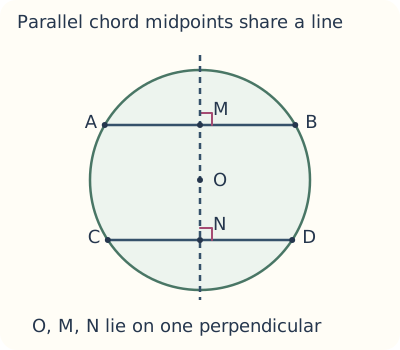
Parallel chord midpoints lie on one diameter line
For distinct parallel chords with midpoints M, N, the perpendicular bisector of each passes through O. Since the chord lines are parallel, their perpendicular bisectors have the same direction and pass through O, so they are the same line. Hence O, M, N are collinear and MN is perpendicular to both chords. If one chord is a diameter, its midpoint is O and the other bisector still determines the line.
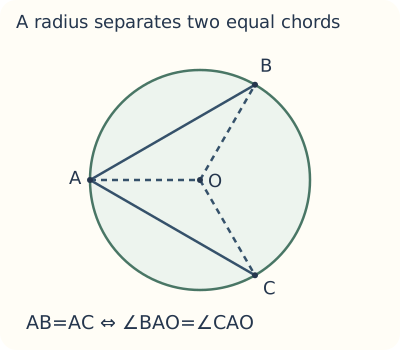
Equal chord angles about a radius
Chords AB, AC from the same boundary point A on opposite sides of AO have equal lengths exactly when their angles with AO are equal. Equal chords and equal radii give triangles OAB, OAC congruent by SSS, hence equal angles at A. Conversely each radius triangle is isosceles; equal angles at A imply equal central angles and SAS with two radii yields AB=AC. State that B, C are distinct and the intended rays are on opposite sides.
The right-triangle circumcentre is a hypotenuse midpoint
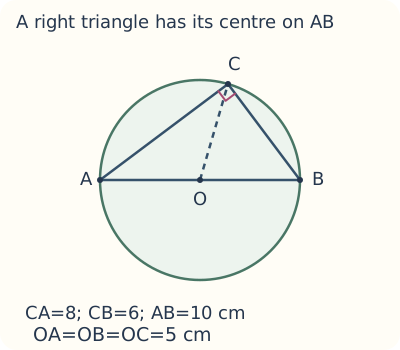
For right ABC with C=90°, complete rectangle ACBD by drawing parallels through A and B. Its diagonals AB, CD are equal and bisect at O, so OA=OB=OC. A circle centred O with radius AB/2 passes through A, B, C. The circumcentre is the centre of this circle. Two independent chord bisectors make it unique; the right-angle vertex itself is not the centre.
Concentric chord portions have a shared midpoint
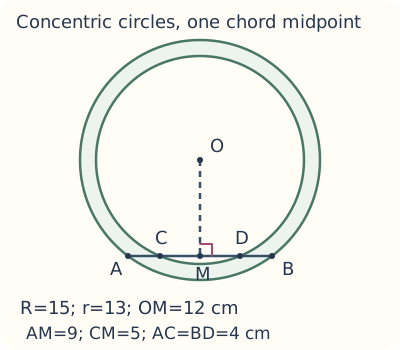
Concentric circles have the same centre. On an outer-circle chord AB crossing the inner circle at C, D in order A, C, D, B, drop perpendicular OM. It bisects both chords, so AM=BM and CM=DM. Subtract:AC=AM−CM=BM−DM=BD. For outer radius 15, inner 13 and distance 12 cm, half chords are 9 and 5, so each outside portion is 4 cm. A line missing the inner circle has noC, D portions.
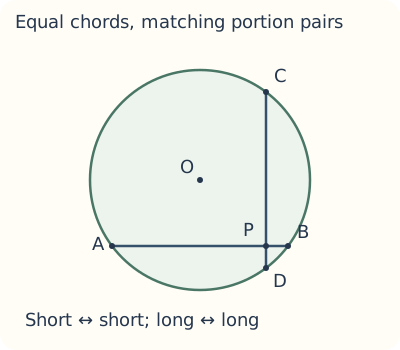
Equal intersecting chords have matching portion pairs
For equal chords AB, CD meeting inside at P, let M, N be perpendicular feet from O. Equal chords give OM=ON and equal half-chord length k. If P≠O, right triangles OMP, ONP give PM=PN=t. Each chord’s two portions therefore have lengths k−t, k+t in some order. State which short portion matches which short portion in your labelled drawing. IfP=O, all four portions are radii. Do not assert an unspecified endpoint matching.
Midpoint loci and diametral chord pairs
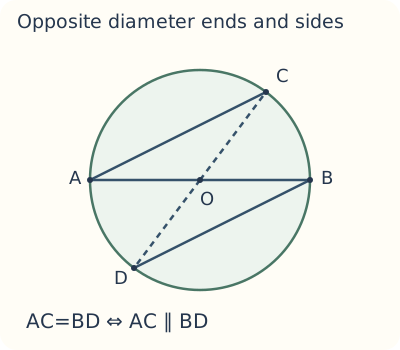
All chords of one fixed length L<2r have midpoint distance √(r²−(L/2)²) from O; their midpoint locus is a smaller concentric circle. IfL=2r, all midpoints collapse to O, not an ordinary positive-radius circle. Equal chords AC, BD drawn from opposite diameter endpoints A, B to opposite sides give OAC≅OBD by SSS, so matching alternate angles make AC∥BD. Conversely such parallel chords give equal base angles in the two isosceles radius triangles, hence equal chords.
A longer chord lies nearer the centre
For fixed r, chord length L satisfiesL²=4(r²−h²). If h increases from 0 to r, L decreases. Comparing two unequal lengths in the same circle therefore reverses their distances:the larger is nearer O. The comparison does not work across different radii without more information. The diameter is the distance 0 maximum, and a tangent is the limiting one-point case.
Worked example
For concentric radii 15 cm,13 cm and a crossing line12 cm from O, the half lengths are 9 cm and 5 cm. The two outer portions each measure4 cm by subtraction about the shared midpoint.
Name the centre, radii, chord endpoints and required length or area. State the chosen pi approximation and all units.
Draw the labelled model. Give reasons for congruence, perpendicular distance, sector rearrangement or included cylinder faces before calculating.
Check existence, radius versus diameter, positive roots and units. Numeric checks assess the requested value only; proofs, drawings and measurements need guardian or teacher review.
Locus has an exception
Equal diameters have only one midpoint O. Calling that a positive-radius circle would overlook a degenerate case.
Portion pairs need an order
For equal intersecting chords, the shorter portions match and the longer portions match. Unspecified endpoint correspondence can assert the wrong equality.
A proof route for each chord family
List full givens before choosing a theorem.
A proof route for each chord family
Given
Bridge
Required result
Mutual bisection
A nonzero OP cannot be perpendicular to two distinct crossing lines
P=O
Parallel chords
Their perpendicular bisectors coincide through O
Midpoints and O collinear
Concentric crossing
Subtract outer and inner half chords at one foot
AC=BD
Equal intersecting chords
Equal half lengths k and equal foot distances t
Portion pair {k−t, k+t}
Fixed length L<2r
h²=r²−(L/2)² is constant
Midpoint locus is a concentric circle
For diameters, the midpoint locus is one point O. The unordered portion pair does not justify arbitrary endpoint matches.
Subtract concentric half chords
Outer radius 15 cm, inner 13 cm, perpendicular distance 12 cm.
AM=√(15²−12²)=9 cm
CM=√(13²−12²)=5 cm
AC=AM−CM=4 cm=BD
AM
Outer half chord.
CM
Inner half chord, on the same side.
AC
Outside portion, not the difference of radii.
Check 12<13<15, so both circles are crossed.
Use each circle’s own radius.
Subtract half lengths on the same side.
Repeat at the opposite end.
The point order is A, C, M, D, B. If the line misses the inner circle, C and D do not exist.
Explore the mathematical figures
Match each letter to its explanation. Read the quantities, units and relationships, then check the counts or equations. These are original teaching models.
Locate parallel chord midpoints
The perpendicular bisectors have one direction and pass through the same centre, so they coincide. Their midpoints are distinct.
A, B
The upper chord endpoints.
C, D
The lower chord endpoints.
M
Upper chord midpoint and perpendicular foot.
N
Lower chord midpoint and perpendicular foot.
O
Centre on both perpendicular bisectors.
Original geometry, not copied artwork. Curved sectors retain their arcs. Perspective cylinders are explicitly schematic; the separate cut layout uses one length scale.
Explore the mathematical figures
Match each letter to its explanation. Read the quantities, units and relationships, then check the counts or equations. These are original teaching models.
Compare chords about a radius
SSS gives equal angles BAO and CAO. For the converse, use the isosceles radius triangles to establish equal central angles, then SAS.
A
Common boundary endpoint of both chords.
B, C
Opposite-side endpoints reflected about the line AO.
O
Equal radius triangles OAB and OAC share OA.
Original geometry, not copied artwork. Curved sectors retain their arcs. Perspective cylinders are explicitly schematic; the separate cut layout uses one length scale.
Explore the mathematical figures
Match each letter to its explanation. Read the quantities, units and relationships, then check the counts or equations. These are original teaching models.
Subtract concentric chord portions
The outer portions AC=BD=9−5=4 cm. At 8 pixels per cm, all four endpoints lie on their stated circles.
O
Common centre, 12 cm from the chord line.
A, B
Outer endpoints; AM=BM=9 cm.
C, D
Inner endpoints; CM=DM=5 cm.
M
The shared perpendicular foot and midpoint.
Original geometry, not copied artwork. Curved sectors retain their arcs. Perspective cylinders are explicitly schematic; the separate cut layout uses one length scale.
Explore the mathematical figures
Match each letter to its explanation. Read the quantities, units and relationships, then check the counts or equations. These are original teaching models.
Match equal chord portions carefully
In this drawing AP=CP is the longer pair and PB=PD is the shorter pair. Endpoint matching depends on the labelled order.
A, B
Endpoints of one equal chord.
C, D
Endpoints of the other equal chord.
P
Crossing splits each chord into the same unordered pair of lengths.
O
Centre; P need not be O unless both chords bisect each other.
Original geometry, not copied artwork. Curved sectors retain their arcs. Perspective cylinders are explicitly schematic; the separate cut layout uses one length scale.
Explore the mathematical figures
Match each letter to its explanation. Read the quantities, units and relationships, then check the counts or equations. These are original teaching models.
State both opposite-side conditions
Equal chords give matching alternate angles and parallelism. Conversely parallelism and the isosceles radius triangles give equal chords.
A, B
Opposite diameter endpoints.
C, D
Other chord endpoints on opposite sides of the diameter.
O
Centre; triangles OAC and OBD compare two equal radii and the chord.
Original geometry, not copied artwork. Curved sectors retain their arcs. Perspective cylinders are explicitly schematic; the separate cut layout uses one length scale.
Explore the mathematical figures
Match each letter to its explanation. Read the quantities, units and relationships, then check the counts or equations. These are original teaching models.
Find a right triangle’s circle centre
Complete a rectangle to prove its equal, bisecting diagonals put all three vertices at equal distance from O.
A, B
Hypotenuse endpoints and ends of a diameter.
C
Right-angle vertex on the circle, not its centre.
O
Midpoint of AB; OA=OB=OC=5 cm.
Original geometry, not copied artwork. Curved sectors retain their arcs. Perspective cylinders are explicitly schematic; the separate cut layout uses one length scale.
Your written practice
Show your working on paper. Check your answer, then choose Next.
Show model answer and explanation
7
Their crossing is the centre and each half is a radius.
Show model answer and explanation
7
Opposite-side perpendicular distances add:3+4.
Show model answer and explanation
1
Same-side distances subtract:4−3.
Show model answer and explanation
35
SSS congruence gives the matching angle.
Show model answer and explanation
9
The centre is the hypotenuse midpoint, at half its length from each vertex.
Show model answer and explanation
9
√(15²−12²)=9.
Show model answer and explanation
5
√(13²−12²)=5.
Show model answer and explanation
4
Subtract the same-side half lengths:9−5.
Show model answer and explanation
5
The unordered portion pair is the same:{5,11}.
Show model answer and explanation
11
Match the longer members of the equal unordered pairs.
Show model answer and explanation
3
√(25−4²)=3.
Show model answer and explanation
1
Every diameter midpoint is the same point O; the locus is not a positive-radius circle.
Show model answer and explanation
9
The given equal-chord condition fixes BD.
Show model answer and explanation
12
Half length 5 gives √(169−25)=12.
Show model answer and explanation
5
Half length 12 gives √(169−144)=5; the longer chord is nearer O.
Write in your own words. A guardian or teacher should review this response.
Show model answer and explanation
Let their common midpoint P differ from O. Then OP is perpendicular to both distinct intersecting chord lines, which is impossible. Therefore P=O, and both chords are diameters.
State distinct chord lines and avoid assigning a direction to OP once P=O.
Write in your own words. A guardian or teacher should review this response.
Show model answer and explanation
Both perpendicular bisectors pass through O and have the same direction. They coincide as one line through both distinct midpoints. If one midpoint is O, use the other bisector to determine this line.
Explain why parallel chords do not give two independent lines for locating O.
Write in your own words. A guardian or teacher should review this response.
Show model answer and explanation
Triangles OAB, OAC have common OA, equal radii OB=OC and given AB=AC. SSS makes corresponding angles at A equal.
Write the correspondence before taking the angles.
Write in your own words. A guardian or teacher should review this response.
Show model answer and explanation
Each of OAB, OAC is isosceles by its equal radii. Equal angles at A give equal corresponding base angles and hence equal included angles at O. With OA common, OB=OC, SAS gives equal chord bases AB=AC.
Do not use an invalid ambiguous side-side-angle congruence rule.
Write in your own words. A guardian or teacher should review this response.
Show model answer and explanation
Complete a rectangle with the triangle as one half. Its equal, bisecting diagonals show the midpoint O of the hypotenuse is equidistant from all three triangle vertices. The circle of that radius goes through them, and chord-bisector uniqueness fixes its centre.
Do not assume the centre is the right-angle vertex.
Write in your own words. A guardian or teacher should review this response.
Show model answer and explanation
The perpendicular from their common centre bisects both chords at the same M. Then AM=BM, CM=DM, and AC=AM−CM=BM−DM=BD.
Use the stated point order and verify that the line intersects both circles.
Write in your own words. A guardian or teacher should review this response.
Show model answer and explanation
Let the half length be k. Equal perpendicular distances and shared OP give PM=PN=t by RHS. The portions on each chord are k−t, k+t. Pair short with short, long with long. AtP=O all four equal r.
If a foot equals P, then both feet do andt=0; handle that case without a degenerate triangle proof.
Write in your own words. A guardian or teacher should review this response.
Show model answer and explanation
The perpendicular-foot distanceh=√(r²−(L/2)²) is the same positive value for every such chord, so their midpoints form a circle centred O. For L=2r, h=0 and the locus is only O.
Define locus as the complete set of positions, including that every direction can occur.
Write in your own words. A guardian or teacher should review this response.
Show model answer and explanation
OA=OB, OC=OD and AC=BD make OAC≅OBD by SSS. Matching angles between the chords and diameter are equal alternate angles, so AC∥BD. The opposite-side placement selects the correct alternate-angle configuration.
Draw endpoints cyclically and do not omit the side-of-diameter condition.
Write in your own words. A guardian or teacher should review this response.
Show model answer and explanation
Parallelism gives equal alternate angles OAC, OBD. Radius triangles OAC, OBD are isosceles, so their remaining base angles also match; their central angles match. OA=OB, OC=OD and that central angle give SAS, so AC=BD.
State both equal radii and the matching included angle.
Write in your own words. A guardian or teacher should review this response.
Show model answer and explanation
For each chord L²=4(r²−h²). The larger L has largerL², so its h² is smaller; nonnegative distances preserve the comparison. Thus its perpendicular distance is smaller.
Use a fixed commonr and explain why positive square roots preserve order.
Write in your own words. A guardian or teacher should review this response.
Show model answer and explanation
Their lengths are 2√(25−9)=8 cm and 2√(25−16)=6 cm. The nearer chord is longer. If the chords are parallel, the line separation is 1 cm on the same side of O or7 cm on opposite sides.
Do not add distances until the placement is specified.
Write in your own words. A guardian or teacher should review this response.
Show model answer and explanation
Mutual bisection forces the crossing to O, so each chord is a diameter 14 cm and each half is 7 cm. Equal total chord lengths alone would not force the crossing to O.
Separate the intersection, equality and bisection premises.
Write in your own words. A guardian or teacher should review this response.
Show model answer and explanation
Midpoint O of the 10 cm hypotenuse has distance 5 cm to both its endpoints and to the right-angle vertex by the rectangle argument. The circle has radius 5 cm, not10 cm.
Show a labelled construction and all three equal joins.
Write in your own words. A guardian or teacher should review this response.
Show model answer and explanation
No. A fixed chord length is needed. Different lengths have different perpendicular centre distances; all chord midpoints together fill the disk interior, while a fixed non-diameter length gives one concentric circle.
State which quantity is fixed before naming the locus.
Progress and browser storage
Notebook challenge, sources and further study
Your circle and cylinder notebook
Build a proof portfolio for parallel and concentric chords.
Review with a guardian or teacher
Label the common midpoint and all circle centres.
State the point order before subtracting lengths.
Include a diameter or missing-inner-circle exception.
Keep your work on paper or in a local file. This page does not upload it or automatically grade the project.
Chapter companion and further study
This original Kidemy practice follows the topic order of 2026 Class 8 Mathematics · English Version, chapter 10, printed pages 159–170. It does not replace the complete chapter or its practical teaching.
Original tasks teach the mapped methods rather than reproduce every exact printed question. Review independent full proofs and constructions.
Historical pi biography claims are outside this mathematical-method crosswalk. Original companions for all 11 chapter headings are available; independent source exercises and full working still need review.
Teacher-led lessons, schedules and prices for this outline are upcoming. You can use any starter practice above now without booking.
Your next step
Solo practice works without an account. Sign in to save a practice record to your learner profile.
Keep practising
Exact lesson links and related activities are labelled separately. Return-to-course links retain your selected learning path.