2026 Class 8 Mathematics · English Version · Chapter 7 · Chapter companion part
Chapter 7B: Operations, Venn regions and set laws
Use union, intersection and complements, read every region of two- and three-set Venn diagrams and justify the set laws element by element.
About this lesson and its coverage
Class 8 English Version: part B of the chapter 7 companion. Eight sections, 30 written tasks and a notebook challenge. Selected companion coverage, not complete textbook coverage; use all three parts. Counts are checked, while rosters, equivalent set-builder rules, diagrams and general proofs need guardian or teacher review.
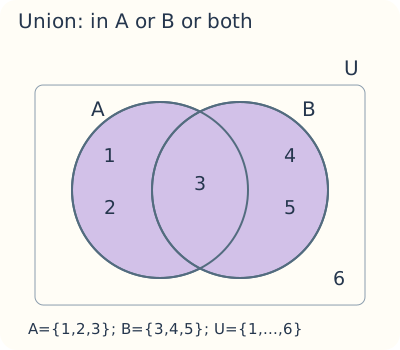
A∪B contains elements in A or B or both. For A={1,2,3}, B={3,4,5}, their union is {1,2,3,4,5}. The shared element 3 is listed once. A Venn union shades both circles, including their overlap. In this definition or is inclusive; it does not mean exactly one of the two sets.
Intersection requires both conditions
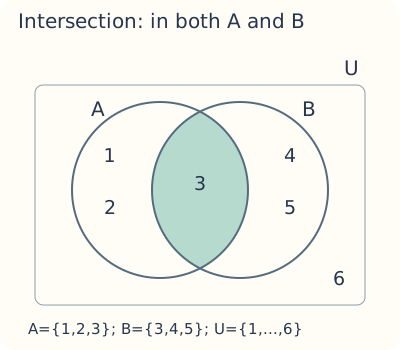
A∩B contains elements that belong to both A and B. For A={1,2,3}, B={3,4,5}, it is {3}. A Venn intersection shades only the overlap. An element in A but outside B is not in the intersection. The set A∖B contains elements in A and not B; reversing this difference generally changes the answer.
Disjoint means an empty intersection
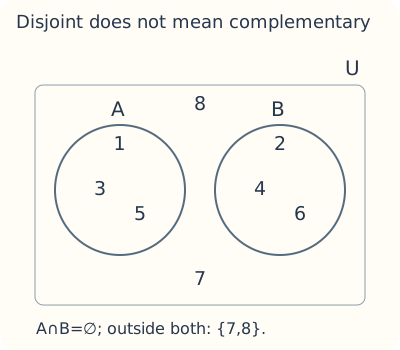
The sets {1,3,5} and {2,4,6} are disjoint because no element is shared, so their intersection is ∅. This says nothing by itself about whether their union fills the chosen universe. A set can be disjoint from ∅; the empty set has no shared member with any set. A nonempty set is not disjoint from itself.
Empty and universal sets give useful checks
For A⊆U, A∪∅=A, A∩∅=∅, A∪U=U and A∩U=A. Also A∪A=A and A∩A=A: repeating a condition does not add a second copy of each element. The operations describe membership, not arithmetic addition and multiplication of the written sets.
Changing order or grouping has specific rules
Union and intersection are commutative: A∪B=B∪A and A∩B=B∩A. They are associative: (A∪B)∪C=A∪(B∪C) and similarly for intersection. Mixed operations still need brackets. A∩(B∪C) is not in general (A∩B)∪C; distributing correctly gives (A∩B)∪(A∩C).
Explain a distributive law using membership
An element belongs to A∩(B∪C) exactly when it belongs to A and at least one of B,C. This is exactly the condition belongs to both A,B or to both A,C, so A∩(B∪C)=(A∩B)∪(A∩C). The dual law is A∪(B∩C)=(A∪B)∩(A∪C). A correct concrete example verifies that example; the membership reasoning establishes the general identity.
Complement swaps union and intersection
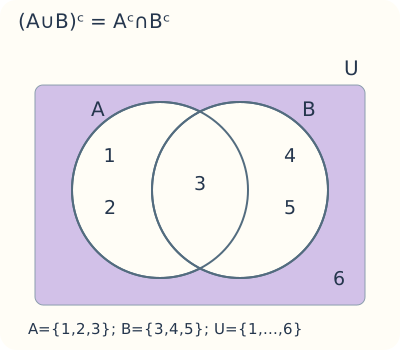
With one fixed U, (A∪B)ᶜ=Aᶜ∩Bᶜ: outside either circle’s union means outside both circles. Also (A∩B)ᶜ=Aᶜ∪Bᶜ: not in both means missing from at least one set. These are De Morgan’s laws. The complement applies to the entire bracket. A membership table uses 1 for in and 0 for out, and checks all four A/B cases; those symbols are logical states, not probabilities.
Read the triple overlap as well as the pair-only regions
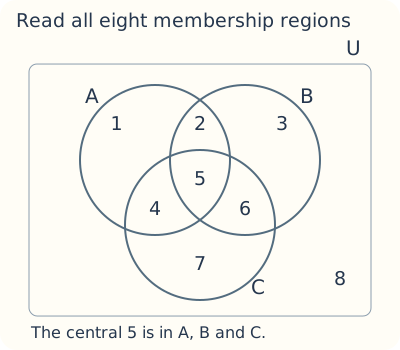
In the original three-set model, U={1,...,8}, A={1,2,4,5}, B={2,3,5,6}, C={4,5,6,7}. The central element 5 belongs to all three sets. Thus A∩B={2,5}, not just the pair-only element 2. The element 8 is outside every circle but still inside U. Region areas are illustrative; they are not proportional to numbers of elements.
Worked example
For U={1,...,6}, A={1,2,3},B={3,4,5}, (A∪B)ᶜ={6}. The same element is obtained from Aᶜ∩Bᶜ. Both complements use the same universe.
State the number domain or universal set, read the operation and identify each distinct element.
Build a roster, membership table or labelled Venn diagram. Keep overlap elements once and complements inside the stated universe.
Check every element or justify the membership rule. Automatic checks assess only the requested count/value; full sets, diagrams and proofs need review.
Difference has a direction
A∖B generally differs from B∖A. State which first set supplies the remaining elements.
A colour is not the definition
The written membership condition and adjacent rosters explain each shaded region without requiring colour recognition.
Union, intersection and differences
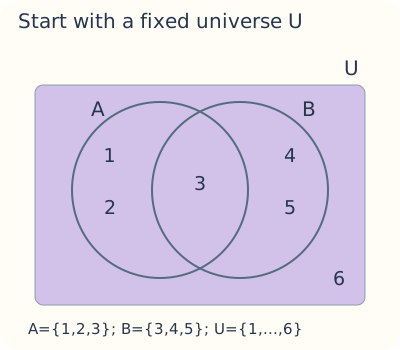
Use A={1,2,3},B={3,4,5},U={1,...,6}.
Union, intersection and differences
Operation
Membership rule
Result
A∪B
In at least one
{1,2,3,4,5}
A∩B
In both
{3}
A∖B
In A but not B
{1,2}
B∖A
In B but not A
{4,5}
(A∪B)ᶜ
In U but neither
{6}
Shared 3 remains in the inclusive union. Exactly one of A,B would instead give {1,2,4,5}.
All membership cases prove both De Morgan laws
Here 1 means belongs and 0 means does not belong; these are logical states, not scores or probabilities.
All membership cases prove both De Morgan laws
In A
In B
Not (A or B)
Not A and not B
Not (A and B)
Not A or not B
0
0
1
1
1
1
0
1
0
0
1
1
1
0
0
0
1
1
1
1
0
0
0
0
The third/fourth columns agree in all four cases, as do the fifth/sixth. This checks every possible membership state for an arbitrary element of U.
Correctly distribute the shared condition
For A={1,2,4},B={2,3},C={4,5}, keep A in both alternatives.
A∩(B∪C) = {2,4}
(A∩B)∪(A∩C) = {2}∪{4} = {2,4}
∩
Both membership conditions must hold.
∪
At least one alternative holds.
Combine B and C into {2,3,4,5}.
Intersect with A to retain 2 and 4.
Compute A∩B and A∩C independently.
Explain the general belongs-to-A-and-either condition.
The finite example illustrates the identity. The membership argument establishes it for arbitrary sets.
Build the complement of a union
Keep one universe and the same six members through every stage. Shading indicates membership, not population area.
All stages: readable static alternative
1 · Fix the universe: U={1,...,6}. A={1,2,3},B={3,4,5}. Every displayed member is in the universe.
2 · Select the union: Shade all of A and B, including shared 3. Selected members are 1,2,3,4,5.
3 · Complement the entire union: Only 6 is outside both circles within U. Thus (A∪B)ᶜ=Aᶜ∩Bᶜ={6}.
No autoplay or sound is needed. Manual stage buttons, replay and all static stages remain available. Reduced motion disables timed playback; leaving the page pauses it.
Explore the mathematical figures
Match each letter to its explanation. Read the quantities, units and relationships, then check the counts or equations. These are original teaching models.
Union keeps the shared member once
The selected members are 1,2,3,4,5: in A or B or both.
U
All six displayed elements.
A
Members 1,2,3.
B
Members 3,4,5; the shared 3 is not duplicated.
Original membership model, not copied source artwork. Circle areas and distances do not encode member counts. Read the labels and element rosters.
Explore the mathematical figures
Match each letter to its explanation. Read the quantities, units and relationships, then check the counts or equations. These are original teaching models.
Intersection selects only the overlap
Test membership in both sets, rather than either one alone.
U
The surrounding six-member universe is unchanged.
A
A-only members 1,2 are not selected.
B
B-only members 4,5 are not selected; shared 3 is.
Original membership model, not copied source artwork. Circle areas and distances do not encode member counts. Read the labels and element rosters.
Explore the mathematical figures
Match each letter to its explanation. Read the quantities, units and relationships, then check the counts or equations. These are original teaching models.
Disjoint sets need not fill the universe
An empty intersection makes the sets disjoint. The extra 7 and 8 show why they are not each other’s complements.
U
The eight-member universe also contains 7 and 8.
A
Members 1,3,5 have no member in common with B.
B
Members 2,4,6 are disjoint from A, but B is not all of Aᶜ in this U.
Original membership model, not copied source artwork. Circle areas and distances do not encode member counts. Read the labels and element rosters.
Explore the mathematical figures
Match each letter to its explanation. Read the quantities, units and relationships, then check the counts or equations. These are original teaching models.
Eight regions in a three-set diagram
Reconstruct every set from its circle and include central members when reading a pairwise intersection.
U
All eight displayed elements occur exactly once.
A
A={1,2,4,5}.
B
B={2,3,5,6}.
C
C={4,5,6,7}; the centre 5 belongs to all pairwise intersections.
Original membership model, not copied source artwork. Circle areas and distances do not encode member counts. Read the labels and element rosters.
Explore the mathematical figures
Match each letter to its explanation. Read the quantities, units and relationships, then check the counts or equations. These are original teaching models.
Outside the union is outside both sets
Compare the selected member with the complement-of-union and intersection-of-complements rules.
U
Complements are taken only within these six members.
A
Outside A excludes 1,2,3.
B
Outside B excludes 3,4,5; being outside both leaves only 6.
Original membership model, not copied source artwork. Circle areas and distances do not encode member counts. Read the labels and element rosters.
Your written practice
Show your working on paper. Check your answer, then choose Next.
Show model answer and explanation
5
List {1,2,3,4,5}; shared 3 appears once.
Show model answer and explanation
1
The only common element is 3.
Show model answer and explanation
3
Three belongs to both sets.
Show model answer and explanation
0
No member occurs in both, so the intersection is empty.
Show model answer and explanation
0
The empty set contributes no shared member.
Show model answer and explanation
3
Union with empty leaves A unchanged.
Show model answer and explanation
3
Repeating A does not duplicate its members.
Show model answer and explanation
2
Both 2 and central 5 are shared.
Show model answer and explanation
5
Only 5 belongs to all three sets.
Show model answer and explanation
8
The seven values 1 through 7 occur in at least one circle; 8 is outside all.
Show model answer and explanation
6
The union is {1,2,3,4,5}; only 6 remains in U.
Show model answer and explanation
5
Remove the shared element 3 from U.
Show model answer and explanation
2
The result is {2,4}, matching (A∩B)∪(A∩C).
Show model answer and explanation
4
Both union groupings give {1,2,3,4}.
Show model answer and explanation
2
A-only elements are 1 and 2.
Write in your own words. A guardian or teacher should review this response.
Show model answer and explanation
The union admits a member in A, B or both. It is {1,2,3,4,5}, including the shared 3 once. Exclusive or would wrongly omit that shared member.
Explain the overlap, not just the combined list.
Write in your own words. A guardian or teacher should review this response.
Show model answer and explanation
They are {3}, {1,2} and {4,5} respectively. Intersection requires both; each difference uses only the named first set while excluding the second.
Order matters for difference, unlike intersection.
Write in your own words. A guardian or teacher should review this response.
Show model answer and explanation
For example {1,3} and {2,4} share no member, but their union leaves 5,6,7,8 outside both. Disjoint does not mean complementary.
Verify both the empty intersection and the missing universal elements.
Write in your own words. A guardian or teacher should review this response.
Show model answer and explanation
Nothing belongs to ∅, so no element can satisfy both conditions for intersection. For union, membership in A or in ∅ reduces to membership in A.
State the two logical conditions in ordinary words.
Write in your own words. A guardian or teacher should review this response.
Show model answer and explanation
A∪B and B∪A both give {1,2,3,4}; A∩B and B∩A both give {3}. The result depends on membership, not the order in which the sets are named.
The example illustrates the laws; explain the symmetric membership conditions too.
Write in your own words. A guardian or teacher should review this response.
Show model answer and explanation
(A∪B)∪C={1,2,3}∪{3,4}={1,2,3,4}. A∪(B∪C)={1,2}∪{2,3,4} gives the same result.
Compute intermediate sets and keep duplicates only once.
Write in your own words. A guardian or teacher should review this response.
Show model answer and explanation
B∪C={2,3,4,5}, so the left side is {2,4}. On the right A∩B={2} and A∩C={4}; their union is {2,4}.
Then explain why the belongs-to-A condition applies to both alternatives.
Write in your own words. A guardian or teacher should review this response.
Show model answer and explanation
If an element is in A, it belongs to both right-hand unions. If it is outside A, the right side requires it to be in both B and C, exactly the remaining condition on the left.
Cover membership in A and outside A; one numerical example alone is not a proof.
Write in your own words. A guardian or teacher should review this response.
Show model answer and explanation
The union is {1,2,3,4,5}, with complement {6}. Separately Aᶜ={4,5,6},Bᶜ={1,2,6}; their intersection is {6}.
Use the same U for every complement and shade outside both circles.
Write in your own words. A guardian or teacher should review this response.
Show model answer and explanation
A∩B={3}, so its complement is {1,2,4,5,6}. Aᶜ={4,5,6} and Bᶜ={1,2,6}; their union gives exactly those five elements.
Do not keep the same intersection sign after complementing the whole bracket.
Write in your own words. A guardian or teacher should review this response.
Show model answer and explanation
An element may be in A only, in B only or in neither; all three fail the in-both condition. Outside both is just the neither case. This distinction explains why the complement of an intersection is a union of complements.
Account for all four membership combinations, including in both.
Write in your own words. A guardian or teacher should review this response.
Show model answer and explanation
They are {2,5}, {4,5} and {5,6}. Central element 5 belongs to every pairwise intersection as well as the triple intersection.
Do not confuse a pairwise intersection with a pair-only region.
Write in your own words. A guardian or teacher should review this response.
Show model answer and explanation
A-only 1; B-only 3; C-only 7; AB-only 2; AC-only 4; BC-only 6; all three 5; outside all 8. Each element appears in exactly one of these eight regions.
Check every roster against the circle membership and the universe.
Write in your own words. A guardian or teacher should review this response.
Show model answer and explanation
Take A={1},B=∅,C={2}. The left side is empty but the right side is {2}. The correct distributed expression also intersects A with C.
Compute both sides and explain the missing condition.
Write in your own words. A guardian or teacher should review this response.
Show model answer and explanation
A finite example confirms the identity for those particular sets. A general proof must show the same membership condition for every element of an arbitrary universe, using all relevant cases. A Venn diagram can encode those cases if every region is accounted for.
Use a membership argument or all logical cases rather than claiming one example proves every instance.
Progress and browser storage
Notebook challenge, sources and further study
Your set-and-Venn notebook
Make a two-set operation chart and an eight-region three-set diagram.
Review with a guardian or teacher
Include central elements in all relevant pairwise intersections.
Explain one De Morgan law using both a concrete roster and general membership cases.
Distinguish a schematic region from an area proportional to a count.
Keep your work on paper or in a local file. This page does not upload it or automatically grade the project.
Chapter companion and further study
This original Kidemy practice follows the topic order of 2026 Class 8 Mathematics · English Version, chapter 7, printed pages 121–132. It does not replace the complete chapter or its practical teaching.
Use the independent source exercises and have full set notation, region placement and proofs reviewed. These fresh tasks map the source methods rather than reproduce all printed questions.
Keep the stated universe, number domain and inclusive/exclusive bounds. Do not infer actual student counts from percentages without a population total. Original companions for all 11 chapter headings are available; independent source exercises and full working still need review.
Teacher-led lessons, schedules and prices for this outline are upcoming. You can use any starter practice above now without booking.
Your next step
Solo practice works without an account. Sign in to save a practice record to your learner profile.
Keep practising
Exact lesson links and related activities are labelled separately. Return-to-course links retain your selected learning path.