2026 Class 8 Mathematics · English Version · Chapter 3 · Chapter companion part
Chapter 3B: Area, perimeter and land units
Explain square units, find direct and reverse areas, use land conventions and distinguish area from perimeter.
About this lesson and its coverage
Class 8 English Version: part B of the Measurement companion. Eight sections, 30 written tasks and a notebook challenge. Selected companion coverage, not complete textbook coverage. Use all four parts for the mapped chapter methods; these fresh tasks do not reproduce every printed question. Drawings and explanations need guardian or teacher review.
Perimeter is boundary length; area is the amount of flat surface covered. A 6 m by 4 m rectangle has perimeter 2(6 + 4) = 20 m and area 6 × 4 = 24 m². A square of side s has perimeter 4s and area s². Doubling every length doubles perimeter but multiplies area by four.
A triangle needs a perpendicular height
A triangle of base b and perpendicular height h has area bh/2. Pair two identical triangles into a parallelogram or rectangle to explain the half. A sloping side is not generally the height. With b = 12 m and h = 5 m, area is 30 m². Reverse the relation as h = 2A/b when b is nonzero.
Square the length conversion
One metre is 100 cm, so a square metre is 100 × 100 = 10000 cm². Adjacent metric area levels based on a tenfold length change differ by 100. One are is 100 m²; one hectare (ha) is 100 ares = 10000 m². One square kilometre is 100 hectares. Use ha rather than the book’s spelling hector.
Convert British area from exact lengths
One square foot is 12² = 144 square inches; one square yard is 3² = 9 square feet. From the international inch, one square inch is exactly 6.4516 cm²; a square yard is 0.83612736 m². An acre defined as 4840 international square yards is 4046.8564224 m², approximately 4046.86 m². Distinguish this classroom international-yard convention from an old U.S. survey-foot acre.
State local land conventions before calculating
For this chapter’s local classroom chain, 1 ganda = 324 in² = 2.25 ft²; 20 ganda = 45 ft² per chatak; 16 chatak = 720 ft² per katha; 20 katha = 14400 ft² per bigha. One decimal is 1/100 acre = 435.6 ft². These are the stated source conventions, not a universal rule for regional property records.
Find missing lengths from area or perimeter
For a rectangle with length 3 times breadth x and area 192 m², 3x² = 192, so x = 8 m and length is 24 m. Take the positive root for a physical length. If length exceeds breadth by 4 m and perimeter is 40 m, l + b = 20 and l − b = 4, giving l = 12 and b = 8. Verify both conditions.
Measure a surface and interpret its diagonal
Measure a book cover or table in one consistent unit, then multiply the perpendicular lengths. A diagonal across a rectangle uses d² = l² + b², a later-chapter relation supplied here as an extension. For a 12 m by 5 m rectangle, d = 13 m; its perimeter is 34 m and area 60 m². Those quantities answer different questions. Do not use a diagonal as a rectangle’s breadth.
Use rounding and corrections honestly
Printed example 6 converts 40 m by 30 m 30 cm to 1212 m²; its intermediate line drops the square symbol and says metres. The area is still a square quantity. For a task using 2.47 acres per hectare, 700/2.47 is about 283.40 ha and rounds to 283 ha. A modern exact-acre calculation can differ slightly: state the factor requested rather than silently changing it. Area conversion does not settle a land title or legal survey.
Worked example
A triangle has area 90 m² and base 15 m. Since A = bh/2, height h = 2A/b = 180/15 = 12 m. Check: 15 × 12/2 = 90 m²; a sloping edge need not be 12 m.
Name the quantity and required unit. Draw and label the dimensions; identify given assumptions.
Convert all dimensions to compatible units before substituting. Show why the formula applies.
Check arithmetic, units and the physical meaning. Use the model answer to correct your written working.
Area figures are explanations
The grid and height diagrams show mathematical relationships, not a legal plot survey. Read dimensions from labels rather than measuring your phone screen.
One quantity, compatible units
Write 1212 m² rather than 1212 m. An area rate in Tk/m² and a fence rate in Tk/m cannot be substituted for each other.
Retain the acre conversion until the final rounding
For Exercise 3(4), use 1 acre = 4840 international yd² and 1 yd = 0.9144 m. Ten acres are 40468.564224 m². With length four times breadth, 4b² equals this area: b = 100.584 m and length = 402.336 m, or 402.34 m to two decimal places. The printed 402.31 m does not match this conversion. A calculation using a different rounded source factor must name that factor. Do not round intermediate lengths and then call the final result exact.
Square-unit changes
Each tenfold change in side length gives a hundredfold change in area.
Square-unit changes
Area unit
Equivalent
How to read it
1 dm²
100 cm²
10 cm × 10 cm
1 m²
100 dm² = 10000 cm²
100 cm × 100 cm
1 are
100 m²
10 m × 10 m
1 hectare
100 ares = 10000 m²
100 m × 100 m
1 km²
100 hectares = 1000000 m²
1000 m × 1000 m
For 0.4 km² use 0.4 × 100 = 40 hectares. For 2.5 m² use 2.5 × 10000 = 25000 cm².
Land factors with the convention visible
Local rows use the source chapter’s classroom chain, not a universal survey rule.
Land factors with the convention visible
Unit
Square feet or inches
Equivalent relationship
1 ganda / square arm
324 in² = 2.25 ft²
1.5 ft × 1.5 ft
1 chatak
45 ft²
20 ganda
1 katha
720 ft²
16 chatak
1 bigha
14400 ft²
20 katha
1 acre
43560 ft²
4840 international yd² = 100 decimals
1 decimal
435.6 ft²
1/100 acre = 1000 square kari in the source chain
1 kari
0.66 ft
100 kari = 66 ft; square this length for square kari
1 square statute mile
27878400 ft²
640 acres = 1936 source-convention bigha
Three katha give 3 × 720 = 2160 ft². One square metre is about 10.7639 ft², 4.78396 ganda or 0.239198 chatak in this chain. One are is about 23.9198 chatak. One acre is 3 bigha 8 chatak under this same chain. Keep rounded comparisons labelled.
Area, perimeter and reverse dimensions
Use perpendicular lengths in compatible units.
Rectangle: A = lb; P = 2(l + b)
Square: A = s²; P = 4s
Triangle: A = bh/2; h = 2A/b
If l = kb: b = √(A/k), l = kb
A / P
Area in square units / perimeter in length units.
l / b
Rectangle length / breadth; in the triangle b denotes the base.
s / h
Square side / perpendicular triangle height.
k
Positive length-to-breadth ratio.
For l = 6 m and b = 4 m: A = 24 m² and P = 20 m.
For triangle A = 84 m² and base b = 14 m: h = 168/14 = 12 m.
For rectangle A = 192 m² and k = 3: b = √64 = 8 m; l = 24 m.
Check 24/8 = 3 and 24 × 8 = 192.
A sloping triangle side is not generally its height. Use a positive root for a physical length.
Derive squared international conversions
Square the entire length factor rather than moving the decimal once.
1 in² = (2.54 cm)² = 6.4516 cm²
1 yd² = (0.9144 m)² = 0.83612736 m²
1 acre = 4840 × 0.83612736 m² = 4046.8564224 m²
in / yd
International inch / yard.
acre
Here defined by 4840 international square yards.
Square both perpendicular dimensions.
One square yard has 9 square feet, consistent with 3 feet per yard.
Retain the exact factor until the final requested rounding.
Two decimal places give 4046.86 m² per international-yard acre.
An old survey-foot-based acre differs slightly. Use the task’s stated convention; never silently mix different acre factors.
Diagonal as a supplied extension
This is the later-chapter right-triangle relationship, introduced only to interpret the sample question.
d² = l² + b²
d = √(l² + b²)
d
Rectangle diagonal, a length.
l / b
Perpendicular rectangle sides in the same unit.
For l = 12 m and b = 5 m, compute 144 + 25 = 169.
The positive square root gives d = 13 m.
Perimeter is separately 2(12 + 5) = 34 m.
Area is separately 12 × 5 = 60 m².
The diagonal does not replace the breadth in an area formula. A full proof belongs to the later Pythagoras chapter.
Explore the mathematical figures
Match each letter to its explanation. Read the quantities, units and relationships, then check the counts or equations. These are original teaching models.
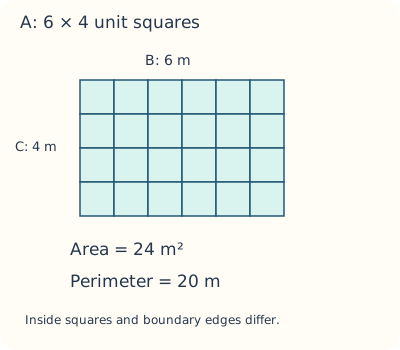
Twenty-four squares, twenty boundary units
Count inside squares for area and outside edge lengths for perimeter. If both sides double, the square count becomes four times as large.
A · Covered area
6 × 4 = 24 m² counts unit squares.
B · Horizontal boundary
Top and bottom together have length 12 m.
C · Vertical boundary
Left and right together have length 8 m; perimeter is 20 m.
Original exact rectangular grid: every cell is the same square unit. Display pixels are a model, not a physical metre scale.
Explore the mathematical figures
Match each letter to its explanation. Read the quantities, units and relationships, then check the counts or equations. These are original teaching models.
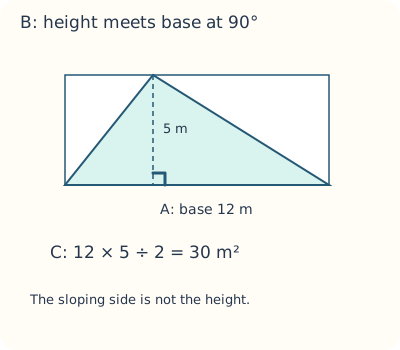
Height is perpendicular to the base
Follow the dashed height, not the sloping edge. Use A = 12 × 5/2 = 30 m² and rearrange as h = 2A/b for reverse problems.
A · Base
The 12 m horizontal side is the chosen base.
B · Perpendicular height
The dashed 5 m segment meets the base at 90 degrees.
C · Half the rectangle
A 12-by-5 bounding rectangle has area 60 m²; the triangle has area 30 m².
Original geometric model with one consistent drawing scale for the triangle and its perpendicular height. The bounding rectangle explains the half; it is not a second measured plot.
Your written practice
Show your working on paper. Check your answer, then choose Next.
Show model answer and explanation
24
6 × 4 = 24 m².
Show model answer and explanation
20
2(6 + 4) = 20 m.
Show model answer and explanation
49
7² = 49 m².
Show model answer and explanation
30
12 × 5/2 = 30 m².
Show model answer and explanation
12
2 × 84/14 = 12 m.
Show model answer and explanation
25000
2.5 × 10000 = 25000 cm².
Show model answer and explanation
300
3 × 100 = 300 ares.
Show model answer and explanation
40
0.4 × 100 = 40 ha.
Show model answer and explanation
12.9032
2 × 2.54² = 12.9032 cm².
Show model answer and explanation
2178
5 × 435.6 = 2178 ft².
Show model answer and explanation
2160
3 × 720 = 2160 ft².
Show model answer and explanation
50
2.5 × 20 = 50 katha.
Show model answer and explanation
8
3b² = 192, so b² = 64 and positive b = 8 m.
Show model answer and explanation
13
d² = 144 + 25 = 169, so d = 13 m.
Show model answer and explanation
102
8 m 50 cm = 8.5 m; 12 × 8.5 = 102 m².
Write in your own words. A guardian or teacher should review this response.
Show model answer and explanation
Draw 24 squares in 6 columns and 4 rows. Count the boundary as 6 + 4 + 6 + 4 = 20 units. Interior count is 24 square units.
Check that boundary edges are not counted as unit squares.
Write in your own words. A guardian or teacher should review this response.
Show model answer and explanation
Pair the triangles to make a parallelogram of base b and perpendicular height h. The whole has area bh, so one has bh/2. Mark a right angle at the height.
A sloping side used as height without justification is incorrect.
Write in your own words. A guardian or teacher should review this response.
Show model answer and explanation
Height = 7.5 m. Area = 16 × 7.5/2 = 60 m².
Convert mixed units before multiplication and label the perpendicular height.
Write in your own words. A guardian or teacher should review this response.
Show model answer and explanation
The unit square is 100 cm along each of two perpendicular sides, so it contains 100 × 100 = 10000 unit cm² squares.
Use both dimensions or a labelled grid rather than only quoting the result.
Write in your own words. A guardian or teacher should review this response.
Show model answer and explanation
One yard = 0.9144 m, so square yard = 0.9144² = 0.83612736 m². Multiply by 4840 to get 4046.8564224 m², or 4046.86 m² rounded to two decimals.
Name the international-yard convention and round only at the end.
Write in your own words. A guardian or teacher should review this response.
Show model answer and explanation
One ganda = 324 in²/144 = 2.25 ft². Twenty ganda make 45 ft² per chatak; sixteen chatak make 720 ft² per katha; twenty katha make 14400 ft² per bigha.
Do not use the source’s square-inch count as a square-foot count.
Write in your own words. A guardian or teacher should review this response.
Show model answer and explanation
43560/100 = 435.6 ft² per decimal. Five decimals give 2178 ft².
Explain that decimal is a land-area unit here, not the decimal-point operation.
Write in your own words. A guardian or teacher should review this response.
Show model answer and explanation
Let breadth b > 0. Then length = 3b and 3b² = 192. Thus b = 8 m and length = 24 m. Check 24 × 8 = 192.
Use the positive root and verify the ratio as well as area.
Write in your own words. A guardian or teacher should review this response.
Show model answer and explanation
l + b = 20 and l − b = 4. Hence l = 12 m and b = 8 m. Area is 96 m², a separate quantity.
Require the perimeter relation and a check.
Write in your own words. A guardian or teacher should review this response.
Show model answer and explanation
Both areas are 24 m². Perimeters are 20 m and 22 m. Equal area does not force equal boundary length.
Explain what each result measures.
Write in your own words. A guardian or teacher should review this response.
Show model answer and explanation
Measure length and breadth with stated resolution, multiply for cm², then divide by 10000 for m². Actual dimensions must come from your measurement.
Check tool alignment, compatible units and realistic precision.
Write in your own words. A guardian or teacher should review this response.
Show model answer and explanation
The 13 m is the diagonal from sqrt(12² + 5²); 34 m is the perimeter; 60 m² is covered area.
Use a labelled sketch to identify each quantity.
Write in your own words. A guardian or teacher should review this response.
Show model answer and explanation
494/2.47 = 200 ha under that supplied approximation. The result uses the given factor, not an assertion that 2.47 is exact.
State the convention and avoid replacing it without explanation.
Write in your own words. A guardian or teacher should review this response.
Show model answer and explanation
30 m 30 cm = 30.3 m. Product = 1212 m², also 12 ares 12 m². The numeric product is correct but the linear unit is wrong.
Identify the missing squared unit and show the conversion.
Write in your own words. A guardian or teacher should review this response.
Show model answer and explanation
Names such as katha and bigha can be used with regional conventions. This lesson states 720 ft² per katha and 20 katha per bigha for its classroom problems. A real property record must be interpreted from its own applicable survey information.
Do not claim one classroom chain determines every property area.
Progress and browser storage
Notebook challenge, sources and further study
Your measurement notebook
Draw one rectangle and one triangle, and create a land-unit conversion card using explicit conventions.
Review with a guardian or teacher
Distinguish boundary, covered area, perpendicular height and diagonal.
Show squared conversion factors and solve one reverse-dimension problem.
Label every approximation and state the local land chain used.
Keep your work on paper or in a local file. This page does not upload it or automatically grade the project.
Chapter companion and further study
This original Kidemy practice follows the topic order of 2026 Class 8 Mathematics · English Version, chapter 3, printed pages 29–47. It does not replace the complete chapter or its practical teaching.
Compare the companion methods with the source exercises and have full written solutions reviewed. Local land factors are stated classroom conventions, not a property-survey service.
Some source questions omit conditions or use rounded factors. Our finite-answer tasks state the needed assumptions. Later Class 8 mathematics chapters remain in preparation.
Teacher-led lessons, schedules and prices for this outline are upcoming. You can use any starter practice above now without booking.
Your next step
Solo practice works without an account. Sign in to save a practice record to your learner profile.
Keep practising
Exact lesson links and related activities are labelled separately. Return-to-course links retain your selected learning path.