2026 Class 8 Mathematics · English Version · Chapter 7 · Chapter companion part
Chapter 7A: Elements, notation, subsets and complements
Describe well-defined sets, convert roster and set-builder forms, include every subset and take complements inside a stated universe.
About this lesson and its coverage
Class 8 English Version: part A of the chapter 7 companion. Eight sections, 30 written tasks and a notebook challenge. Selected companion coverage, not complete textbook coverage; use all three parts. Counts are checked, while rosters, equivalent set-builder rules, diagrams and general proofs need guardian or teacher review.
A set is a well-defined collection of distinct objects called elements. For A={2,4,6}, 4∈A means 4 belongs to A and 5∉A means it does not. Reordering or repeating entries does not change a set: {2,4,4,6}={6,2,4}. A rule such as integers from 1 through 5 determines membership; an unspecified collection of nice numbers does not. Elements need not be lowercase letters or even numbers.
A member and a subset are different things
The braces in {2} make a set whose one element is 2. For A={2,4}, write 2∈A but {2}⊆A. The symbol ⊆ means every element on its left is also on its right. The entire set A is a subset of itself. A roster, also called tabular form, lists the distinct elements in braces; commas separate elements, not digits inside one number.
Give a domain and every boundary
Set-builder form names a variable and a condition, such as {x∈N: x is a multiple of 4 and 1≤x≤20}={4,8,12,16,20}. Here N={1,2,3,...}; some books include zero in N, so our convention is explicit. The colon means such that. If x is allowed to be any integer, even and x≤20 would also include zero and infinitely many negatives. A finite source list needs its intended lower bound stated.
Finite and infinite do not mean known and unknown
A finite set has some non-negative whole number of elements. A huge finite set does not become infinite because counting it is inconvenient. The natural numbers continue without a last member and are infinite. They can be listed 1,2,3,... and are called countably infinite: this means their elements can be paired with natural-number positions, not that the list ends. An ellipsis requires a clear continuing rule.
No element differs from one special element
The empty set ∅, also written {}, has no elements. The set {0} has one element, the number zero. The set {∅} also has one element, which happens to be the empty set itself. For positive integers x with x<1, the resulting set is empty. Zero is not a spare symbol to put inside an empty roster.
Include the empty subset and the whole set
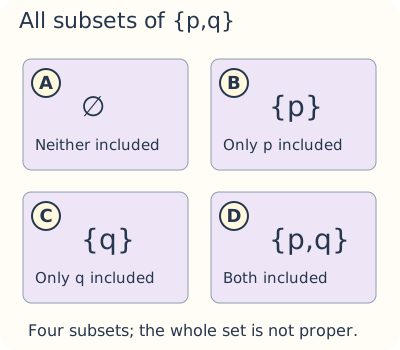
For A={p,q}, all subsets are ∅,{p},{q},{p,q}. Every set contains ∅ as a subset because there is no element of ∅ that could violate the subset condition. The opening source illustration lists only three nonempty subsets, but its later worked example includes ∅; the complete list needs it. A proper subset is a subset different from the whole set. A finite n-element set has 2ⁿ subsets and 2ⁿ−1 proper subsets, since each element is either included or not.
Choose the universe for the question
The universal set U contains all elements under discussion; every set being considered is a subset of U. It is a context, not a set containing absolutely everything. For A={2,4}, U={1,2,3,4} is possible, but a larger stated universe could also contain A. A rectangle represents U in our Venn diagrams. A suitable universe is not necessarily the only possible choice.
A complement is the remainder of U
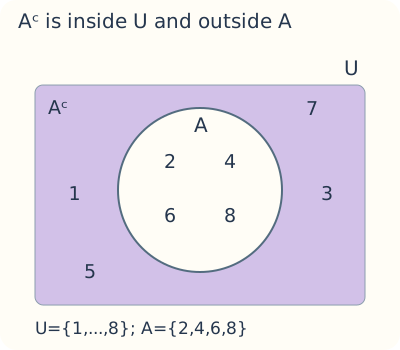
With U={1,2,3,4,5,6,7,8} and A={2,4,6,8}, Aᶜ=U∖A={1,3,5,7}. The superscript c, or a prime mark A′ in some books, means complement relative to the chosen U. Changing U may change Aᶜ. Inside U, (Aᶜ)ᶜ=A, Uᶜ=∅ and ∅ᶜ=U. The set A and its complement share no elements and together contain all of U.
Worked example
For U={1,2,3,4,5,6} and A={2,4}, the elements of U not in A are {1,3,5,6}. They form Aᶜ. Enlarging U can enlarge this complement without changing A.
State the number domain or universal set, read the operation and identify each distinct element.
Build a roster, membership table or labelled Venn diagram. Keep overlap elements once and complements inside the stated universe.
Check every element or justify the membership rule. Automatic checks assess only the requested count/value; full sets, diagrams and proofs need review.
Roster is also called tabular form
It lists members, rather than being a numerical data table. Equivalent element order is acceptable.
A chosen universe is a context
Do not treat a source example’s possible universe as the only set capable of containing its named subsets.
Three different kinds of membership
The braces and their contents have different jobs.
Three different kinds of membership
Written set
Elements
Number of elements
∅
None
0
{0}
The number zero
1
{∅}
The empty set as an element
1
{1,2,2,3}
The distinct numbers 1,2,3
3
An empty set is not a container that must be filled with the number zero. Repetition does not change membership.
All choices for a two-element set
Choose whether to include each of p and q.
All choices for a two-element set
Include p?
Include q?
Subset
No
No
∅
Yes
No
{p}
No
Yes
{q}
Yes
Yes
{p,q}
All four are subsets; only the first three are proper subsets. The complete list includes the empty set.
A complement stays inside its universe
Here U={1,2,3,4,5,6,7,8} and A={2,4,6,8}.
Aᶜ = U∖A = {1,3,5,7}
A∩Aᶜ = ∅
A∪Aᶜ = U
(Aᶜ)ᶜ = A
U
The fixed universe for all four statements.
Aᶜ
Members of U that are not in A.
Test each member of U against A.
Place even members in A and odd members outside A but inside U.
Check that every U member is in exactly one of A,Aᶜ.
Take the complement again to recover A.
A larger universe could add members to the complement. Never complement against an unstated collection.
Explore the mathematical figures
Match each letter to its explanation. Read the quantities, units and relationships, then check the counts or equations. These are original teaching models.
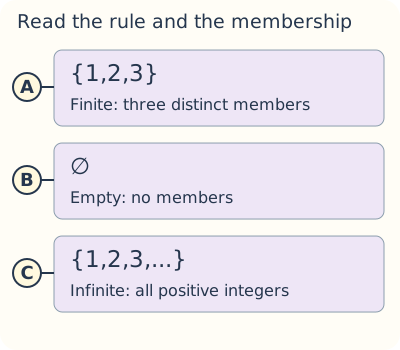
Finite, empty and infinite are different
Name the collection, its membership rule and whether a last member exists.
A · Finite
The set has exactly three members.
B · Empty
It has zero members, not a zero member.
C · Infinite
Every positive integer has a successor; the ellipsis is not an unknown finite total.
Original membership model, not copied source artwork. Circle areas and distances do not encode member counts. Read the labels and element rosters.
Explore the mathematical figures
Match each letter to its explanation. Read the quantities, units and relationships, then check the counts or equations. These are original teaching models.
Every subset of {p,q}
Explain all four choices. Omitting the empty set gives an incomplete subset list.
A · Empty choice
Exclude both members to get ∅.
B · Include p
The subset is {p}.
C · Include q
The subset is {q}.
D · Whole set
Include both; it is a subset but not a proper subset.
Original membership model, not copied source artwork. Circle areas and distances do not encode member counts. Read the labels and element rosters.
Explore the mathematical figures
Match each letter to its explanation. Read the quantities, units and relationships, then check the counts or equations. These are original teaching models.
Complement means outside A but inside U
Check each element’s circle membership and universe membership separately.
U
The fixed universe {1,2,3,4,5,6,7,8}.
A
The even members {2,4,6,8}.
Aᶜ
The odd members of U, {1,3,5,7}.
Original membership model, not copied source artwork. Circle areas and distances do not encode member counts. Read the labels and element rosters.
Your written practice
Show your working on paper. Check your answer, then choose Next.
Show model answer and explanation
3
Repeating 4 does not create another element.
Show model answer and explanation
1
Twelve is one number, not the two separate elements 1 and 2.
Show model answer and explanation
5
They are 4,8,12,16,20.
Show model answer and explanation
5
The roster is {5,7,9,11,13}; both endpoints are excluded.
Show model answer and explanation
6
They are 1,2,3,6,9,18.
Show model answer and explanation
0
The empty set contains no element.
Show model answer and explanation
1
It contains the single element zero.
Show model answer and explanation
1
It contains one element: the empty set.
Show model answer and explanation
4
Each of two elements has an include/exclude choice: 2²=4.
Show model answer and explanation
8
2³=8 includes both ∅ and the whole set.
Show model answer and explanation
7
Exclude the whole set from its eight subsets.
Show model answer and explanation
0
Its only subset is itself; no proper subset remains.
Show model answer and explanation
4
The complement is {1,3,5,7}.
Show model answer and explanation
4
The complement in this specific U is {1,3,5,6}.
Show model answer and explanation
2
Double complementation returns A, which has two elements.
Write in your own words. A guardian or teacher should review this response.
Show model answer and explanation
The distinct elements in each are exactly 2,4,6. Order and repetition do not change membership.
Compare elements in both directions rather than comparing written lengths.
Write in your own words. A guardian or teacher should review this response.
Show model answer and explanation
The first says a number is an element. The second says every member of the singleton set {2} belongs to A. They are different relations with different objects on the left.
Use the symbols with their full meanings.
Write in your own words. A guardian or teacher should review this response.
Show model answer and explanation
{5,10,15,20,25}={x∈N:5 divides x and 1≤x≤25}, with N={1,2,3,...}. Other equivalent bounded rules are acceptable.
State the domain, positivity and upper bound.
Write in your own words. A guardian or teacher should review this response.
Show model answer and explanation
The pairs 1×18,2×9,3×6 give {1,2,3,6,9,18}. Each positive divisor appears once.
Keep positive divisors distinct from prime divisors.
Write in your own words. A guardian or teacher should review this response.
Show model answer and explanation
For example {x∈Z:1≤x≤4} gives {1,2,3,4}. Favourite numbers needs a specified person and a stated list or criterion before its membership can be decided.
Explain what additional information would make the unclear collection precise.
Write in your own words. A guardian or teacher should review this response.
Show model answer and explanation
Every natural number has a successor, so there is no last element. The list 1,2,3,... assigns a position to each number and is countably infinite; it does not finish after some large finite count.
Do not confuse an uncompleted count with proof that a finite set is infinite.
Write in your own words. A guardian or teacher should review this response.
Show model answer and explanation
∅ has no members. {0} contains one number, zero. {∅} contains one set, the empty set. Thus their counts are 0,1,1, and the three sets are distinct.
Identify the actual element when the count is one.
Write in your own words. A guardian or teacher should review this response.
Show model answer and explanation
The subsets are ∅,{p},{q},{p,q}. The proper subsets are the first three; the whole set is excluded from the proper list.
Include the empty subset, which the source opening illustration leaves out.
Write in your own words. A guardian or teacher should review this response.
Show model answer and explanation
For each of the n distinct elements choose in or out. Independent choices produce 2×2×...×2=2ⁿ selections, including all-out and all-in. For n=0 the empty choice gives the one subset ∅.
Explain the choices, not only the formula.
Write in your own words. A guardian or teacher should review this response.
Show model answer and explanation
They are ∅,{1},{2},{3},{1,2},{1,3},{2,3}. There are seven; the full three-element set is not proper.
Check for omissions, repeats and accidental inclusion of the whole set.
Write in your own words. A guardian or teacher should review this response.
Show model answer and explanation
For example U₁={1,2,3,4} and U₂={1,2,3,4,5,6}. Both contain A, but its complements are {1,3} and {1,3,5,6}.
State each universe explicitly and compute within it.
Write in your own words. A guardian or teacher should review this response.
Show model answer and explanation
Aᶜ={1,3,5,7}. Draw U as a rectangle, A inside it, and place these four odd elements outside A but inside U.
No complement element may be placed outside the universe.
Write in your own words. A guardian or teacher should review this response.
Show model answer and explanation
An element in A is outside Aᶜ and returns on the second complement. An element of U outside A enters Aᶜ and is removed by the second complement. Thus membership matches A exactly.
Use both membership cases and a fixed U.
Write in your own words. A guardian or teacher should review this response.
Show model answer and explanation
It admits zero and negative evens as well as evens not divisible by 4. Specify a positive natural number, divisibility by 4 and x≤20. The complete rule determines the intended list.
Name each missing restriction rather than silently imposing it.
Write in your own words. A guardian or teacher should review this response.
Show model answer and explanation
No. At a fixed time the school has a finite number of enrolled learners even if you do not know the count. Unknown information differs from an unending mathematical collection. The school-and-date context defines the universe.
Keep the mathematical meaning separate from what the observer happens to know.
Progress and browser storage
Notebook challenge, sources and further study
Your set-and-Venn notebook
Build a set-notation card collection and a complete subset tree for a three-element set.
Review with a guardian or teacher
State every universe/domain and boundary.
Include ∅, distinguish membership from subset, and explain the count.
Draw a complement and verify every element’s placement.
Keep your work on paper or in a local file. This page does not upload it or automatically grade the project.
Chapter companion and further study
This original Kidemy practice follows the topic order of 2026 Class 8 Mathematics · English Version, chapter 7, printed pages 121–132. It does not replace the complete chapter or its practical teaching.
Use the independent source exercises and have full set notation, region placement and proofs reviewed. These fresh tasks map the source methods rather than reproduce all printed questions.
Keep the stated universe, number domain and inclusive/exclusive bounds. Do not infer actual student counts from percentages without a population total. Original companions for all 11 chapter headings are available; independent source exercises and full working still need review.
Teacher-led lessons, schedules and prices for this outline are upcoming. You can use any starter practice above now without booking.
Your next step
Solo practice works without an account. Sign in to save a practice record to your learner profile.
Keep practising
Exact lesson links and related activities are labelled separately. Return-to-course links retain your selected learning path.