2026 Class 8 Mathematics · English Version · Chapter 5 · Chapter companion part
Chapter 5C: Products, reciprocals and division
Multiply and divide algebraic fractions using complete factors and correct nonzero conditions.
About this lesson and its coverage
Class 8 English Version: part C of the chapter 5 companion. Eight sections, 30 written tasks and a notebook project. Selected companion coverage, not complete textbook coverage; use all four parts. Numerical/coefficient answers are checked; equivalent symbolic forms, domains and proofs need guardian or teacher review.
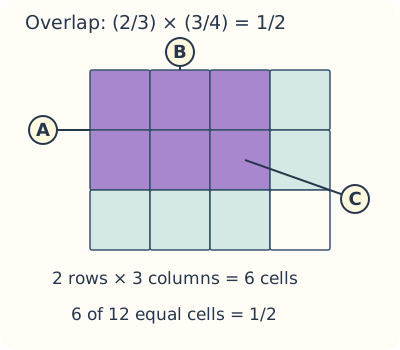
For B,D nonzero, (A/B)(C/D)=AC/(BD). Unlike addition, multiplication does not require a common denominator. For (3/4)(8/9), cancel complete common factors 3 with 9 and 8 with 4, obtaining 2/3. The original grid shows 2/3 of 3/4 of one whole: six of twelve cells, or one half. It is an area model of a product, not the sum of the two fractions.
Pre-cancellation reduces arithmetic without changing the product
In [6a²b/(5c)] × [10c/(9ab)], cancel whole factors across the product to get 4a/3, for a,b,c nonzero. A factor in a numerator may cancel a nonzero factor in either denominator because the entire expression is one product. It cannot be cancelled across an addition sign unless the whole sum factors first.
Polynomial products need factorisation before cancellation
For [(x²−9)/(x²−5x+6)] × [(x−2)/(x+3)], factor to [(x−3)(x+3)/((x−2)(x−3))] × [(x−2)/(x+3)]. It reduces to 1, but the original restrictions x≠2,3,−3 remain. A constant final result is not permission to use a formerly forbidden input.
Three fractions follow the same product rule
The product (yz/x²)(zx/y²)(xy/z²) is x²y²z²/(x²y²z²)=1, for xyz≠0. A fourth or later factor follows the same rule. Keep exponents until the full factor count is clear. A zero numerator makes a product zero when every denominator is defined; multiplication does not require every numerator to be nonzero.
A reciprocal reverses a nonzero fraction
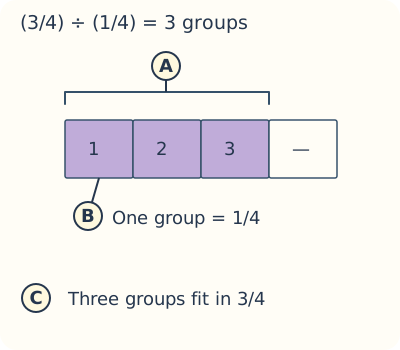
The reciprocal of C/D is D/C, requiring both D≠0 for the original fraction and C≠0 to reverse it. Division A/B ÷ C/D means A/B × D/C. In the grouping bar, 3/4 contains three groups of size 1/4, so (3/4)÷(1/4)=3. Dividing by a fraction can increase a positive result; it is not the same operation as multiplying by that fraction.
Division adds a nonzero-divisor restriction
For [(x²−1)/(x−2)] ÷ [(x−1)/(x+3)], exclude x=2 and −3 for the original denominators, and x=1 because it makes the divisor zero. Factor and reverse the second fraction to get (x+1)(x+3)/(x−2), on that original domain. x=−1 is allowed: the dividend is zero while the divisor is defined and nonzero.
A compound divisor is reversed as a whole
For (1+1/x) ÷ (1−1/x²), first write (x+1)/x and (x²−1)/x². Reverse the whole second fraction, then factor x²−1. The result is x/(x−1), with x≠0,1,−1. Do not reverse only the last term 1/x², and do not restore x=−1 simply because it cancels.
Use cube factors and verify the chosen operation
For [(a²−b²)/(a²+ab+b²)] ÷ [(a+b)/(a³−b³)], reverse the divisor and use a³−b³=(a−b)(a²+ab+b²). The result is (a−b)² on the original domain: a²+ab+b²≠0, a³−b³≠0, a+b≠0. Multiplying the same two fractions gives a different expression. Write the operation before cancelling and check a permitted pair such as a=5,b=2.
Worked example
For [(x²−1)/(x−2)] ÷ [(x−1)/(x+3)], first exclude x=2,−3,1. Multiply (x−1)(x+1)/(x−2) by (x+3)/(x−1). The result is (x+1)(x+3)/(x−2) on that original domain. At x=4, the original 15/2 ÷ 3/7 gives 17.5, agreeing with 5×7/2.
Record every original nonzero denominator and, for division, the nonzero divisor. Identify the operation and factor complete expressions.
Show a common denominator for addition/subtraction or a reciprocal for division. Cancel only complete common factors and preserve brackets.
Check a permitted numerical input and retain the original exclusions. Compare full written reasoning with the model; the automatic checker handles only the requested finite answer.
Multiplication allows a zero numerator
A defined zero factor makes a product zero. A divisor must be nonzero; these are different rules.
Reciprocal does not remove earlier restrictions
The reverse fraction may look defined at an input where the original divisor was not. Preserve the original conditions.
Product and quotient have different conditions
In these rules B and D are originally nonzero.
Product and quotient have different conditions
Operation
Rule
Additional condition
Multiply
(A/B)(C/D)=AC/(BD)
C may be zero
Divide
(A/B)÷(C/D)=AD/(BC)
C must be nonzero
Reciprocal
1/(C/D)=D/C
Both C and D nonzero
A zero numerator is allowed for a multiplier but not for a divisor. At C=0 the original division is undefined even if later factors look cancellable.
Keep an explicit restriction ledger
Example: [(x²−1)/(x−2)] ÷ [(x−1)/(x+3)].
Keep an explicit restriction ledger
Original part
Forbidden value
Why
Dividend denominator x−2
2
Original fraction undefined
Divisor denominator x+3
−3
Original divisor undefined
Divisor numerator x−1
1
Division by a zero fraction
The value x=−1 is allowed: the dividend is zero, while the divisor is defined and nonzero. Do not forbid every numerator root.
Polynomial product: factor all pieces
Multiplication can cancel complete factors across the product.
Combine the second over x²; it vanishes when x=±1.
Reverse that entire fraction and factor x²−1.
At x=3, (4/3)÷(8/9)=3/2.
Keep x=−1 excluded even though x+1 cancels. Reversing just the last term is invalid.
Explore the mathematical figures
Match each letter to its explanation. Read the quantities, units and relationships, then check the counts or equations. These are original teaching models.
The overlap models a product of fractions
Count the overlap, not all cells selected by either condition. Compute (2/3)(3/4)=6/12=1/2.
A · Two thirds
Two of three equal rows are selected.
B · Three quarters
Three of four equal columns are selected.
C · Product overlap
6/12 = 1/2 of the whole is selected by both.
Original exact-area unit rectangle. Positive numerical fractions illustrate multiplication; signed algebra is justified by its rules, not negative physical areas.
Explore the mathematical figures
Match each letter to its explanation. Read the quantities, units and relationships, then check the counts or equations. These are original teaching models.
Count groups of a quarter within three quarters
Compare with multiplication by the reciprocal, (3/4)×4=3. A zero-sized divisor cannot supply a meaningful group count.
A · Available amount
Three shaded quarters make 3/4 of the whole.
B · Group size
Each group has size 1/4.
C · Quotient
Exactly three such groups fit: (3/4)÷(1/4)=3.
Original exact equal-part bar. It models positive numerical measurement division; the algebraic quotient rule carries its stated nonzero conditions.
Your written practice
Show your working on paper. Check your answer, then choose Next.
Show model answer and explanation
2
24/36 = 2/3.
Show model answer and explanation
3
The x factors cancel and 6/2 = 3.
Show model answer and explanation
8
The product reduces to 4a/3, giving 8.
Show model answer and explanation
4
Numerator powers give x⁵ divided by x, leaving x⁴.
Show model answer and explanation
3
The combined y denominator power is 5, reduced by numerator power 2.
Show model answer and explanation
1
All factors cancel at this permitted input.
Show model answer and explanation
1
Each variable appears twice in both numerator and denominator.
Show model answer and explanation
0
A numerator is zero while both denominators are nonzero.
Show model answer and explanation
5
The reciprocal reverses numerator and denominator.
Show model answer and explanation
1.5
Multiply x/3 by 9/(2x): the result is 3/2 = 1.5.
Show model answer and explanation
1
The quotient is 45x³/(8ay²) = 360/360 = 1.
Show model answer and explanation
4
Its numerator vanishes at 4, while the denominator there is nonzero.
Show model answer and explanation
3
Exclude 2 and −3 for denominators, and 1 for the zero divisor.
Show model answer and explanation
1.5
The reduced expression is x/(x−1), giving 3/2.
Show model answer and explanation
9
The expression reduces to (a−b)² = 9.
Write in your own words. A guardian or teacher should review this response.
Show model answer and explanation
Divide one whole into 3 rows and 4 columns. Select two rows and three columns; their overlap is 6 of 12 equal cells, hence 1/2.
Show equal cell areas and distinguish the overlap product from an addition.
Write in your own words. A guardian or teacher should review this response.
Show model answer and explanation
4a/3, requiring a,b,c≠0. Coefficients reduce 60/45 to 4/3; b,c and one a factor cancel.
Retain variables excluded by either original denominator.
Write in your own words. A guardian or teacher should review this response.
Show model answer and explanation
1 for x≠2,3,−3. Factor the quadratic denominator as (x−2)(x−3), then cancel complete factors.
A final 1 must still carry all original exclusions.
Write in your own words. A guardian or teacher should review this response.
Show model answer and explanation
1/(x²+xy+y²), on x³+y³≠0 and x³−y³≠0. Use both cube factorizations and x²−y²=(x−y)(x+y).
Keep the original domain rather than only the final quadratic restriction.
Write in your own words. A guardian or teacher should review this response.
Show model answer and explanation
The numerator and denominator are both x²y²z²; cancellation is allowed for x,y,z≠0.
Count every exponent and explain why a zero variable is forbidden.
Write in your own words. A guardian or teacher should review this response.
Show model answer and explanation
(x−2)²(x+4)/[(x−3)²(x+3)], with x≠1,3,4,−3. Factor all six quadratics and cancel complete factors. x=2 is allowed and gives zero.
Track restrictions from original denominators before cancelling; numerator roots are not automatically exclusions.
Write in your own words. A guardian or teacher should review this response.
Show model answer and explanation
There are three quarter-sized groups in three quarters. Algebra gives (3/4)×4=3. The divisor 1/4 is nonzero.
The grouping picture and reciprocal calculation must agree.
Write in your own words. A guardian or teacher should review this response.
Show model answer and explanation
45x³/(8ay²), requiring a,x,y≠0. Reverse the whole second fraction to 15x/(4y²).
Include the zero-divisor condition y≠0 as well as original denominators.
Write in your own words. A guardian or teacher should review this response.
Show model answer and explanation
(x+1)(x+3)/(x−2), with x≠2,−3,1. The extra exclusion 1 makes the divisor zero; −1 is allowed.
Distinguish zero dividend from zero divisor.
Write in your own words. A guardian or teacher should review this response.
Show model answer and explanation
(x²+3x+9)(x+6)/[(x−1)(x+3)], with x≠1,6,−6,3,−3. Reverse the second fraction, factor all pieces, and retain the divisor-zero roots ±3.
Original and zero-divisor restrictions both belong in the final answer.
Write in your own words. A guardian or teacher should review this response.
Show model answer and explanation
(x²+xy+y²)/(x²−xy+y²), requiring x³+y³≠0, x+y≠0 and x²−y²≠0. The last condition makes the divisor nonzero.
Use the cube identities and retain the cancelled x−y restriction.
Write in your own words. A guardian or teacher should review this response.
Show model answer and explanation
x/(x−1), for x≠0,1,−1. Write the two bracketed fractions separately before reversing the divisor.
Do not invert only one term inside the divisor.
Write in your own words. A guardian or teacher should review this response.
Show model answer and explanation
(a−b)², requiring a²+ab+b²≠0, a³−b³≠0 and a+b≠0. The reciprocal turns the cube difference into numerator factors.
Show every factor and the nonzero numerator of the original divisor.
Write in your own words. A guardian or teacher should review this response.
Show model answer and explanation
The product is 8/15. The quotient is (2/3)(5/4)=5/6. Multiplication uses 4/5 directly; division uses its reciprocal.
A numerical countercheck should show these are different operations.
Write in your own words. A guardian or teacher should review this response.
Show model answer and explanation
The simplified form is (x+3)/(x+2), but x≠−2,−3,1. At 1 the original divisor is zero, so the original division is undefined.
Explain why the divisor condition survives cancellation.
Progress and browser storage
Notebook challenge, sources and further study
Your algebraic-fraction notebook
Create a multiplication/division notebook with one numeric grid, one polynomial product and two quotients.
Review with a guardian or teacher
Write the operation before cancelling and reverse the whole divisor only for division.
Record original denominator restrictions and any extra zero-divisor restriction.
Check a permitted value and a forbidden value; explain rather than evaluating division by zero.
Keep your work on paper or in a local file. This page does not upload it or automatically grade the project.
Chapter companion and further study
This original Kidemy practice follows the topic order of 2026 Class 8 Mathematics · English Version, chapter 5, printed pages 77–100. It does not replace the complete chapter or its practical teaching.
Fresh tasks map the chapter methods rather than reproduce every printed question. Keep full working and review source exercises and alternative equivalent forms with a guardian or teacher.
A cancelled denominator remains excluded. A divisor must also be nonzero. Later Class 8 chapters remain in preparation.
Teacher-led lessons, schedules and prices for this outline are upcoming. You can use any starter practice above now without booking.
Your next step
Solo practice works without an account. Sign in to save a practice record to your learner profile.
Keep practising
Exact lesson links and related activities are labelled separately. Return-to-course links retain your selected learning path.