2026 Class 8 Mathematics · English Version · Chapter 6 · Chapter companion part
Chapter 6A: Shared solutions and substitution
Explain a simultaneous solution, substitute a complete expression and check both original equations, including reciprocal substitutions.
About this lesson and its coverage
Class 8 English Version: part A of the chapter 6 companion. Eight teaching sections, 30 written tasks and a notebook challenge. Selected companion coverage, not complete textbook coverage; use all four parts. Numeric checks cover only the requested value; full equations, graphs, conditions and explanations need guardian or teacher review.
A linear equation in x and y has the form ax + by = c, with fixed coefficients a,b not both zero. Each variable has first power and there is no product xy. One equation such as x + y = 9 admits many real ordered pairs. A simultaneous solution must satisfy every equation with the same x and y. The order matters: (6,3) means x=6 and y=3, not the other way round.
A candidate is checked twice
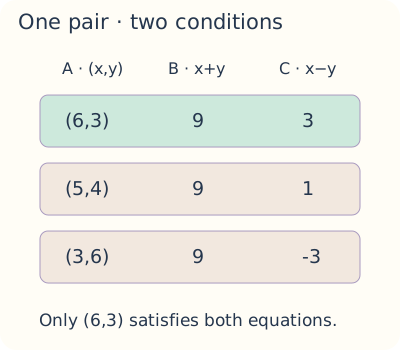
For x + y = 9 and x − y = 3, the pair (6,3) gives 9 and 3, so it satisfies both. The pair (5,4) gives the first total but difference 1, so it is not a simultaneous solution. Calculate the left-hand side of each original equation separately. Finding any pair on one line does not finish the problem.
Express one variable, then replace it
Substitution means replacing a variable by an equal complete expression. From x − y = 3 obtain x = y + 3. In x + y = 9 replace x, giving (y + 3) + y = 9. Thus 2y = 6, y = 3 and x = 6. Substituting back into only the rearranged equation is not a full verification; use both original equations.
A coefficient multiplies the whole replacement
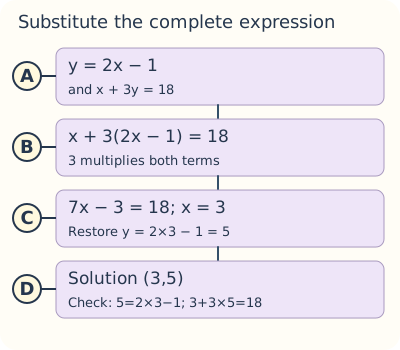
If y = 2x − 1 and x + 3y = 18, write x + 3(2x − 1) = 18. Distribution gives 7x − 3 = 18, so x = 3 and y = 5. The expression 3(2x − 1) is 6x − 3, not 6x − 1. Brackets preserve the quantity being replaced and prevent a sign or multiplier from disappearing.
Clear fixed denominators on every term
For x/2 + y/3 = 4, multiply every term by 6 to obtain 3x + 2y = 24. Combine it with x − y = 3: substitute x = y + 3 to obtain 5y + 9 = 24, so y = 3 and x = 6. Multiplying only the fractions and leaving the right-hand side at 4 would create a different equation. A fixed nonzero multiplier keeps the solutions unchanged.
Reciprocal variables must be reversed at the end
For 2/x + 3/y = 2 and 4/x − 3/y = 1, require x,y nonzero. Set u = 1/x and v = 1/y. Then 2u + 3v = 2 and 4u − 3v = 1. Their sum gives u = 1/2; then v = 1/3, so x = 2 and y = 3. Do not report u and v as x and y. If a transformed solution has u=0, no finite nonzero x can have reciprocal zero.
Check the source arithmetic, too
On printed page 102 the source goes from 2y = 4 to a line saying y = 7 − 3, then states y = 2. The valid step is y = 4/2 = 2; 7 − 3 equals 4. On printed pages 103–104, example 3 asks 2y + 5z = 16 and y − 2z = 1, but its solution uses −1 in the second equation. As stated, z = 14/9 and y = 37/9. The changed −1 system gives z = 2 and y = 3. Keep these different systems separate.
Choose the easy replacement and explain it
Choose an equation where a variable already has coefficient 1 or −1 when possible. Isolate it by doing the same operation on both sides, substitute into the other equation, solve and restore the second variable. Fractions in a valid answer are allowed. A method is justified by preserving equality, not by a rule that a term magically jumps across the sign.
Worked example
For x=3y+2 and 2x+y=18, replace the whole x by (3y+2): 6y+4+y=18, so y=2,x=8. Both original equations hold.
Define the variables, their order and units. Translate both conditions without changing their signs.
Show substitution, scaled elimination or two labelled graphs. Retain nonzero denominators and any parameter conditions.
Check the same pair in both original equations and in the story. A matched single number does not assess all written reasoning.
One number versus a pair
An automatic check may ask only for x or y. Your written answer still needs the complete pair and both original checks.
Fractions are legitimate
The solution of a linear system need not be integral. Keep exact fractions until a task explicitly asks for a rounded graph reading.
One pair, two separate checks
The equations are x+y=9 and x−y=3. A shared solution must pass both.
One pair, two separate checks
Candidate (x,y)
x+y
x−y
Shared solution?
(6,3)
9
3
Yes
(5,4)
9
1
No: difference fails
(3,6)
9
−3
No: coordinate order matters
Matching a single equation is not sufficient. Negative or fractional coordinates may be valid in other systems.
Substitute a complete expression
From y=2x−1, replace every y in x+3y=18.
x + 3(2x−1) = 18
7x−3 = 18
x = 3; y = 5
x,y
The same two unknowns in both equations.
3(2x−1)
Three times the entire replacement for y.
Distribute to get 6x−3, not 6x−1.
Add 3 to both sides and divide by 7.
Restore y=2×3−1=5.
Check 3+3×5=18 and 5=2×3−1.
The numeric checker asks for a specified value. These written steps and both checks remain part of the task.
A transformed zero reciprocal does not represent a finite original variable.
Printed source discrepancy: two systems
Example 3 changes a sign between printed 103 and 104; the original question and altered solution cannot be mixed.
Printed source discrepancy: two systems
Version
Equations
(y,z)
Check of second equation
Stated question
2y+5z=16; y−2z=1
(37/9,14/9)
37/9−28/9=1
Changed solution
2y+5z=16; y−2z=−1
(3,2)
3−4=−1
The source page 102 arithmetic line y=7−3 also does not follow from 2y=4. The correct division is y=4/2=2.
Explore the mathematical figures
Match each letter to its explanation. Read the quantities, units and relationships, then check the counts or equations. These are original teaching models.
One pair must satisfy both conditions
Read a whole row. A sum match alone does not establish a simultaneous solution.
A · Pair order
The first coordinate is x and the second is y.
B · First equation
All three displayed pairs have sum 9.
C · Second equation
Only (6,3) has difference 3.
Original reasoning table; cell widths do not represent numerical magnitudes.
Explore the mathematical figures
Match each letter to its explanation. Read the quantities, units and relationships, then check the counts or equations. These are original teaching models.
Replace the entire expression
Trace the equality-preserving route, explaining the bracket before collecting terms.
A · Equal replacement
Every y is replaced by the same expression 2x−1.
B · Brackets
The multiplier 3 applies to both terms.
C · Restore
x=3 gives y=5.
D · Check
The same pair (3,5) satisfies both original equations.
Original symbolic guide; arrows show reasoning order, not forces or a measured scale.
Your written practice
Show your working on paper. Check your answer, then choose Next.
Show model answer and explanation
2
The distinct variables are x and y; 4,7,20 are fixed numbers.
Show model answer and explanation
9
6+3=9; the difference condition must be checked separately.
Show model answer and explanation
1
5−4=1, so this pair fails the condition x−y=3.
Show model answer and explanation
6
Substitute x=y+3: 2y+3=9 gives y=3, x=6.
Show model answer and explanation
3
The same solution pair is (6,3), checked in both originals.
Show model answer and explanation
-3
Three multiplies −1 as well as 2x.
Show model answer and explanation
3
7x−3=18 gives x=3; then y=5.
Show model answer and explanation
5
At x=3, y=6−1=5; 3+3×5=18.
Show model answer and explanation
24
The multiplier applies to every term, including 4.
Show model answer and explanation
3
3(y+3)+2y=24 gives 5y=15.
Show model answer and explanation
2
Adding gives 6/x=3, hence x=2; all original denominators are nonzero.
Show model answer and explanation
3
With x=2, 1+3/y=2 gives y=3.
Show model answer and explanation
2
Divide both sides by the coefficient 2; the answer is y=2.
Show model answer and explanation
14
y=2z+1 gives 9z+2=16, hence z=14/9.
Show model answer and explanation
2
y=2z−1 gives 9z−2=16, so z=2 and y=3.
Write in your own words. A guardian or teacher should review this response.
Show model answer and explanation
For x+y=9, choose any real x and set y=9−x. For example (0,9), (6,3) and (10,−1) all work. A second independent condition may select one of them.
Give at least two pairs and explain how they arise.
Write in your own words. A guardian or teacher should review this response.
Show model answer and explanation
Both give sum 9, but their differences are 3 and −3 respectively. Only (6,3) satisfies both conditions in the stated order.
Check both left-hand sides for each pair.
Write in your own words. A guardian or teacher should review this response.
Show model answer and explanation
x=y+4, so 2y+4=12, y=4 and x=8. Verify 8+4=12 and 8−4=4.
Show the replacement and both final checks.
Write in your own words. A guardian or teacher should review this response.
Show model answer and explanation
2(3y+2)+y=18 gives 7y=14. Thus y=2,x=8; 2×8+2=18.
The coefficient must multiply both terms in brackets.
Write in your own words. A guardian or teacher should review this response.
Show model answer and explanation
The correct expansion is 10−2y. Two multiplies every term inside the bracket; at y=1 the original is 8, agreeing with 10−2 but not 10−1.
Give a structural reason and a numerical check.
Write in your own words. A guardian or teacher should review this response.
Show model answer and explanation
x=y. Multiply the first equation by 6: 2x+3y=30. Thus 5x=30, x=y=6. Each original is satisfied.
Preserve the right-hand side when clearing denominators.
Write in your own words. A guardian or teacher should review this response.
Show model answer and explanation
Set u=1/x,v=1/y with x,y≠0. Add to get 2u=1, u=1/2; then v=1/4. Hence x=2,y=4. Verify the original fractions.
Restore the reciprocals; do not report (1/2,1/4) as (x,y).
Write in your own words. A guardian or teacher should review this response.
Show model answer and explanation
For a finite real nonzero x, 1/x cannot equal zero. Multiplying by x would give 1=0. Reject this transformed value as outside the reciprocal substitution.
Explain the domain rather than dividing by zero.
Write in your own words. A guardian or teacher should review this response.
Show model answer and explanation
Add to get 2x/a=2/a, so x=1. Subtract to obtain 2y/b=2/b, so y=1. Require a,b nonzero and verify both original equations.
State which quantities are fixed parameters and keep their restrictions.
Write in your own words. A guardian or teacher should review this response.
Show model answer and explanation
The intermediate printed y=7−3 would equal 4 and does not follow from 2y=4. Divide by 2 to obtain y=2; keep the correction beside the source wording.
Distinguish the wrong intermediate step from the correct final value.
Write in your own words. A guardian or teacher should review this response.
Show model answer and explanation
Substitute y=2z+1 into 2y+5z=16: 9z=14, so z=14/9,y=37/9. The pair (3,2) has y−2z=−1, not 1; it solves the changed system.
Check both versions explicitly; do not silently replace a sign.
Write in your own words. A guardian or teacher should review this response.
Show model answer and explanation
Use y=19−4x. Then x−2(19−4x)=−2 gives 9x=36, x=4 and y=3. Check 16+3=19 and 4−6=−2.
A different valid replacement is acceptable with correct working.
Write in your own words. A guardian or teacher should review this response.
Show model answer and explanation
Find y from an original equation, state the ordered pair in the defined order, and substitute that pair into both originals. A single x-coordinate does not itself establish a simultaneous solution.
Use a complete pair and both checks in an example.
Write in your own words. A guardian or teacher should review this response.
Show model answer and explanation
The product xy is not ax+by with fixed coefficients; the coefficient of x would depend on y. First powers written separately are not sufficient when variables multiply each other.
Contrast it with a valid linear example, such as 2x+3y=6.
Write in your own words. A guardian or teacher should review this response.
Show model answer and explanation
One choice is x+y=3 and 2x−y=−9. Adding gives 3x=−6, x=−2 and y=5. Many other independently constraining pairs are valid.
Check the same pair in both equations and explain whether the solution is unique.
Progress and browser storage
Notebook challenge, sources and further study
Your simultaneous-equation notebook
Make a two-condition solution card and a reciprocal-substitution card.
Review with a guardian or teacher
Define coordinate order and all nonzero restrictions.
Show each equality-preserving step, including brackets.
Verify the full pair and annotate one printed source discrepancy.
Keep your work on paper or in a local file. This page does not upload it or automatically grade the project.
Chapter companion and further study
This original Kidemy practice follows the topic order of 2026 Class 8 Mathematics · English Version, chapter 6, printed pages 101–120. It does not replace the complete chapter or its practical teaching.
Complete independent source exercises and have full working and drawings reviewed. These fresh tasks teach the mapped methods rather than reproduce each printed question.
Keep original denominator restrictions and investigate a zero elimination coefficient before dividing. Original companions for all 11 chapter headings are available; independent source exercises and full working still need review.
Teacher-led lessons, schedules and prices for this outline are upcoming. You can use any starter practice above now without booking.
Your next step
Solo practice works without an account. Sign in to save a practice record to your learner profile.
Keep practising
Exact lesson links and related activities are labelled separately. Return-to-course links retain your selected learning path.