2026 Class 8 Mathematics · English Version · Chapter 3 · Chapter companion part
Chapter 3C: Volume, capacity, density and water levels
Model cubes and tanks, convert cubic units and litres, use stated densities and explain displacement stage by stage.
About this lesson and its coverage
Class 8 English Version: part C of the Measurement companion. Eight sections, 30 written tasks and a notebook challenge. Selected companion coverage, not complete textbook coverage. Use all four parts for the mapped chapter methods; these fresh tasks do not reproduce every printed question. Drawings and explanations need guardian or teacher review.
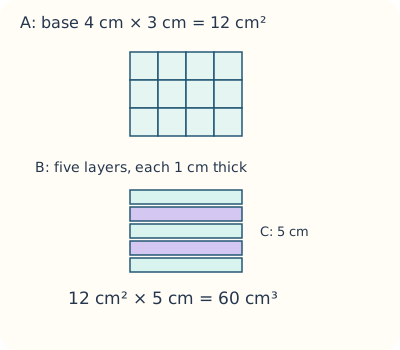
A rectangular cuboid with internal length l, breadth b and height h has volume V = lbh. A 4 cm by 3 cm base contains 12 unit squares; five one-centimetre layers make 60 unit cubes, or 60 cm³. A cube of side s has volume s³ and total outside surface area 6s². Surface area and volume answer different questions.
Cube the conversion factor
One metre is 100 cm, so 1 m³ = 100³ = 1000000 cm³. One dm³ = 1000 cm³ = 1 L; 1 cm³ = 1 mL. Thus 1 m³ = 1000 L. A cubic international foot is 0.3048³ m³ = 28.316846592 L. Printed page 38 gives 28.67 L; this is not a valid rounding of the correct value.
Use internal tank dimensions and capacity
A tank’s outside dimensions include its walls. Capacity uses the space inside. For internal dimensions 2 m by 1.5 m by 0.8 m, V = 2.4 m³ = 2400 L. If the water occupies 1.2 m³ over a 2 m by 1.5 m base, depth is V/(lb) = 0.4 m. State whether full or partial filling is meant.
Density links mass to volume
Density ρ means mass per unit volume, so mass m = ρV. With a stated model density of 7.5 g/cm³ and bar dimensions 8 cm by 5 cm by 2 cm, volume is 80 cm³ and mass is 600 g. This does not prove every sample of iron has exactly that density. Convert volume and density to compatible units before multiplying.
Water and air values are stated models
The chapter uses approximately 1 g/cm³ or 1000 kg/m³ for water, so a specified water volume of 2.4 m³ gives about 2400 kg in that model. Actual density depends on conditions. A supplied air density of 1.29 kg/m³ gives 77.4 kg for 60 m³. The source’s phrase 0.00129 times heavier than water means a density ratio of 0.00129, not that air is heavier than water.
A submerged solid occupies space
A non-absorbing solid fully submerged in a vertical-sided tank displaces water equal to its submerged volume. In a 20 cm by 10 cm base tank, adding 400 cm³ below the surface raises the level by 400/200 = 2 cm if there is room and no spill. A floating object or a partly submerged object needs different information; use the submerged volume, not automatically the whole object volume.
Distinguish adding, overflowing and removing
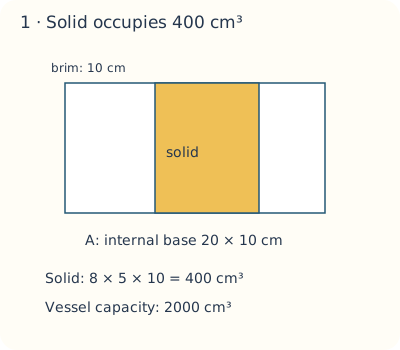
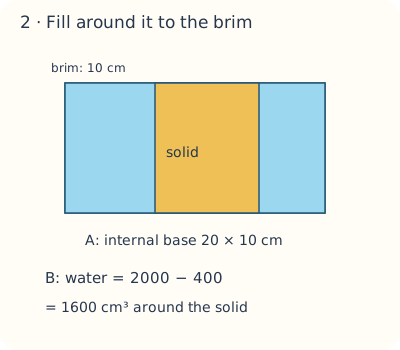
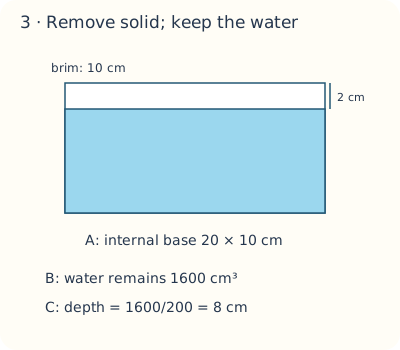
For the controlled example, a vessel has internal base 20 × 10 cm and height 10 cm. An 8 × 5 × 10 cm solid rests fully inside it. Fill to the brim around the solid: water volume is 2000 − 400 = 1600 cm³. Remove the solid without adding water: the remaining 1600 cm³ has depth 8 cm. A completely full vessel would spill 400 cm³ when this solid is submerged; removal would not recover the spilled water.
Read scale resolution and sheet thickness
Read a graduated vessel at eye level and name its smallest division; estimation error is the difference from the reference reading, which also has limits. For a book with 100 physical sheets each 0.1 mm thick, paper thickness is 10 mm = 1 cm, excluding covers and compression. Printed page 46 says 200 pages and gives thickness per page: a page can mean one side of a sheet, so a physical leaf count or an explicit convention is needed. Our finite versions name sheets.
Worked example
A vessel’s base is 30 cm by 20 cm and its internal height is 15 cm, giving 9000 cm³. A fully submerged 1200 cm³ solid is inside when water reaches the brim. After removal, water volume is 7800 cm³ and depth is 7800/600 = 13 cm; the level falls by 2 cm.
Name the quantity and required unit. Draw and label the dimensions; identify given assumptions.
Convert all dimensions to compatible units before substituting. Show why the formula applies.
Check arithmetic, units and the physical meaning. Use the model answer to correct your written working.
Motion has a teaching purpose
Use Previous/Next or optional Play for displacement. All labelled static stages stay readable, reduced motion disables timed playback, and hiding Learn pauses it.
Use supplied densities as assumptions
The book’s water and air ratios are school models. We do not infer a real sample’s density, purity or identity from its drawn shape.
A printed page is not always a physical sheet
Exercise 3(19) names 200 pages and a thickness of 0.1 mm per page. If it means 200 physical paper layers, thickness is 20 mm = 2 cm and volume is 25 × 18 × 2 = 900 cm³. If 200 printed sides mean 100 sheets, each sheet 0.1 mm thick, volume is 450 cm³. The key uses 450. Ask which thickness convention is intended, ignore covers only when stated, and accept a clearly explained interpretation.
Air occupies volume; its mass needs a density
The room in Exercise 3(22) is 15 × 10 × 4 = 600 m³ internally. With the supplied air-to-water density ratio 0.00129 and school water density 1000 kg/m³, air density is 1.29 kg/m³. Model air mass is 600 × 1.29 = 774 kg, ignoring furniture and people. The 1 m floor margin changes the stone-covered floor, not the volume of air in the whole room.
Cubic units and capacity
Three perpendicular lengths determine volume.
Cubic units and capacity
Relation
Exact volume/capacity value
Reason
1 dm³
1000 cm³ = 1 L
10 × 10 × 10 cm³
1 m³
1000000 cm³ = 1000 L
100 × 100 × 100 cm³
1 cm³
1 mL
Capacity definition
1 in³
16.387064 cm³ = 16.387064 mL
2.54³
1 ft³
28.316846592 L
0.3048³ × 1000
1 m³
about 35.3147 ft³
Rounded reciprocal
10 m³
about 13.0795 yd³
Rounded reciprocal of 0.9144³
The source’s old stayor means m³ and decastayor means 10 m³. Prefer modern m³ symbols. A cubic-foot value of 28.67 L on printed 38 is incorrect.
Volume, surface and an unknown tank depth
All lengths must refer to the intended inside space or outside solid.
Cuboid V = lbh
Cube V = s³; total surface S = 6s²
Tank depth h = V/(lb)
Mass m = ρV
V / S
Volume / total surface area, with different units.
l / b / h / s
Length / breadth / height / cube side.
ρ
Density, mass per unit volume; read rho.
m
Mass, not the metre symbol in this equation.
A 4 × 3 × 5 cm cuboid has V = 60 cm³.
A 4 cm cube has V = 64 cm³ and S = 96 cm².
A 1.2 m³ water volume on a 3 m² base has h = 0.4 m.
At stated density 7.5 g/cm³, an 80 cm³ bar has mass 600 g.
Real water density is not defined to be exactly 1 kg/L. A task using 1000 kg/m³ must label it as its school approximation.
The solid leaves; the water stays
Original vertical-sided vessel: internal base 20 × 10 cm, height 10 cm. The fully submerged solid is 8 × 5 × 10 cm. No water is added during removal.
All stages: readable static alternative
1 · The solid takes 400 cm³: Vessel capacity is 2000 cm³. Place the 400 cm³ solid inside; it occupies some of that space.
2 · Fill around the solid to the brim: Water occupies 2000 − 400 = 1600 cm³. Solid and water together reach the 10 cm brim.
3 · Remove the solid, keep the water: Water remains 1600 cm³ over a 200 cm² base. Depth is 8 cm; the 2 cm fall corresponds to the removed 400 cm³.
These are labelled side-projection schematics, not volume-scaled photographs. Read breadth from the labels. Play is optional; all static stages and step controls remain, reduced motion disables playback, and changing lesson mode pauses it.
Level change uses base area
Assume a fully submerged non-absorbing solid, a vertical-sided vessel and no unmentioned refill.
No-spill level rise = submerged volume / base area
Water at brim = vessel capacity − submerged solid volume
Depth after removal = water volume / base area
base area
Internal horizontal length × breadth, in cm² here.
submerged volume
Volume below the water surface, in cm³.
Vessel base is 20 × 10 = 200 cm²; capacity is 200 × 10 = 2000 cm³.
Solid volume is 8 × 5 × 10 = 400 cm³.
Water at the brim around it is 2000 − 400 = 1600 cm³.
After removal, depth is 1600/200 = 8 cm.
If the vessel starts full, inserting the solid spills water. Removal does not put that spill back. Floating and partly submerged bodies require different information.
Explore the mathematical figures
Match each letter to its explanation. Read the quantities, units and relationships, then check the counts or equations. These are original teaching models.
Base area becomes volume through layers
Explain how a square-unit base is multiplied by a length to give cube units. A cube uses the same length in all three directions.
A · One base
4 cm × 3 cm = 12 cm².
B · Five layers
Each 1 cm thickness adds 12 unit cubes.
C · Whole cuboid
12 cm² × 5 cm = 60 cm³.
Original exact-count grid and schematic layer stack. The stack uses separated bands for readability; gaps are not extra empty volume.
Explore the mathematical figures
Match each letter to its explanation. Read the quantities, units and relationships, then check the counts or equations. These are original teaching models.
Remove the solid without replacing its volume
Compare the controlled stages. State the difference between the solid’s volume and the water volume, then use base area to recover the level.
A · Internal base
20 × 10 = 200 cm².
B · Same water
Water at the brim around the solid was 2000 − 400 = 1600 cm³; removal does not add water.
C · New depth
1600/200 = 8 cm, a fall of 2 cm.
Original side-projection schematic. The vessel’s breadth is stated by a label; coloured side-view area does not itself measure cubic volume. Assumes a non-absorbing fully submerged solid and no refill.
Your written practice
Show your working on paper. Check your answer, then choose Next.
Show model answer and explanation
60
4 × 3 × 5 = 60 cm³.
Show model answer and explanation
64
4³ = 64 cm³.
Show model answer and explanation
96
6 × 4² = 96 cm².
Show model answer and explanation
25000
0.025 × 1000000 = 25000 cm³.
Show model answer and explanation
2.4
2400/1000 = 2.4 m³.
Show model answer and explanation
375
1 cm³ = 1 mL, so 375 mL.
Show model answer and explanation
2400
2 × 1.5 × 0.8 = 2.4 m³ = 2400 L.
Show model answer and explanation
0.4
1.2/(2 × 1.5) = 0.4 m.
Show model answer and explanation
600
Volume = 80 cm³; mass = 80 × 7.5 = 600 g.
Show model answer and explanation
2400
2.4 × 1000 = 2400 kg under the stated approximation.
Show model answer and explanation
77.4
60 × 1.29 = 77.4 kg under the given model.
Show model answer and explanation
2
400/(20 × 10) = 2 cm.
Show model answer and explanation
1600
2000 − 400 = 1600 cm³ of water.
Show model answer and explanation
8
1600/(20 × 10) = 8 cm.
Show model answer and explanation
1
100 × 0.1 = 10 mm = 1 cm.
Write in your own words. A guardian or teacher should review this response.
Show model answer and explanation
The pictured 4 × 3 base gives 12 unit cubes per centimetre of height and five layers give 60 cm³. For the fresh mixed-unit box, convert to 5.2 × 4.5 × 3 cm; volume is 70.2 cm³.
Label three perpendicular dimensions, distinguish layer area from volume, and convert all millimetre components before multiplying.
Write in your own words. A guardian or teacher should review this response.
Show model answer and explanation
Six faces each have area 16 cm², giving total 96 cm². Volume is 4³ = 64 cm³. Surface covering and internal space have different units.
The cube’s 16 cm² is one face, not total surface area.
Write in your own words. A guardian or teacher should review this response.
Show model answer and explanation
1 m³ = 1000000 cm³. Since 1 L = 1000 cm³ and 1 mL = 1 cm³, 1 m³ = 1000 L = 1000000 mL.
Show the cubic factor and both capacity links.
Write in your own words. A guardian or teacher should review this response.
Show model answer and explanation
1 ft = 0.3048 m, so 1 ft³ = 0.3048³ m³ = 0.028316846592 m³ = 28.316846592 L, about 28.32 L. The printed 28.67 is not this rounded result.
Cube the full factor; do not multiply 0.3048 only once.
Write in your own words. A guardian or teacher should review this response.
Show model answer and explanation
7200 L = 7.2 m³; 7.2/3.6 = 2 m. Alternatively use 7200000 cm³ over 240 × 150 = 36000 cm² to get 200 cm.
Both methods must agree and use internal dimensions.
Write in your own words. A guardian or teacher should review this response.
Show model answer and explanation
V = 24 cm³; mass = 24 × 19.3 = 463.2 g. Density is a stated classroom condition, not a measured material identification.
Require compatible units and keep density separate from volume.
Write in your own words. A guardian or teacher should review this response.
Show model answer and explanation
Litre is volume and kilogram is mass. The water approximation 1 kg/L gives a useful school calculation, but actual mass depends on substance and density conditions; oil and air cannot use that factor without justification.
Mention density rather than treating all liquids identically.
Write in your own words. A guardian or teacher should review this response.
Show model answer and explanation
Room volume = 60 m³. Model mass = 60 × 1.29 = 77.4 kg, neglecting occupied space. Actual density can change with temperature, pressure and humidity.
State the given model and what volume was assumed.
Write in your own words. A guardian or teacher should review this response.
Show model answer and explanation
An 8 × 5 × 10 cm solid occupies 400 cm³ in a 2000 cm³ vessel. At the brim, water is 1600 cm³. Removing the solid leaves the same water volume over a 200 cm² base, at depth 8 cm.
Distinguish total capacity, solid volume, water volume and water depth.
Write in your own words. A guardian or teacher should review this response.
Show model answer and explanation
For a non-absorbing solid, spilled volume equals its submerged volume. After removal the vessel has less water and its level is lower. Removing the solid does not return the spilled water.
State full submersion and no refill; a floating object is a different case.
Write in your own words. A guardian or teacher should review this response.
Show model answer and explanation
Cube volume = 0.5³ = 0.125 m³. Reservoir capacity is 6 m³, so water is 5.875 m³. Remaining depth = 5.875/6 = 47/48 m, about 0.97917 m.
Convert 50 cm to 0.5 m before cubing and retain exact values until final rounding.
Write in your own words. A guardian or teacher should review this response.
Show model answer and explanation
Paper thickness = 9.6 mm = 0.96 cm. Volume = 24 × 15 × 0.96 = 345.6 cm³.
Use sheet count, not printed page sides, and state the simplified compression assumption.
Write in your own words. A guardian or teacher should review this response.
Show model answer and explanation
If each physical sheet is 0.1 mm, 200 printed pages often correspond to 100 sheets and 10 mm. If 200 physical layers are explicitly intended, the thickness is 20 mm. Covers and compression are additional assumptions.
Accept conditional results only with clearly stated interpretations.
Write in your own words. A guardian or teacher should review this response.
Show model answer and explanation
Estimate the mL count, take a reference reading at eye level, record scale divisions and compare the readings. Report whether the estimate was high or low. Avoid glass breakage, electrical items and entering a tank.
An actual reading has uncertainty; do not label it exact simply because it was measured.
Write in your own words. A guardian or teacher should review this response.
Show model answer and explanation
The book uses stayor for a cubic metre and decastayor for ten cubic metres, related to the older name stere. Use m³ and 10 m³ in modern notation; the older name does not create a new volume formula.
Read the source vocabulary while retaining standard modern unit symbols.
Progress and browser storage
Notebook challenge, sources and further study
Your measurement notebook
Make a labelled cuboid model and a paper drawing of a three-stage water displacement experiment.
Review with a guardian or teacher
Define internal dimensions, cube units and capacity conversions.
Separate volume, density, mass and water depth, with units in each equation.
State full submersion, spill/refill timing and any approximation; review written explanations.
Keep your work on paper or in a local file. This page does not upload it or automatically grade the project.
Chapter companion and further study
This original Kidemy practice follows the topic order of 2026 Class 8 Mathematics · English Version, chapter 3, printed pages 29–47. It does not replace the complete chapter or its practical teaching.
Compare the companion methods with the source exercises and have full written solutions reviewed. Local land factors are stated classroom conventions, not a property-survey service.
Some source questions omit conditions or use rounded factors. Our finite-answer tasks state the needed assumptions. Later Class 8 mathematics chapters remain in preparation.
Teacher-led lessons, schedules and prices for this outline are upcoming. You can use any starter practice above now without booking.
Your next step
Solo practice works without an account. Sign in to save a practice record to your learner profile.
Keep practising
Exact lesson links and related activities are labelled separately. Return-to-course links retain your selected learning path.