2026 Class 8 Mathematics · English Version · Chapter 8 · Chapter companion part
Chapter 8B: Proofs, converses and midpoint challenges
Write valid congruence proofs and distinguish a theorem from its converse; justify midpoint, perpendicular-foot and angle-bisector applications.
About this lesson and its coverage
Class 8 English Version: part B of the chapter 8 companion. Eight teaching sections, 30 written tasks and a notebook challenge. Selected companion coverage, not complete textbook coverage; use all five parts. Independent proofs, compass work, drawings and nets require guardian or teacher review.
A proof starts with the givens and the desired conclusion. State a construction such as joining AC, then write each equality with its reason. Congruent triangles have matching vertices in matching order. ASA means two angles and their included side; SAS means two sides and their included angle; SSS means all three sides. Never cite a rule whose required data have not been established.
Prove the opposite-side theorem
In parallelogram ABCD, join AC. AB∥CD gives angle BAC= DCA; BC∥AD gives BCA= DAC; AC is common. Thus triangles BAC and DCA are congruent by ASA. Hence AB=CD and BC=DA. Matching remaining angles gives B=D; the split equalities at A, C also give A=C. The diagonal therefore divides the figure into two congruent triangles.
Prove bisection and its converse
Let diagonals meet at O. In triangles AOB and COD, opposite sides AB=CD and alternate angles at A, C and B, D give ASA congruence, so AO=OC, BO=OD. Conversely, if both diagonals bisect, triangles AOB, COD have equal half-side pairs and equal vertical angle: SAS. Matching alternate angles prove AB∥CD. A second triangle pair proves AD∥BC. Do not assume parallelism in the converse.
Prove rectangle diagonals with SAS
For rectangle ABCD compare triangles ABD and DCA: AB=DC, AD=DA, and included angles BAD=CDA=90°. SAS gives BD=CA. Mutual bisection follows because a rectangle is a parallelogram. Printed source page 137 labels this side-angle-side step ASA and mismatches triangle order; the applicable rule is SAS with correspondence ABD↔DCA.
Prove right-angle diagonals of a rhombus
In rhombus ABCD, diagonals bisect at O. Triangles AOB and COB have AB=CB, AO=CO and BO common, so SSS makes AOB=COB. These adjacent angles on straight AC add to 180°, hence each is 90°. A square inherits both rhombus and rectangle properties. Conversely, mutual bisection first gives a parallelogram; perpendicular diagonals give a rhombus and equal diagonals give a rectangle, together a square.
Use midpoint structure without guessing shape
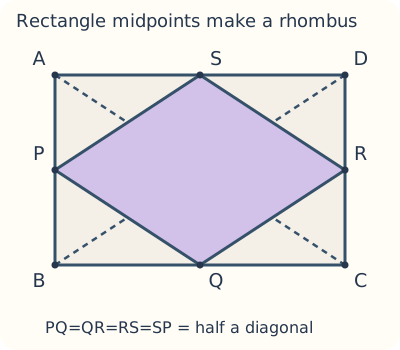
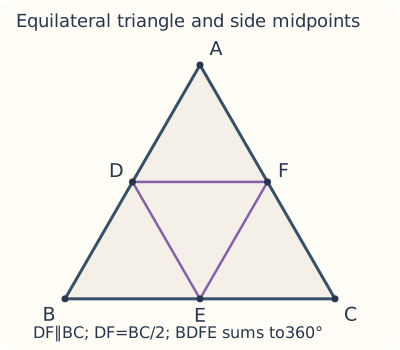
Join consecutive side midpoints of a rectangle. By the triangle midpoint theorem, each small segment is parallel to a rectangle diagonal and half its length. Equal rectangle diagonals make all four small sides equal, so the midpoint figure is a rhombus. In an equilateral triangle, joining midpoints gives segments parallel to the third sides and half their lengths; each smaller triangle has the corresponding 60° angles.
Perpendicular feet inherit central symmetry
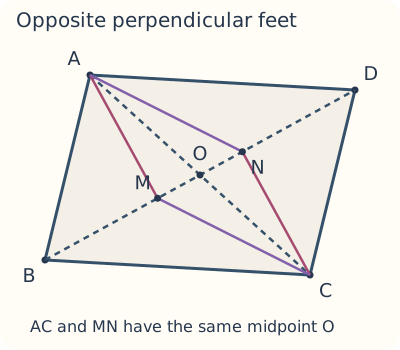
For a parallelogram let O be its diagonal crossing. A half-turn about O maps A to C and B to D. Orthogonal projection onto line BD then maps the foot M from A to the foot N from C. Thus M, N have midpoint O, as do A, C; the diagonals of AMCN bisect, so it is a parallelogram when nondegenerate. If a perpendicular diagonal makes both feet coincide at O, the proposed four-vertex figure degenerates; state this exception.
Use sufficient conditions and read labels carefully
One opposite side pair that is both equal and parallel suffices: a diagonal gives SAS, then equal alternate angles establish the other parallel pair. A parallelogram with equal diagonals is a rectangle: compare triangles ABC and BAD by SSS, giving adjacent equal supplementary angles and hence 90°. With equal adjacent sides it is a rhombus. Printed page 143 question 17 calls BACD the vertex order while naming AC, BD diagonals; use explicit cyclic ABCD for the intended argument and record the naming inconsistency.
Worked example
For rectangle ABCD, triangles ABD and DCA match A↔D, B↔C, D↔A. The known two sides and included right angle establish SAS, so BD=CA. Correct correspondence is part of the proof.
Name the figure in cyclic vertex order and state every given length, angle and assumption.
Draw a labelled model; give a reason for each proof, area calculation or construction step. Check that the data can form the required figure.
Verify the original conditions, units and vertex order. Numeric checks assess the requested value only; proofs, nets and constructions need guardian or teacher review.
A proof label was corrected
Printed page 137 uses ASA beside a two-side/included-angle argument. The companion uses SAS and matching triangle order.
A foot can collapse
If the two perpendicular feet coincide, four distinct vertices do not exist. Such a special case is explained instead of marked as a valid parallelogram.
Rectangle diagonal proof with the correct correspondence
Compare triangle ABD with triangle DCA.
Rectangle diagonal proof with the correct correspondence
Statement
Reason
AB=DC
Opposite rectangle sides
AD=DA
Common side
BAD=CDA=90°
Rectangle right angles
ABD≅DCA
SAS: included angle between the two known sides
BD=CA
Corresponding sides
The source labels this step ASA. Its supplied data justify SAS; triangle order must match A↔D, B↔C, D↔A.
Useful converses need their full premises
A converse starts with the old conclusion and must be proved independently.
Useful converses need their full premises
Given in a simple nondegenerate quadrilateral
Conclusion
Reason route
Both diagonals bisect
Parallelogram
SAS on half-diagonal triangles
One opposite side pair both equal and parallel
Parallelogram
SAS across one diagonal
Parallelogram and equal diagonals
Rectangle
SSS gives equal supplementary adjacent angles
Parallelogram and perpendicular diagonals
Rhombus
SAS on right half-triangles gives adjacent sides equal
Equal perpendicular diagonals with mutual bisection
Square
Rectangle and rhombus together
Equal diagonals alone and perpendicular diagonals alone are not sufficient. Degenerate four-point arrangements are excluded.
Explore the mathematical figures
Match each letter to its explanation. Read the quantities, units and relationships, then check the counts or equations. These are original teaching models.
Consecutive rectangle midpoints form a rhombus
Each new side is half one rectangle diagonal. Equal parent diagonals give four equal new sides.
A
A is an outer rectangle vertex.
B
B is the next rectangle vertex along AB.
C
C is opposite A.
D
D is opposite B.
P
P is the midpoint of AB.
Q
Q is the midpoint of BC.
R
R is the midpoint of CD.
S
S is the midpoint of DA; PQRS is a rhombus.
Original labelled mathematical model, not copied source artwork. Verify stated conditions rather than judging shape from appearance.
Explore the mathematical figures
Match each letter to its explanation. Read the quantities, units and relationships, then check the counts or equations. These are original teaching models.
Midpoint segments in an equilateral triangle
DF is parallel to BC and half its length. The quadrilateral BDFE has angles60°,120°,120°,60°.
A
A is the top vertex of the equilateral triangle.
B
B is a base endpoint.
C
C is the other base endpoint.
D
D is midpoint of AB.
E
E is midpoint of BC.
F
F is midpoint of CA; DF is half and parallel to BC.
Original labelled mathematical model, not copied source artwork. Verify stated conditions rather than judging shape from appearance.
Explore the mathematical figures
Match each letter to its explanation. Read the quantities, units and relationships, then check the counts or equations. These are original teaching models.
Perpendicular feet share the diagonal midpoint
The half-turn about O exchanges A, C and M, N. Thus AC and MN bisect; exclude coincident feet.
A
A projects to M on BD.
B
B is one end of diagonal BD.
C
C projects to N on BD.
D
D is the other end of BD.
M
M is the perpendicular foot from A.
N
N is the perpendicular foot from C.
O
O is midpoint of AC, BD and MN; AMCN is nondegenerate in this model.
Original labelled mathematical model, not copied source artwork. Verify stated conditions rather than judging shape from appearance.
Your written practice
Show your working on paper. Check your answer, then choose Next.
Show model answer and explanation
3
SSS means side-side-side.
Show model answer and explanation
8
Opposite sides AB, CD are equal.
Show model answer and explanation
5
BC=DA.
Show model answer and explanation
6
Mutual bisection gives equal halves.
Show model answer and explanation
9
Each half is 18/2.
Show model answer and explanation
17
SAS proves the diagonal lengths equal.
Show model answer and explanation
90
Equal adjacent angles on a straight line each equal 180/2.
Show model answer and explanation
5
Each midpoint segment is half a rectangle diagonal.
Show model answer and explanation
20
Four midpoint sides of 5 cm give 20.
Show model answer and explanation
6
The midpoint theorem gives half the third side.
Show model answer and explanation
6
3−(−3)=6; O is their midpoint.
Show model answer and explanation
90
The equal-diagonal converse makes it a rectangle.
Show model answer and explanation
4
The conditions make a square.
Show model answer and explanation
70
180−42−68=70; state the triangle angle-sum reason.
Show model answer and explanation
107
They sum to 180°.
Write in your own words. A guardian or teacher should review this response.
Show model answer and explanation
AB∥CD and BC∥AD give two pairs of alternate angles about AC. The shared AC is their included side. ASA proves triangles BAC≅DCA with the correct correspondence.
Write both angle equalities and the common-side reason.
Write in your own words. A guardian or teacher should review this response.
Show model answer and explanation
With O their crossing, AB=CD and alternate angles BAO=DCO, ABO=CDO give triangles ABO≅CDO by ASA. Matching sides yield AO=CO and BO=DO.
First establish the opposite-side equality; do not assume bisection.
Write in your own words. A guardian or teacher should review this response.
Show model answer and explanation
AO=CO, BO=DO and vertical angles give AOB≅COD by SAS, so corresponding alternate angles imply AB∥CD. Similarly AOD≅COB gives AD∥CB.
Use two pairs and name SAS; no parallel premise may be assumed.
Write in your own words. A guardian or teacher should review this response.
Show model answer and explanation
AB=DC, AD=DA, included BAD=CDA=90°. Hence ABD≅DCA by SAS and BD=CA. The source ASA label is corrected.
Match triangle vertices and show the included angle.
Write in your own words. A guardian or teacher should review this response.
Show model answer and explanation
Bisection gives AO=CO. AB=CB and BO common give AOB≅COB by SSS. Equal angles AOB, COB are supplementary, so each is 90°.
Both equality and straight-line sum are needed.
Write in your own words. A guardian or teacher should review this response.
Show model answer and explanation
Bisection gives a parallelogram by the converse. Equal diagonals give a rectangle. The perpendicular-bisection triangles have equal corresponding adjacent sides, making a rhombus. A figure both rectangle and rhombus is a square.
Explain each implication; perpendicularity alone does not suffice.
Write in your own words. A guardian or teacher should review this response.
Show model answer and explanation
The triangle midpoint theorem makes two midpoint segments half AC and the other two half BD. A rectangle has AC=BD, so all four new sides are equal. Their parallelism also follows from the midpoint theorem.
Identify the parent triangles and all four new sides.
Write in your own words. A guardian or teacher should review this response.
Show model answer and explanation
The midpoint theorem in ABC gives DF∥BC and DF=BC/2. B, D, F, E form a simple quadrilateral, so their interior-angle sum is 360°. In this equilateral setting the angles are 60°,120°,120°,60°.
Keep the new cyclic order B, D, F, E explicit.
Write in your own words. A guardian or teacher should review this response.
Show model answer and explanation
Half-turn symmetry about O sends A↔C and the line BD to itself, so M↔N and both diagonals AC, MN have midpoint O. Their bisection proves AMCN a parallelogram if the four vertices are distinct. If AC⊥BD, M=N=O and the construction degenerates.
Include the exception rather than claiming a four-vertex figure always exists.
Write in your own words. A guardian or teacher should review this response.
Show model answer and explanation
If AB=CD and AB∥CD, join AC. Alternate BAC=DCA, shared AC and AB=CD give BAC≅DCA by SAS. Matching BCA=DAC proves BC∥AD; both opposite pairs are parallel.
Use the same pair for both the equal and parallel premises.
Write in your own words. A guardian or teacher should review this response.
Show model answer and explanation
In ABC and BAD, AB is common, BC=AD and AC=BD. SSS gives ABC=BAD. These adjacent parallelogram angles sum to 180°, so each is 90° and the figure is a rectangle.
The equality premise alone for an arbitrary quadrilateral would fail.
Write in your own words. A guardian or teacher should review this response.
Show model answer and explanation
Because BO is a median, AO=OC. Given BO=OD, both diagonals AC and BD bisect at O. Apply the proved converse.
A median is defined by the midpoint of the opposite side, not by perpendicularity.
Write in your own words. A guardian or teacher should review this response.
Show model answer and explanation
Equal adjacent sides together with equal opposite sides make all four equal, hence a rhombus. Its diagonals meet at 90° by the SSS and supplementary-angle proof.
Do not assume equal diagonals for a nonsquare rhombus.
Write in your own words. A guardian or teacher should review this response.
Show model answer and explanation
In cyclic BACD, AC and BD would be sides. Use intended cyclic ABCD explicitly. A+B=180° gives AD∥BC by the converse of the same-side interior-angle rule; B+C=180° similarly gives AB∥CD. Thus ABCD is a parallelogram and AB=CD, AD=BC. Unequal diagonals do not prevent this.
State the naming correction, prove both parallel pairs from the supplied angle sums, and only then apply the opposite-side theorem.
Write in your own words. A guardian or teacher should review this response.
Show model answer and explanation
Opposite interior bisectors have the same direction, so AB∥CD; BC lies on CQ and AD on PA, which are parallel. Thus ABCD is a parallelogram when nondegenerate. No right-angle condition was supplied.
Record where B, D lie and exclude a collapsed segment.
Progress and browser storage
Notebook challenge, sources and further study
Your quadrilateral geometry notebook
Write three two-column proofs and one corrected counterexample.
Review with a guardian or teacher
Separate givens, construction and conclusion.
Match triangle vertices before citing congruence.
State degeneracy and terminology exceptions.
Keep your work on paper or in a local file. This page does not upload it or automatically grade the project.
Chapter companion and further study
This original Kidemy practice follows the topic order of 2026 Class 8 Mathematics · English Version, chapter 8, printed pages 133–151. It does not replace the complete chapter or its practical teaching.
Compare these original method-based tasks with the independent source exercises. This companion does not reproduce every printed question.
Verify drawings with instruments and review full proof reasons. Original companions for all 11 chapter headings are available; independent source exercises and full working still need review.
Teacher-led lessons, schedules and prices for this outline are upcoming. You can use any starter practice above now without booking.
Your next step
Solo practice works without an account. Sign in to save a practice record to your learner profile.
Keep practising
Exact lesson links and related activities are labelled separately. Return-to-course links retain your selected learning path.