2026 Class 8 Mathematics · English Version · Chapter 6 · Chapter companion part
Chapter 6C: Build equations from real situations
Translate numbers, transfers, ages, digits, fractions, rectangles and prices into two equations, then interpret and verify the result.
About this lesson and its coverage
Class 8 English Version: part C of the chapter 6 companion. Eight teaching sections, 30 written tasks and a notebook challenge. Selected companion coverage, not complete textbook coverage; use all four parts. Numeric checks cover only the requested value; full equations, graphs, conditions and explanations need guardian or teacher review.
If two numbers total 84 and the larger exceeds the smaller by 18, let x be the larger and y the smaller. Write x+y=84 and x−y=18. Adding gives x=51, then y=33. Twice a number means 2x; twice the same number and three times that same number still use one variable, giving 5x, not a new independent variable.
A ratio and a total are two different conditions
For two shares in the ratio 3:2 with total Tk 250, use x=3k,y=2k and 5k=250. Thus k=50 and the shares are Tk 150,Tk 100. Equivalently use x+y=250 and 2x=3y. For a ratio of ages, compare the ages at the same time. A ratio is not a difference in years or taka.
Transfers change both owners and preserve the total
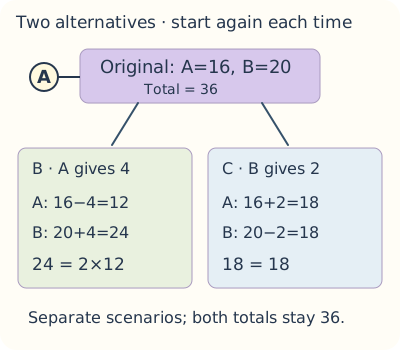
Let A and B start with x and y counters. If A gives 4 to B, the new counts are x−4 and y+4. The condition B then has twice A becomes y+4=2(x−4). In a separate alternative where B gives 2 to A, equal counts give x+2=y−2. Solving gives x=16,y=20. These are separate scenarios from the same starting counts, not two transfers performed in sequence.
Shift both ages by the same number of years
Let present ages be F and C. Five years ago a 3:1 ratio means F−5=3(C−5); fifteen years from now a 2:1 ratio means F+15=2(C+15). Solve to obtain C=25,F=65. Their difference stays 40 years; their ratio changes. Past ages in a stated ratio must be meaningful and its denominator nonzero.
Place value and reversal need digit restrictions
If a is the tens digit and b the units digit, the number is 10a+b, with 1≤a≤9 and 0≤b≤9. Its reversed numeric value is 10b+a. A difference of 27 gives a−b=3. If the digit sum is 11 and the tens digit is larger, a=7,b=4 and the number is 74. Without specifying which digit is larger, an absolute digit difference can permit reversed answers; the source exercise 6.2(11) needs that distinction.
Changing a numerator is not scaling the fraction
Let n/d be a written fraction. If adding 8 to its numerator gives 2 and subtracting 2 from its denominator gives 1, write (n+8)/d=2 and n/(d−2)=1, with d≠0,2. These imply n−2d=−8 and n−d=−2, so d=6,n=4. The requested written fraction is 4/6. Its value is 2/3, but changing the numerator of 2/3 by 8 is a different operation.
Perimeter counts each side twice
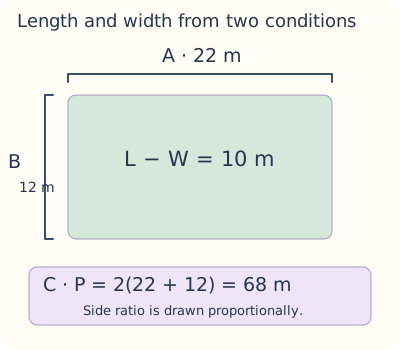
For a rectangle of perimeter 68 m whose length is 10 m greater than width, write 2L+2W=68 and L−W=10. Thus L+W=34, L=22 m,W=12 m. Check 2(22+12)=68. For a second condition L=1.5W or L=2W+5, translate that full relationship; perimeter is not area.
Two baskets can reveal two unit prices
Suppose 3 notebooks and 2 pencils cost Tk 76, while 2 notebooks and 5 pencils cost Tk 69. Let n,p be the unit prices in taka: 3n+2p=76 and 2n+5p=69. Eliminate to find n=22,p=5. Verify both basket totals. A price is not a basket total, and count constraints may exclude an algebraic result that is negative or not a whole number.
Worked example
For the two basket equations, 5(3n+2p)=380 and 2(2n+5p)=138. Subtraction yields n=22; substitution yields p=5. The checks concern fictional unit prices in taka.
Define the variables, their order and units. Translate both conditions without changing their signs.
Show substitution, scaled elimination or two labelled graphs. Retain nonzero denominators and any parameter conditions.
Check the same pair in both original equations and in the story. A matched single number does not assess all written reasoning.
Source wording can be incomplete
A digit difference without naming its direction can describe reversed numbers. Preserve and explain that ambiguity rather than inventing an unstated condition.
Representation matters
A fraction value can have many equivalent forms. An instruction to change its numerator or denominator needs the original written terms.
Translate the original situation
Keep definitions, time and units consistent.
Translate the original situation
Situation
First condition
Second condition
Total 84, difference 18
x+y=84
x−y=18, x≥y
Tk 250, ratio 3:2
x+y=250
2x=3y
Rectangle P=68 m, extra length 10 m
2L+2W=68
L−W=10
Three notebooks/two pencils; two/five
3n+2p=76
2n+5p=69
These are invented classroom quantities, not real prices or measurements. Each situation is solved using its own two unknowns.
Counter transfers are alternative scenarios
Both scenarios start from x counters for A and y for B.
A gives 4: y+4=2(x−4)
B gives 2: x+2=y−2
y=x+4; x=16; y=20
x,y
Original starting counts, not counts after the first scenario.
x−4,y+4
Equal transfer out of A and into B.
Use the equal-count scenario to get y=x+4.
Substitute in y+4=2x−8.
Solve x+8=2x−8, so x=16,y=20.
Check (12,24) and, separately, (18,18); each totals 36.
Performing the two alternatives successively changes the story and creates the wrong equations.
The age difference stays 40 years; the ratio does not stay fixed.
Written fraction versus reduced value
Changes apply to the original numerator n and denominator d.
Written fraction versus reduced value
Condition/check
Original n=4,d=6
Reduced terms n=2,d=3
Original value
4/6=2/3
2/3
Add 8 to numerator
12/6=2
10/3≠2
Subtract 2 from denominator
4/4=1
2/1≠1
Equal fraction values do not make their written terms interchangeable in a problem that changes those terms. Original d must avoid 0 and 2.
Explore the mathematical figures
Match each letter to its explanation. Read the quantities, units and relationships, then check the counts or equations. These are original teaching models.
Two alternatives start from the same counts
The diagram branches. It does not show the second transfer happening after the first.
A · Start
Use the original x=16,y=20 for each alternative.
B · A gives four
A loses four; B gains four. B then has twice A.
C · B gives two
A gains two; B loses two. Their counts become equal.
Original counter-count model. Cards organise values rather than represent areas or actual possessions.
Explore the mathematical figures
Match each letter to its explanation. Read the quantities, units and relationships, then check the counts or equations. These are original teaching models.
Two dimensions from perimeter and difference
The shape’s displayed side ratio is 22:12. Use labelled lengths, not screen pixels, for the calculation.
A · Length
L=22 m.
B · Width
W=12 m, so L−W=10 m.
C · Both conditions
2(L+W)=68 m and the difference is 10 m.
Original proportional rectangle, not a surveyed site. Metre labels give the mathematical dimensions.
Your written practice
Show your working on paper. Check your answer, then choose Next.
Show model answer and explanation
51
Adding x+y=84 and x−y=18 gives 2x=102.
Show model answer and explanation
33
84−51=33, and 51−33=18.
Show model answer and explanation
150
Five equal ratio parts give Tk 50 each; three parts are Tk 150.
Show model answer and explanation
60
Six parts total 360, so one part is 60.
Show model answer and explanation
16
The second gives y=x+4; substitute into the first to obtain x=16.
Show model answer and explanation
20
y=x+4=20; the original total is 36.
Show model answer and explanation
25
F−3C=−10 and F−2C=15 give C=25.
Show model answer and explanation
65
F=2×25+15=65; past ages 60,20 have ratio 3:1.
Show model answer and explanation
74
a+b=11 and a−b=3 give a=7,b=4.
Show model answer and explanation
3
Divide by 9; a and b are digits in their defined places.
Show model answer and explanation
6
Subtract n−2d=−8 from n−d=−2 to get d=6.
Show model answer and explanation
4
n=d−2=4. Verify 12/6=2 and 4/4=1.
Show model answer and explanation
12
L+W=34 and L−W=10 give 2W=24.
Show model answer and explanation
22
Five times the first minus twice the second gives 11n=242. This is one notebook’s price, not a basket total.
Show model answer and explanation
5
3×22+2p=76 gives p=5; 44+25=69.
Write in your own words. A guardian or teacher should review this response.
Show model answer and explanation
Let x,y be the first and second numbers. Use 3x+2y=34,2x−y=4. Then y=2x−4; 7x=42, x=6,y=8. Check 18+16=34 and 12−8=4.
Translate the order of subtraction explicitly.
Write in your own words. A guardian or teacher should review this response.
Show model answer and explanation
Let x,y be the shares. x+y=420 and 3x=4y give y=180,x=240. Both shares sum to 420 and their ratio reduces to 4:3.
Give units and verify both conditions.
Write in your own words. A guardian or teacher should review this response.
Show model answer and explanation
Starting at 16,20, the first alternative gives 12,24 and B has twice A. The second alternative gives 18,18. Each alternative preserves total 36 and starts from the original counts.
Do not apply the alternatives successively.
Write in your own words. A guardian or teacher should review this response.
Show model answer and explanation
F−5=3(C−5) gives F−3C=−10; F+15=2(C+15) gives F−2C=15. Hence C=25,F=65. Past ages 60,20 have ratio 3:1; future ages 80,40 have ratio 2:1.
Shift both people and check the same time in each ratio.
Write in your own words. A guardian or teacher should review this response.
Show model answer and explanation
Let F=4C and (F−4)+(C−4)=52. Then F+C=60, C=12,F=48. Four years ago the ages were 8 and 44, totalling 52.
Do not subtract four from the combined age only once.
Write in your own words. A guardian or teacher should review this response.
Show model answer and explanation
a=7,b=4, so the number is 74 and the reversed value 47. Their difference is 27=9×3.
Use 10a+b, not a+b, for the number itself.
Write in your own words. A guardian or teacher should review this response.
Show model answer and explanation
The digit values are 7 and 3, giving both 73 and 37 as two-digit numbers. Add a condition such as tens digit exceeds units digit to select 73. Source exercise 6.2(11) needs this ordering clarification.
Do not automatically mark one reversal wrong when both satisfy the wording.
Write in your own words. A guardian or teacher should review this response.
Show model answer and explanation
10a+b−18=10b+a gives a−b=2. Also a+b+7=3a gives 2a−b=7. Subtract to get a=5,b=3, number 53. Check 53−18=35 and 5+3+7=15.
State the place definitions and check the digit range.
Write in your own words. A guardian or teacher should review this response.
Show model answer and explanation
The original terms are n=4,d=6, so the written fraction is 4/6, with value 2/3. The operations attach to the original numerator and denominator. Applying +8 to the reduced numerator 2 gives 10/3, not 2.
Keep d≠0,2; distinguish a representation from its reduced value.
Write in your own words. A guardian or teacher should review this response.
Show model answer and explanation
n+d=16,d−n=6 give d=11,n=5. The proper fraction is 5/11; both original conditions hold.
Clarify which difference is positive instead of assuming n−d=6.
Write in your own words. A guardian or teacher should review this response.
Show model answer and explanation
L+W=50 and L=1.5W give 2.5W=50, W=20 m,L=30 m. The perimeter is 2(30+20)=100 m.
Differentiate dimensions, perimeter and area.
Write in your own words. A guardian or teacher should review this response.
Show model answer and explanation
L+W=50,L=2W+5. Thus 3W+5=50,W=15 m,L=35 m. Check perimeter 100 m and 35=2×15+5.
A labelled graph can also show the intersection (35,15).
Write in your own words. A guardian or teacher should review this response.
Show model answer and explanation
Multiply by 5 and 2: 15n+10p=380 and 4n+10p=138. Subtract: 11n=242, n=22,p=5. Verify 66+10=76 and 44+25=69.
The model prices are invented classroom values, not current market prices.
Write in your own words. A guardian or teacher should review this response.
Show model answer and explanation
Whole notebooks require non-negative integer counts. Recheck translation, quantities and arithmetic. If the equations were copied correctly and still give 2.5, the stated whole-item situation has no feasible solution as described.
Distinguish a mathematical solution from a feasible count.
Write in your own words. A guardian or teacher should review this response.
Show model answer and explanation
Both phrases name the same quantity t, so 3t+2t=85. Thus t=17. Writing independent x and y would discard the fact that the number is the same.
Translate identity of quantities, not just the number of phrases.
Progress and browser storage
Notebook challenge, sources and further study
Your simultaneous-equation notebook
Make four original two-condition stories: one transfer, one age, one digit and one dimension or basket problem.
Review with a guardian or teacher
Define every variable and unit before the equations.
Solve and verify both original verbal conditions.
Discuss restrictions, an ambiguity or a physically impossible result.
Keep your work on paper or in a local file. This page does not upload it or automatically grade the project.
Chapter companion and further study
This original Kidemy practice follows the topic order of 2026 Class 8 Mathematics · English Version, chapter 6, printed pages 101–120. It does not replace the complete chapter or its practical teaching.
Complete independent source exercises and have full working and drawings reviewed. These fresh tasks teach the mapped methods rather than reproduce each printed question.
Keep original denominator restrictions and investigate a zero elimination coefficient before dividing. Original companions for all 11 chapter headings are available; independent source exercises and full working still need review.
Teacher-led lessons, schedules and prices for this outline are upcoming. You can use any starter practice above now without booking.
Your next step
Solo practice works without an account. Sign in to save a practice record to your learner profile.
Keep practising
Exact lesson links and related activities are labelled separately. Return-to-course links retain your selected learning path.