2026 Class 8 Mathematics · English Version · Chapter 7 · Chapter companion part
Chapter 7C: Counts, remainders and applied set problems
Count overlapping groups without double counting, apply set rules to factors and remainders, and recognise when a question lacks enough information.
About this lesson and its coverage
Class 8 English Version: part C of the chapter 7 companion. Eight sections, 30 written tasks and a notebook challenge. Selected companion coverage, not complete textbook coverage; use all three parts. Counts are checked, while rosters, equivalent set-builder rules, diagrams and general proofs need guardian or teacher review.
For a finite set A, n(A) denotes the number of its distinct elements, sometimes called its cardinality. In two finite sets, n(A∪B)=n(A)+n(B)−n(A∩B), because adding the separate counts counts shared elements twice. For A with 18 members, B with 15 and 6 shared, the union has 27. This identity counts the elements in these named groups; it does not measure their ability or quality.
Only and neither are different regions
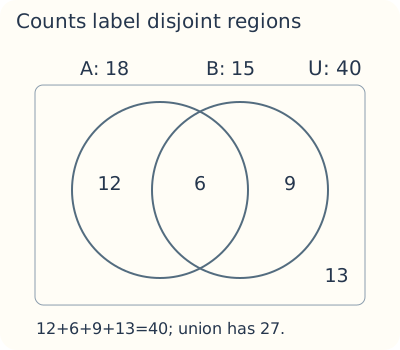
If U has 40 members, n(A)=18,n(B)=15 and n(A∩B)=6, A-only has 12, B-only 9, both 6 and neither 13. These four disjoint regions total 40. Exactly one means A-only or B-only, giving 21. At least one means the union, 27. Neither means outside both, not merely outside one chosen set.
Percentages need a stated population for actual counts
In an invented group of exactly 100 learners, 60% like activity A, 50% like B and 30% like both. That means 60,50 and 30 learners; 80 like at least one and 20 neither. In a group of 200 with those same proportions, the counts double. Source creative 6 gives percentages but no total: the actual student counts, and hence their factor sets, are not uniquely determined. Do not silently assume its population is 100.
Positive factors and prime factors supply different sets
The positive factors of 18 are {1,2,3,6,9,18}; its prime factors form {2,3}, with repeated prime occurrences still listed once. For 18 and 24, their common positive factors are {1,2,3,6}. Their largest common member is 6, the greatest common divisor. A union combines either number’s factors; an intersection selects factors dividing both.
A valid remainder must be smaller than the divisor
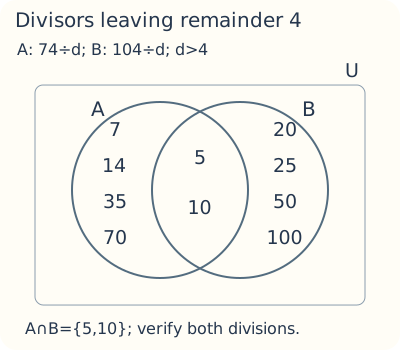
For positive N divided by a positive integer d with remainder r, write N=qd+r with 0≤r<d. Thus d divides N−r and d>r. For N=74,r=4, the valid divisors are {5,7,10,14,35,70}; factors 1,2 are excluded by the remainder bound. For N=104,r=4, the valid divisors are {5,10,20,25,50,100}. The shared divisors are {5,10}. Divisibility of N−r alone is not sufficient.
A squared condition may include negatives and zero
For integer x with x²<17, the set is {−4,−3,−2,−1,0,1,2,3,4}. If the domain were positive naturals, only 1,2,3,4 would remain. Within U={1,...,8}, x²−5x+6=0 factors as (x−2)(x−3)=0, so its solution set is {2,3}. A condition and a domain are both needed to determine a roster.
An unbounded multiple set does not acquire a last member
Let P be the positive multiples of 6 and Q the positive multiples of 8. Their union begins {6,8,12,16,18,24,...} and continues indefinitely; specify the rule rather than giving a finite list as the whole set. Their intersection is the positive multiples of 24. A bounded task, such as x≤48, instead has a finite count. Source short 8(d) gives no finite upper bound, so its union is infinite under the stated positive-multiple interpretation.
Read a complement of a complement literally
If a question asks for the complement of (B∪C)ᶜ, it asks for ((B∪C)ᶜ)ᶜ=B∪C inside one fixed U. This is how the wording of source creative 7(c) reads; taking only one complement gives the opposite region. For B={1,3,5},C={2,3,5}, the union is {1,2,3,5}; one complement depends on U, while a second restores that union. When a task is ambiguous or missing a total, state the problem and any explicitly chosen illustration before calculating.
Worked example
For a group of 40 with 18 in A,15 in B and 6 in both, the four disjoint regions are 12,9,6,13. Adding them gives the whole group, and adding 12+9+6 gives the union 27.
State the number domain or universal set, read the operation and identify each distinct element.
Build a roster, membership table or labelled Venn diagram. Keep overlap elements once and complements inside the stated universe.
Check every element or justify the membership rule. Automatic checks assess only the requested count/value; full sets, diagrams and proofs need review.
Schematic areas do not encode counts
Use the numbers and membership labels. A larger coloured region does not mean more learners unless a chart explicitly establishes an area scale.
A bounded sample is not the infinite set
Listing multiples through 48 answers that bounded question only; it does not finish an unbounded union.
Check every disjoint count region
U has 40 members, A has 18, B has 15 and 6 are in both.
Check every disjoint count region
Region
Calculation
Count
A only
18−6
12
Both
Given overlap
6
B only
15−6
9
Neither
40−(12+6+9)
13
The four disjoint region counts sum to 40. A-only plus both recovers A=18; B-only plus both recovers B=15.
Subtract the duplicated overlap once
For two finite sets, n(S) means the number of distinct members of S.
Read the source wording complement of an already complemented expression literally.
Do not silently give a single complement when the question names two. If wording is disputed, state both readings and their different results.
Explore the mathematical figures
Match each letter to its explanation. Read the quantities, units and relationships, then check the counts or equations. These are original teaching models.
Whole-circle counts include the overlap
Here the numbers label counts, not individual set elements. Add disjoint regions to check each total.
U
12+6+9+13=40 members in total.
A
12+6=18 members; do not put 18 in A-only.
B
6+9=15 members; union is 27 and neither is 13.
Original membership model, not copied source artwork. Circle areas and distances do not encode member counts. Read the labels and element rosters.
Explore the mathematical figures
Match each letter to its explanation. Read the quantities, units and relationships, then check the counts or equations. These are original teaching models.
Valid divisors must exceed the remainder
Verify a candidate using N=qd+4 with a remainder strictly smaller than d.
U
The displayed universe is the union of these two valid-divisor sets.
A
Every member divides 70 and exceeds 4.
B
Every member divides 100 and exceeds 4. The shared members are {5,10}.
Original membership model, not copied source artwork. Circle areas and distances do not encode member counts. Read the labels and element rosters.
Your written practice
Show your working on paper. Check your answer, then choose Next.
Show model answer and explanation
27
18+15−6=27; shared members were counted twice before subtraction.
Show model answer and explanation
12
18−6=12 excludes the shared region.
Show model answer and explanation
9
15−6=9.
Show model answer and explanation
13
The union has 27, so 40−27=13 are outside both.
Show model answer and explanation
21
A-only 12 plus B-only 9 gives 21; both are excluded.
Show model answer and explanation
20
The union has 60+50−30=80 learners; 20 of the 100 remain.
Show model answer and explanation
60
Thirty out of every hundred gives 0.30×200=60 learners.
Show model answer and explanation
2
The set is {2,3}; repeated powers do not add members.
Show model answer and explanation
4
They are {1,2,3,6}.
Show model answer and explanation
6
The divisors of 70 greater than 4 are 5,7,10,14,35,70.
Show model answer and explanation
2
The shared valid divisors are 5 and 10.
Show model answer and explanation
9
They are the nine integers from −4 through 4, including zero.
Show model answer and explanation
2
The roots 2 and 3 are both in the stated U.
Show model answer and explanation
12
There are 8 multiples of 6 and 6 of 8, with 2 common multiples of 24; 8+6−2=12.
Show model answer and explanation
4
The second complement returns B∪C={1,2,3,5}.
Write in your own words. A guardian or teacher should review this response.
Show model answer and explanation
Adding n(A) and n(B) counts each shared member twice but every A-only or B-only member once. Subtract n(A∩B) once to count every union member exactly once.
Identify what is counted twice and why it is subtracted once.
Write in your own words. A guardian or teacher should review this response.
Show model answer and explanation
A-only 12, B-only 9, both 6, neither 13. The A circle totals 12+6=18, B totals 9+6=15 and all regions total 40.
Do not place the full set counts in the exclusive regions.
Write in your own words. A guardian or teacher should review this response.
Show model answer and explanation
The counts are 30,20,30,20 respectively. They total 100; at least one is 80 and exactly one is 50. This is an invented group with a stated total.
Explain that each percent becomes that many learners only because the total is 100.
Write in your own words. A guardian or teacher should review this response.
Show model answer and explanation
A missing population total leaves the counts unknown. For the source proportions 65%,55%,40% both, only-one groups are 25% and 15%. At total 100 their counts are 25,15 with common factors {1,5}; at total 200 they are 50,30 with common factors {1,2,5,10}. Both populations fit the proportions but give different factor sets.
State the missing total and label examples as illustrations, not the source’s actual headcount.
Write in your own words. A guardian or teacher should review this response.
Show model answer and explanation
A={1,2,3,6,9,18}; B={1,2,3,4,6,8,12,24}. Their intersection is {1,2,3,6}; union is {1,2,3,4,6,8,9,12,18,24}.
Check every member and count duplicates once.
Write in your own words. A guardian or teacher should review this response.
Show model answer and explanation
Its positive factors are {1,2,3,4,6,8,12,24}. Its distinct prime factors are {2,3}, since 24=2³×3. One is a factor but not prime.
Do not list repeated 2s as separate set elements.
Write in your own words. A guardian or teacher should review this response.
Show model answer and explanation
d divides 74−4=70 and d>4. From {1,2,5,7,10,14,35,70}, retain {5,7,10,14,35,70}. For instance 74=14×5+4.
Enforce the strict remainder bound as well as divisibility.
Write in your own words. A guardian or teacher should review this response.
Show model answer and explanation
The valid sets are {5,7,10,14,35,70} and {5,10,20,25,50,100}. Their intersection is {5,10}; its subsets are ∅,{5},{10},{5,10}.
Verify each common divisor in both original divisions.
Write in your own words. A guardian or teacher should review this response.
Show model answer and explanation
A remainder must be smaller than its positive divisor. Four is not smaller than 2, and the actual division 74÷2 has remainder 0. Divisibility of N−r without d>r does not suffice.
Use the original division as well as the bound.
Write in your own words. A guardian or teacher should review this response.
Show model answer and explanation
Integers give {−4,−3,−2,−1,0,1,2,3,4}; positive naturals give {1,2,3,4}. The inequality is the same but the domains differ.
Include negative values and zero when the domain is all integers.
Write in your own words. A guardian or teacher should review this response.
Show model answer and explanation
Factor (x−2)(x−3)=0 to get A={2,3}. Its proper subsets are ∅,{2},{3}; the whole A is not proper.
Check both roots belong to U and distinguish the two uses of braces.
Write in your own words. A guardian or teacher should review this response.
Show model answer and explanation
Union is {x∈N:6 divides x or 8 divides x}; it begins 6,8,12,16,18,24,... and is infinite. Intersection is {24,48,72,...}, the positive multiples of their least common multiple 24.
A few listed elements need an ellipsis and an explicit continuing rule.
Write in your own words. A guardian or teacher should review this response.
Show model answer and explanation
B∪C={1,2,3,5}. One complement gives {4,6,7}; complementing that set returns {1,2,3,5}. Source creative 7(c) asks for the complement of an already complemented expression, so read both operations.
Do not silently turn two complements into a single complement.
Write in your own words. A guardian or teacher should review this response.
Show model answer and explanation
The overlap must be a subset of each circle. Seven shared members cannot fit within a B set of only five. The B-only formula would give −2, showing that the supplied counts are inconsistent.
Explain the impossible membership relation rather than reporting a negative group size.
Write in your own words. A guardian or teacher should review this response.
Show model answer and explanation
Specify positive integers or another domain, the divisor rules, an inclusive or exclusive upper/lower bound, and the operation. Without a finite bound, a positive-multiple union is infinite and should not be marked by a finite total.
Give one well-defined bounded task and one clearly unbounded rule.
Progress and browser storage
Notebook challenge, sources and further study
Your set-and-Venn notebook
Build a four-region count model and a common-remainder divisor investigation.
Review with a guardian or teacher
State population/domain, overlap and bounds before calculating.
Verify every region total and every claimed remainder in the originals.
Explain one missing-information case and use literal double complements.
Keep your work on paper or in a local file. This page does not upload it or automatically grade the project.
Chapter companion and further study
This original Kidemy practice follows the topic order of 2026 Class 8 Mathematics · English Version, chapter 7, printed pages 121–132. It does not replace the complete chapter or its practical teaching.
Use the independent source exercises and have full set notation, region placement and proofs reviewed. These fresh tasks map the source methods rather than reproduce all printed questions.
Keep the stated universe, number domain and inclusive/exclusive bounds. Do not infer actual student counts from percentages without a population total. Original companions for all 11 chapter headings are available; independent source exercises and full working still need review.
Teacher-led lessons, schedules and prices for this outline are upcoming. You can use any starter practice above now without booking.
Your next step
Solo practice works without an account. Sign in to save a practice record to your learner profile.
Keep practising
Exact lesson links and related activities are labelled separately. Return-to-course links retain your selected learning path.