2026 Class 7 Science · English Version · Chapter 2 · Chapter companion part
Chapter 2B: Tissues, movement and coordination
Connect specialised cells to tissue jobs and explain how several tissues cooperate in a plant or animal organ.
Class 7 English Version: part B of the companion for chapter 2, Cellular Organisation of Plants and Animals. Eight teaching sections, 30 written tasks and a notebook challenge. Selected companion coverage, not complete textbook coverage; practical and independent review remain.
In multicellular organisms, groups of cells and their surrounding material cooperate in tissues. A tissue can contain different specialised cell types. Several tissues combine in an organ; several organs cooperate in an organ system. Skin is an organ containing epithelial, connective, nervous and other tissues, not a single uniform tissue. The body’s division of labour means different structures contribute different jobs, rather than every cell doing every task identically.
Meristems make new plant cells
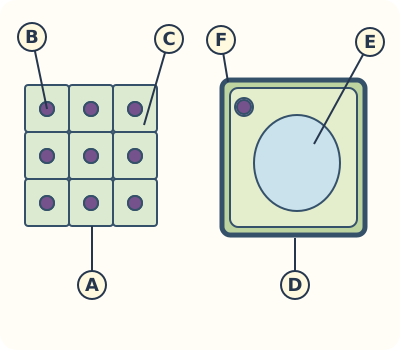
Meristematic tissues contain actively dividing cells in growing regions. Apical meristems near root and shoot tips contribute to length; lateral meristems contribute to girth. Young meristematic cells commonly have dense cytoplasm, prominent nuclei and small vacuoles rather than a large central vacuole. They still have cell walls and membranes. Do not turn the source multiple-choice option cell vacuole absent into a claim that no small vacuoles can occur.
Permanent plant tissues specialise
As cells differentiate, many stop actively dividing and become permanent tissues. Permanent is a useful school category, not a claim that no living plant cell can ever regain division. Parenchyma can store materials or photosynthesise; collenchyma provides flexible support; sclerenchyma provides stiff support through thick walls. Xylem conducts water and minerals, while phloem transports sugars and other organic materials from sources to sinks. These are complex vascular tissues. Secretory tissues produce or release substances such as nectar or resin. Not every permanent cell has the same thick wall.
Epithelial tissues cover and line
Epithelial cells form close sheets on a basement membrane. Sheets can have one layer or several, and can protect, absorb or secrete according to their location. They cover surfaces, line cavities and form glands. Cells have little extracellular material between them, rather than literally no connections or supporting material. The intestinal lining absorbs nutrients as well as helping protect the body. A cheek-lining example is a tissue location, not a request to scrape or collect cells at home.
Muscles pull; bones do not contract
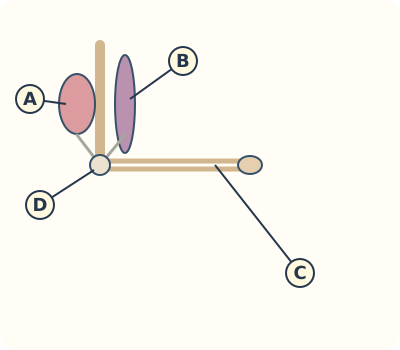
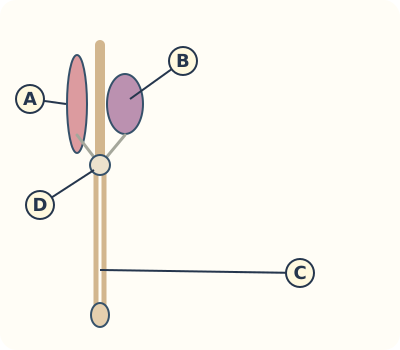
Skeletal muscles often attach to bones through tendons and can be controlled voluntarily. To bend an elbow, the biceps contracts while the opposing triceps relaxes; straightening reverses their roles. Muscles pull rather than actively push bones. The bone moves at a joint; it does not shorten like the muscle. Move gently within a comfortable range without weights. If movement is uncomfortable, use the supplied sequence instead of a body demonstration.
Three muscle types have different jobs
Skeletal muscle moves the skeleton and has striated fibres. Smooth muscle in the stomach, intestines and many blood vessels works involuntarily and lacks those striations. Cardiac muscle is found in the heart; it is striated and involuntary. The source exercise Q depicts the stomach, not the heart. Compare the stomach’s smooth muscle with an arm’s skeletal muscle, then use cardiac muscle as a third example. Involuntary does not mean a muscle has a mind or wishes of its own.
Connective tissues include blood
Bone provides support and protection using living cells in a mineralised, protein-containing matrix. Cartilage gives flexible support in locations such as the nose and parts of the ear. Tendons attach muscle to bone; ligaments connect bones at joints. Adipose tissue stores fat. Blood is connective tissue with cells in liquid plasma: red cells transport oxygen, white cells contribute to defence and platelets help clotting. Different bone-marrow regions have different roles; red marrow makes blood cells and yellow marrow stores fat. A whole-bone outline alone does not identify its marrow type.
Nervous tissue coordinates responses
Neurons have a cell body, branching dendrites and an axon; nervous tissue also contains supporting cells. In the simplified pathway, a stimulus is detected, sensory signals enter the nervous system, and motor signals can lead to a muscle response. Dendrites generally receive inputs; the axon conducts signals towards its terminals. Memory involves networks, not a single empty storage pocket in one neuron. Trace a harmless response such as seeing a ball and moving a hand; never test pain, heat or electric shock.
Worked example
For elbow bending, trace nerve signal → biceps contraction → tendon pull → forearm movement at the joint. The triceps relaxes. For straightening, reverse which muscle contracts. A stomach also moves, but its smooth muscle works involuntarily; this does not make it cardiac muscle.
Plant growthMeristematic tissue
Plant transportXylem and phloem
Cover and absorbEpithelial tissue
Pull and moveMuscle tissue
Support and transportConnective tissue
CoordinateNervous tissue
Different tissues cooperate; one organ contains several tissue types.
Read the labelled model and connect each structure to its job.
Show a comparison or calculation with the relevant evidence and units.
Check the model answer, correct one misconception and try the notebook task.
Read the exercise images carefully
Printed page 23 shows an arm at P and a stomach at Q. Their muscle comparison is skeletal versus smooth, not skeletal versus cardiac. Its phrase contraction and expansion of the bone needs correction: muscles change length and pull bones around joints.
Compare models without guessing an unlabeled cell
Printed page 22 pairs a whole-bone drawing with an uncaptioned cell-like picture B. The exact cell identity is not confirmed by the scan. The companion’s bone-and-blood plate is an explicit teaching comparison; it does not claim to identify B. Skin is a multi-tissue organ, although its outer epidermis is epithelial tissue.
Plant tissues: structure, place and job
Read each row as a structure–function connection. The examples are selected types, not a claim that every plant has identical tissues in identical positions.
Plant tissues: structure, place and job
Tissue
Feature or location
Function
Apical meristem
Growing root and shoot tips
Produces cells contributing to length
Lateral meristem
Growing regions alongside stems/roots
Contributes to girth
Parenchyma
Living cells; walls commonly thin
Storage or photosynthesis in suitable cells
Collenchyma
Living cells with uneven wall thickening
Flexible support
Sclerenchyma
Thick, often lignified walls
Stiff support; many cells dead at maturity
Xylem
Conducting elements and other cell types
Water/mineral transport and support
Phloem
Sieve elements with associated cells
Organic material transport from sources to sinks
Secretory tissue
Specialised cells or glands
Produces/releases substances such as nectar or resin
Worked reading: a growing tip and a sugar-transport tube perform different jobs. Xylem and phloem are complex tissues; permanent tissue is broader than the single support-cell model.
Compare the three muscle types
First choose a location, then read its control and appearance. Shared involuntary control does not make stomach muscle the same type as heart muscle.
Compare the three muscle types
Type and example
Typical control
Microscopic pattern
Skeletal: upper arm
Voluntary
Striated; long fibres, many nuclei
Smooth: stomach wall
Involuntary
Non-striated; tapered cells, one central nucleus
Cardiac: heart
Involuntary
Striated, branching cells; usually one central nucleus
Worked reading: the stomach row is involuntary and non-striated. The source Q drawing is a stomach; it belongs in this row. This is an original summary table, not a diagnostic test.
Play the opposing-muscle sequence
Watch bending and straightening, then use the step buttons to explain which muscle contracts. The forearm bone keeps the same length in both positions.
All stages: readable static alternative
Bend: biceps contracts; triceps relaxes: The contracting biceps pulls through a tendon. The forearm rotates at the elbow joint; the bone does not shorten.
Straighten: triceps contracts; biceps relaxes: The opposing muscle now provides the pull. The two muscles take different roles while the same forearm model changes orientation.
The positions and two-second teaching pace are illustrative, not a measured movement or medical assessment. Nothing plays automatically. Both labelled static stages remain available below; reduced motion disables automatic playback.
Read the scientific images
Match each letter to its structure and function. These original study diagrams are simplified models, not microscope observations.
Compare growing and specialised plant cells
Compare division, specialisation and vacuole size without turning one illustrated permanent-cell type into a rule for all plant tissues.
A · Meristematic cells
Actively dividing cells in a growing region; their wall boundaries remain present.
B · Prominent nucleus
The diagram highlights nuclei, not an absence of cell walls.
C · Dense cytoplasm
Young cells commonly have small vacuoles rather than one large central vacuole.
D · Specialised permanent tissue
Many differentiated cells no longer actively divide and have specific jobs.
E · Large vacuole
Common in many mature living plant cells; not present in every permanent tissue cell.
F · Thickened wall example
Shown for support. Other permanent cells can have thinner walls, and mature conducting or support cells may be dead.
Original paired models account for source figures 2.6 and 2.7. The figures are not scaled micrographs and are not a complete picture of every permanent tissue.
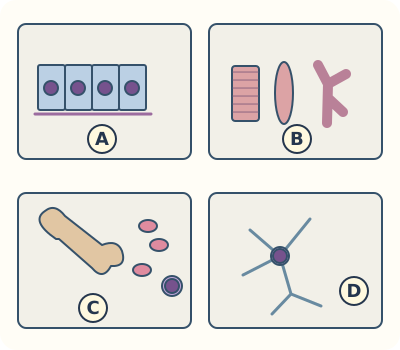
Four animal tissue families
Explain why flow does not prevent blood being connective tissue, and why an organ such as skin contains several tissue families.
A · Epithelial
Close cells form coverings or linings. The line beneath represents basement membrane, not a plant wall.
B · Muscle
The three small forms stand for striated skeletal, non-striated smooth and striated branching cardiac muscle. Use the comparison table for control and location.
C · Connective
A bone model and blood cells in plasma illustrate solid and fluid matrices. Red marrow can produce blood cells; yellow marrow stores fat.
D · Nervous
Neurons and supporting cells contribute to communication and coordination; a neuron is shown in more detail separately.
Original category models, not histology slides. Source exercise B on printed page 22 is uncaptioned and its exact cell identity is unresolved; this plate does not claim to identify it.
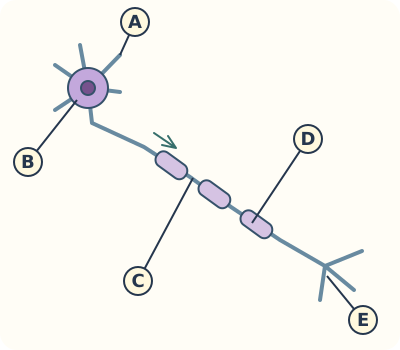
Follow a simplified neuronal signal
Trace receiving region → cell body region → axon → terminals in this simplified model, then connect nervous coordination to a safe movement example.
A · Dendrites / dendron branches
Generally receive inputs. The source uses dendron for the branching receiving region.
B · Cell body
Contains the nucleus and maintains the cell; it is not a store of isolated memory packets.
C · Axon
Conducts signals towards the terminals. Its length is shortened in this study drawing.
D · Myelin example
Insulating segments help rapid conduction in this illustrated neuron; not every axon has myelin.
E · Terminal branches
Communicate with another cell across a specialised junction. A complete response usually involves several cells.
Original schematic, not to scale. An animated marker illustrates order only, not measured electrical speed or a chemical travelling intact through the whole pathway.
Elbow bending: muscles pull bones
Compare with the straightening stage. Identify which muscle contracts in each stage and explain why bone itself does not contract.
A · Biceps contracts
Its pull helps bend the elbow. It does not push the forearm bone.
B · Triceps relaxes
The opposing muscle lengthens as the elbow bends.
C · Forearm moves
Bone length is unchanged; it moves around the joint.
D · Elbow joint and tendons
The joint permits movement and tendons transmit muscle pulls to bone.
Original mechanical model, not detailed anatomy. The source P drawing is an arm; Q is a stomach with smooth muscle, not the heart. Use comfortable movements or the supplied sequence.
Elbow straightening: reverse the muscle roles
Read both stages as an antagonistic muscle pair. A pair of still models is also available when animation is paused or reduced motion is preferred.
A · Biceps relaxes
The muscle that pulled during bending now relaxes.
B · Triceps contracts
The opposing pull helps straighten the elbow.
C · Forearm moves
The same bone model changes orientation, not length.
D · Elbow joint
The bones rotate at the joint while tendons transmit pulls.
Original simplified model; angles and durations are chosen for explanation, not measured from a person. Never force or test painful movement.
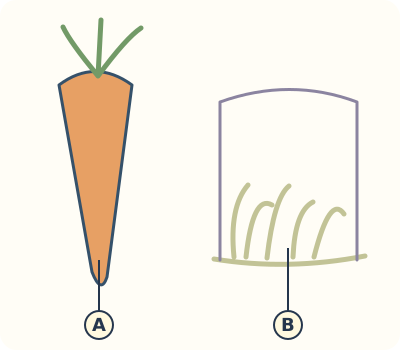
A root can be coloured without green chloroplasts
Use plastid function to explain the two cases. In the source the covered grass is N and the carrot M; the question about the covered plant mistakenly repeats M.
A · Coloured root
Chromoplast pigments can colour a root. Orange carrots commonly contain beta-carotene; varieties differ. Exact pigment cannot be identified from a monochrome drawing.
B · Shaded grass
Without sufficient light, grass can become pale as chlorophyll is lost or not maintained. Outcomes depend on conditions; 8–10 days is the source’s scenario, not a universal schedule.
Original scenario models, not recorded experimental results. Do not damage a lawn or handle knives to reproduce the example; reason from the supplied cases.
Your written practice
Show your working on paper and enter your answer here. If it does not match, compare the model and try again.
Show model answer and explanation
meristematic tissue
Apical meristems contribute to growth in length.
Show model answer and explanation
lateral meristem
Lateral meristems contribute to thickening.
Show model answer and explanation
xylem
Do not interchange water transport with sugar transport.
Show model answer and explanation
phloem
Transport can occur in different directions in different tubes.
Show model answer and explanation
collenchyma
Its uneven wall thickening provides flexible support.
Show model answer and explanation
epithelial tissue
The cells rest on a basement membrane.
Show model answer and explanation
smooth muscle
Stomach movement is involuntary and the muscle lacks striations.
Show model answer and explanation
cardiac muscle
Cardiac muscle is striated and involuntary.
Show model answer and explanation
tendon
A ligament instead connects bones.
Show model answer and explanation
axon
Dendrites generally receive incoming signals.
Write in your own words. A guardian or teacher should review this response.
Show model answer and explanation
Meristematic cells divide actively and commonly have dense cytoplasm, prominent nuclei and small vacuoles. A mature storage cell is specialised, usually no longer actively divides and may have a large central vacuole.
Use typical differences without claiming all permanent cells are identical.
Write in your own words. A guardian or teacher should review this response.
Show model answer and explanation
Parenchyma can store food or photosynthesise, collenchyma gives flexible support and sclerenchyma gives stiff support with thick walls.
Give a different structure–job link for each.
Write in your own words. A guardian or teacher should review this response.
Show model answer and explanation
Each contains several specialised cell types cooperating in transport and support. Xylem conducts water and minerals; phloem moves organic materials including sugars.
Do not claim phloem is always downward or that every xylem cell is dead.
Write in your own words. A guardian or teacher should review this response.
Show model answer and explanation
A thin lining gives a short route for exchange and can contain specialised absorptive cells. Several layers resist wear at exposed surfaces. The function depends on location and structure.
Relate the number of layers to a job without calling every epithelium identical.
Write in your own words. A guardian or teacher should review this response.
Show model answer and explanation
During bending the biceps contracts and the triceps relaxes; during straightening the triceps contracts and the biceps relaxes. Tendons transmit pulls to bones that move around a joint.
Muscles pull and bones move; bones do not contract or expand as muscles do.
Write in your own words. A guardian or teacher should review this response.
Show model answer and explanation
Arm skeletal muscle is generally voluntary and striated. Stomach smooth muscle is involuntary and non-striated. Heart cardiac muscle is involuntary and striated.
The source stomach drawing is not a cardiac-muscle example.
Write in your own words. A guardian or teacher should review this response.
Show model answer and explanation
Its cells and platelets are suspended in extracellular liquid plasma. It transports materials, contributes to defence and helps clotting. Connective tissue does not have to be solid.
Name the matrix and more than one function.
Write in your own words. A guardian or teacher should review this response.
Show model answer and explanation
Bone gives rigid support, cartilage gives flexible support or cushions some joints, tendons attach muscle to bone and ligaments connect bones. Their matrices and roles differ.
Do not use tendon and ligament interchangeably.
Write in your own words. A guardian or teacher should review this response.
Show model answer and explanation
Label branching dendrites receiving inputs, a cell body containing the nucleus, and an axon conducting signals towards terminals. State that the model is not to scale.
A complete answer links each label to its role.
Write in your own words. A guardian or teacher should review this response.
Show model answer and explanation
Sensory receptors and nervous pathways convey information, nervous coordination activates skeletal muscles, and connective structures support and transmit movement; blood supplies materials.
Use a safe ordinary action, with no pain or electrical experiments.
Show model answer and explanation
A
A is the meristematic panel.
Show model answer and explanation
connective
Bone and blood illustrate connective tissue.
Show model answer and explanation
E
E marks the output end of the simplified neuron.
Show model answer and explanation
biceps
A identifies the biceps contraction.
Show model answer and explanation
triceps
B identifies the opposing triceps contraction.
Write in your own words. A guardian or teacher should review this response.
Show model answer and explanation
Permanent tissues include diverse specialised cells. F illustrates a support-cell wall; many living storage cells have thinner walls and large vacuoles.
Use the scope of the plate rather than overgeneralise it.
Write in your own words. A guardian or teacher should review this response.
Show model answer and explanation
Seeing a ball leads to sensory signalling, nervous coordination and motor activation of muscles moving a hand. The single-neuron drawing and two arm stages simplify a pathway involving many cells.
Give a safe example and a genuine model limitation.
Write in your own words. A guardian or teacher should review this response.
Show model answer and explanation
Q is a stomach model. Its smooth muscle is involuntary and non-striated. Heart muscle is cardiac, involuntary and striated; it is a separate comparison.
Use the visually reviewed source image, not a guess based on involuntary movement.
Write in your own words. A guardian or teacher should review this response.
Show model answer and explanation
A root may have chromoplast pigments without being photosynthetic. Grass kept in darkness can become pale as chlorophyll is lost or not maintained. Pigment identity and timing need more evidence.
The plate is illustrative, and the source’s M/N reference is corrected.
Write in your own words. A guardian or teacher should review this response.
Show model answer and explanation
Its defining features and intended identity are uncertain from the scan. State the uncertainty, use clearly labelled teaching models, and ask for a clearer source before making an identity-dependent assessment.
Do not reward an invented identification.
Your science notebook challenge
Make a tissue field guide on paper using the supplied models: compare plant tissues, three muscle types and a simple response pathway.
Review with a guardian or teacher
Give one structure–function link for each tissue and distinguish tissue from organ.
Show both elbow positions with the correct opposing-muscle roles; no painful experiments.
Explain one source-wording correction and how a real observation would differ from a model.
Keep your work on paper or in a local file. This page does not upload it or automatically grade the project.
Chapter companion and further study
This original Kidemy practice follows the topic order of 2026 Class 7 Science · English Version, chapter 2, printed pages 12–24. It does not replace the complete chapter or its practical teaching.