Show model answer and explanation
cell membrane
The membrane regulates movement in and out.
Class 6 · English Version · General science
2026 Class 6 Science · English Version · Chapter 3 · Chapter companion part
Compare plant and animal cells and connect cell parts to their functions.
Class 6 English Version chapter companion with expanded teaching, 20 written tasks and a notebook challenge. Further independent assessment and teacher-reviewed practical work remain; this is not complete textbook coverage.
Open this topic in Skills Lab →
A cell is a basic structural and functional unit of living organisms. Some organisms consist of one cell; others contain many specialised cells. Similar cells working together form tissues; different tissues can work together in an organ. An organ system contains organs with related functions.
A cell membrane controls exchange with the surroundings. Cytoplasm is where many chemical reactions occur. A nucleus contains genetic material in typical plant and animal cells. Mitochondria are involved in aerobic respiration. Do not assume every specialised cell has every structure.
A cellulose cell wall supports a plant cell outside its membrane. A large permanent vacuole contains cell sap. Chloroplasts contain chlorophyll and photosynthesise in green cells; an underground onion bulb cell usually has no chloroplasts. Bacteria have genetic material but no membrane-bound nucleus. A diagram is a model, not an exact photograph.
Chromosomes contain genetic information. A nucleus has an envelope and contains nucleoplasm, chromatin and a nucleolus. The chapter introduces body and reproductive cells; more detailed cell division belongs to later study. For a microscope observation, start at low power and use prepared material with a teacher.
A school light microscope uses a light source, stage, objective lenses and an eyepiece. Start with low power so the specimen is easier to find; follow the teacher’s focusing instructions and keep the lens clear of the slide. Total magnification is eyepiece magnification × objective magnification. A larger image does not necessarily reveal more detail; some cell structures need other imaging methods.
The vacuole in a typical mature plant cell contains cell sap and helps maintain turgor. Chloroplasts contain chlorophyll; other plastids can store substances or contribute colour. Mitochondria are involved in releasing usable energy during aerobic respiration, not creating energy from nothing. Cytoplasm contains many cell components and supports many reactions. A cell model should label what is shown and state what is omitted.
A nuclear envelope separates the nucleus from the surrounding cytoplasm in a typical eukaryotic cell. The nucleus contains genetic material as chromatin, which can form visible chromosomes during division. The nucleolus is involved in making components for protein production. A bacterium contains genetic material without a membrane-bound nucleus. Reproductive cells carry genetic information into reproduction; body cells perform many specialised roles.
A root-hair cell’s extension increases its exchange area. A leaf cell with chloroplasts can photosynthesise. Cells can store materials, release useful substances or form tissues that work in organs. Sketch a typical cell with clear single label lines, give the title and distinguish an observed image from a model. Root, leaf and animal cells need not look identical, and a stained microscope image may show fewer structures than a textbook drawing.
A leaf cell may contain chloroplasts because it receives light. A root cell can still be a plant cell without chloroplasts: it has other plant features such as a cell wall.
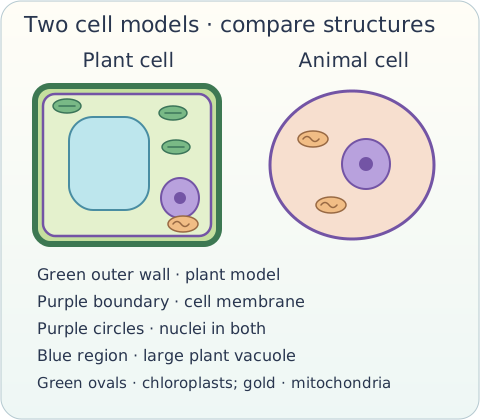
A cell wall and a cell membrane are separate structures. “All plant cells contain chloroplasts” is incorrect; function and location matter.
A ×10 eyepiece and ×20 objective give ×200 total magnification. This number is an image-size ratio, not the specimen’s size or a guarantee that every organelle is visible.
A green leaf cell may have many chloroplasts; a root-hair cell usually has none. Both are plant cells, but their structures support different jobs.
Show your working on paper and enter your answer here. If it does not match, compare the model and try again.
cell membrane
The membrane regulates movement in and out.
nucleus
The nucleus contains chromosomes.
chloroplast
Chloroplasts contain the photosynthetic pigment.
tissue
Tissues contain cells with related functions.
cell wall
The cellulose cell wall provides support.
Write in your own words. A guardian or teacher should review this response.
It can have a cellulose cell wall and a large vacuole. Not all plant cells photosynthesise; underground bulb cells do not normally receive light.
Use structure and function rather than a single compulsory feature.
Write in your own words. A guardian or teacher should review this response.
A bacterium has genetic material without a membrane-bound nucleus; a typical animal cell contains a membrane-bound nucleus.
Do not say a bacterium has no genetic material.
Write in your own words. A guardian or teacher should review this response.
Muscle cells form muscle tissue; tissues combine in the heart; the heart works with blood vessels in a circulatory system.
Give a coherent example across the levels.
Apply the idea in a new situation and explain your method. Open writing needs a guardian or teacher to review it.
400
10 × 40 = 400. This means the image is magnified 400 times, not that its detail is unlimited.
cell sap
The vacuole contains cell sap.
mitochondria
Mitochondria transfer energy into a usable form during aerobic respiration.
nucleolus
The nucleolus is a region inside the nucleus.
low
Low power gives a wider field of view; follow the teacher’s instructions.
envelope
A nuclear envelope surrounds the nucleus.
Write in your own words. A guardian or teacher should review this response.
Its long extension increases surface area for exchange with the soil.
Connect the structural feature to its role.
Write in your own words. A guardian or teacher should review this response.
Resolution, magnification, preparation and staining limit what can be seen; the model may combine structures from other evidence.
Do not invent an observation just because a model contains it.
Write in your own words. A guardian or teacher should review this response.
Chromatin is DNA with associated proteins in the nucleus; it becomes more condensed into visible chromosomes during cell division.
Explain their relationship at an introductory level.
Write in your own words. A guardian or teacher should review this response.
A cell is a basic structural and functional unit of a living organism. Cells can carry out reactions, store substances or release useful materials; for example, some cells secrete enzymes.
Give a definition, function and suitable example.
Write in your own words. A guardian or teacher should review this response.
Draw and label the wall outside the membrane for the plant model, using separate clear lines.
Keep the two boundaries separate and name the drawing as a model or observation.
Write in your own words. A guardian or teacher should review this response.
It has genetic material, but that material is not enclosed in a membrane-bound nucleus.
Distinguish absence of a nucleus from absence of genetic information.
Prepare a labelled plant/animal comparison and a root-hair/leaf-cell comparison. Calculate one microscope magnification from supplied lens values. If you use a real microscope, have a teacher review safe handling and record only structures you actually observe.
Keep your work on paper or in a local file. This page does not upload it or automatically grade the project.
This original Kidemy practice follows the topic order of 2026 Class 6 Science · English Version, chapter 3, printed pages 23–31. It does not replace the complete chapter or its practical teaching.
Official book catalogue and source →
Teacher-led lessons, schedules and prices for this outline are upcoming. You can use any starter practice above now without booking.
Solo practice works without an account. Sign in to save a practice record to your learner profile.
Exact lesson links and related activities are labelled separately. Return-to-course links retain your selected learning path.